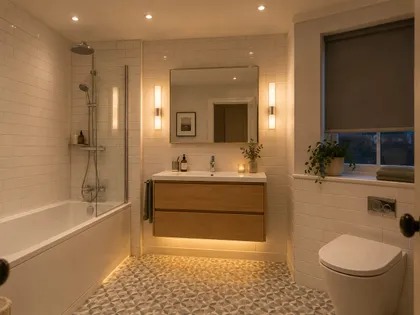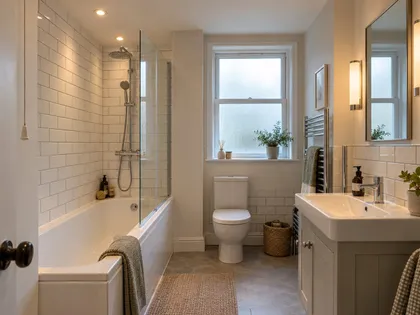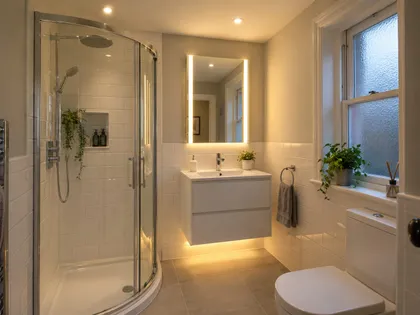
Bathroom mirror lighting ideas: no shadows, no glare, and the right height

Some links below are affiliate links: if you buy through them I may earn a small commission, at no extra cost to you. As an Amazon Associate I earn from qualifying purchases. How LightGuru makes money

Mike's quick answer
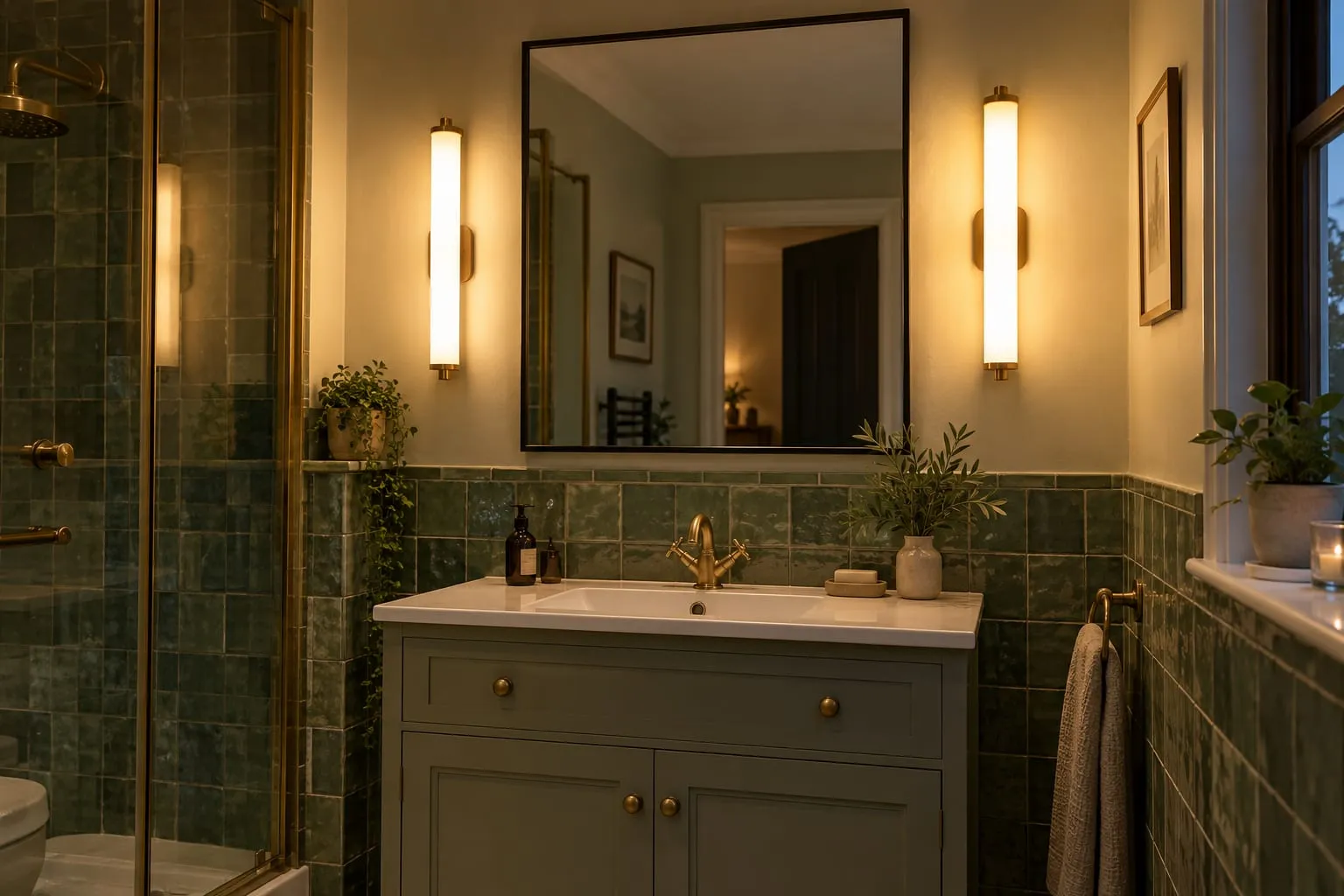
Light the mirror from both sides at face height: a wall light either side, with the centre of each about 150 to 160 cm from the floor and 7 to 15 cm out from the edge of the mirror. If there's no room at the sides, fit a long bar light 5 to 10 cm above the mirror. Use IP44 fittings with CRI 90 or above.
The bathroom mirror is where bad lighting shows most. A downlight overhead puts shadows under your eyes and chin, makes shaving a guessing game and leaves make-up looking different once you step outside.
The fix is simple: get light onto your face from the front and sides, at face height, through a diffuser. What decides the best way to do that in your bathroom is how much wall you have either side of the mirror, where the mirror sits relative to the bath and shower, and if you’d rather have separate fittings or light built into the mirror.
Why light from the sides works
Light from directly above lands on your forehead, nose and cheekbones and leaves everything beneath them in shadow. Light from the sides, level with your face, fills those shadows in. It’s the reason theatre dressing rooms have bulbs down both sides of the mirror.

The light also needs to be soft. A bare bulb or clear glass shade at eye level is glaring, because you’re looking straight at it. Opal, frosted or fabric-effect diffusers spread the light and take the sting out of it.
Which mirror lighting is best?
| Wall lights either side | Front-lit LED mirror | Halo mirror | Bar above | |
|---|---|---|---|---|
| Light on your face | Best | Good if lit at the sides | Low | Fair |
| Shadows | Almost none | Few | Some | Some under the chin |
| Wall space | Needs room both sides | Just the mirror | Just the mirror | Just above the mirror |
| Wiring | Two feeds | One feed | One feed | One feed |
| Rough cost | £50–£160 a pair | £80–£300 | £60–£200 | £25–£70 |
Yellow = the better option on that line.
For everyday shaving and make-up, wall lights either side win. A good LED mirror comes close and is tidier in a small bathroom. A halo mirror and a bar above are both better than a downlight alone, but each needs help from somewhere else if you do detailed make-up.
Wall lights either side
This is the layout I’d choose wherever the wall allows it. Put the centre of each light at about eye level, which for most UK adults means 150 to 160 cm from the finished floor, not from the basin. If the people who use the mirror most are very tall or short, set it to their eye height instead.
Keep each light 7 to 15 cm out from the edge of the mirror. Closer than that and the fittings crowd the mirror and you get hot spots in the glass; much further away and the light reaches your face at too wide an angle to fill the shadows.
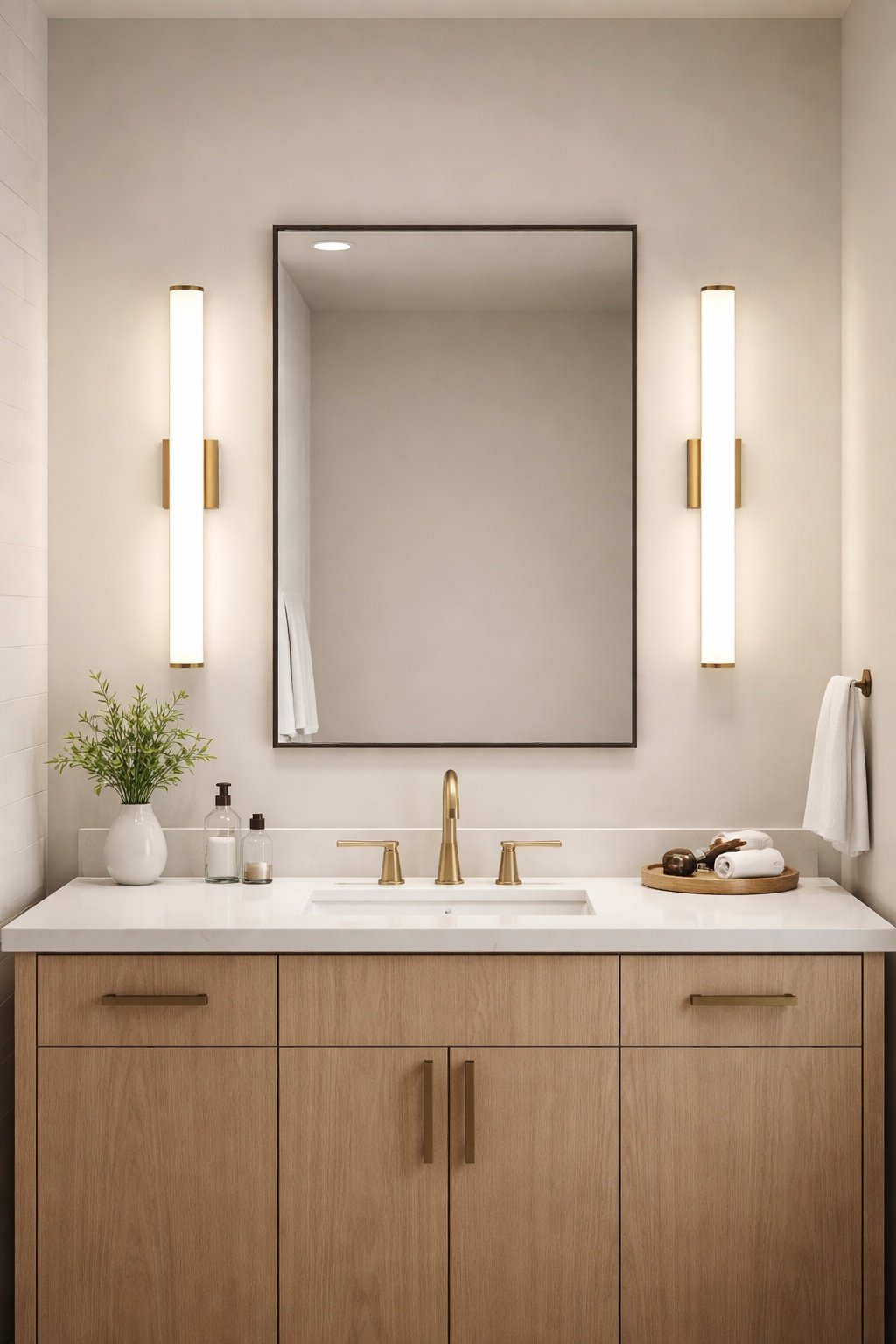
Tall vertical fittings work best, because they light your face along its whole height. Opal glass globes and short sconces suit a traditional bathroom just as well, as long as the bulb is hidden behind the glass. Each light wants about 300 to 500 lumens.
Side lights need two cable feeds, one each side, so plan them before the walls are tiled. If you choose wall lights with built-in LEDs, ask where the driver goes: some sit in the back box, and you’ll want to be able to reach it if it ever fails.
LED mirrors
An LED mirror puts the light in the glass, so there’s nothing else on the wall. The ones worth having are front-lit: a band of light shines out through the glass, ideally down both sides as well as along the top. That lights your face well enough for most people.

Look for CRI 90 or above, a demister pad (which keeps the middle of the glass clear after a shower) and IP44. Many have a touch switch, dimming or adjustable colour from warm to cool white, which is handy if more than one person uses the mirror. Most still need a permanent feed from the lighting circuit, so it’s an electrician’s job unless there’s already a supply behind the mirror. Sizes and prices vary a lot: roughly £80 for a basic one and £300 or more for a large mirror with every feature.
Halo and backlit mirrors
A halo mirror is lit only from behind, so the light spills onto the wall around it. It looks lovely, makes the mirror seem to float and works well as a night light. What it doesn’t do is put much light on your face, because the light is pointing away from you.
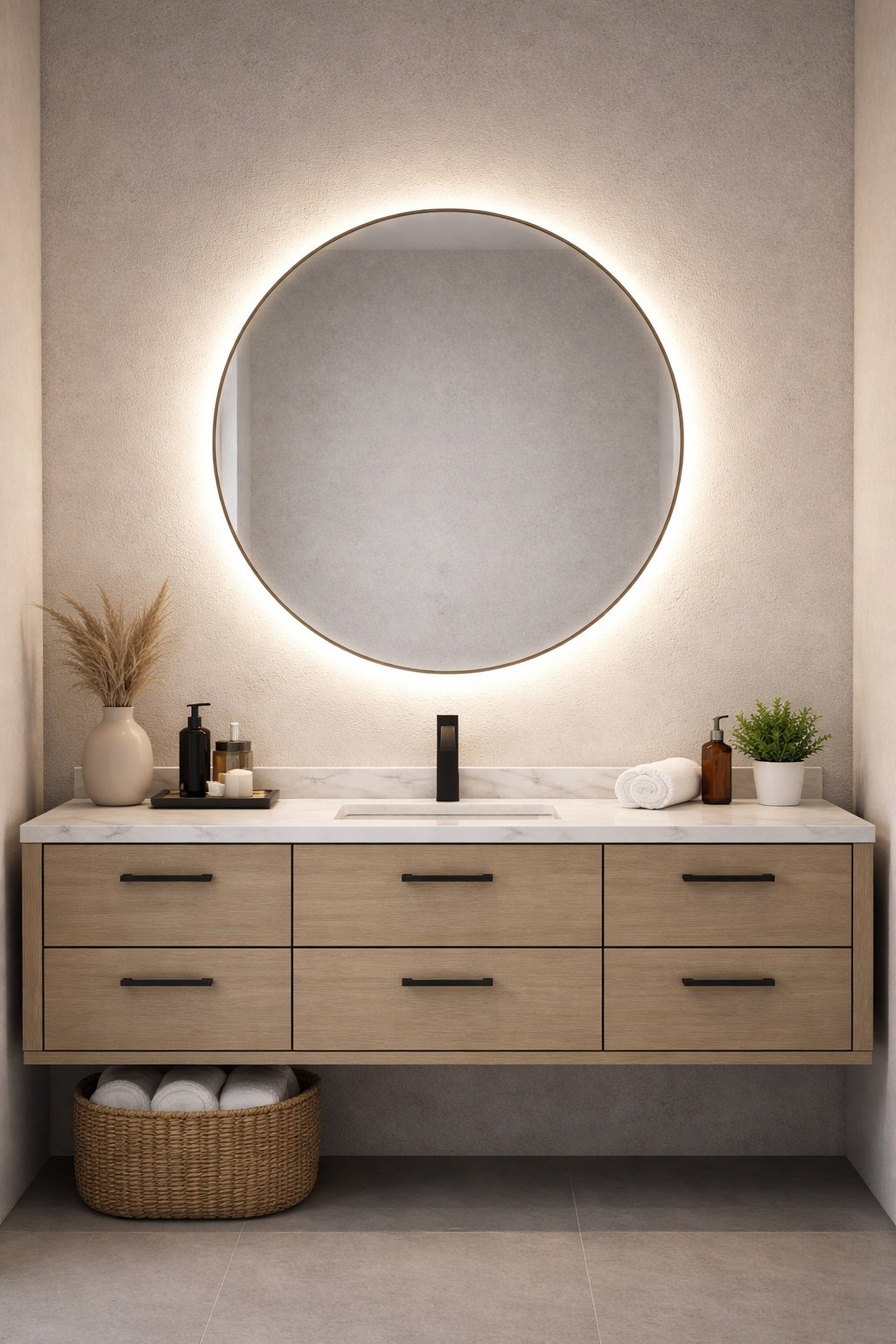
Treat a halo mirror as accent lighting. Pair it with side lights, a front-lit band or at least a downlight positioned slightly in front of where you stand, and use it on its own for evening baths and night-time visits.
A light above the mirror
If the mirror runs wall to wall, or there’s a cabinet or shower screen in the way, a bar light above is the fallback. Mount it 5 to 10 cm above the top of the mirror, centred, which usually puts it 180 to 200 cm from the floor. Choose one that spreads light down and outwards through a diffuser, and make it at least as wide as your face; most of the mirror’s width is better.
A single downlight or spotlight over the mirror is the version to avoid. It’s a point of light from straight above, which is exactly what causes the shadows in the first place.
How high should mirror lights be?
| Height from the floor | Position | |
|---|---|---|
| Wall lights either side | 150–160 cm to the centre of the light | 7–15 cm out from the mirror edge |
| Bar light above | Usually 180–200 cm | 5–10 cm above the top of the mirror, centred |
| LED or halo mirror | Mirror centred roughly at eye level | Wherever the mirror goes |
Measure from the finished floor, not the top of the basin or vanity. If the light has a fixing point well off its centre, work out where the middle of the glowing part will end up, not the backplate.
Double vanities
Over two basins with two mirrors, the neat answer is three lights: one on each outer side and one in the gap between the mirrors, all at the same height. If the mirrors are far apart, give each mirror its own pair.

A single wide mirror over a double vanity can take a long bar above plus a light at each end, or a large front-lit LED mirror. Either way, check each person gets light from both sides rather than one.
Wall lights elsewhere in the bathroom
Wall lights aren’t only for the mirror. Away from the basin they soften a room lit only by downlights, and they look good on a textured or feature-tiled wall.
Up-and-down lights wash a stripe of light up and down the wall, which makes a low ceiling look taller and shows off stone or ribbed tiles. A pair either side of a freestanding bath is a lovely evening light. Diffused wall lights with frosted glass give a soft, even glow for a bath when the downlights are off. In a small bathroom, slim vertical fittings take up little visual space and draw the eye upward. Use warm white, 2700K to 3000K, for these; they’re about atmosphere, not tasks.
Watch the zones with wall lights near the bath. A light on the wall directly above the bath is in zone 1 if it’s below 2.25 m, so it needs IPX4 at least, and I’d choose IP65. Within 60 cm of the edge of the bath or shower it’s zone 2 and needs IPX4. For a wet room, IP65 wall lights are the safe choice throughout the showering area.
IP ratings and zones for mirror lights
The zones are measured from the bath and shower, not the basin. A mirror light over a basin within 60 cm of the bath or shower is in zone 2 and needs IPX4; further away it’s outside the zones and technically needs no rating. I’d choose IP44 either way, because a light right over a basin gets splashed and steamed every day. The bathroom zones guide has the full rules.
Ordinary wall switches can’t go in the zones, so mirror lights are usually switched from a pull cord or a switch outside the door, unless the mirror has its own built-in switch. New wiring for wall lights within the zones is notifiable under Part P in England, which a registered electrician deals with for you.
Colour and brightness at the mirror
3000K warm white is the most flattering and blends with most ceiling lights. 4000K neutral white shows skin and make-up more truly, so it’s the better choice if you do detailed make-up. If your ceiling lights are 3000K, a 4000K mirror light looks slightly cooler beside them; most people don’t notice, but if you do, use 3000K throughout or a mirror with adjustable colour. The colour temperature guide explains the difference.
CRI matters more than the colour temperature for judging skin. Look for CRI 90 or above. For brightness, two wall lights at 300 to 500 lumens each, or a front-lit mirror of similar output, is plenty. Dimming is worth having for night-time, as long as the fittings and dimmer are made to work together.
For how the mirror fits into the rest of the room, see bathroom lighting ideas, and for tight spaces, small bathroom lighting.
What I'd buy
Affiliate linksFAQs
How high should bathroom mirror lights be mounted?
For lights either side of the mirror, put the centre of each about 150 to 160 cm from the floor, roughly eye level. A bar light above the mirror goes 5 to 10 cm above its top edge, usually 180 to 200 cm from the floor.
How far from the mirror should wall lights be?
About 7 to 15 cm out from the edge of the mirror, at the same height on both sides.
What is the best bathroom lighting for make-up?
Light from both sides at face height: a pair of wall lights or a front-lit LED mirror, at 4000K with CRI 90 or above. A halo mirror alone isn’t enough.
Is IP44 enough for mirror lights?
Yes, over a basin. If the mirror is directly above a bath, the light is in zone 1: IPX4 is still the legal minimum, but I’d use IP65 there.
Should bathroom mirror lights be warm or cool white?
3000K is warmer and more flattering; 4000K is crisper and better for judging make-up. Either works if the CRI is 90 or above.
Can I put a downlight above the mirror instead?
It’s better than nothing, but a downlight overhead causes the shadows you’re trying to avoid. If a downlight is all you can have, place it slightly in front of where you stand, not directly above your head, and add side or mirror lighting when you can.
 Save
Save it for later
Pin this guide to one of your Pinterest boards so it's there when you start the job.