Bathroom zones and IP ratings: what IP rating your bathroom lights need

Some links below are affiliate links: if you buy through them I may earn a small commission, at no extra cost to you. As an Amazon Associate I earn from qualifying purchases. How LightGuru makes money
This guide mentions Enso Lighting, a business I work with. I've flagged it wherever it comes up. More on that

Mike's quick answer
Zone 0 is inside the bath or shower tray and needs IPX7 on 12 V SELV. Zone 1 is above the bath or shower up to 2.25 m, and zone 2 is the 60 cm around it: both need at least IPX4, and I'd specify IP65 over a shower. Outside the zones no IP rating is required, but every bathroom circuit needs a 30 mA RCD.
Every light in a UK bathroom has to suit where it sits in relation to the bath and shower. The wiring regulations divide the room into zones, and each zone sets a minimum IP rating, which is how well a fitting keeps water out.
There are fewer rules than most people think, and two common beliefs are wrong: the zones are measured from the bath and shower, not the basin, and IPX4 rather than IP65 is the legal minimum over a bath or shower. Here’s the whole picture at a glance.
| Where it is | Minimum IP rating | Lights allowed | |
|---|---|---|---|
| Zone 0 | Inside the bath or shower tray | IPX7 | Only fittings made for zone 0, on SELV at no more than 12 V AC (30 V DC) |
| Zone 1 | Above the bath or shower tray, up to 2.25 m from the floor, or the shower head if that is higher | IPX4 | Lights the maker says suit zone 1, or SELV fittings |
| Zone 2 | 60 cm out from the edge of zone 1, up to the same height | IPX4 | Any light rated IPX4 or better |
| Outside the zones | The rest of the room | None required | Any light. IP44 is wise in a steamy room |
Use the checker below to find the zone and the minimum rating for a particular light position. Over a bath or shower it gives the legal minimum, IPX4, and points out that a sealed IP65 fitting is the usual choice there.
What are bathroom zones?
The zones come from BS 7671, the IET Wiring Regulations. Section 701 covers “locations containing a bath or shower” and divides the space around them into zones 0, 1 and 2, plus everything outside them. Wet skin conducts far better than dry skin, so the closer you are to water, the stricter the rules.
The zones are three-dimensional spaces, measured from the finished floor and the edges of the bath or shower tray. A solid wall stops a zone: it doesn’t carry on into the next room.
If you see a guide with a zone 3, or a zone 2 that goes up to 3 m, it’s working from the old rules. Both went with the 2008 edition of the regulations. NICEIC’s guide to bathrooms and electrics is a good plain-English summary of the current rules, and the IET publishes BS 7671 itself.
Zone 0: inside the bath or shower tray
Zone 0 is the inside of the bath or shower tray: the part that holds water. In a wet room with no tray, it’s the floor area of zone 1 up to 10 cm high.
Anything electrical in zone 0 must be rated at least IPX7, made for use in zone 0, fixed and permanently connected, and run on SELV (separated extra-low voltage) at no more than 12 V AC or 30 V DC. The transformer or driver that supplies it must sit outside zones 0, 1 and 2. No switches are allowed in zone 0.
In most homes nothing goes in zone 0 at all. The exceptions are lights built into some whirlpool and spa baths, and floor lights in a wet room, which are specialist products and a job for an electrician.
Zone 1: above the bath or shower
Zone 1 is the space directly above the bath or shower tray, from the floor up to 2.25 m, or up to the highest fixed shower head or outlet if that’s higher. The space under the bath counts as zone 1 too, if you can get into it without a tool. For a shower with no tray, zone 1 reaches 1.2 m out in every direction from the centre of the fixed water outlet, so a wet room’s whole shower area is usually zone 1.
The rule is a minimum of IPX4. Lights are allowed if they’re fixed, permanently connected and the maker says they suit zone 1, or if they run on SELV at no more than 25 V AC or 60 V DC, with the transformer outside zones 0, 1 and 2. Extractor fans, towel rails and electric showers are allowed on the same terms. Switches aren’t, unless they’re on a 12 V SELV circuit.
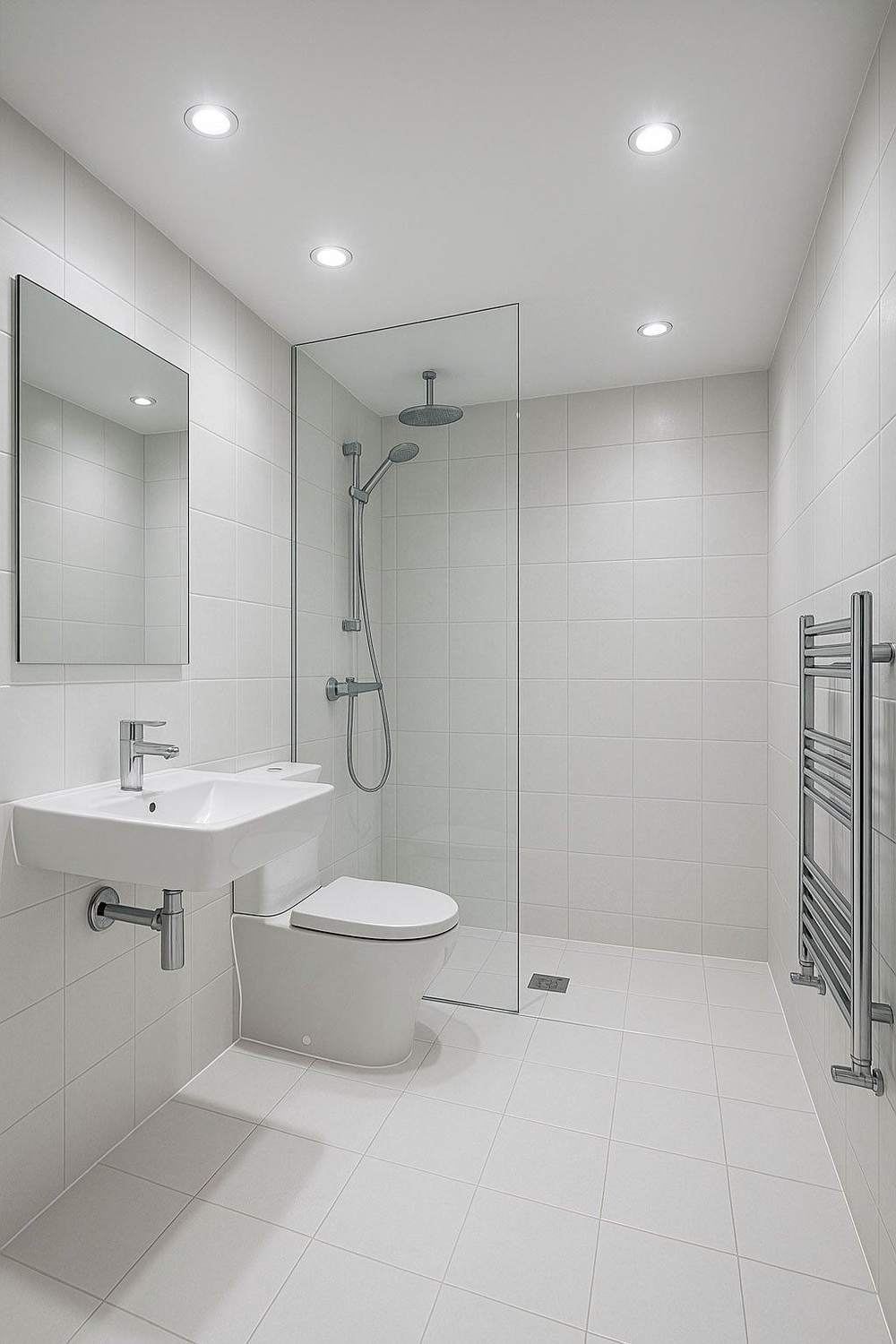
IPX4 is the legal minimum, but over a shower I’d specify IP65. Spray and steam hit the ceiling every day, and an IP65 fitting is protected against water jets as well as splashes. The difference in price is small.
What about the ceiling itself? On a standard 2.4 m ceiling, a light directly over the bath or shower sits only just above the 2.25 m line, and if the shower head is fixed higher, or mounted on the ceiling, zone 1 goes right up to it. Most electricians treat lights over a bath or shower as zone 1 for that reason, and I’d recommend you do the same. A pendant over a freestanding bath is in zone 1 if any part of it hangs below 2.25 m, so it must be IPX4 and approved by its maker for zone 1. Most decorative chandeliers aren’t.
Zone 2: the 60 cm around zone 1
Zone 2 runs 60 cm out horizontally from the edge of zone 1, from the floor up to the same height: 2.25 m, or the shower head if higher. A shower with no tray has no zone 2; it gets the bigger 1.2 m zone 1 instead.
Lights in zone 2 need IPX4 or better. Typical ones are mirror lights near the bath, wall lights beside the shower, and ceiling lights just outside the area above the tray. Switches and sockets aren’t allowed in zone 2 unless they’re on SELV, with one exception: a shaver supply unit made to BS EN 61558-2-5 can go there if it’s out of direct spray from the shower.
What about the basin?
A basin doesn’t create a zone. Plenty of guides draw a 60 cm zone around it, but BS 7671 doesn’t have one. If the basin is within 60 cm of the bath or shower, the wall above it is in zone 2. If it’s further away, it’s outside the zones.
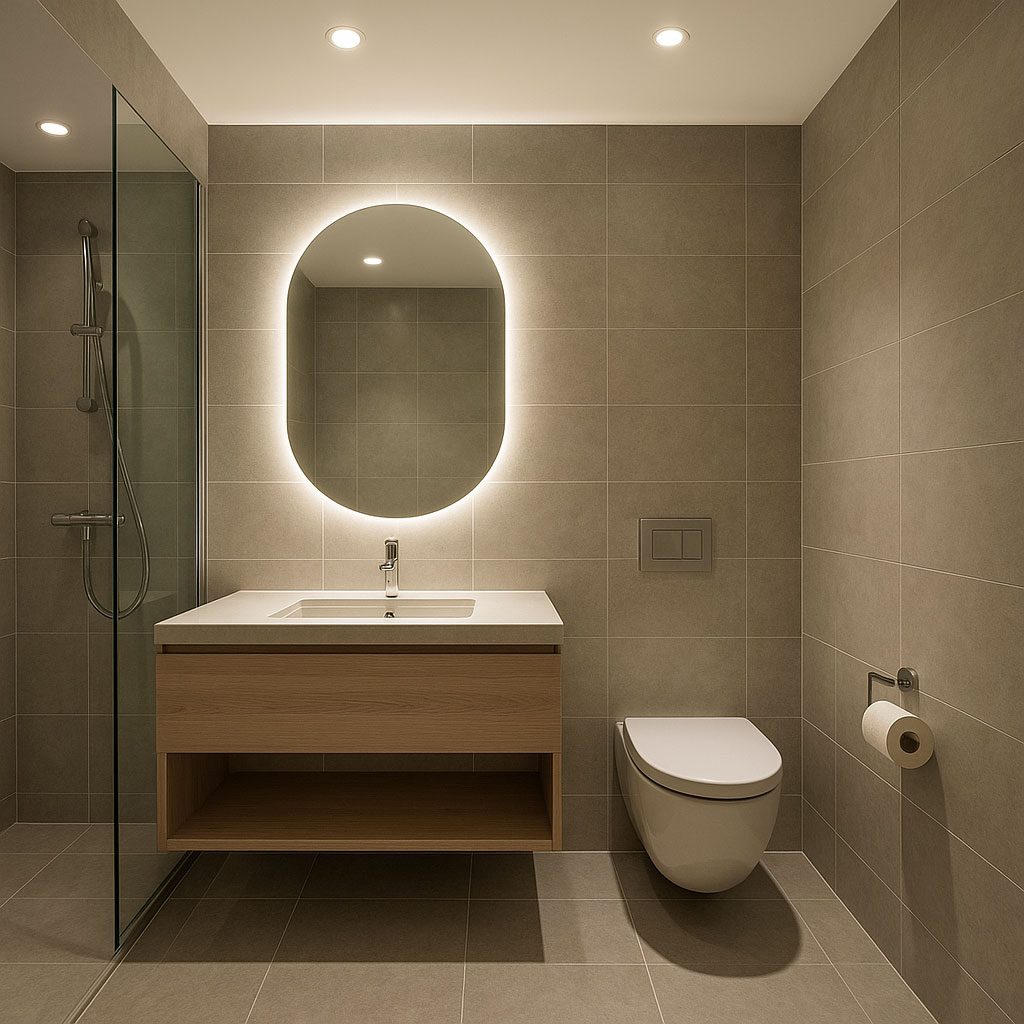
In a small bathroom the basin is often right next to the shower, so its mirror light ends up in zone 2. Either way I’d use IP44 for a light right over a basin, because splashes and steam reach it whatever the regulations say. Mirror heights and layouts are covered in bathroom mirror lighting ideas.
Outside the zones
Everywhere else in the bathroom is outside the zones, including the space above zones 1 and 2 on a high ceiling. Section 701 sets no IP rating here, so any light can go in, as long as its circuit has 30 mA RCD protection like every other bathroom circuit.
Bathrooms are steamy, though, and a small room with a weak extractor gets damp right up to the ceiling. For that reason I recommend IP44 or better for anything in a bathroom. Fitting IP65 downlights throughout makes life simple: you don’t need to work out where one zone ends and the next starts. It also leaves you free to move the shower in a future refit.
What IP rating do bathroom lights need?
IP stands for ingress protection, and the rating comes from the standard BS EN 60529. The first digit is protection against solids and dust, from 0 to 6. The second is protection against water, from 0 to 9 (9 is high-pressure hot water jets, which you’ll rarely see on a light). An X in place of either digit means it wasn’t tested for that, so an IPX4 fitting is splash-proof with no dust rating.
| What it means | Where it suits in a bathroom | |
|---|---|---|
| IP20 | Keeps fingers out. No water protection | Outside the zones only |
| IP44 | Keeps out objects over 1 mm and splashing water from any direction | Zones 1 and 2 (the minimum), and outside the zones |
| IP65 | Dust-tight and protected against low-pressure water jets | Over a shower, in a wet room, anywhere |
| IP67 | Dust-tight and survives immersion up to 1 m for 30 minutes | Zone 0 (with SELV), shower niches |
| IP68 | Dust-tight and survives continuous immersion, to limits set by the maker | Zone 0 and underwater lights |
Up to 6, a higher water number covers the lower ones, so IP65 is fine anywhere IPX4 is asked for. Immersion is a different test, though: a fitting marked only IPX7 or IPX8 isn’t tested against water jets unless it’s also marked IPX5 or IPX6. The one thing a rating can’t do is survive bad fitting. A downlight is only IP65 if it’s installed the way its instructions say, with the seal sitting flat on the ceiling.
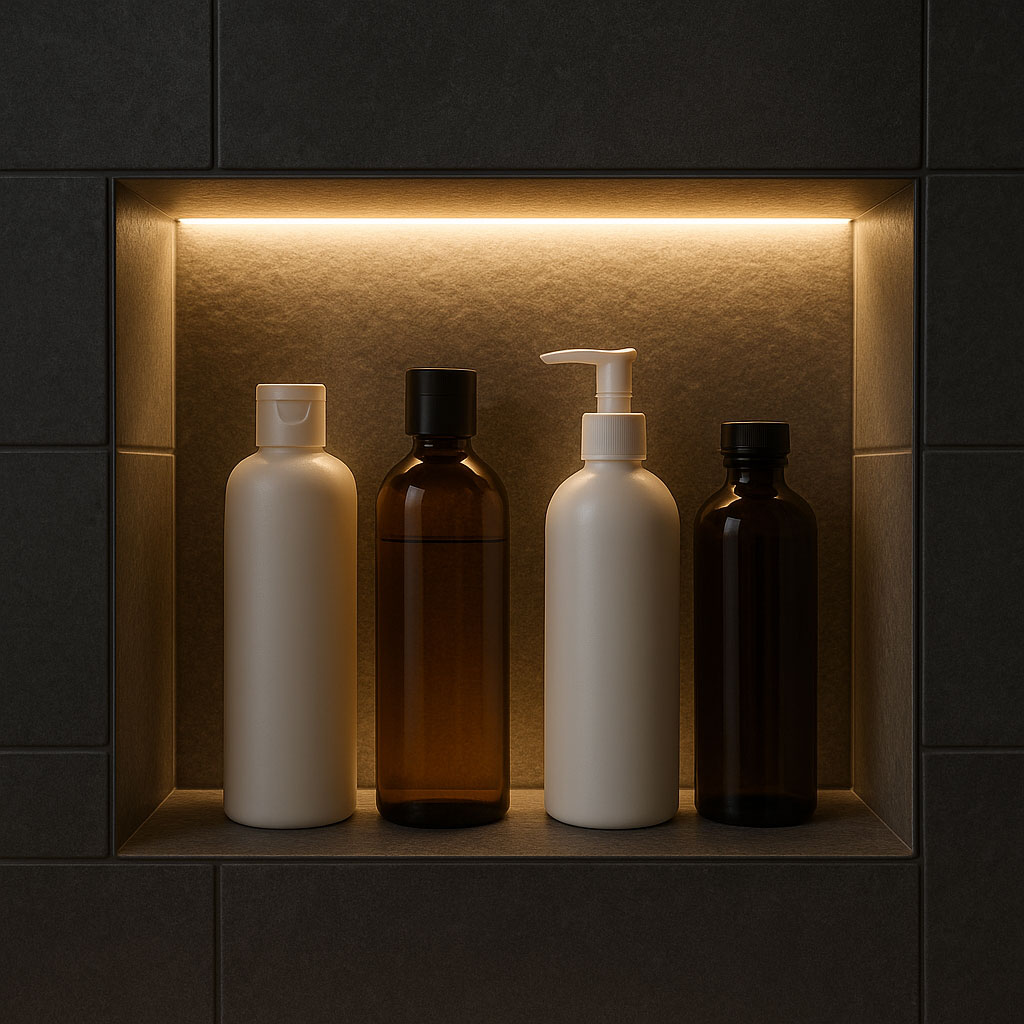
LED strip has its own ratings. IP65 strip has a thin silicone coating and suits splash areas such as under a vanity or along a bath panel. Inside a shower niche, where it’s hit by water every day, use IP67 or IP68 strip, which is fully encased, and run it on 12 or 24 V with the driver outside zones 0, 1 and 2. The bathroom LED strip guide covers the details.
Switches, sockets and RCDs
Ordinary light switches can’t go in zones 0, 1 or 2. In a small bathroom that usually means a pull-cord switch, which sits on the ceiling with only the cord hanging down, or a switch on the wall outside the door.
Standard sockets must be at least 2.5 m from the edge of zone 1, which rules them out of most UK bathrooms. That’s why plug-in lights and LED strips with a plug rarely work in a bathroom.
Every circuit serving the bathroom needs 30 mA RCD protection, and so does any circuit that passes through zones 1 or 2 on its way somewhere else. Most modern consumer units already have it; in an older house, check before you add anything.
Who can do the work?
In England, bathroom electrical work is notifiable under Part P if it means a new circuit, a new consumer unit, or adding to or altering a circuit within the zones. Replacing a light like for like isn’t notifiable. The easy route is an electrician registered with a competent person scheme such as NICEIC or NAPIT, who certifies the work and notifies building control for you. The rules are in Approved Document P.
Even where the work isn’t notifiable, I’d use an electrician for anything near the bath or shower. The rules are simple; getting the seals, cable entries and RCD protection right is where the skill is.
Lights for each zone
Over the bath or shower, use a sealed IP65 downlight, fire-rated if there’s a room above. The JCC V50 and Luceco FType Mk2 are both widely sold. Beside the basin or bath in zone 2, any IP44 wall light will do. For a period bathroom, a caged IP44 fitting such as Enso Lighting’s Visby wall light in antique brass (I work with Enso Lighting) suits, and Endon and Saxby both make plenty of IP44 wall lights too. For the overall layout, see bathroom lighting ideas and bathroom ceiling lighting ideas.
What I'd buy
Affiliate linksFAQs
What IP rating do I need for bathroom lights?
At least IPX4 in zones 1 and 2, IPX7 in zone 0 (with 12 V SELV), and none outside the zones. In practice, IP65 over a bath or shower and IP44 everywhere else covers you.
Is IP44 OK above a shower?
Yes, by the regulations: the minimum in zone 1 is IPX4. Over a shower, where spray and steam hit the ceiling every day, I’d still fit IP65.
What is bathroom zone 1?
The space directly above the bath or shower tray, from the floor up to 2.25 m or the shower head if higher. For a shower with no tray, it’s everything within 1.2 m of the fixed water outlet. Fittings there need IPX4 or better.
Is a mirror light over the basin in zone 2?
Only if the basin is within 60 cm of the bath or shower. The basin doesn’t create a zone of its own. IP44 is still the sensible choice right over a basin.
Can I use a normal light fitting in a bathroom?
Outside the zones, yes, provided the circuit has RCD protection. In a steamy bathroom, an IP44 fitting lasts better.
Do bathroom lights need an RCD?
Yes. Every circuit serving a bathroom needs 30 mA RCD protection, whatever zone the light is in.
 Save
Save it for later
Pin this guide to one of your Pinterest boards so it's there when you start the job.