What is colour temperature? Warm vs cool lighting explained

Some links below are affiliate links: if you buy through them I may earn a small commission, at no extra cost to you. As an Amazon Associate I earn from qualifying purchases. How LightGuru makes money

Mike's quick answer
Colour temperature is the colour of white light, measured in kelvin (K). Low numbers look warm and yellowish, high numbers look cool and bluish. Use 2700K–3000K warm white in living rooms and bedrooms, and 4000K neutral white in kitchens, bathrooms and work areas if you like a crisper light.
If you’ve ever put a new bulb in and thought the room suddenly looked yellow, or cold and blue like a supermarket, that’s colour temperature. It’s the colour of the white light a bulb gives out, and it’s printed on every box as a number followed by K, for kelvin.
Low numbers look warm, high numbers look cool. Most homes are happiest with 2700K to 3000K in living rooms and bedrooms, and some go up to 4000K in kitchens, bathrooms and workspaces. Very few rooms suit the 6500K daylight bulbs that fill the shelves.
What colour temperature means
The scale comes from physics. Heat a piece of metal and it glows red, then orange, then yellow-white, then bluish-white as it gets hotter. Colour temperature describes a light by the temperature, in kelvin, at which that idealised glowing object would give off the same colour.
So the number has nothing to do with how hot the bulb gets. A 6500K LED is no hotter than a 2700K one. For LEDs, the figure on the box is strictly the correlated colour temperature, or CCT, which is why you’ll see “CCT” on spec sheets and on downlights with a colour switch.
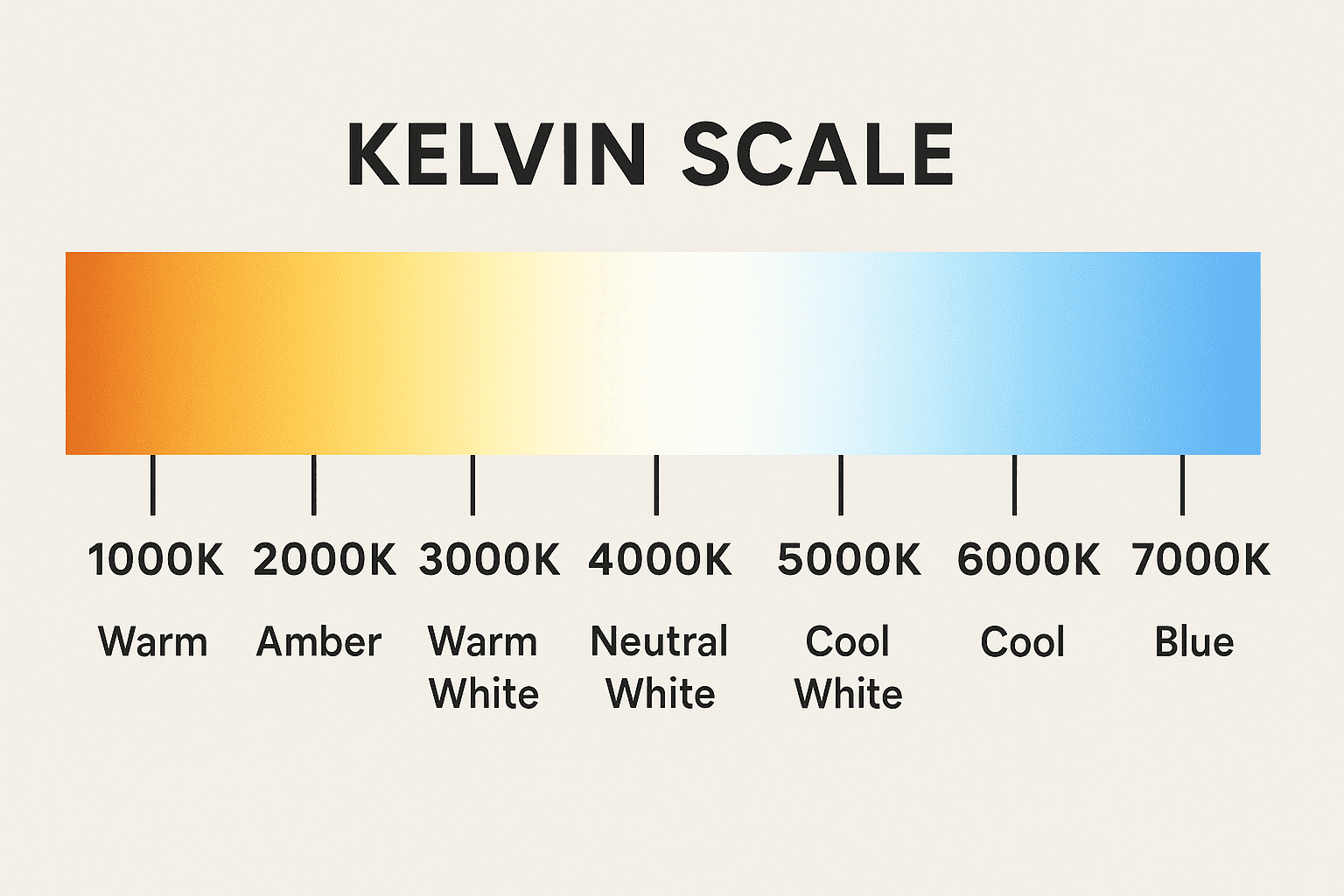
The confusing part is that the scale runs the opposite way to what we call warm and cool. Low kelvin numbers give warm, amber light; high numbers give cool, blue-white light.
The Kelvin scale at a glance
| Colour temperature | What it looks like | Name on UK packaging | Where it suits |
|---|---|---|---|
| 1800K–2200K | Deep amber, like candlelight | Extra warm, amber, filament | Decorative bulbs, low mood lighting |
| 2700K | Soft, yellowish warm white | Warm white | Living rooms, bedrooms, dining |
| 3000K | Warm but cleaner | Warm white | Living spaces, hallways, kitchens |
| 4000K | Crisp, neutral white | Cool white, neutral or natural white | Kitchens, bathrooms, utility rooms, desks |
| 5000K | Bright white with a slight blue tint | Daylight | Workshops, craft and hobby spaces |
| 6500K | Blue-white, like an overcast sky | Daylight, cool daylight | Garages, sheds, workshops |
Old filament bulbs were around 2700K and halogens slightly whiter, nearer 3000K, so warm white LEDs are what most of us grew up with. Watch the naming: on UK shelves, 4000K is often sold as cool white, while the trade calls it neutral or natural white. Go by the number, not the name.

Warm, neutral and cool light compared
| Warm white | Neutral white | Daylight | |
|---|---|---|---|
| Kelvin | 2700K–3000K | 4000K | 5000K–6500K |
| Looks | Soft, slightly yellow | Clean, no strong tint | Bright, bluish |
| Feels | Relaxed, homely | Fresh, practical | Clinical in a home |
| Evenings | Comfortable | Fine in work areas | Harsh |
| Best for | Living rooms, bedrooms, halls | Kitchens, bathrooms, desks | Garages, workshops |
2700K and 3000K warm white
Warm white is the light of a living room in the evening. It’s flattering to skin, makes wood, fabric and brick look warmer, and feels restful. 2700K is the cosier of the two and the closest match to old filament bulbs. 3000K is a touch whiter and cleaner, which suits modern interiors, pale rooms and kitchens that open onto a living area.
4000K neutral white
4000K has no obvious yellow or blue in it. It’s crisp and clear, the white you’d see in a modern office or shop, and it shows whites as white. That makes it popular in kitchens, bathrooms and utility rooms, and for desk lamps. In a living room after dark it can feel a little like an office, so it’s best kept to rooms where you work.
6500K daylight white
6500K is the blue-white of an overcast sky, and the coolest light most people will see on a shelf. “Daylight” sounds healthy, so people buy it for living rooms and bedrooms, and the room ends up looking cold and flat at night. It belongs in garages, sheds and workshops, or anywhere you’re matching colours by day and want something close to the light outside.
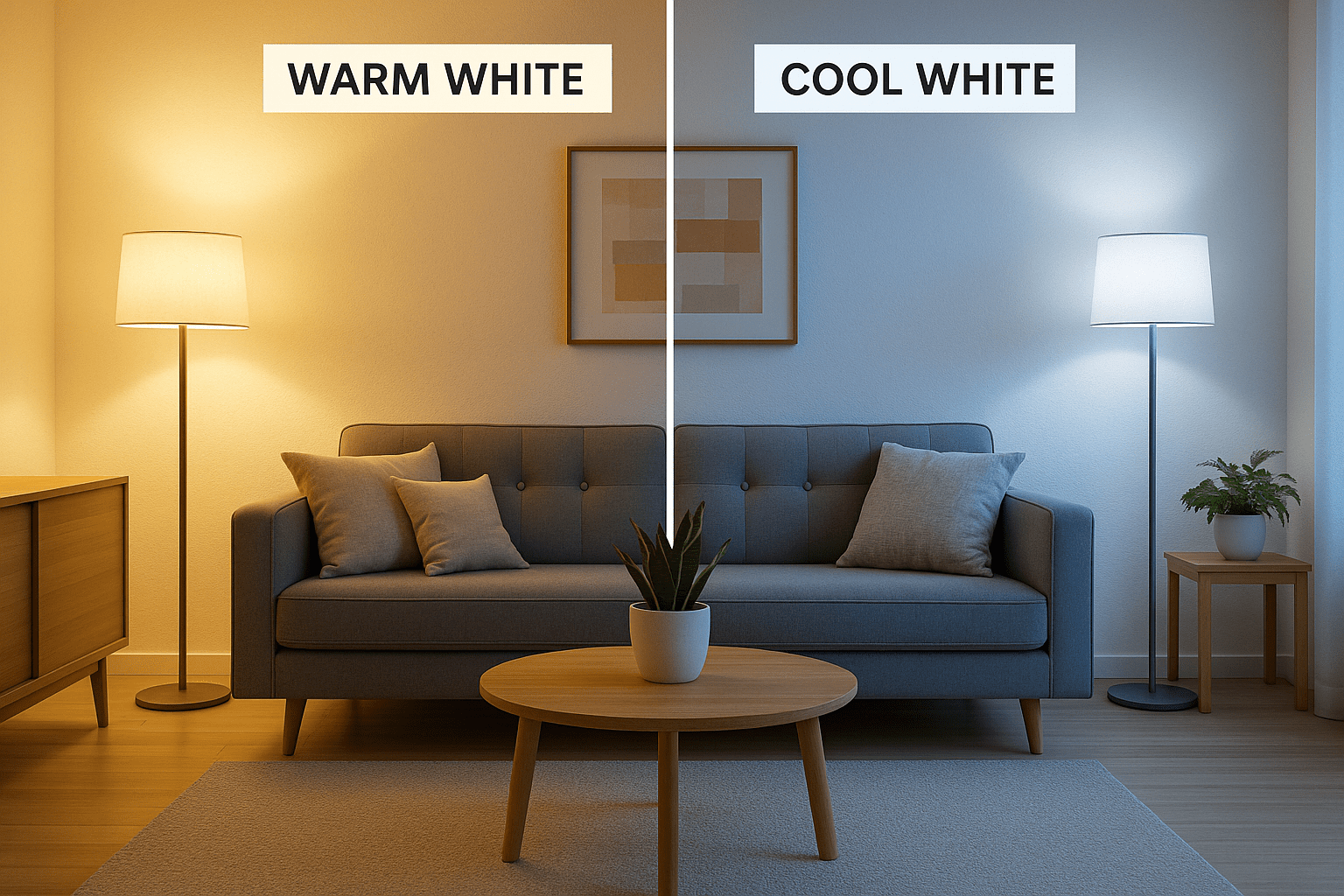
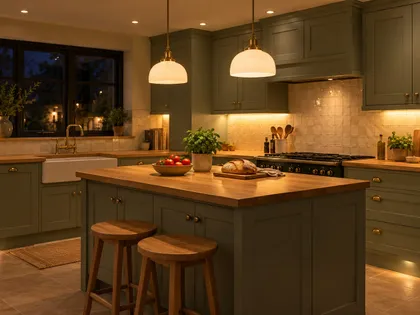
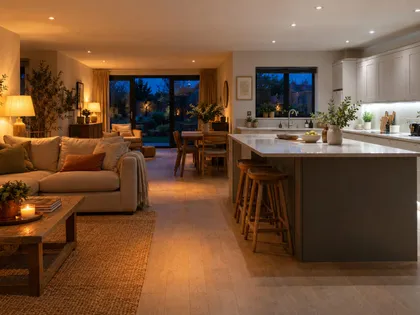
The picture above shows why it matters. Same room, same furniture, same lamp: on the warm side it looks lived in, on the cool side it looks like a waiting room.
Which colour temperature for each room
Living rooms suit 2700K to 3000K. You spend evenings there, and warm light is what makes a room feel relaxed. I wouldn’t go above 3000K.
Kitchens work at 3000K or 4000K. 3000K sits comfortably next to a dining or living area; 4000K looks crisper over worktops and suits very white, modern kitchens. The kitchen colour temperature guide goes through the choice in more detail.
Bathrooms also suit 3000K to 4000K. 4000K at the mirror makes shaving and make-up easier; 3000K is more relaxing for a bath. Some illuminated mirrors let you switch between the two.
Bedrooms should be warm, 2700K, for the simple reason that you use them at the start and end of the day. Light with more blue in it late in the evening is linked to poorer sleep, which is one more reason to keep bedroom lighting warm.
Home offices and desks can go to 4000K for the task light, with warmer light elsewhere in the room. Hallways and stairs work best at 2700K to 3000K, matching the rooms they lead to so you don’t step from warm into cold. Outside, stick to 2700K to 3000K for wall, path and garden lights; 4000K is fine for a security light over a drive.

If you can’t picture the difference, the colour temperature selector shows warm, neutral and cool white side by side in different rooms. For the wider picture, room by room, see the guide to lighting for every room.
Colour temperature isn’t brightness
This catches a lot of people out. Colour temperature is the colour of the light; lumens are the amount of it. A 2700K bulb and a 6500K bulb can both give 806 lumens and put the same amount of light into a room.
Many people find cool light looks a little brighter than warm light at the same lumens, which is partly why daylight bulbs get bought for dim rooms. If a room feels gloomy, the fix is more lumens or more light sources, not a bluer bulb. The lumens guide has the figures for each room.
Colour temperature makes no difference to running costs either. Two bulbs with the same wattage use the same electricity whatever their colour.
Colour temperature and CRI
There’s a second number worth checking: CRI, the colour rendering index. Colour temperature tells you whether the light is warm or cool. CRI tells you how accurately colours look under it, on a scale up to 100.
Two 3000K bulbs can look the same on the ceiling and very different on a plate of food or a face. Most decent LEDs are CRI 80 or above; for kitchens, bathrooms and anywhere you care about colours, look for 90 or more. The CRI vs colour temperature guide explains how the two work together.
Mixing colour temperatures
Within one room, keep it consistent. A ceiling of downlights in two different whites looks patchy, and a 2700K table lamp next to a 6500K floor lamp looks like two rooms fighting. My rule is to keep every light in a room within about 500K of the others, such as 3000K downlights with 2700K lamps.
Between rooms, vary as much as you like. A 4000K utility room next to a 2700K hall is fine because you never see them together.
The trap people don’t expect is that one brand’s 3000K isn’t always another’s. LEDs are sorted into batches by colour, and cheaper bulbs vary more, so a bulb from a different brand or batch can look slightly warmer or greener than the ones next to it. Buy a full set for a room at once, from one brand.
Tunable white and smart bulbs
If one room has to do two jobs, such as a kitchen-diner or a bedroom with a desk in it, a tunable white bulb lets you change the colour temperature without changing anything else. Cooler for working in the day, warmer in the evening.
Philips Hue White Ambiance bulbs run from 2200K to 6500K and dim smoothly, and they can follow a schedule so the light warms up through the evening. They work best with the Hue Bridge. Cheaper Wi-Fi bulbs from WiZ and TP-Link Tapo do the same job without a hub; check the Kelvin range on the box, as some only cover part of the scale.
For downlights, there are two other routes. Many integrated fittings have a small switch to pick 3000K, 4000K or 6500K before you fit them, which is handy if you’re unsure but fixed once they’re in. And dim-to-warm fittings get warmer as you dim them, the way old halogens did, so full brightness is a clean white and low light turns amber. In kitchens, smart scenes can do this across a whole circuit, covered in smart kitchen lighting scenes.
FAQs
What does 4000K light look like?
A crisp, neutral white with no obvious yellow or blue tint, the kind of white you’d see in a modern office. It’s popular in kitchens and bathrooms. UK shops often label it cool white.
Is a daylight bulb warm or cool?
Cool. Daylight bulbs are 5000K to 6500K and give a bright, slightly blue-white light. They’re good for garages and workshops but look cold in living rooms and bedrooms.
What is the best colour temperature for a house?
2700K to 3000K warm white for living rooms, bedrooms, dining areas and hallways. Kitchens, bathrooms and desks can go up to 4000K. There’s no single right setting for the whole house; match it to how each room is used.
Is 3000K warm or cool?
Warm. 3000K is warm white, slightly cleaner than 2700K. Neutral white starts at about 3500K to 4000K.
Does cool light use more electricity than warm light?
No. Colour temperature has no effect on energy use. Two LEDs of the same wattage cost the same to run whether they’re 2700K or 6500K.
Do LEDs change colour as they age?
Good-quality LEDs hold their colour well for most of their life. Cheap ones can drift noticeably, so a replacement may not match the bulbs around it, which is another reason to buy a matched set from one brand.
 Save
Save it for later
Pin this guide to one of your Pinterest boards so it's there when you start the job.