Best Christmas tree lights in the UK: how many you need and which to buy

Some links below are affiliate links: if you buy through them I may earn a small commission, at no extra cost to you. As an Amazon Associate I earn from qualifying purchases. How LightGuru makes money

Mike's quick answer
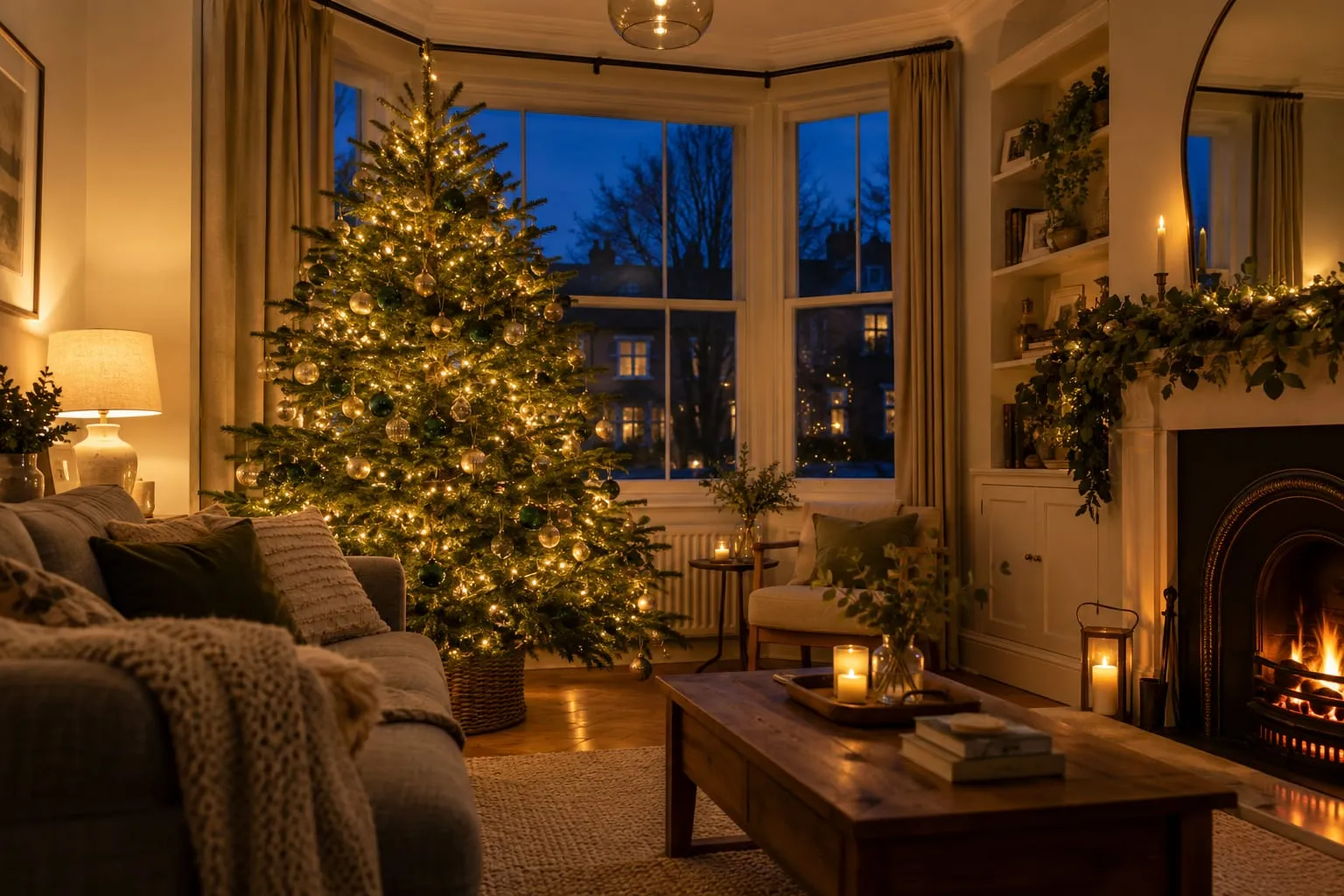
Aim for about 100 bulbs per foot of tree for a full glow, so around 600 on a 6 ft tree, and treat 50 per foot as the bare minimum. Warm white suits most UK living rooms, and cluster lights on green cable, wound along the branches from trunk to tip, give the fullest look. Buy a low-voltage LED set with a static setting, a memory and a timer.
Most Christmas trees are under-lit. A box of 200 lights looks generous in the shop, then vanishes into a 6 ft tree, and you’re left with a dark middle and a few bright dots on the tips. The trees that glow from the inside have far more lights than people expect, and they’re wound in along the branches rather than wrapped round the outside.
Three things decide what to buy: how tall and full the tree is, which white suits your room, and the type of light, which decides how dense it looks. Get those right and the rest, from the controller to the cable colour, is detail.
How many lights per foot of tree
UK retailers don’t agree on one number, but their advice falls in a clear range. Lights4fun and Coolings garden centres work on 5 metres of lights for every 2 ft of tree, which Lights4fun puts at about 100 bulbs: roughly 50 bulbs per foot. Gates garden centre and Balsam Hill start at 100 per foot, and suggest 150 to 200 per foot for a really full tree.
My advice is to treat 50 per foot as the bare minimum and aim for 100. At 50 the tree is lit; at 100 it glows.
| Bare minimum | Full glow | Very full | |
|---|---|---|---|
| 4 ft (1.2 m) | 200 bulbs (about 10 m) | 400 bulbs | 600–800 bulbs |
| 5 ft (1.5 m) | 250 bulbs (about 12.5 m) | 500 bulbs | 750–1,000 bulbs |
| 6 ft (1.8 m) | 300 bulbs (about 15 m) | 600 bulbs | 900–1,200 bulbs |
| 7 ft (2.1 m) | 350 bulbs (about 17.5 m) | 700 bulbs | 1,050–1,400 bulbs |
| 8 ft (2.4 m) | 400 bulbs (about 20 m) | 800 bulbs | 1,200–1,600 bulbs |
Two things move the number. The first is width: a slim or pencil tree needs fewer lights, and a wide, bushy Nordmann fir needs more, because there are more branches to cover. The second is the type of light: fairy lights spread their bulbs along the cable, so go by length; cluster lights pack hundreds into a short run, so go by the bulb count.
Check the lit length on the box, not the total cable length. Most sets have a few metres of unlit lead between the plug and the first bulb, and that part does nothing on the tree. If you’re between sizes, buy more: spare lights can always go on a garland or the mantelpiece.
Warm white, vintage gold or cool white
Warm white is the right choice for most living rooms. It usually sits around 2700K to 3000K, the same as the warm white bulbs in your lamps, so the tree looks as if it belongs in the room rather than being lit separately. It suits green trees, gold and red decorations and natural wood, and it’s soft on a flocked tree too.
Vintage gold is warmer again, a deeper amber-gold that’s closer to candlelight or an old filament bulb. It’s lovely on a traditional real tree with brass and glass baubles, and it looks cosiest late in the evening with the other lights turned down. Christmas light boxes often don’t print a Kelvin figure, so look at a photo of the set lit up, or see it in a shop, before you buy.
Cool white, sometimes sold as ice white, is a blue-white, often 6000K or more. It looks crisp on a white or silver tree in a modern scheme, but next to warm table lamps it looks cold. In between sits “pure” or “bright” white, which can look stark at home.
Whichever you choose, match it to the room. I keep every light in a room within about 500K of the others (the colour temperature guide explains why), and a tree is no different: with 2700K lamps, a warm white tree sits happily beside them. Multicolour is a separate decision, more about fun than mood, and LEDs give far cleaner colours than the old bulbs did. For the rest of the room, cosy living room lighting ideas covers lamps, shades and dimming.
Cluster, fairy, micro or bulb lights
| Cluster | Fairy (string) | Micro (pin wire) | Bulb-style | |
|---|---|---|---|---|
| Look | Dense glow | Even points of light | Fine sparkle | Bold and retro |
| Best for | Full-size trees | Any tree, long runs | Small trees, wreaths, garlands | Big trees, over a base layer |
| Cable | Thick bundle that hides in branches | Single cable | Fine copper or silver wire | Thicker, more visible |
| Usual power | Mains, low voltage | Mains, battery or USB | Battery or USB | Mains, low voltage |
Cluster lights are what I’d choose for a full-size tree. Hundreds of tiny LEDs sit close together on short strands off a main cable, so even a big set is short: Premier’s 960-bulb Cluster Brights set is about 12 metres long. Wound along the branches, they fill the inside of the tree with light, and the bundle of cable disappears into the needles. They’re the easiest way to reach 100 bulbs per foot, and warm white cluster lights from the big Christmas brands cost about £20 to £35 a set.
Fairy lights, also sold as string lights, space single bulbs along one cable, often every 5 or 6 cm. They give clear points of light rather than a glow, cover more length for the money and are the easiest to wind neatly. A 6 ft tree needs at least 15 metres, and double that for a full look.
Micro lights, also called pin-wire, copper-wire or seed lights, are tiny LEDs on a fine bare wire. The wire almost vanishes, which makes them good for small trees, wreaths, garlands and glass jars, and for weaving through a big tree on top of a main set for extra sparkle. On their own they’re too faint for a full-size tree, and the fine wire kinks easily if you wrestle it on and off the branches every year.
Bulb-style lights use larger, old-fashioned shaped bulbs spaced further apart. They make a bold, retro statement on a big tree or in a room with a high ceiling, but on their own they leave the inside of the tree dark, so they work best over a base layer of cluster or fairy lights.
Green or clear cable
Match the cable to the tree. Green cable disappears into a real tree or a green artificial one, and it’s what most cluster and tree sets come on. On a white, silver or flocked tree, green cable shows as dark lines through the branches, so look for clear cable instead. Micro lights on copper or silver wire work on any tree, because the wire is so fine.
Check the colour before you buy, especially with smart sets. Twinkly’s UK-plug Gold Edition strings, for example, come on black cable, which hides well in a dark green tree but shows on a pale one.
How to put lights on a tree
The aim is light coming from inside the tree as well as the tips. This is the order that works:
- Unpack and test. Take every set fully out of its packaging before you plug it in (Electrical Safety First warns against powering lights while they’re still in the box), then check that every section lights.
- Shape the tree first. Fluff out every branch of an artificial tree. Give a real tree a day out of its netting so the branches can drop.
- Start at the bottom, by the socket. That way the plug, transformer and controller sit at the base, where you can reach them.
- Work from the trunk out. Take the cable in along a branch from the trunk to the tip and back again, then on to the next branch. Lights near the trunk make the glow; lights near the tips add the sparkle.
- Step back and check. Look from across the room with your eyes half closed. Dark patches show up at once, and they’re easy to fill before the decorations go on.
- Lights first, then everything else. Garlands and baubles go on afterwards, so they hang in front of the light rather than blocking it.
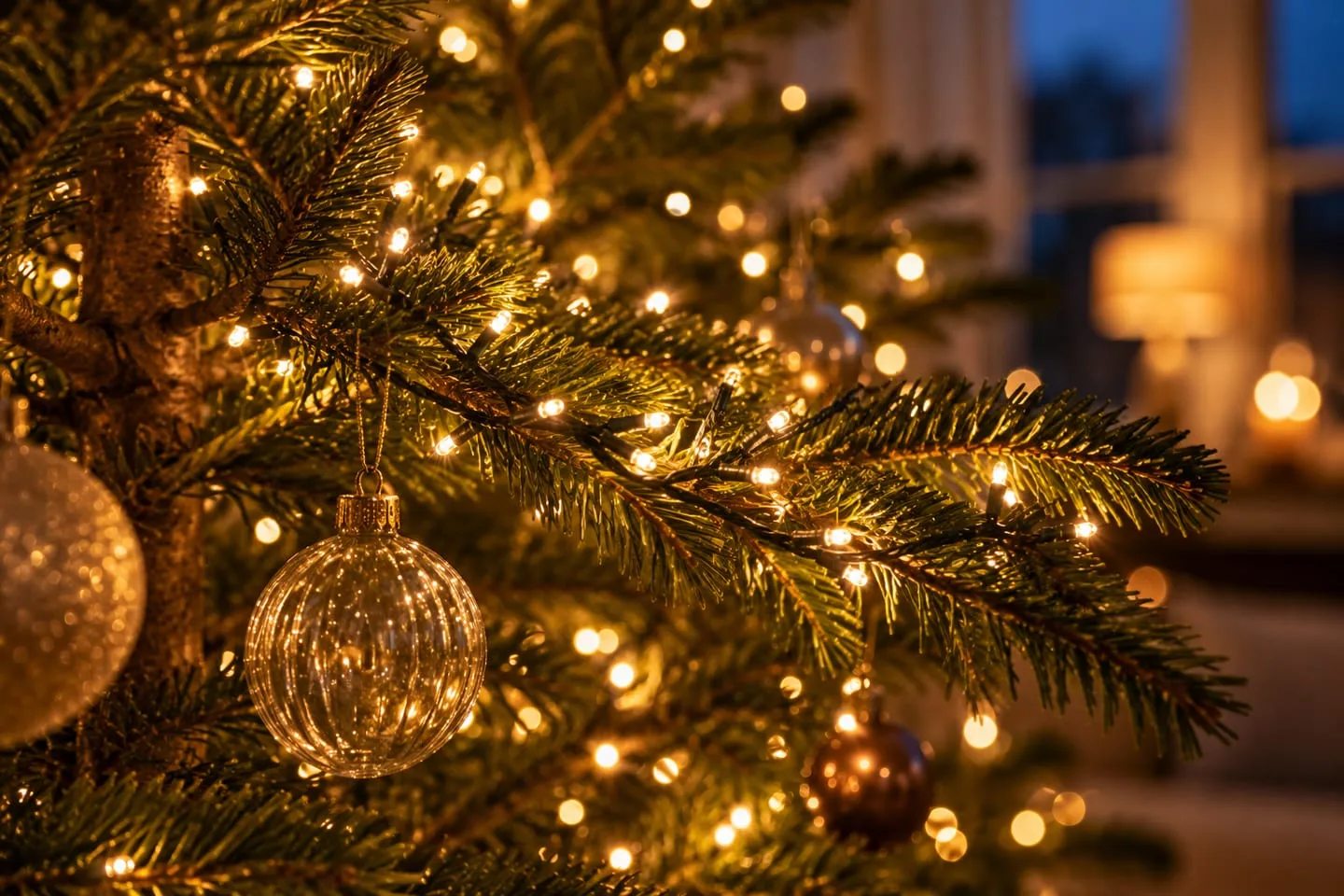
The quick method, walking round and round the tree wrapping the outside in a spiral, leaves the middle dark and puts the lights on the surface in stripes. For most trees I’d use vertical sections instead. Picture the tree split into three wedges from top to bottom, like slices of a cake, and light one wedge at a time, zigzagging up and down along the branches. Each set gets its own section, so you can see straight away if you’re running short, and taking the lights down in January is far easier when nothing is wound round the whole tree.
Controllers, timers and smart lights
Most plug-in sets have a small controller with eight settings, from steady through flashing, chasing and fading. You’ll probably leave it on steady most of the time, so make sure there’s a static setting. Two other features are worth paying for. A memory keeps your chosen setting when you switch off at the wall. A built-in timer keeps the lights on for six or eight hours, then switches them off until the same time the next day, so switch the set on at the time you want it to come on each evening.
Some controllers dim as well, which helps: a tree at full brightness can overpower a room lit by lamps.
Smart sets go further. Twinkly is the best-known name. Its app uses your phone’s camera to map where every LED sits on your tree, so effects such as waves and gradients move across the shape of the tree rather than along the cable, and you can set schedules and dim from your phone or by voice. The standard sets do millions of colours; the Gold Edition swaps those for amber and warm-to-cool white LEDs, which suits a traditional room better. A Twinkly Strings set of 250 LEDs costs about £90 to £130. Its 20 metres will go round a 6 ft tree, but at about 40 bulbs a foot it’s well short of a full glow, so a 6 ft tree really wants the 400-LED set or two sets. If you already use Philips Hue, its Festavia string lights work in the same app as the rest of your lights.
Mains, battery or USB
| Mains (plug-in) | Battery | USB | |
|---|---|---|---|
| Brightness | Good | Modest | Modest |
| Lengths | Long sets, connectable runs | Short sets | Short sets |
| Best for | The main tree lights | Wreaths, garlands, a tree away from a socket | Small trees, shelves, a desk |
| Watch for | A UK plug and a low-voltage transformer | Battery life; a timer helps | A USB plug or power bank to run it |
For the main tree lights, plug-in is the answer: bright, reliable every night and cheap to run, with the cable on the tree at a safe extra-low voltage.
Battery sets are for where there’s no socket nearby, such as a wreath on a door or a garland on the stairs. The battery box is bulky to hide in a tree, and a built-in timer makes the batteries last. Battery micro lights with a timer cost about £8 to £20. USB sets run from a USB plug or a power bank and suit small trees, shelves and desks. Neither is bright or long enough to light a full-size tree on its own.
Real or artificial tree
A real tree has stiffer, more open branches, so the lights sit deeper and you see more of the cable, which is one more reason to choose cluster lights on green cable. Keep it watered. Electrical Safety First’s Christmas safety tips point out that a real tree can catch fire far more quickly than a fire-retardant artificial one, and that it can drink up to a litre of water a day, so don’t let it dry out. Stand it away from fires and radiators, which dry it faster, and switch the lights off before you top up the water.
Artificial trees have more, softer tips, so the lights hide easily and you can bend branches round them. Pre-lit trees save the wrapping, but check how many bulbs they have against the table, and bear in mind that a failed section built into the tree is harder to sort out than a separate set. An extra set of cluster lights wound through a pre-lit tree fills it out.
If the tree is outside, everything changes: the lights, controller and transformer all need an outdoor rating. Outdoor Christmas lights covers what to buy and how to put them up safely.
Safety for UK homes
Christmas tree lights are low-risk if you buy them from a proper retailer and check them every year. Electrical Safety First’s Christmas lights advice covers the essentials, and these are the points that matter most indoors.
Buy low voltage, from a known seller. The safest sets run at extra-low voltage from a transformer at the plug. Look for a UKCA or CE mark (Great Britain accepts either) and a proper UK three-pin plug or plug-in transformer, not a foreign plug in a travel adaptor. Buy from an established retailer rather than a third-party marketplace seller, whose lights may not have passed the safety checks, and register the set with the maker so they can contact you about a recall.
Check old sets before they go up. Look for cracked bulbs, split or bare cable, a loose plug and a cracked controller. Bin a damaged set rather than taping it. Very old sets with glass filament bulbs often carry the full mains voltage along the cable, and their bulbs run hot. If a bulb fails, replace it before you use the set again, only with one of the same type and rating, and with the set unplugged. If the set can’t take new bulbs, or it’s that old, a new LED set costs little and is much safer.
Use the timer, and switch off at bedtime. There’s no reason for a tree to be lit while everyone’s asleep or out. Let the timer bring the lights on in the evening, and switch off at the socket at bedtime or when you go out, as Electrical Safety First advises.
Don’t overload the socket. Plug straight into a wall socket where you can. If you need an extension lead, use one fused lead rather than a stack of adaptors, and never plug one extension lead into another. If your consumer unit has no RCD protection, a plug-in RCD adaptor adds it at the socket.
Keep cables tidy. Run them along the wall rather than across the floor, keep lights away from curtains, paper decorations and candles, and keep an eye on pets and small children who like to chew or pull.
The tree lights I'd buy
Affiliate linksFAQs
How many lights do I need for a 6 ft Christmas tree?
At least 300 bulbs, or about 15 metres of fairy lights, and around 600 for a full glow. For a really dense tree, use cluster sets totalling 900 or more.
Are cluster lights better than fairy lights?
For a full-size tree, usually yes. They pack far more LEDs into a short length, so the tree glows from inside and the cable hides in the branches. Fairy lights give clearer points of light and cover more length for the money.
What colour Christmas tree lights look best?
Warm white, around 2700K to 3000K, suits most UK living rooms because it matches warm lamps. Vintage gold is warmer and more traditional. Cool white looks crisp on a white or silver tree but cold next to warm lamps.
Should Christmas tree lights go on vertically or round the tree?
Vertically, in sections, working along each branch from the trunk to the tip. Spiralling round the outside is quicker but leaves the middle of the tree dark.
Can I leave Christmas tree lights on all night?
It’s better not to. Use the set’s timer for the evening, then switch off at the socket at bedtime and when you go out, as Electrical Safety First advises.
How much does it cost to run Christmas tree lights?
Very little with LED. Premier’s 750-bulb TreeBrights set, for example, is rated at 6 watts, so six hours a night through December uses around 1 kWh, well under a pound for the season.
 Save
Save it for later
Pin this guide to one of your Pinterest boards so it's there when you start the job.