Best outdoor Christmas lights in the UK: what to buy and how to put them up safely

Some links below are affiliate links: if you buy through them I may earn a small commission, at no extra cost to you. As an Amazon Associate I earn from qualifying purchases. How LightGuru makes money

Mike's quick answer
Buy mains-powered LED sets from an established brand such as Premier, Konstsmide, Lights4fun or NOMA, rated IP44 or better, with a low-voltage transformer and a timer. Cluster lights for trees, icicle lights for the gutter, net lights for hedges. Plug them into an RCD-protected socket and keep every connection off the ground.
The best outdoor Christmas lights aren’t the brightest or the ones with the most effects. They’re the ones that still work in January after six weeks of wind, rain and frost, and that come out of the loft working again next year. That comes down to a proper outdoor rating, a decent transformer and controller, and a brand that will still be selling spares and replacements when something fails.
What you should buy depends on what you’re lighting (a tree, the gutter, a hedge or the front wall) and where the nearest socket is. Get those two things straight before you shop and you’ll buy the right lengths first time. The safety side matters as much as the lights, so it’s covered properly below.
Which lights for which job
| Best type | What to look for | |
|---|---|---|
| Trees and large shrubs | Cluster or string lights | Long sets, 500 LEDs and up for a decent tree |
| Gutters and eaves | Icicle or connectable string lights | Measured by width; check the drop length |
| Hedges and bushes | Net lights | Pick a net a little bigger than the hedge face |
| House front and walls | Curtain lights or a projector | Fixings that suit brick or render |
| Porch and front door | Lit garland or battery string | Battery sets with a timer if no socket |
| Paths and borders | Stake lights or low-voltage string | Warm white, kept off the walkway |
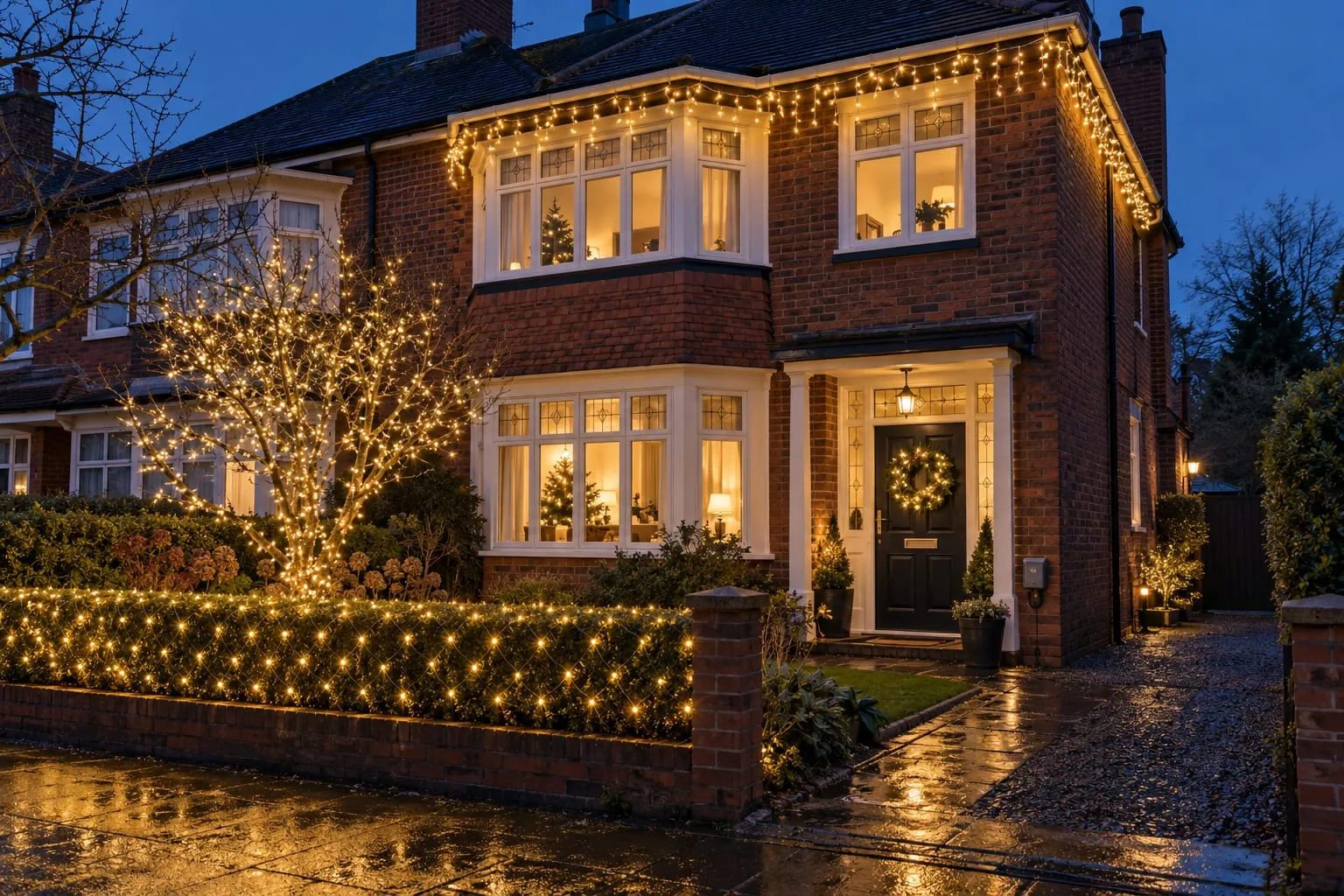
Cluster lights pack hundreds or thousands of tiny LEDs tightly along a short length of cable, so they look dense and sparkly wrapped round a tree trunk and through the branches. They’re the best choice for an outdoor tree because they look full even from across the road. String (fairy) lights space the bulbs out along the cable, which suits outlining a fence, a pergola or a roofline, and goes further for the money. For the tree indoors, see my guide to the best Christmas tree lights and how many you need.
Icicle lights hang short drops of different lengths from a main cable and are made for gutters, eaves and porch edges. They’re sold by the width they cover, so measure the run of gutter you want to light. Net lights are a grid of bulbs you throw over a hedge or bush in seconds, and they give the most even coverage with the least effort.
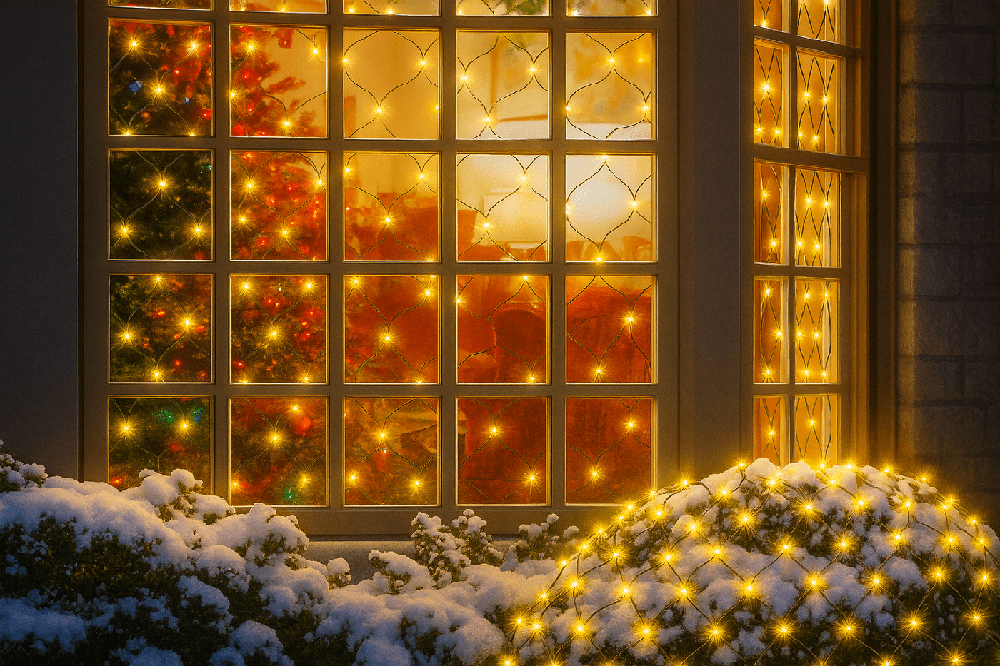
Curtain lights hang vertical strands from a horizontal cable and suit a large window, a bare wall or a fence panel. Projectors throw patterns onto the house front and are the quickest way to cover a big wall, though they look less special up close.
What to look for on the box
The best Christmas lights have a few things in common, and you can check all of them on the box before you buy.
An outdoor IP rating, IP44 at least. That covers the lights, the controller and any transformer that has to go outside. Some sets have an outdoor-rated string but a transformer marked for indoor use only, which has to stay indoors. If the box doesn’t say it’s for outdoor use, don’t put it outside. There’s a full explanation of the numbers in IP ratings for outdoor lighting.
A low-voltage transformer. Most plug-in LED Christmas lights run at a safe low voltage (often 24 V or 31 V) from a transformer at the plug end, so the string itself only carries low voltage. That’s what you want outdoors.
A long lead cable. The unlit cable between the transformer and the first bulb decides how far the lights can be from the socket. Better sets often have five metres or more; cheap ones can be much shorter, which is how people end up stretching indoor extension leads across the drive.
A controller with a static setting, memory and timer. Most sets have eight flashing modes. You’ll probably want steady light most of the time, so make sure there’s a static option. A memory function remembers your setting after you switch off at the wall, and a built-in timer (usually six or eight hours on, then off until the same time the next day) saves you buying a separate one.
Connectable sets. If you might extend the display, buy a connectable range and check how many sets one transformer can run.
A known brand and a UKCA or CE mark. Very cheap, unbranded sets sold through online marketplaces are where unsafe Christmas lights tend to turn up. Established brands like Premier, Konstsmide, Lights4fun and NOMA sell through mainstream retailers and stand behind their warranties.
Warm white, cool white or colour
Warm white is the classic look and the safest choice. It looks good against brick, stone and greenery, and it matches the warm light from your windows. Cool or ice white looks crisp and frosty, especially on icicle lights, but in a row of houses it can look harsh and blueish. Multicolour is cheerful and traditional, and red and white is a popular combination on cluster lights and trees.

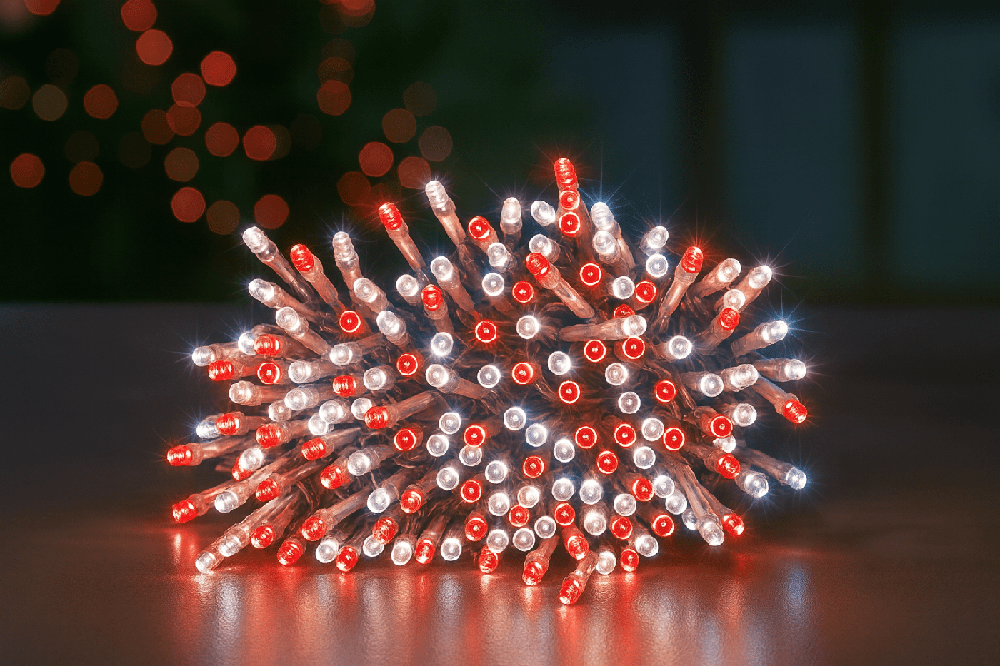
Whichever you choose, keep it consistent across the house. Warm white on the tree and cool white on the gutter, from different brands and batches, rarely looks deliberate. If you want variety, change the type of light (icicles, net, cluster) rather than the white.
Mains, battery, solar or smart
| Mains plug-in | Battery | Solar | Smart (app) | |
|---|---|---|---|---|
| Brightness | Good | Modest | Low | Good |
| In December | Every night | Fine with fresh batteries | Weak, often short | Every night |
| Needs | A socket in reach | AA or C cells | A sunny spot | A socket and Wi-Fi |
| Best for | Trees, gutters, big displays | Wreaths, porches, planters | Small accents only | Effects, colour, schedules |
| Rough cost | £15–£70 a set | £10–£25 a set | £10–£30 a set | £50–£200 a set |
For most displays, mains is the answer: brighter, reliable every night, and cheap to run. Battery sets are handy for a wreath on the front door, a porch or window boxes where there’s no socket; choose one with a built-in timer and expect to change batteries every week or two depending on the set. Solar Christmas lights are the weak option, because December is exactly when British solar panels get the least sun. They’re fine as a small extra, not as the main display.
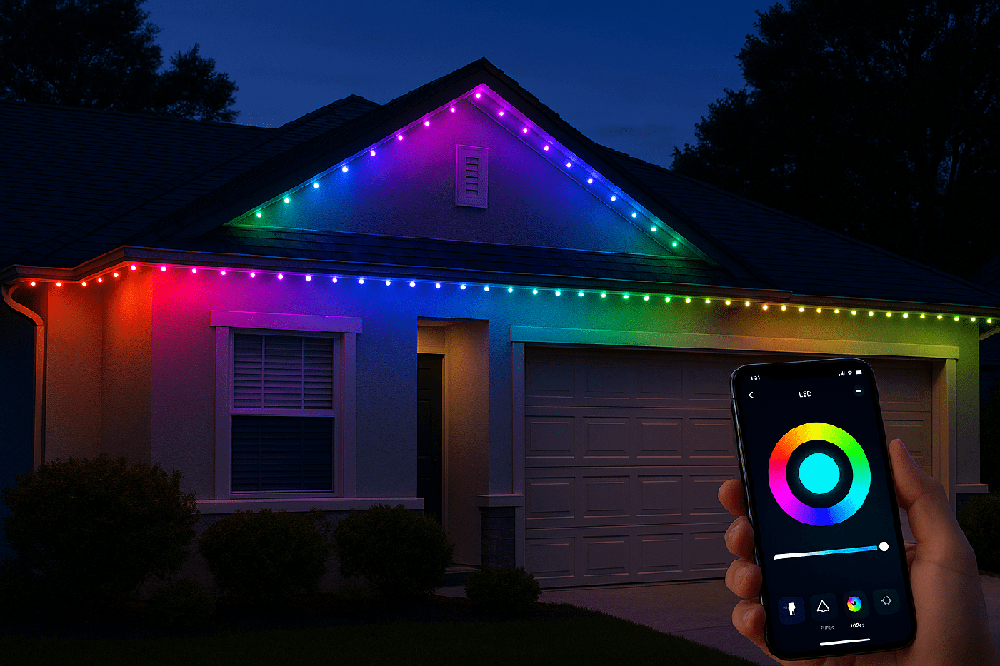
Smart sets let you change colours and effects from your phone, set schedules and, with some, map patterns to the shape of the tree. Twinkly is the best-known name, and Philips Hue makes outdoor Festavia string lights that work with the rest of a Hue system. Permanent app-controlled lights fixed under the eaves are also popular, giving warm white for the rest of the year and colour at Christmas.
The best outdoor Christmas lights to buy
Affiliate linksHow to put them up safely
Outdoor Christmas lights mean mains plugs, extension leads and wet weather, usually with someone up a ladder in the dark. These are the things to get right.
Plug into an RCD-protected socket. An RCD cuts the power in a fraction of a second if current leaks through a damaged cable or water gets into a connection. Most modern consumer units have RCD protection built in; if yours is an old fuse box, use a plug-in RCD adaptor at the socket. NICEIC’s Christmas lights advice says the same.
Use an outdoor socket or an outdoor-rated extension lead. An indoor extension lead or multi-way adaptor left outside is the most common hazard. If you need a lead, use one made for outdoor use, unwind a cable reel fully so it doesn’t overheat, and put any plug-and-socket connection in a weatherproof connection box raised off the ground, not sitting in a puddle on the patio. Don’t plug extension leads into each other.
Don’t trap cables in windows or doors. Running a cable through a window or under a door crushes it every time it closes and eventually damages the insulation. Use an outdoor socket, or a socket in a garage or porch with a proper route out.
Keep the plug and transformer indoors where you can. Electrical Safety First advises plugging in indoors even when the lights are rated for outdoor use, with the low-voltage cable taken out by a proper route. Any connection that has to be outside belongs in a weatherproof box, off the ground and out of standing water.
Check the lights before they go up. Lay them out indoors and test them. Bin any set with cracked bulbs, damaged cable or a cracked controller, and don’t repair a cut cable with tape.
Fix them with clips, not nails. Plastic gutter and fascia clips, cup hooks in timber fascia, or adhesive light hooks hold lights without piercing the cable. Never staple or nail through the wire.
Be careful on the ladder. Put it on firm, level ground at the right angle (about one unit out for every four up), have someone foot it, and move the ladder rather than leaning out. Keep well away from overhead power lines.
Planning the display
Measure before you buy. Pace out the gutter run, the fence or the hedge, and for a tree, estimate the height and spread; wrapping a tree’s branches takes far more length than people expect. Then measure from the socket to where the lights start, because that distance has to be covered by the lead cable, not by an indoor extension lead.
Light a few things well rather than everything. A lit tree, an outlined porch and lit hedges at the front usually look better than every surface covered. Keep lights below a neighbour’s bedroom window rather than shining across it, and if you use a projector, aim it at your own house front, never up into the sky, where a laser can distract pilots.
For the back garden, the same ideas from garden lighting ideas apply: warm white, aimed at surfaces, with some darkness between. Festoon lights you already have over the patio can do festive duty too; patio lighting ideas covers hanging them properly. There’s more on wires, fixings and power in festoon and string lights for the garden.
Running costs and timers
LED Christmas lights cost very little to run. A typical outdoor set uses somewhere around 5 to 15 watts, so six hours a night through December comes to well under a pound per set for the whole season. Even a big display with several sets rarely adds more than a few pounds.
Still, there’s no reason to run them all night. Use the set’s built-in timer, a plug-in timer, or an outdoor-rated smart plug so the lights come on at dusk and go off at bedtime. It saves energy, keeps neighbours happy, and means nothing’s live and unattended overnight.
When they stop working, and storing them
Most modern LED sets are sealed, so you can’t swap individual bulbs. If the whole set is dead, check the plug fuse if it has one, then the connection between the transformer and the string, then the controller. If one section has gone out, it’s often a damaged connection or water in a joint. If a set fails within its warranty, take it back rather than trying to repair it. If an RCD trips as soon as the lights go on after rain, unplug them and let everything dry; if it keeps happening, the set has a fault and needs replacing. For outdoor lights in general, outdoor lighting faults goes through the usual causes.
Take the lights down on a dry day, let them dry fully indoors, and wind each set round a piece of card or a cable reel rather than balling it up. Store them with the transformer and controller in a labelled box in a dry place, and you’ll get several seasons out of a good set.
FAQs
What IP rating do outdoor Christmas lights need?
At least IP44, for the lights, the controller and the transformer. If the transformer is marked for indoor use only, it has to stay indoors with the cable taken outside safely, not through a closed window.
Can I use indoor Christmas lights outside?
No. Indoor sets aren’t sealed against rain, and water in a connection can trip your electrics or cause a fault. Only use lights clearly marked for outdoor use.
Can I leave outdoor Christmas lights on overnight?
Electrical Safety First advises switching them off and unplugging them before bed or when you go out. A timer or outdoor-rated smart plug does that for you, saves energy and avoids disturbing the neighbours.
Do I need an outdoor socket for Christmas lights?
It’s the safest way, and worth fitting if you decorate every year. Without one, use a socket in a garage or porch with a safe route out, or battery sets, rather than running cable through a window or door.
How much do outdoor Christmas lights cost to run?
Very little. A typical LED set uses around 5 to 15 watts, so six hours a night through December costs well under a pound per set for the season.
Are solar Christmas lights any good?
As a small extra in a sunny spot, they’re fine. As the main display, they’re disappointing: December has the shortest, greyest days of the year, so many solar sets only manage a short, dim glow. Mains or battery sets are more reliable.
 Save
Save it for later
Pin this guide to one of your Pinterest boards so it's there when you start the job.