Light bulb fittings explained: B22, E27, E14, GU10, G9 and more

Some links below are affiliate links: if you buy through them I may earn a small commission, at no extra cost to you. As an Amazon Associate I earn from qualifying purchases. How LightGuru makes money

Mike's quick answer
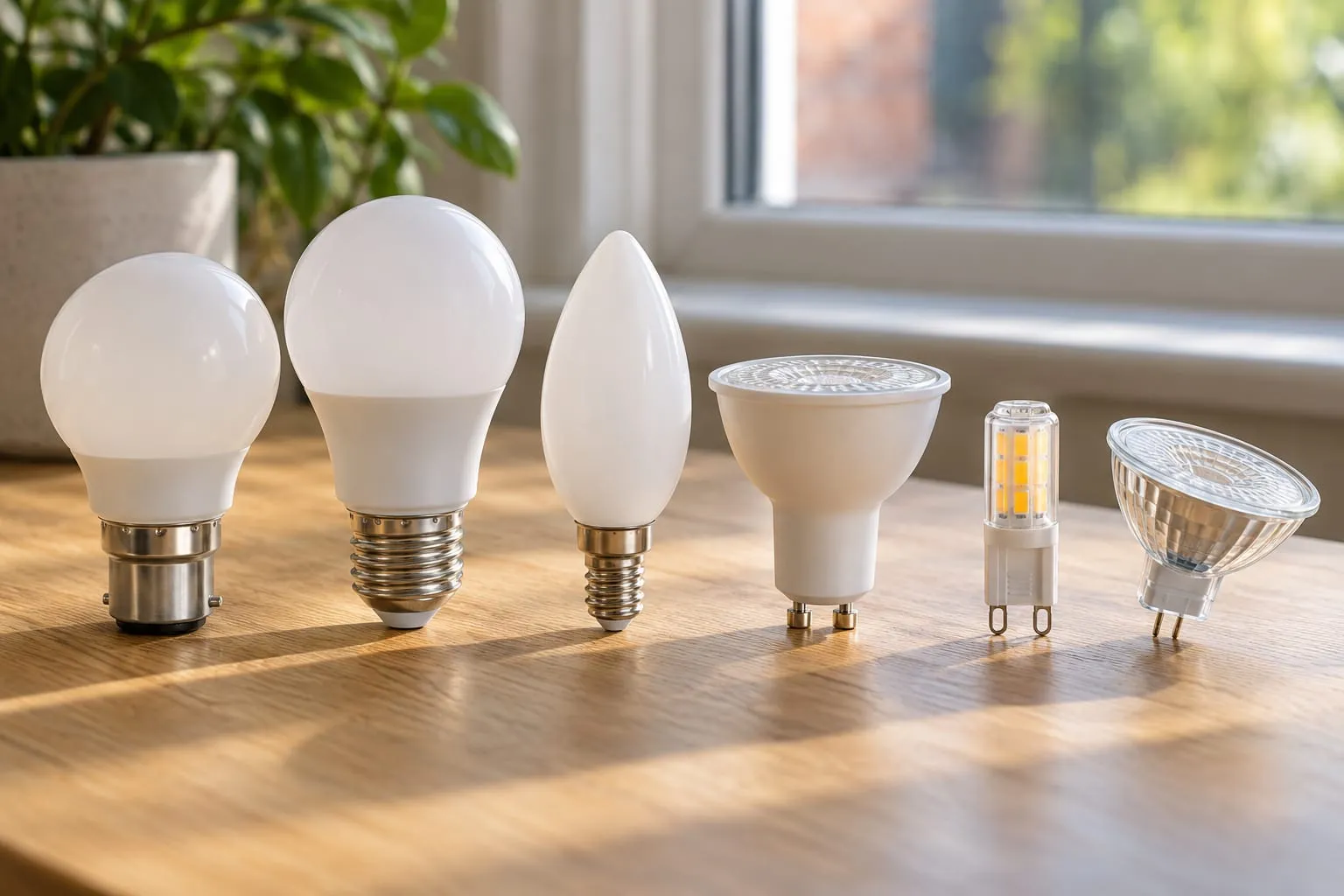
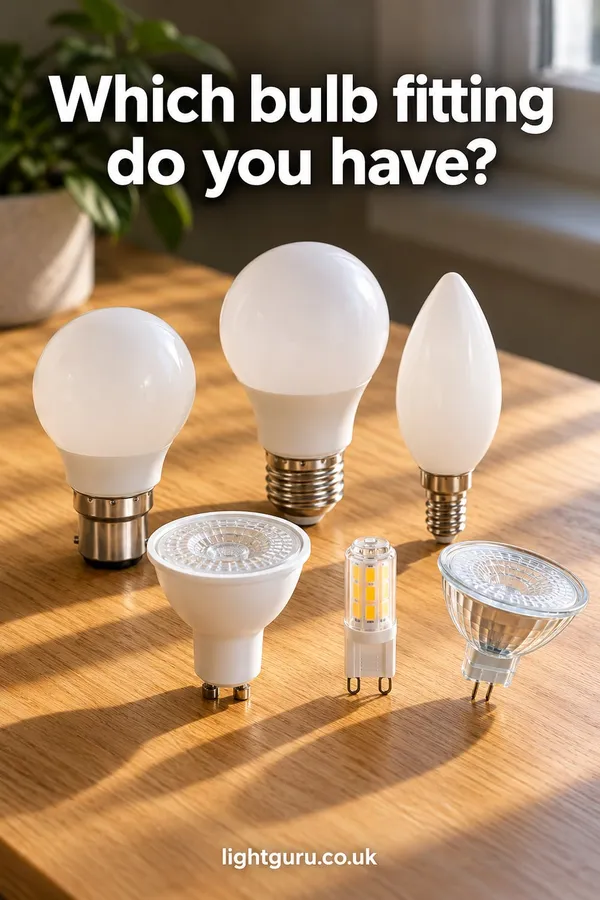
Take the old bulb out and look at the base. Most UK ceiling pendants take B22, the bayonet with two pins on the side; lamps often take E27 or the smaller E14 screw; downlights take GU10 (mains, push and twist) or MR16 (12 V, two thin pins that push straight in). In each code the letter is the type and the number is the cap's width, or the gap between its pins, in millimetres.
Pull out a dead bulb and look at the end that went into the light. That base, the cap, decides what you can buy, and there are only a dozen or so you’re likely to meet in a UK home. Get it right and the new bulb goes in first time. Get it wrong and you’re left with a bulb that won’t fit, or one that fits and doesn’t work.
The codes on the box are more logical than they look. A letter tells you the type of cap and a number tells you its size. Once you know that, most of the shelf makes sense, and the rest of this guide is about telling look-alikes apart and picking the right LED replacement.
What the codes mean
The letter is the type of cap:
- B is a bayonet: a smooth metal sleeve with two small pins on the side. You push it in and twist.
- E is an Edison screw, named after Thomas Edison. It screws in.
- G is a pin cap, with two pins or loops underneath. GU, GX and GY are variations on the same idea.
- R7s is a double-ended linear bulb with a contact at each end.
T8 and T5 aren’t caps at all: they’re fluorescent tube sizes, named differently (more below).
The number is millimetres. For bayonet and screw caps it’s the diameter of the cap, so a B22 is 22 mm across and an E14 is 14 mm. For pin caps it’s the distance between the centres of the pins: GU10 pins are 10 mm apart, G9 loops 9 mm and GU5.3 pins 5.3 mm. You’ll sometimes see a letter after the number, as in B22d. For buying a bulb you can ignore it.
Shops and older packaging also use trade names. BC (bayonet cap) is B22, SBC (small bayonet cap) is B15, ES (Edison screw) is E27 and SES (small Edison screw) is E14. They’re the same fittings under different names.
UK bulb fittings at a glance
These are the caps you’ll find in UK homes, with how to spot each one:
| Fitting | Also called | How to spot it | Voltage | Where you’ll find it |
|---|---|---|---|---|
| B22 | BC, bayonet | Smooth sleeve, two pins on the side, 22 mm | Mains | Ceiling pendants, most UK lamps |
| B15 | SBC, small bayonet | As B22 but 15 mm | Mains | Candle bulbs, wall lights, chandeliers |
| E27 | ES, Edison screw | Screw thread, 27 mm | Mains | Lamps and pendants, especially from European brands |
| E14 | SES, small Edison screw | Screw thread, 14 mm | Mains | Candle bulbs, small lamps, chandeliers |
| GU10 | Mains spotlight | Two short pins with fat ends; push and twist | Mains | Downlights, track, spotlight bars |
| GU5.3 (MR16) | 12 V spotlight | Two thin straight pins; push straight in | 12 V, via a transformer | Older downlights, display lighting |
| G9 | Capsule | Small capsule with two wire loops | Mains | Modern ceiling lights, wall lights, chandeliers |
| G4 | 12 V capsule | Tiny capsule with two thin pins | Usually 12 V | Display, cabinet and desk lights |
| R7s | Linear | Slim tube with a contact at each end, 78 or 118 mm long | Mains | Uplighters, floodlights |
| GX53 | Puck | Flat disc with two pins on the back; twist in | Mains | Shallow downlights, under-cabinet lights |
| T8 and T5 | Fluorescent tube | Long tube with two pins at each end | Mains, via control gear | Garages, utility rooms, older kitchens |
How to identify your fitting
Start with the old bulb. Many have the cap type printed on them, along with the wattage and voltage, although it can wear off.
If you can’t read it, look at the shape. Two pins on the side of a smooth sleeve is a bayonet. A thread is a screw cap. Two pins or loops coming out of the bottom is a pin cap. Then measure: across the cap for bayonets and screws, and between the centres of the pins for pin caps. A ruler is enough to tell 22 mm from 15 mm, or 27 mm from 14 mm. With spotlights, look for fat-ended pins 10 mm apart (GU10) or thin pins 5.3 mm apart (MR16).
If the light is empty, look into the lampholder. A bayonet holder has two L-shaped slots, a screw holder has a thread, a GU10 holder has two curved slots that the pins twist along, and an MR16 holder has two small round holes. The label on the fitting, often on the canopy or inside the shade ring, usually gives the cap type and a maximum wattage. That maximum was set for old bulbs; with LEDs you’ll be far under it.
If you’re still unsure, take the old bulb to the shop with you.
B22 or E27: bayonet or screw
B22 is the British standard. Most pendant sets and UK-made lamps take it. E27 is the continental standard, so lamps from European brands, and many sold online, come with E27 holders.
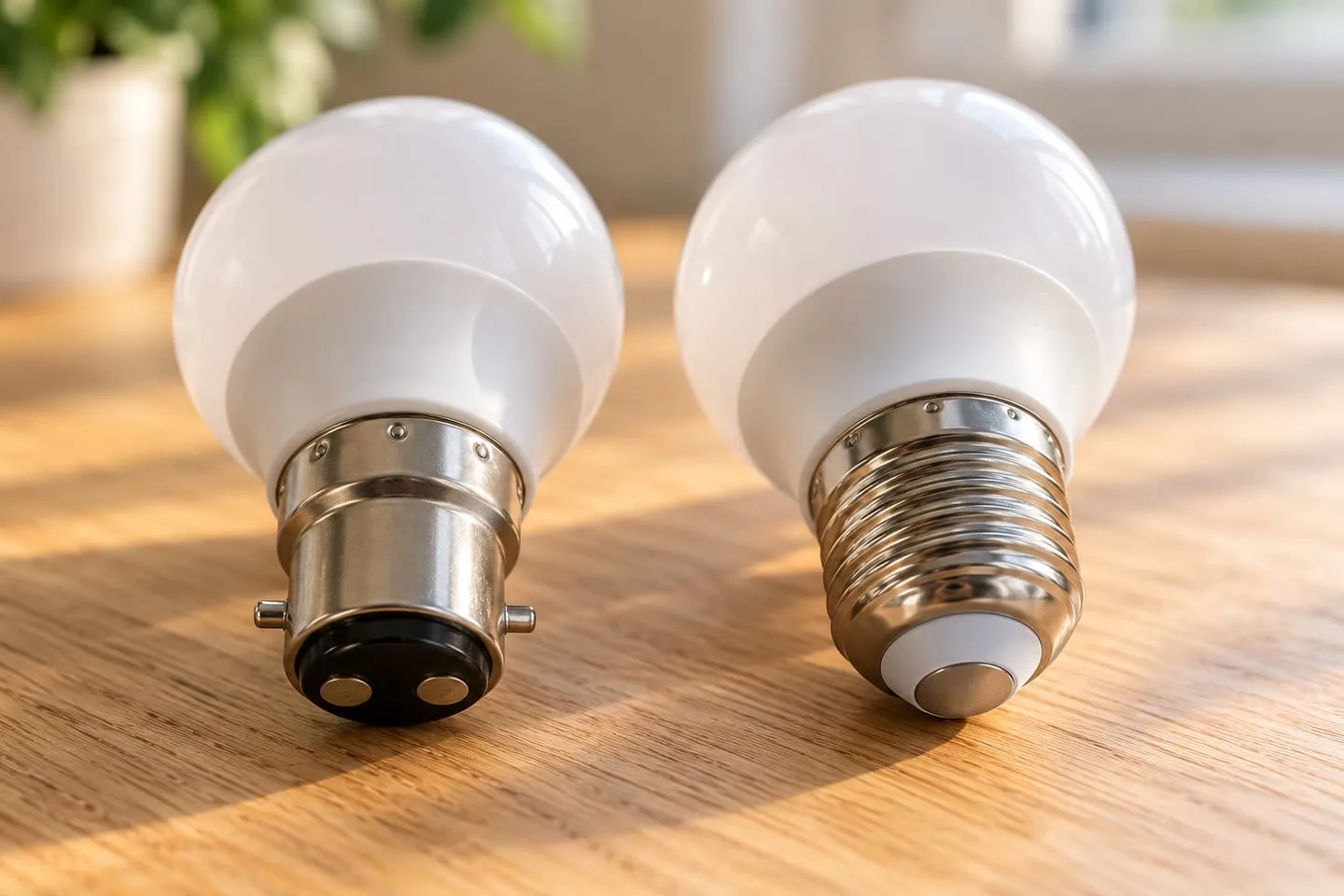
Neither is better. The same LED bulbs are made in both, from everyday 806-lumen bulbs to filaments and smart bulbs, so buy the cap your fitting has. The practical difference is small: a bayonet locks in place, so it’s less likely to work loose in a pendant that gets knocked, while a screw cap can be easier to get in and out of a tight shade.
The smaller versions follow the same pattern. SES is E14, 14 mm across, and ES is E27, nearly twice the width. B15 (SBC) and E14 (SES) are the caps on most candle bulbs and on many small lamps, wall lights and chandeliers. An E14 won’t go into a B15 holder or the other way round, so check before you buy a set of candles for a chandelier.
GU10 or MR16
From the front these two look almost identical: both are reflector spotlights about 50 mm across, used in downlights. Turn them over and they’re different lamps.
A GU10 runs straight off the mains. Its two short pins have fat ends, and you push it into the holder and twist to lock it. Most UK downlights that take a separate bulb are GU10, and it’s the spotlight you’ll find on every supermarket shelf.
An MR16 runs at 12 V. Strictly, MR16 is the shape, a multifaceted reflector 16 eighths of an inch (2 inches, about 50 mm) across, and the cap is GU5.3: two thin, straight pins 5.3 mm apart that push straight in. Because it’s 12 V, there’s a transformer above the ceiling, one per fitting or one for a group. You’ll find MR16s in kitchens and bathrooms lit in the halogen era, and in display lighting. The pins are different by design, so a 12 V lamp can’t go into a mains holder by mistake.
LED MR16s and old transformers
Swapping 12 V halogen MR16s for LED MR16s is where people get caught out. The transformers fitted for halogens are often electronic ones made for a 35 W or 50 W lamp, and many need a minimum load to work properly. A 5 W LED is far below it. The result is flicker, a buzz, lamps that cut out after a few minutes, or no light at all.
There are three ways round it. Buy LED MR16s the lamp maker lists as compatible with your transformer, if you can identify it; the big brands publish transformer compatibility lists. Replace each transformer with a 12 V LED driver. Or have the fittings changed to mains GU10 holders and use GU10 lamps, which gets rid of the transformers altogether. The last two mean wiring work in the ceiling, which I’d leave to an electrician. The flicker and buzz guide covers the symptoms, and if the lights are on a dimmer, LED dimmer switches explains what else to check.
G9 and G4 capsules
G9 is the small mains capsule with two wire loops instead of pins, used in a lot of modern ceiling lights, wall lights and multi-arm chandeliers. It pushes straight in, with no twist. The catch with LED G9s is size: they’re usually a little longer or fatter than the halogen capsules the fitting was designed around, so measure the space inside the glass or shade before ordering a set. Many aren’t dimmable either, so check if the fitting is on a dimmer. Expect 200 to 400 lumens from each.
G4 is a much smaller capsule with two thin pins 4 mm apart. It’s usually 12 V, so the light has a transformer or driver somewhere. You’ll find G4s in display and cabinet lights and some desk lamps. The same size warning applies: LED G4s are often bigger than the halogens they replace.
R7s, GX53 and tubes
R7s is a double-ended linear bulb with a contact at each end, held between two spring-loaded holders. The common lengths are 78 mm and 118 mm, so measure end to end. It’s the bulb in older uplighter floor lamps and security floodlights. LED versions exist, but they’re chunkier than the slim halogen tube, so check the diameter as well as the length or the glass may not close. Some halogen R7s lamps are still on sale, one of the few exceptions when most halogen bulbs for household use were withdrawn from UK shops from 1 September 2021.
GX53 is a flat, puck-shaped lamp with two pins on the back that twists into place. It’s used in shallow downlights and under-cabinet lights where there isn’t room for a GU10, and LED versions are easy to find.
Fluorescent tubes are named by their diameter in eighths of an inch, so a T8 is one inch (about 25 mm) across and a T5 is five-eighths of an inch (about 16 mm). T8s use a G13 cap, with pins 13 mm apart, and T5s a G5 cap; the two aren’t interchangeable. LED replacement tubes come in two broad kinds. Some are made to work with the fitting’s existing control gear, sometimes with the starter swapped for an LED starter. Others run straight off the mains, which means taking the ballast out and rewiring the fitting. That’s a job for an electrician, and once a fitting has been rewired, a fluorescent tube must never go back in it.
Bulb shapes aren’t fittings
Bulb boxes carry a second code that has nothing to do with the cap: the shape. The number in a shape code is the width in millimetres.
| Shape | Code | Usual caps | Where it goes |
|---|---|---|---|
| Standard (old GLS) | A60 | B22, E27 | Pendants, ceiling lights, lamps |
| Candle | C35 | E14, B15 | Chandeliers, wall lights, small lamps |
| Golf ball | G45 | E14, B15 | Small shades, wall lights |
| Globe | G95, G125 | E27, B22 | Bare pendants |
| Reflector | R50, R63, R80 | E14 (R50), E27 or B22 | Spot lamps and older recessed fittings |
| Vintage filament | ST64 | E27, B22 | Bare pendants, cage shades |
The G in G45 means globe, not a pin cap, which catches people out. And one shape comes with several caps: candles and golf balls are sold in bayonet and screw versions of both sizes. So choose the cap first, then the shape to suit the shade, then check the size. A G125 globe won’t fit inside many shades that take an A60.
Adaptors: when they’re fine
A B22 to E27 adaptor is a short sleeve with a bayonet at one end and a screw holder at the other. It lets you use an E27 bulb, perhaps a smart bulb or a decorative filament you can only find in E27, in a B22 fitting.
They’re fine in a table lamp or a simple pendant, on three conditions. The bulb must still suit the shade: an adaptor pushes the bulb further out of the holder, so it can hang below the rim and glare, or touch a small shade. The fitting’s maximum wattage still applies, though with LEDs that rarely matters. And buy a properly made one from a known seller, marked CE or UKCA, not the cheapest on a marketplace.
I wouldn’t use one in an enclosed fitting, a bathroom or outdoor light, or anywhere the extra length strains the lampholder, such as a heavy bulb in a pendant. Don’t stack adaptors. If you’d need one permanently, changing the lampholder is the tidier fix, and it’s a quick job for an electrician.
American bulbs are the other trap. A US E26 screw bulb will physically go into a UK E27 holder, as the two are usually interchangeable. The problem is voltage: US bulbs are made for 120 V, and the UK supply is 230 V. Unless the bulb says it’s rated for 220–240 V (some LEDs are marked 100–240 V), don’t use it here.
Choosing an LED replacement
With most halogen bulbs gone from the shops, the replacement for almost every fitting here is an LED. Once you know the cap, two numbers decide which one.
The first is lumens, the brightness. They’ve replaced watts as the number to shop by:
| Old filament bulb | Lumens to look for | Typical LED |
|---|---|---|
| 25 W | about 250 | 2–3 W |
| 40 W | about 470 | 4–5 W |
| 60 W | about 806 | 6–8 W |
| 75 W | about 1,055 | 8–11 W |
| 100 W | about 1,521 | 11–15 W |
For spotlights, an LED GU10 sold to replace a 50 W halogen usually gives around 350 to 400 lumens. Candle bulbs usually give 250 to 470 lumens. If you’re lighting a whole room rather than replacing one bulb, the lumens guide has room-by-room totals.
The second is colour temperature. 2700K is the warm white of an old filament bulb and suits living rooms and bedrooms. 3000K is a little cleaner and suits most kitchens. 4000K is a crisp neutral white for kitchens, bathrooms and desks. I’d avoid 6500K daylight bulbs in living spaces. The colour temperature guide explains the difference.
Then three checks: dimmable if the light is on a dimmer, suitable for enclosed fittings if it’s going inside a sealed glass shade, and a whole room’s worth from one brand so the colour matches. My picks for each fitting are in the best LED bulbs guide, and if you’re replacing downlights rather than bulbs, GU10 or integrated downlights compares the two.
What I'd buy
Affiliate linksFAQs
Is B22 the same as BC?
Yes. B22 and BC (bayonet cap) are two names for the standard UK bayonet: a 22 mm sleeve with two pins on the side. B15 and SBC are its smaller version.
Can I put an E27 bulb in a B22 fitting?
Not directly. A B22 to E27 adaptor will let you, and it’s fine in a lamp or simple pendant as long as the bulb still sits inside the shade. For a permanent change, have the lampholder swapped.
What’s the difference between ES and SES bulbs?
Size. ES is E27, a 27 mm screw cap used on standard bulbs. SES is E14, a 14 mm screw cap used on candles and small bulbs. They aren’t interchangeable.
Is GU10 the same as MR16?
No. They look alike from the front, but a GU10 runs on mains and has two fat-ended pins that twist in, while an MR16 runs at 12 V through a transformer and has two thin pins (a GU5.3 cap) that push straight in.
What does the 10 in GU10 mean?
The pins are 10 mm apart, measured centre to centre. In pin caps the number is always the pin gap; in bayonet and screw caps it’s the diameter.
Can I use American light bulbs in the UK?
Only if the bulb says it’s rated for 220–240 V. A US E26 bulb will screw into an E27 holder, but most are made for 120 V and shouldn’t be used on the UK’s 230 V supply.
 Save
Save it for later
Pin this guide to one of your Pinterest boards so it's there when you start the job.