How many lumens do I need? Room-by-room table and calculator


Mike's quick answer
Multiply the floor area in square metres by the lumens per square metre the room needs. A 20 m² living room needs about 2,000–3,000 lumens in total, a 12 m² kitchen 3,000–4,800 and a 12 m² bedroom 1,200–1,800, spread across several lights rather than one bulb.
Lumens tell you how much light a bulb gives out. Since LEDs replaced old filament bulbs, watts only tell you how much electricity a bulb uses, so lumens are the number to shop by.
How many you need depends on two things: the size of the room and what you do in it. A kitchen where you’re chopping and reading labels needs two to three times the light per square metre of a bedroom. The table below gives the totals for each room in the house, and the calculator under it works out your own room from its measurements.
Lumens for each room in the house
These are total lumens from all the lights in the room together: ceiling lights, lamps and under-cabinet lights added up. They assume pale walls and a standard UK ceiling height of about 2.4 m.
| Room | Lumens per m² (rule of thumb) | Example room | Total lumens |
|---|---|---|---|
| Living room | 100–150 | 4 × 5 m (20 m²) | 2,000–3,000 |
| Kitchen | 250–400, plus task light for about 300 lux on worktops | 3 × 4 m (12 m²) | 3,000–4,800, plus under-cabinet |
| Dining room | 150–200 | 3 × 4 m (12 m²) | 1,800–2,400 |
| Bedroom | 100–150 | 3 × 4 m (12 m²) | 1,200–1,800 |
| Bathroom | 250–400, mirror included | 2 × 2.5 m (5 m²) | 1,250–2,000 |
| Home office | 300–500 | 2.5 × 3 m (7.5 m²) | 2,250–3,750 |
| Hallway | 75–150 | 1 × 5 m (5 m²) | 375–750 |
| Garage or workshop | 200–300 | 3 × 5 m (15 m²) | 3,000–4,500 |
For a room of a different size, multiply its floor area by the figure to get the total lumens from all your lights. These are planning figures, not lux: walls and ceilings soak up some of the light, and the figures already allow for that. Then adjust: add about 15% if the walls are a mid tone such as beige or light grey, and about 30% if they’re dark. For ceilings higher than 2.4 m, scale up in proportion, so a 2.7 m ceiling needs roughly an eighth more.
Use the low end of each range for a room you mostly use in the evening and the high end where you do close work, or if your eyes aren’t as young as they were. With dimmers fitted, aim high: you can always turn light down, but you can’t get more out of a bulb that’s too dim.
Lumens calculator
Enter your room’s shape and measurements, the ceiling height, the type of room and the wall colour, then move the slider between cosy and bright. It gives you a target in lumens, a range, and a rough number of fittings based on 800-lumen bulbs. It works in metres or feet, and copes with L-shaped rooms. For living rooms its brightest setting goes a little above the table; I’d plan around the table figure and fit dimmers if you want the option of more.
If you’re fitting downlights, the downlight spacing calculator takes the next step and tells you where each one goes.
Lumens, watts and lux
Three numbers get mixed up all the time.
Lumens are the total light a bulb or fitting gives out. A bulb rated at 800 lumens gives 800 lumens whether it’s in a cupboard or a hall.
Watts are the power it uses. With old filament bulbs, more watts meant more light, so we learned to shop by watts. With LEDs that link has gone: two 8 W bulbs can give very different amounts of light. Check lumens on the box.
Lux is how much of that light actually lands on a surface, such as a worktop or desk. The same 800-lumen bulb gives about twice the lux in a 6 m² box room as in a 12 m² bedroom, because the light is spread over half the area. That’s why room size matters more than the bulb. It’s also why the figures in my table are lumens per square metre of floor rather than lux: some of the light goes on walls and ceiling before it reaches the surface you’re looking at.

If you’re replacing old bulbs and still think in watts, this is what to look for:
| Old filament bulb | Lumens to look for | Typical LED |
|---|---|---|
| 25 W | about 250 | 2–3 W |
| 40 W | about 470 | 4–5 W |
| 60 W | about 806 | 6–8 W |
| 75 W | about 1,055 | 8–11 W |
| 100 W | about 1,521 | 11–15 W |
The most efficient new LEDs use even less power for the same light. For downlights, an LED GU10 sold as a replacement for a 50 W halogen usually gives around 350 to 400 lumens.
Working it out yourself
The calculator does this for you, but the sum is simple and it helps to see how a scheme adds up.
- Measure the floor area: length times width in metres. For an L-shaped room, split it into two rectangles and add them together.
- Multiply by the lumens per m² figure from the table to get total lumens.
- Adjust for darker walls or a high ceiling.
- Share the total between your lights, then divide by the lumens per bulb to see how many you need.
Take a 4 × 5 m living room. That’s 20 m², and at 150 lumens per m² it needs about 3,000 lumens. Four downlights at 450 lumens give 1,800, a floor lamp with an 806-lumen bulb and two table lamps at 470 lumens each bring it to about 3,500. That’s a little over target, which is what you want with dimmers, and about half comes from the lamps rather than the ceiling.
A 3 × 4 m kitchen at 300 lumens per m² needs about 3,600 lumens from the ceiling. That’s eight GU10s at 450 lumens or six integrated downlights at 600, plus under-cabinet lighting for the worktops. The kitchen lumens guide goes into worktop and island targets in more detail.
Room-by-room notes
Living room
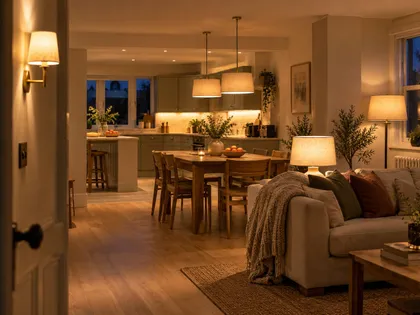
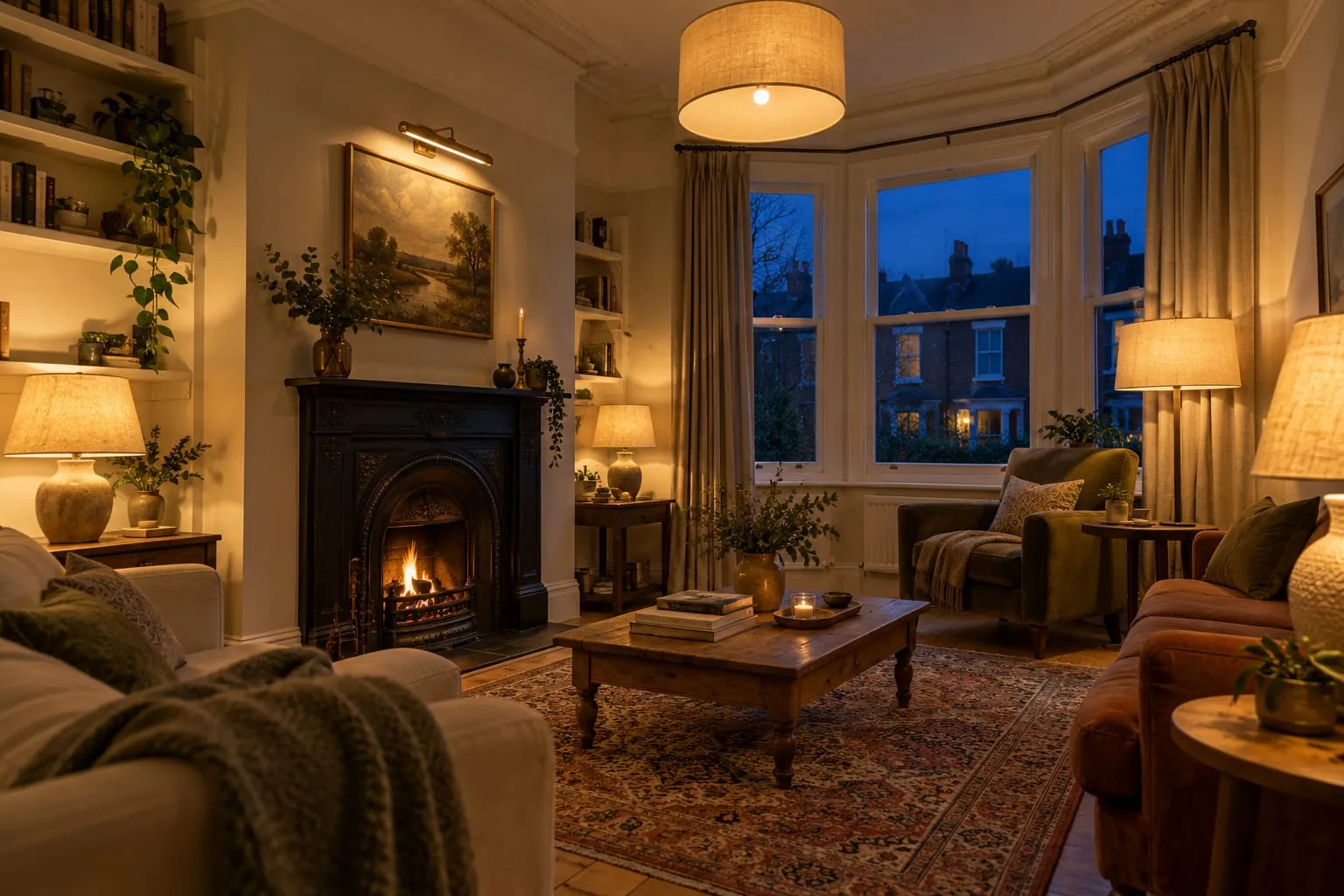
A living room should have the widest range of brightness in the house, so the total matters less than how it’s split. Put about half of it on the ceiling and the rest in lamps and wall lights at lower level, all dimmable. Warm white, 2700K to 3000K. The living room lighting guide covers placement.
Kitchen
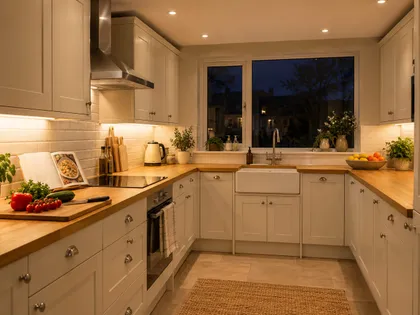
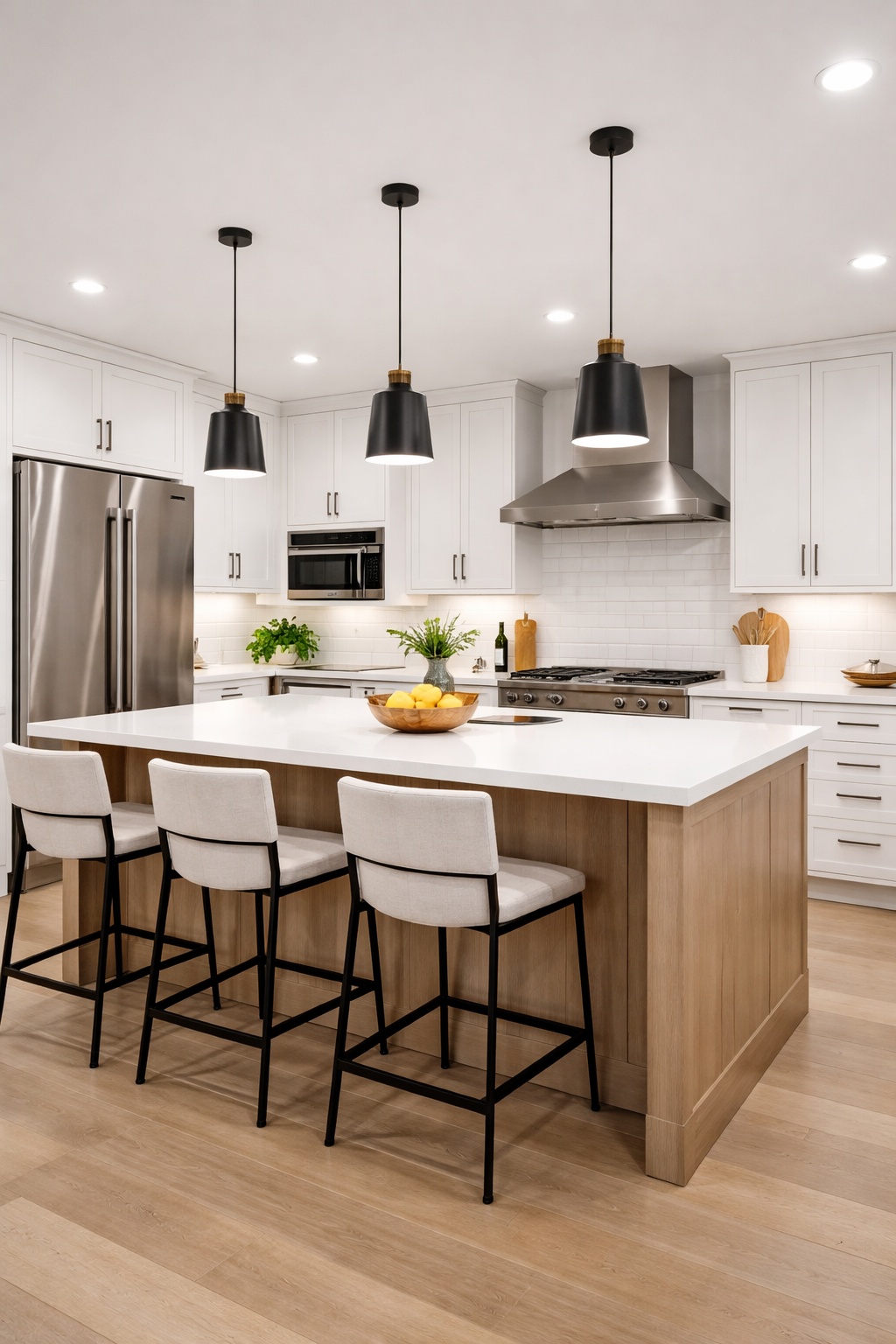
Kitchens need the most light, and it has to land on the worktops rather than the floor. Ceiling lights alone leave you working in your own shadow, so add under-cabinet lighting: LED strip at 400 to 600 lumens per metre is about right alongside downlights, or up to about 800 if it’s the main worktop light or the worktops are dark.
Bedroom
Bedrooms need less light than people think, and it should be soft. A ceiling light of around 800 to 1,000 lumens on a dimmer plus bedside lamps of around 470 lumens each covers a typical double bedroom. Avoid a single very bright bulb overhead; you’ll see it every time you lie down. There’s more on layering the light in my bedroom lighting ideas.
Bathroom
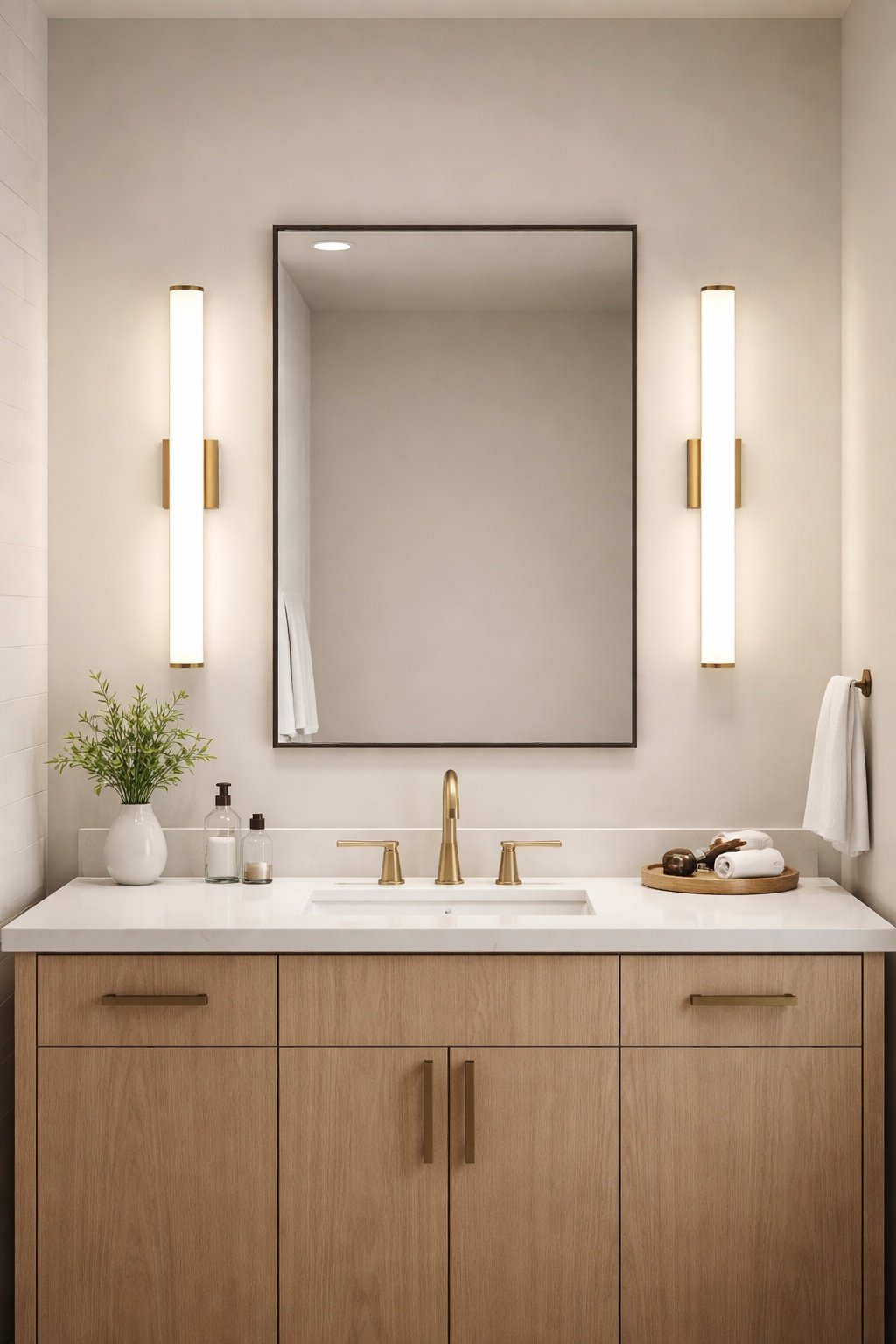
Bathrooms are small but need more light per square metre than you’d expect, because so much of it is about seeing your face clearly. Two or three IP-rated downlights plus a light at the mirror usually reach the total. The mirror light matters more than the downlights: light from either side of your face, not just above. Check the zones and IP ratings before you buy, explained in the bathroom zones guide.
Home office
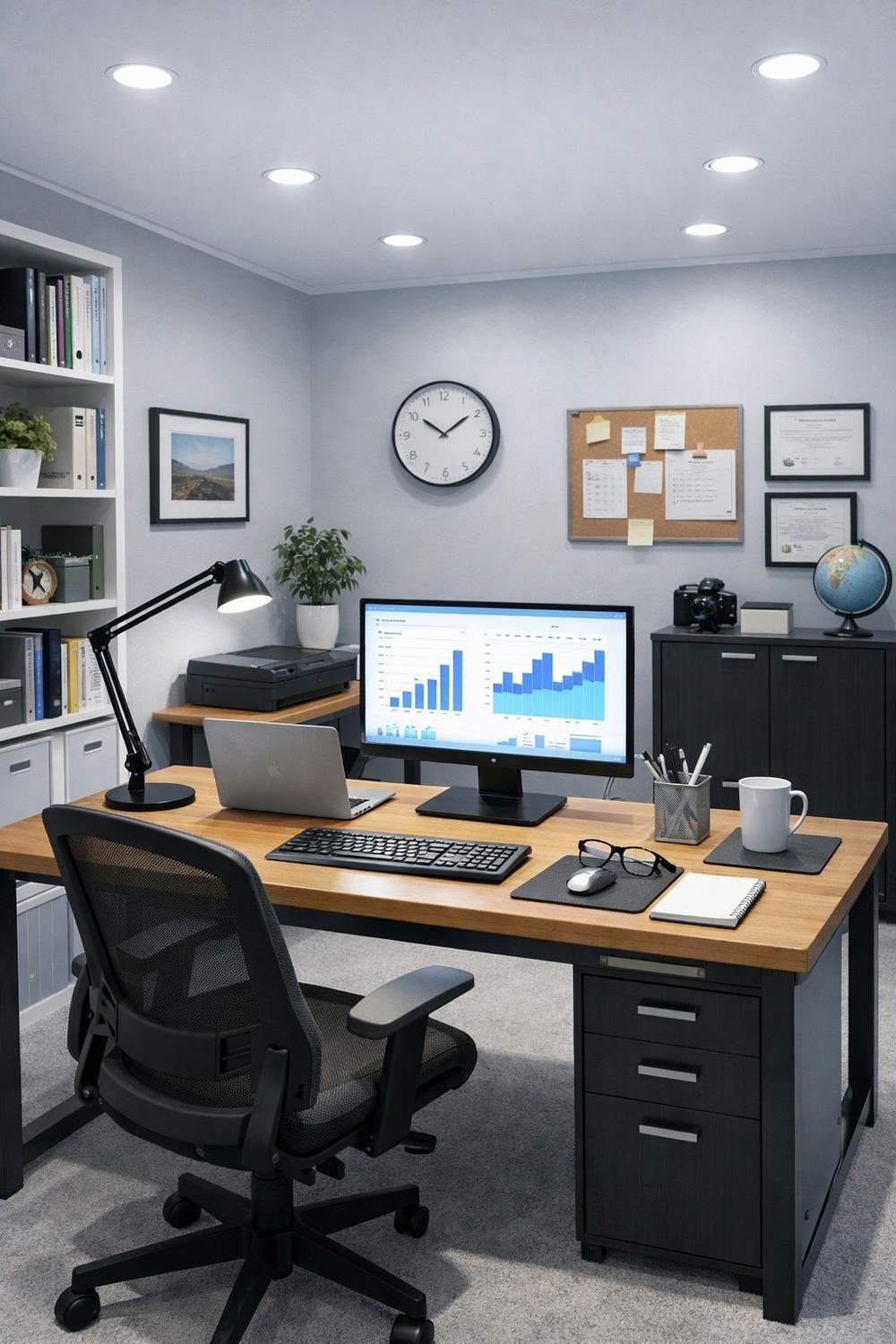
Aim for 300 to 500 lux on the desk itself. A desk lamp of 500 to 800 lumens does most of that; the ceiling lights only need to keep the rest of the room from feeling dark. Light coming from the side of the screen, rather than behind you, avoids reflections. The home office lighting guide covers desk lamps, bulbs and lighting for video calls.
Hallway and stairs
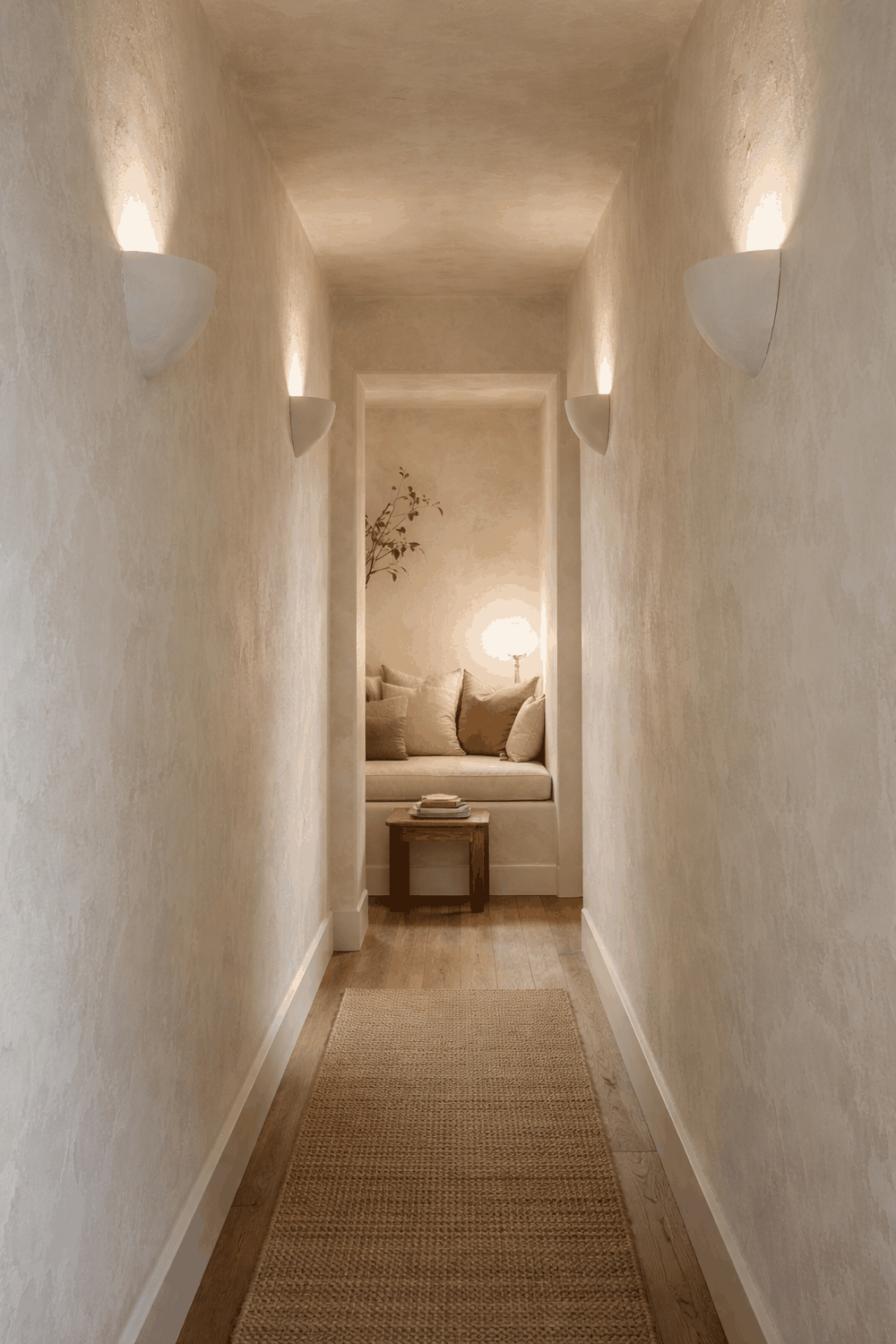
Halls don’t need much, but stairs need light that shows the edge of each step. A ceiling or wall light of 400 to 800 lumens on two-way switching is usually enough, with something low for night-time.
For how each room fits together beyond brightness, see the guide to lighting for every room.
What changes the number
Wall and floor colour make the biggest difference. White walls bounce most of the light back into the room; navy, charcoal or dark wood soak it up, which is where the extra 30% comes from.
Shades and diffusers lose light. The lumens on the box are what the bare bulb gives. Inside a thick fabric shade or frosted glass, less of that reaches the room, so go a step brighter.
Beam angle changes where the light goes, not how much there is. A narrow-beam spotlight puts its lumens on a small patch and leaves the space around it darker, which is great over an island and poor for general light.
Age matters too. Older eyes need noticeably more light to see detail, so if you’re buying for an older relative, aim for the top of each range and add good task lights.
Lumens by bulb type
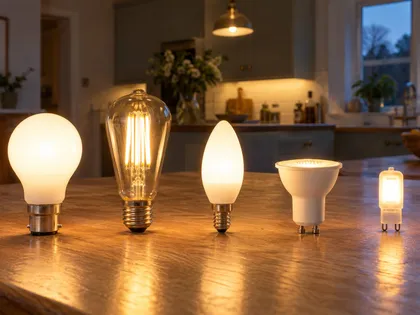
| Bulb or fitting | Common outputs | Good for |
|---|---|---|
| GU10 spotlight | 300–500 lm | Downlights, track, spotlights |
| Integrated downlight | 450–800 lm | Kitchens and larger rooms |
| E27 or B22 standard bulb | 470, 806, 1,055 or 1,521 lm | Pendants, ceiling lights, lamps |
| E14 or B15 candle | 250–470 lm | Chandeliers, wall lights, small lamps |
| LED strip | 150–300 lm/m accent, 400–600 lm/m task | Shelves, plinths, under cabinets |
For strip lighting in kitchens, the LED strip guide breaks it down by position. If you’re choosing bulbs, my picks are in the best LED bulbs guide.
Where lumen plans go wrong
The big one is a single bright ceiling light doing everything. It can hit the lumens target and still feel wrong: flat, glaring, with shadows in the corners. The same lumens from four or five sources at different heights feel far better.
Next is mixing brightness in one row. Three downlights at 400, 600 and 800 lumens look patchy, so keep bulbs in a group the same. Then there’s buying by watts, which no longer tells you anything about brightness, and forgetting task light. Ceiling lights rarely put enough light on a worktop, desk or mirror on their own.
Finally, no dimmers. A room lit for its brightest job is too bright the rest of the time. Fit LED-compatible dimmers and dimmable bulbs, and you can size for the top of the range without regret.
FAQs
How many lumens do I need for a living room?
About 100 to 150 lumens per square metre. For a 20 m² living room that’s 2,000 to 3,000 lumens in total, ideally split between a dimmable ceiling light and several lamps.
Is 800 lumens bright enough for a bedroom?
As the only light in a small bedroom of up to about 8 m², yes. A typical 12 m² double bedroom needs 1,200 to 1,800 lumens, so an 806-lumen ceiling bulb plus two bedside lamps of around 470 lumens gets you there.
How many lumens per square metre does a kitchen need?
About 250 to 400 lumens per square metre for general light, with more over the worktops. In practice that’s the ceiling lights plus under-cabinet lighting at 400 to 600 lumens per metre.
How many lumens is a 60 W bulb?
About 806 lumens. An LED giving the same light uses around 6 to 8 W.
Can you have too many lumens?
Yes. An over-lit room looks harsh and glary and is tiring to sit in. If you’re unsure, go slightly over the target and fit dimmers rather than buying very bright bulbs on a plain switch.
Does colour temperature change how bright a room looks?
It changes the colour of the light rather than the amount. Lumens tell you how much light; colour temperature tells you whether it looks warm or cool. More on that in the colour temperature guide.
 Save
Save it for later
Pin this guide to one of your Pinterest boards so it's there when you start the job.