Best LED bulbs UK: the light bulbs I'd buy for every fitting

Some links below are affiliate links: if you buy through them I may earn a small commission, at no extra cost to you. As an Amazon Associate I earn from qualifying purchases. How LightGuru makes money
This guide mentions Enso Lighting, a business I work with. I've flagged it wherever it comes up. More on that

Mike's quick answer
For most homes: Philips or Ledvance 806-lumen 2700K bulbs for ceiling lights and lamps, Philips CorePro or Osram Parathom GU10s for downlights, and Philips WarmGlow wherever there's a dimmer. Buy a whole room's worth from one brand so the colour matches.
There are thousands of LED bulbs on sale in the UK and most of them work. The difference between a good one and a cheap one shows up later: colour that doesn’t match the bulb next to it, flicker on a dimmer, or a bulb that fails in two years instead of fifteen.
My advice is to stick to the big lighting brands for anything you look at every day, choose by lumens and colour temperature rather than watts, and buy a full room’s worth at once. Below are the bulbs I’d buy for each type of fitting, plus dimmable, home office and smart picks. Prices are rough and move around, so treat them as a guide.
What to check before you buy
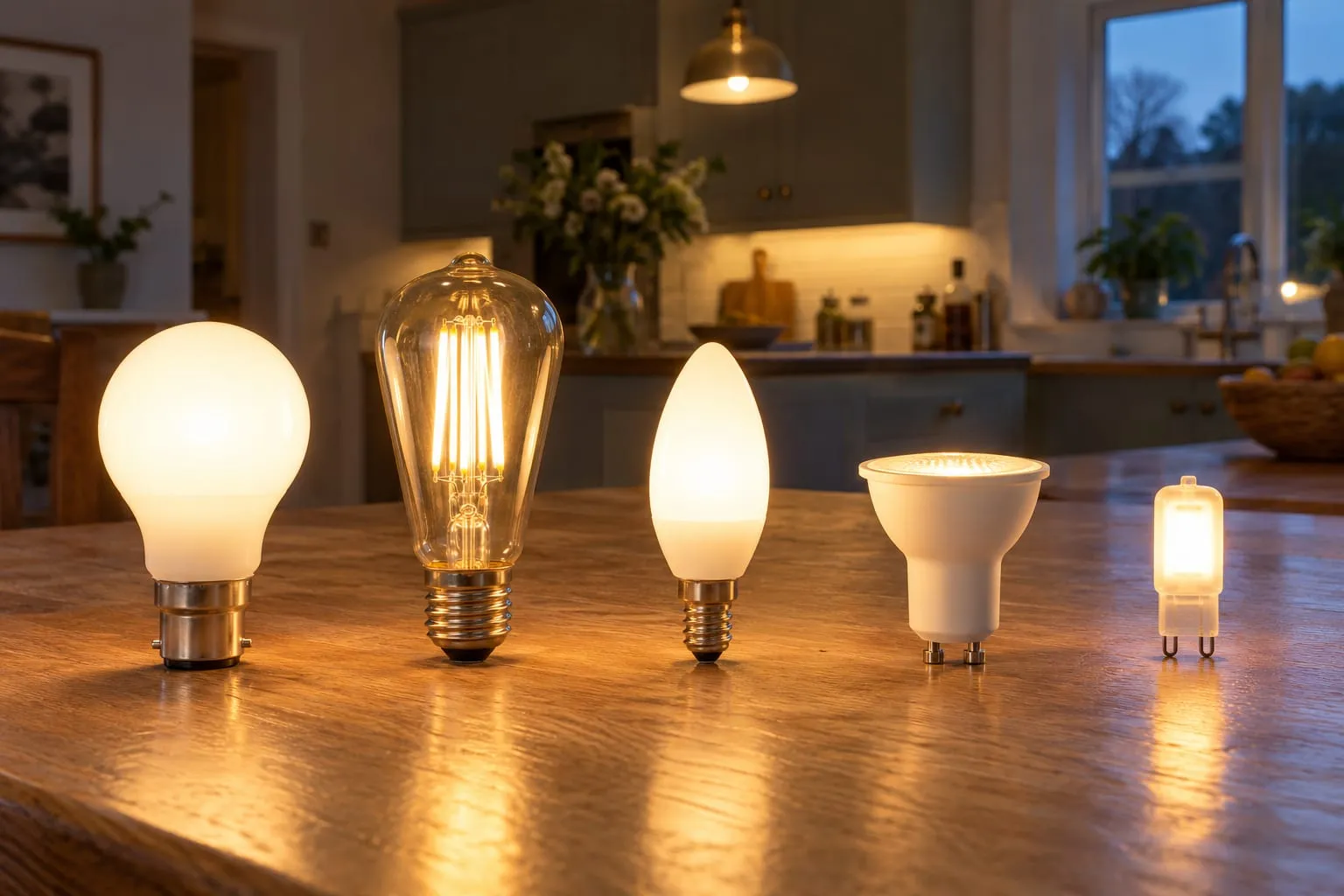
Start with the fitting. Take the old bulb out and look at the base. B22 is the standard UK bayonet, E27 the larger screw. Smaller fittings use B15 (small bayonet) or E14 (small screw). GU10 is the two-pin spotlight used in most downlights, and G9 is the tiny two-loop capsule found in many modern ceiling and wall lights. If you’re still not sure which one you’ve got, here’s how to identify your light bulb fitting.
Then look at three numbers on the box. Lumens are the brightness: 470 replaces an old 40 W bulb, 806 a 60 W and 1,521 a 100 W. Colour temperature is the colour of the light: 2700K is the warm white most living rooms suit, 3000K for most kitchens, 4000K for a crisper look and for desks. And CRI tells you how natural colours look: 80 is fine for most rooms, 90 or more is better where you look at food or faces.
Finally, check whether it says dimmable. Dimmable bulbs work on ordinary switches too, but non-dimmable bulbs on a dimmer will flicker or fail. If you’re not sure how bright to go, the lumens guide has room-by-room figures.

Standard bulbs: B22 and E27
These are the bulbs in most ceiling pendants and lamps, usually in the A60 shape, the classic pear-shaped bulb. For a typical room, an 806-lumen bulb is the everyday choice, and 1,055 or 1,521 lumens for a single pendant in a larger room.
The big names are worth the small extra cost here. Philips and Ledvance (the company behind Osram bulbs) are consistent from one pack to the next, which matters when you have several in one room. Philips also makes an Ultra Efficient range that gives the same light for about half the power of a standard LED. It costs more at the till but less to run, and it’s the one I’d choose for lights that are on for hours every evening.
Standard bulbs I'd buy
Affiliate linksLedvance’s own value packs are a sensible alternative if you’re doing a whole house on a budget. Whatever you pick, use the same bulb for every light in a room.
GU10 spotlights
GU10s are the bulbs in most downlights, track lights and spotlight bars. A good LED GU10 gives 300 to 500 lumens, and a 60° beam is the better all-rounder for general downlighting, because the pools overlap and spread the light evenly. A 36 to 40° beam is for picking out a worktop or a picture.
GU10s are also where the colour match between bulbs shows most, because you see six or eight of them in a row. Buy a full set from one brand and one batch. If you’re deciding between GU10 fittings and built-in LED downlights for a kitchen, GU10 vs integrated downlights compares the two.
GU10 bulbs I'd buy
Affiliate linksIf colour rendering is the priority, for a kitchen with lots of natural materials or over a bathroom mirror, Enso Lighting’s Nimbus Pro GU10 (I work with Enso Lighting) is a dimmable 6 W bulb rated CRI 97. The Osram Parathom above is the widely stocked alternative at CRI 90. More on why CRI matters in CRI vs colour temperature.
Candle, filament and G9 bulbs
Candle bulbs go in chandeliers, wall lights and small lamps, in E14 or B15. Around 470 lumens is the usual output, and frosted glass gives a softer light where the bulb is on show. Golf ball bulbs do the same job in a rounder shape for small shades.
Filament bulbs are for fittings where the bulb is part of the look: bare pendants, cage shades and clear glass lights. They give a warmer, more decorative light than a frosted bulb, and amber-glass versions go warmer still. For a properly candle-like glow, Enso Lighting’s Lumara spiral filament E27 (I work with Enso Lighting) runs at 1800K in amber glass; Philips also makes amber filament bulbs that are easy to find on the high street.
G9 capsules need one warning. LED G9s are often longer or fatter than the halogens they replace, so measure the space in the fitting before you order a set.
Candle, filament and G9 bulbs I'd buy
Affiliate linksBest dimmable LED bulbs
Dimming is where cheap LEDs let you down. A good dimmable bulb fades smoothly to a low glow; a poor one flickers, buzzes or drops straight from dim to off. Three things decide it: the bulb, the dimmer switch and how many bulbs are on the circuit.
The bulbs I’d buy for dimmers are Philips WarmGlow. They get warmer as they dim, from 2700K down to around 2200K, the way old filament bulbs did, so a dimmed room looks cosy rather than grey. For downlights, the Osram Parathom GU10 listed above is dimmable too.
The dimmer matters as much as the bulb. Most older dimmer switches were made for filament bulbs and are leading-edge types; LEDs want a trailing-edge dimmer. Keep every bulb on one dimmer the same make and model, or they’ll dim at different rates.
Dimmable bulbs I'd buy
Affiliate linksIf your lights already flicker, the flicker and buzz guide goes through the causes one by one.
Best light bulbs for a home office
For working, you want enough light on the desk, a colour that keeps you alert without feeling clinical, and no glare on the screen. That usually means 4000K neutral white for the desk lamp and ceiling light over the desk, 500 to 800 lumens in the desk lamp itself, and CRI 90 if you work with colour, such as photos, design or sewing.
I’d avoid 6500K daylight bulbs in a home office that’s also a spare room or part of a bedroom. They’re harsh in the evening and make the rest of the room look cold. If the room has to switch between work and rest, a tunable white smart bulb is the neat answer: cool white in the day, warm in the evening, on the same bulb. The colour temperature guide explains the difference between 4000K and 6500K. Bulbs are only part of it: the home office lighting guide covers desk lamps, layout and lighting for video calls.
Home office bulbs I'd buy
Affiliate linksSmart bulbs
Smart bulbs let you dim, change colour temperature and set schedules from your phone or voice assistant, without new wiring. They need power all the time, so leave the wall switch on and don’t put them on a dimmer.
Philips Hue is the most polished system and works with Alexa, Google Home and Apple Home; it’s at its best with the Hue Bridge. TP-Link Tapo and WiZ bulbs connect straight to Wi-Fi with no hub and cost far less, which makes them a good way to try smart lighting in one room. For kitchens, smart kitchen lighting scenes shows how scenes work in practice.
Smart bulbs I'd buy
Affiliate linksWhat LEDs cost to run
An LED giving 806 lumens uses about 6 to 8 W, against 60 W for the filament bulb it replaces. Taking electricity at 25p per kWh as a round figure (check your own tariff), a 60 W bulb on for three hours a day costs about £16 a year. An 8 W LED costs about £2, and a 4 W ultra-efficient one about £1.
Most LED bulbs are rated for 15,000 to 25,000 hours, which is roughly 14 to 23 years at three hours a day. Cheap bulbs often fade or fail well before their rating, often because the small driver inside runs hot, which is another reason to buy from a brand that will still be making the same bulb when you need a replacement.
FAQs
What are the best LED bulbs in the UK?
For everyday use, Philips and Ledvance standard bulbs in 806 lumens and 2700K. For downlights, Philips CorePro GU10s, or Osram Parathom if you want CRI 90. Philips WarmGlow is my pick wherever there’s a dimmer.
What are the best dimmable LED bulbs?
Philips WarmGlow for standard and GU10 fittings, because they dim smoothly and get warmer as they go down. Pair them with a trailing-edge LED dimmer and keep every bulb on that dimmer the same model.
What are the best light bulbs for a home office?
4000K neutral white bulbs with a CRI of 80 or more (90 if you work with colour), and a desk lamp of 500 to 800 lumens. A tunable white smart bulb suits an office that doubles as a bedroom or living space.
Why do my LED bulbs flicker?
Usually it’s the dimmer: an old leading-edge switch, or too few bulbs to meet its minimum load. Cheap bulbs with poor drivers flicker too. If non-dimmable bulbs flicker on a plain switch, try a bulb from a better brand before calling an electrician.
Can I use LED bulbs in enclosed light fittings?
Most are fine, but heat shortens an LED’s life, and some bulbs say on the box that they aren’t suitable for enclosed fittings. In a sealed bathroom or outdoor light, choose a bulb that says it is.
How do I get rid of old LED bulbs?
Don’t put them in the bin. LEDs contain electronics and go to the small electricals or light bulb recycling at your local recycling centre, and many larger DIY stores and supermarkets have collection points.
 Save
Save it for later
Pin this guide to one of your Pinterest boards so it's there when you start the job.