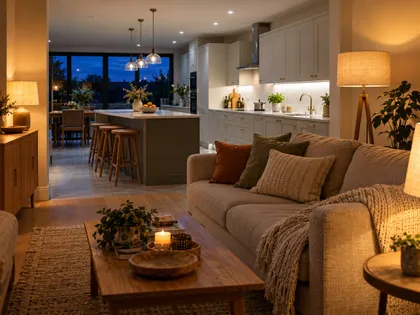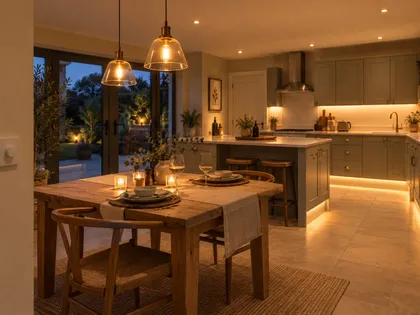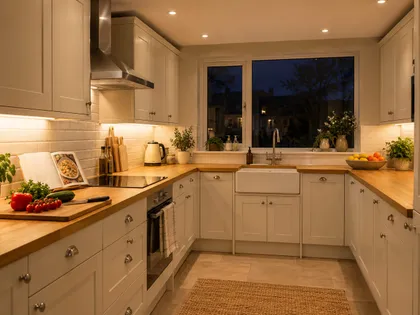
Best colour temperature for kitchen lighting: 3000K or 4000K?

Some links below are affiliate links: if you buy through them I may earn a small commission, at no extra cost to you. As an Amazon Associate I earn from qualifying purchases. How LightGuru makes money

Mike's quick answer
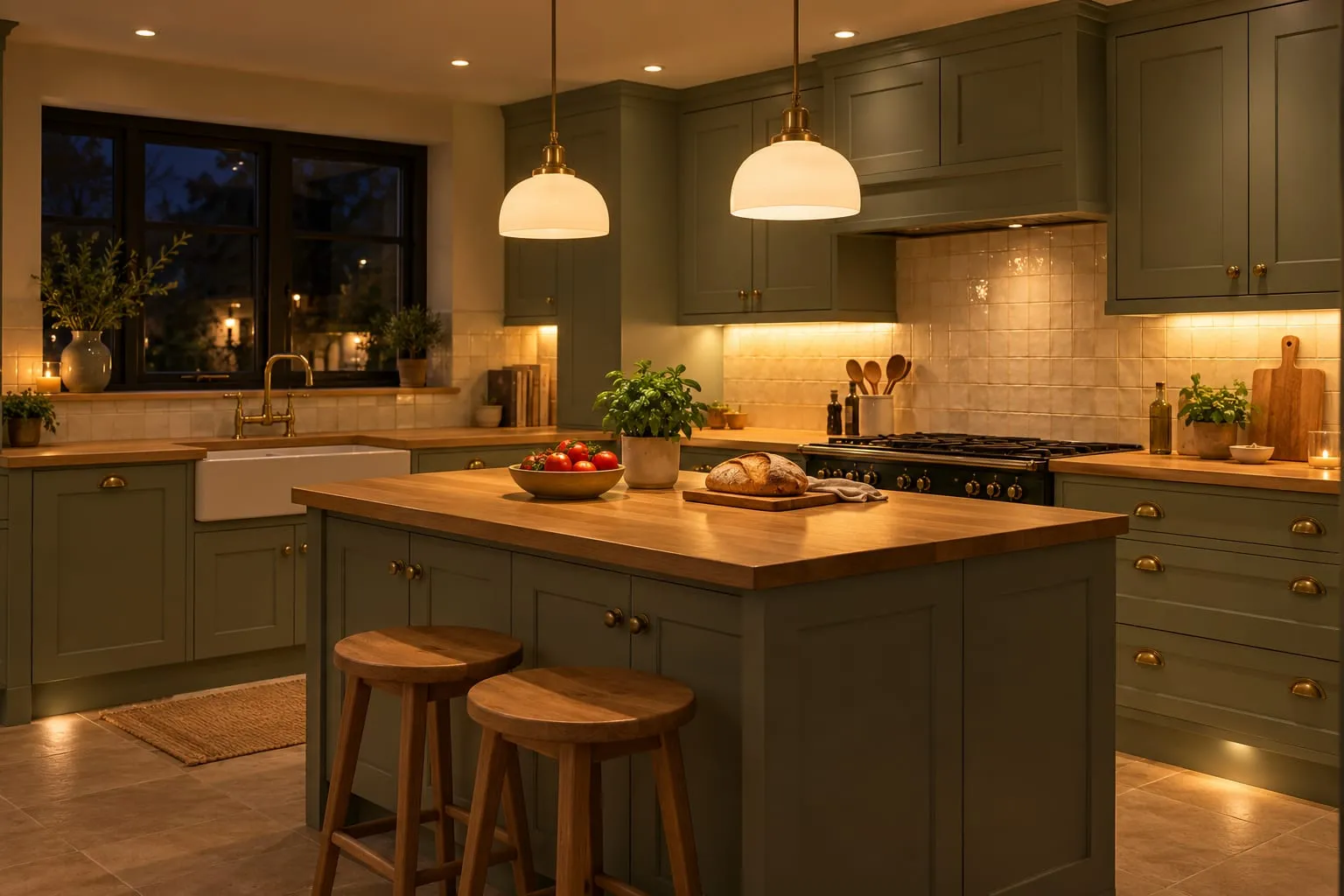
3000K is the best all-round colour temperature for most UK kitchens: warm enough to feel homely, clear enough to cook by. Choose 4000K if you want a crisper, modern look, keep the downlights and under-cabinet lights the same, and avoid 5000K to 6500K daylight bulbs.
Colour temperature is how warm or cool white light looks, measured in kelvin (K). Lower numbers are warmer and more yellow; higher numbers are cooler and bluer. Get it wrong in a kitchen and you notice it every evening: either the room feels like a shop, or the worktops look yellow and dull.
For most kitchens the choice comes down to 3000K or 4000K for the working lights, with something warmer for the pendants. What decides it is the look of your units, whether the kitchen opens onto a living space, and how you use the room once the cooking’s done.
3000K suits most kitchens
If you want one number, it’s 3000K. It’s warm enough to sit comfortably with the rest of the house and clean enough that food, worktops and paint colours look right. It’s also one of the most common colours for downlights, GU10s and LED strips, so matching a fitting later is easy.
4000K is the alternative. It’s a neutral, crisper white that suits bright white, grey and stainless kitchens, and people who want sharp light for cooking. The catch is the evening. In an open-plan room, 4000K can make the kitchen end feel like a separate, colder room from the sofa end.
Go below 3000K for pendants, the dining table and evening light. Go above 4000K, into the 5000K to 6500K “daylight” range, and most home kitchens look clinical and slightly blue; warm woods turn greyish and skin looks pale. I’d keep daylight bulbs for the garage.
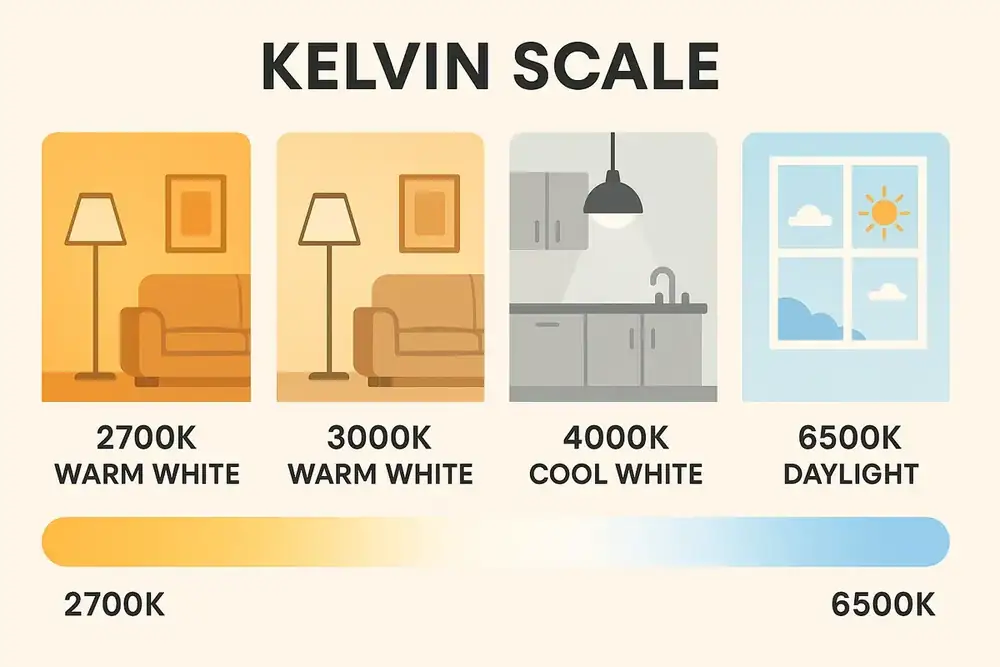
2700K, 3000K and 4000K compared
| 2700K | 3000K | 4000K | |
|---|---|---|---|
| Looks | Golden, like old bulbs | Warm but clean | Neutral and crisp |
| Suits | Traditional and cottage kitchens, wood | Almost any kitchen | Modern white, grey or stainless |
| Best used for | Pendants, dining, evenings | Downlights and worktops, all day | Downlights and worktops in a task-heavy kitchen |
| In the evening | Cosy | Comfortable | Can feel cold |
| Next to a living area | Matches lamps | Blends in | Can clash with warm lamps |
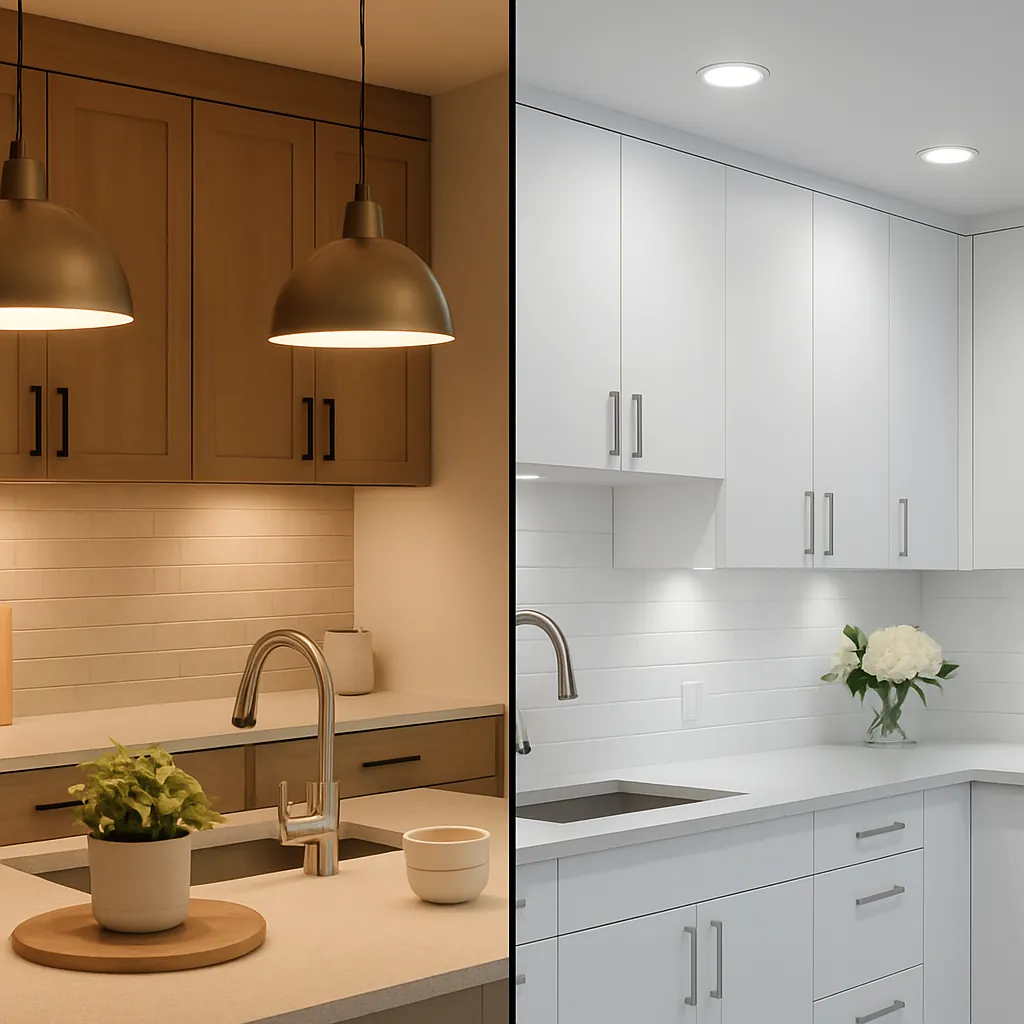
The difference between 3000K and 4000K is bigger than the numbers suggest. Side by side, 3000K reads as warm white and 4000K as a clear, slightly cool white. Between 2700K and 3000K the step is small; most people only see it with the two next to each other. If you want to see the colours on a screen first, the colour temperature selector is a quick way to compare them, and the basics are in warm vs cool white explained.
Which colour where
| Area | Colour temperature | Why |
|---|---|---|
| Ceiling downlights | 3000K, or 4000K for a crisp modern look | The main working light; sets the tone for the room |
| Under-cabinet lights | The same as the downlights | Both land on the worktop and splashback, so a mismatch shows |
| Island pendants | 2700K–3000K | Decorative and often used in the evening |
| Dining table | 2700K | Softer light for eating and sitting |
| Plinth and accent lights | 2700K–3000K | Background glow, mostly used in the evening |
| Inside glass cabinets | Match the downlights | Seen alongside the main lights |
The rule behind the table is simple: lights you see together on the same surface should match. The ones that are a separate layer, used at a different time of day, can go a little warmer.
Mixing warm and cool
You’ll often see advice to put 4000K or even 5000K under the cabinets with 3000K downlights, for “task” light. I wouldn’t. The strip and the downlights both land on the worktop and splashback, so you end up with a cool band under the cabinets and warm pools around it, and it looks like two different kitchens. Keep them the same, and if you need more light on the worktop, choose a brighter strip, not a cooler one.

Where you can mix is between layers. 2700K pendants over an island with 3000K downlights is an easy pairing, because the step is small and the pendants are often on when the downlights are dimmed. Bigger jumps, such as 2700K pendants with 4000K downlights, are more noticeable. They can work when the two are mostly used at different times, but with everything on, the pendants look orange against the ceiling.
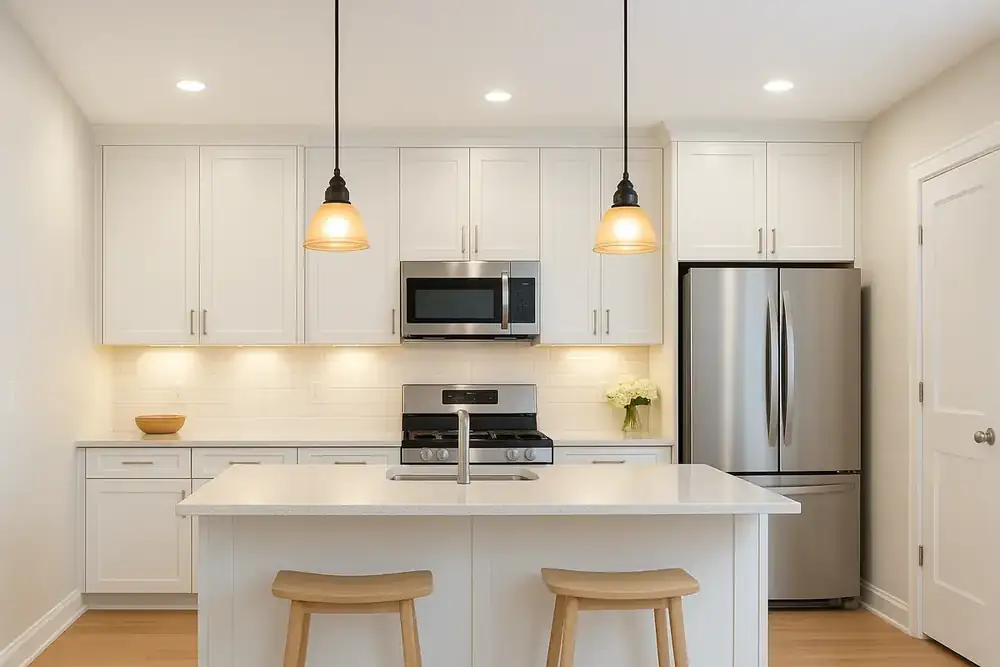
In an open-plan room, keep the kitchen and living areas close in colour. If the sofa end has warm lamps, 3000K in the kitchen sits with them; 4000K tends to divide the room. Open-plan kitchen-diner lighting covers the zoning side.
Match the colour to your kitchen
Wood, cream, sage green, navy and most shaker kitchens look best at 3000K, with 2700K pendants. The warmth brings out the timber and the paint, where 4000K can make warm colours look a little flat.
Bright white gloss, grey, concrete-effect and handleless kitchens can take either. 3000K softens them; 4000K keeps them sharp. If the kitchen is mostly for cooking and opens onto nothing, 4000K is a reasonable choice. If you live in it, 3000K is safer.
A kitchen with little daylight doesn’t need a cooler colour to feel bright. Brightness comes from lumens, not kelvin, so if a dark kitchen feels gloomy, add light rather than cooling it; how many lumens a kitchen needs has the numbers.
If you can’t decide
Colour-switchable (often sold as CCT) downlights have a small switch on the fitting, so you pick 3000K or 4000K when they go in. That’s handy if you’re undecided at the ordering stage, but changing it later means taking each fitting down.
Tunable white lets you change the colour whenever you like from an app, a switch or a voice assistant. Smart GU10s such as Philips Hue White Ambiance do this, so you can run 4000K for cooking and 2700K for dinner. Choice in integrated downlights is smaller, and the setup costs more.
Dim-to-warm fittings get warmer as you dim them, heading towards candlelight at the bottom of the range, much like an old halogen did. You don’t control the colour separately, but you get warm light in the evening without thinking about it. Scenes and tunable white are covered in smart kitchen lighting scenes.
Don’t forget CRI
Colour temperature is the colour of the light; CRI (colour rendering index) is how true it makes everything else look. For a kitchen, CRI 90 or above makes food, wood and paint look right, at any colour temperature. CRI vs colour temperature explains the difference.
What I'd buy
Affiliate linksFAQs
What Kelvin is best for kitchen lighting?
3000K for most kitchens. Choose 4000K if you want a crisp, modern look and the kitchen isn’t open to a living area lit with warm lamps.
Is 4000K too cold for a kitchen?
Not in a bright, modern kitchen used mainly for cooking. It can feel cold in the evening, and in an open-plan room it tends to clash with warm living-room lighting.
What colour temperature should under-cabinet lights be?
The same as your downlights, usually 3000K. A cooler strip under warm downlights shows up as a different white on the splashback.
Can you mix 3000K and 4000K in a kitchen?
Not on the same surface. Across different layers used at different times it can work, but keep the jumps small, and keep pendants and dining lights on the warm side.
Is daylight (6500K) good for a kitchen?
Not in a home kitchen. It looks clinical and blue, makes wood and warm paint colours look grey, and clashes with the rest of the house.
What colour temperature for kitchen pendants?
2700K to 3000K. Pendants are partly decorative and often used in the evening, so a slightly warmer white suits them.
 Save
Save it for later
Pin this guide to one of your Pinterest boards so it's there when you start the job.