How many lumens for a UK kitchen? Brightness by size and zone

Some links below are affiliate links: if you buy through them I may earn a small commission, at no extra cost to you. As an Amazon Associate I earn from qualifying purchases. How LightGuru makes money

Mike's quick answer
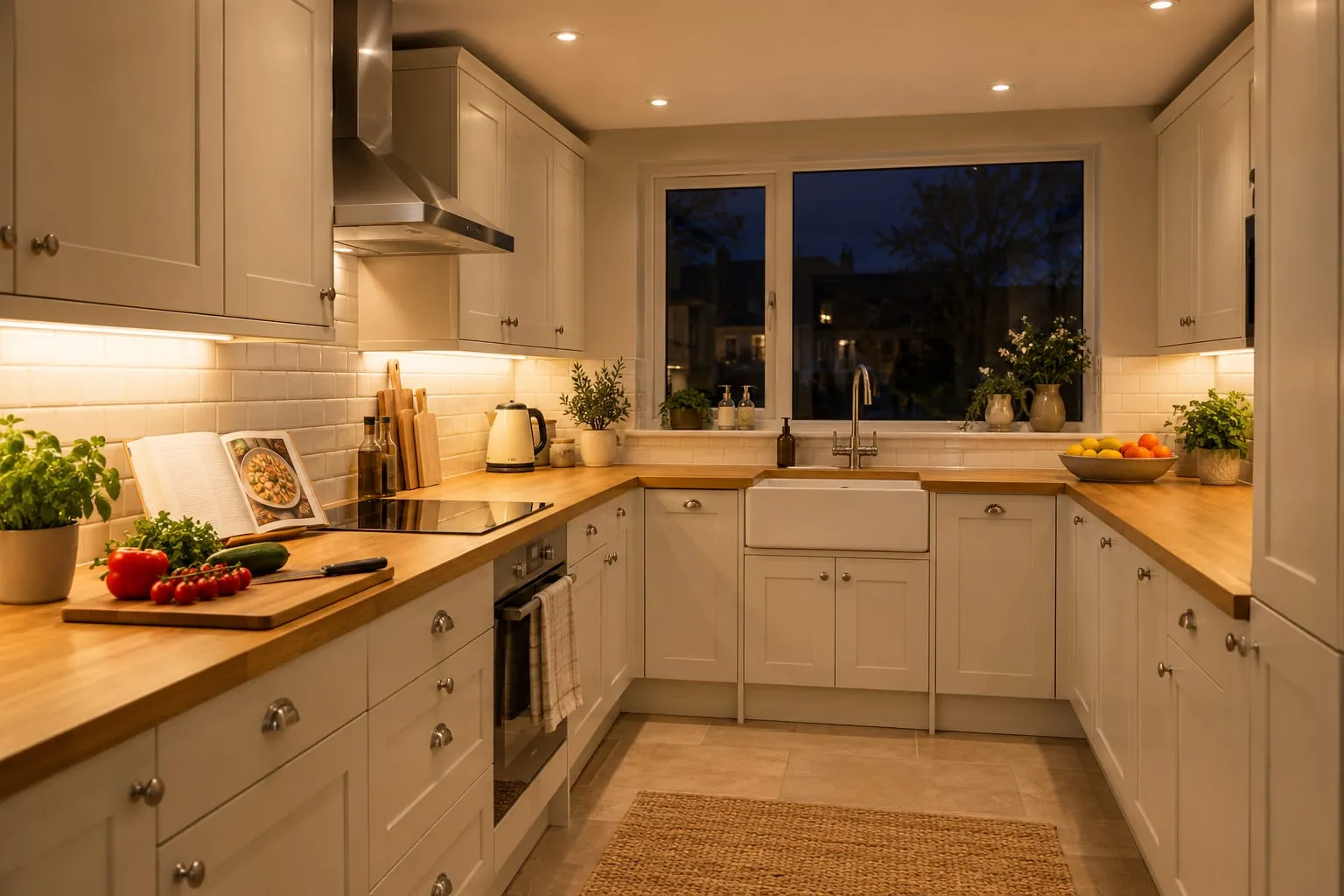
Allow about 300 lumens per square metre from the ceiling lights, so roughly 3,600 lumens for a 12 m² kitchen. Then add under-cabinet strips at 400 to 600 lumens per metre for the worktops. Go higher with dark units, and choose CRI 90 or above so food looks right.
Kitchens need more light than most rooms in the house. You’re working with knives and hot pans, checking whether the chicken is cooked and reading the small print on a packet. Yet plenty of kitchens end up lit to living-room levels, usually because the downlights were counted by eye rather than worked out.
The sum itself is simple: floor area times a lumens figure, then separate light for the worktops. Where you land in the range depends on the colour of your units, the size of the room and how much you cook.
How many lumens does a kitchen need?
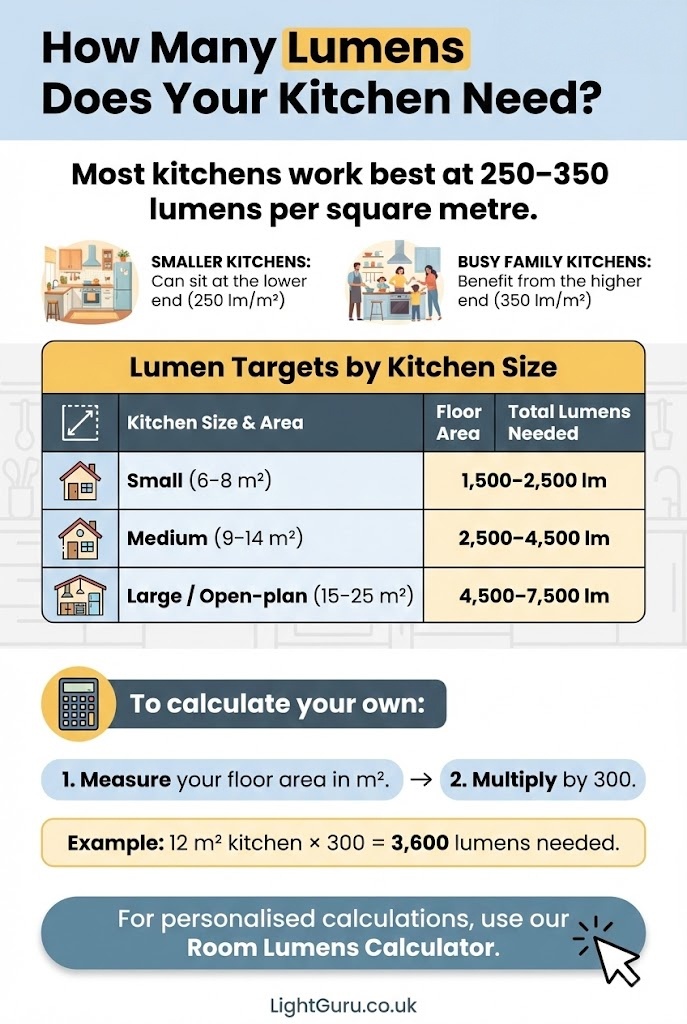
For the ceiling lights, I allow about 300 lumens per square metre. Use 250 in a small kitchen with good under-cabinet lighting, and 350 or so with dark units or if you cook a lot.
Floor area (m²) × 300 = lumens from the ceiling lights
A 12 m² kitchen (4 × 3 m) works out at about 3,600 lumens. That’s six 600-lumen integrated downlights, or eight or nine 400-lumen GU10s.
| Kitchen | Floor area | Lumens from ceiling lights |
|---|---|---|
| Small | 6–8 m² | 1,500–2,500 lm |
| Medium | 9–14 m² | 2,500–4,500 lm |
| Large, or the kitchen zone of an open-plan room | 15–25 m² | 4,500–7,500 lm |
That’s the base layer only. The worktops get their own light from under-cabinet strips, which adds another 1,200 to 2,400 lumens in a typical kitchen with 3 to 4 metres of worktop under wall units. So a 12 m² kitchen ends up with roughly 5,000 to 6,000 lumens in all. For other rooms, the room lumens calculator does the same sum.
Lumens, lux and watts
Lumens are the light a bulb or fitting puts out. Lux is the light that actually lands on a surface: one lux is one lumen spread over a square metre. Watts are just the power it uses.
The simple sum treats lumens as if they all land on the floor. They don’t. Some goes onto the walls, units and ceiling, and some is absorbed, which is why the figure is 300 lumens per m² rather than something lower. For a home kitchen, about 300 lux on the worktops is comfortable, and you don’t need a light meter to get there if you follow these numbers.
Ignore watts when you’re shopping. A good LED gives somewhere around 80 to 120 lumens per watt, so a 5 W GU10 gives roughly 400 lumens, about what an old 50 W halogen did. Two lights of the same wattage can differ a lot in output, so check the lumens on the box.
Brightness zone by zone
Ceiling lights
Downlights or a good flush fitting give the base light that fills the room. Put them over the front edge of the worktops rather than down the middle of the room, or a good share of those lumens lights the floor behind you. Spacing and positions are in the kitchen downlight layout guide.
Worktops
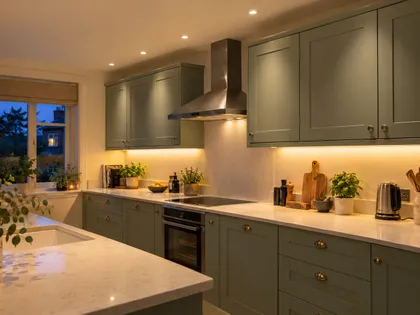
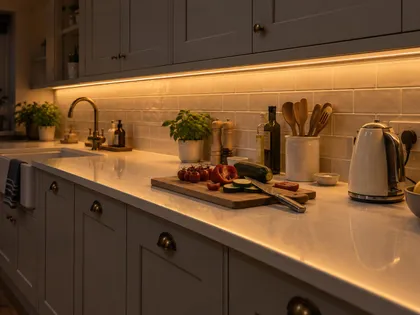
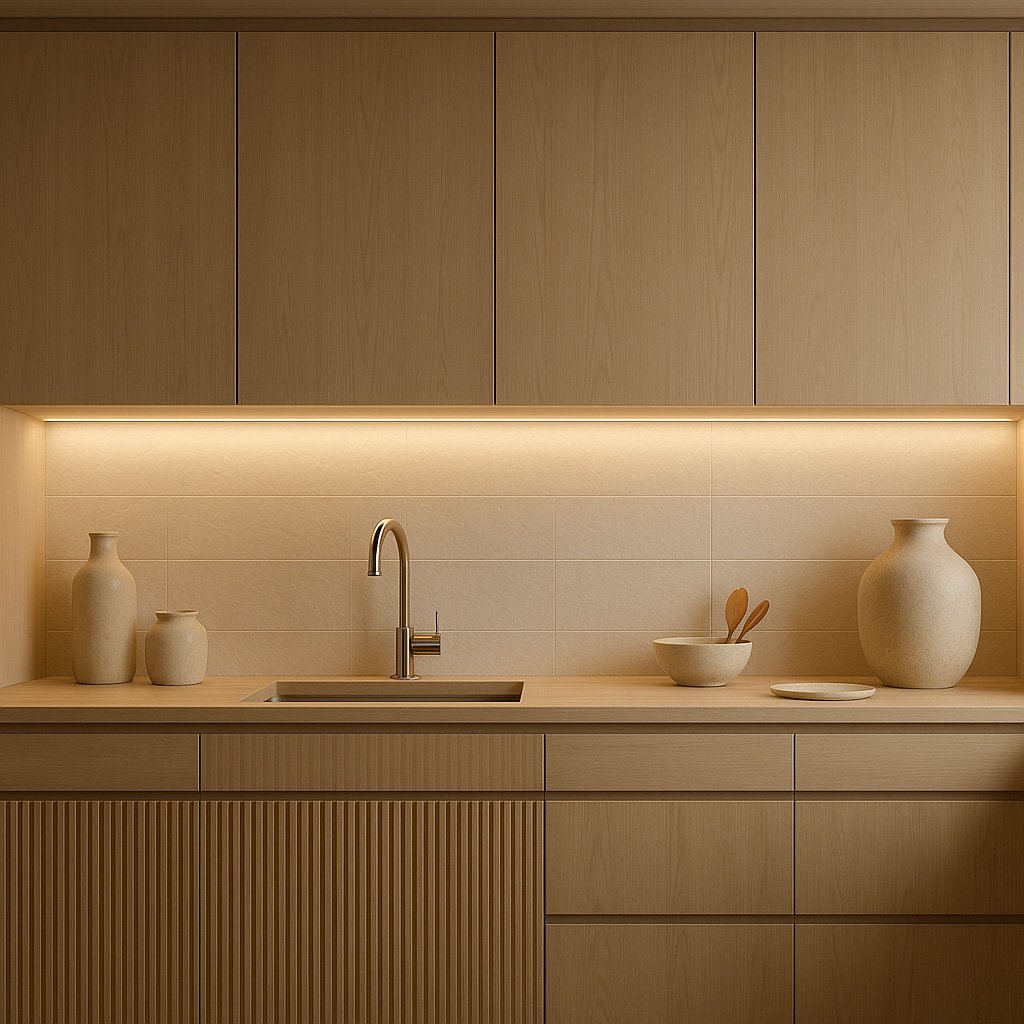
Under-cabinet lighting is the task light, and it’s the layer that stops shadows. Alongside ceiling downlights, 400 to 600 lumens per metre of strip is enough, because the light only has about half a metre to travel to the worktop. Go up to about 800 lumens per metre if the strip is the main worktop light or the worktops are dark. Fix them towards the front of the cabinet base so the light falls on the chopping board rather than the splashback, and use a diffuser so you don’t see a row of dots reflected in a gloss worktop. Shadow-free under-cabinet lighting covers the options.
Islands
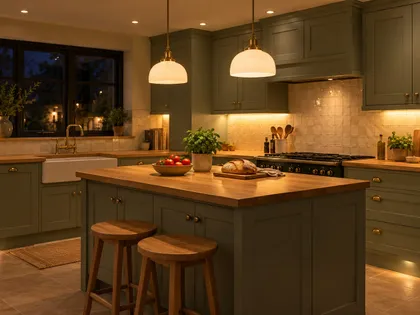
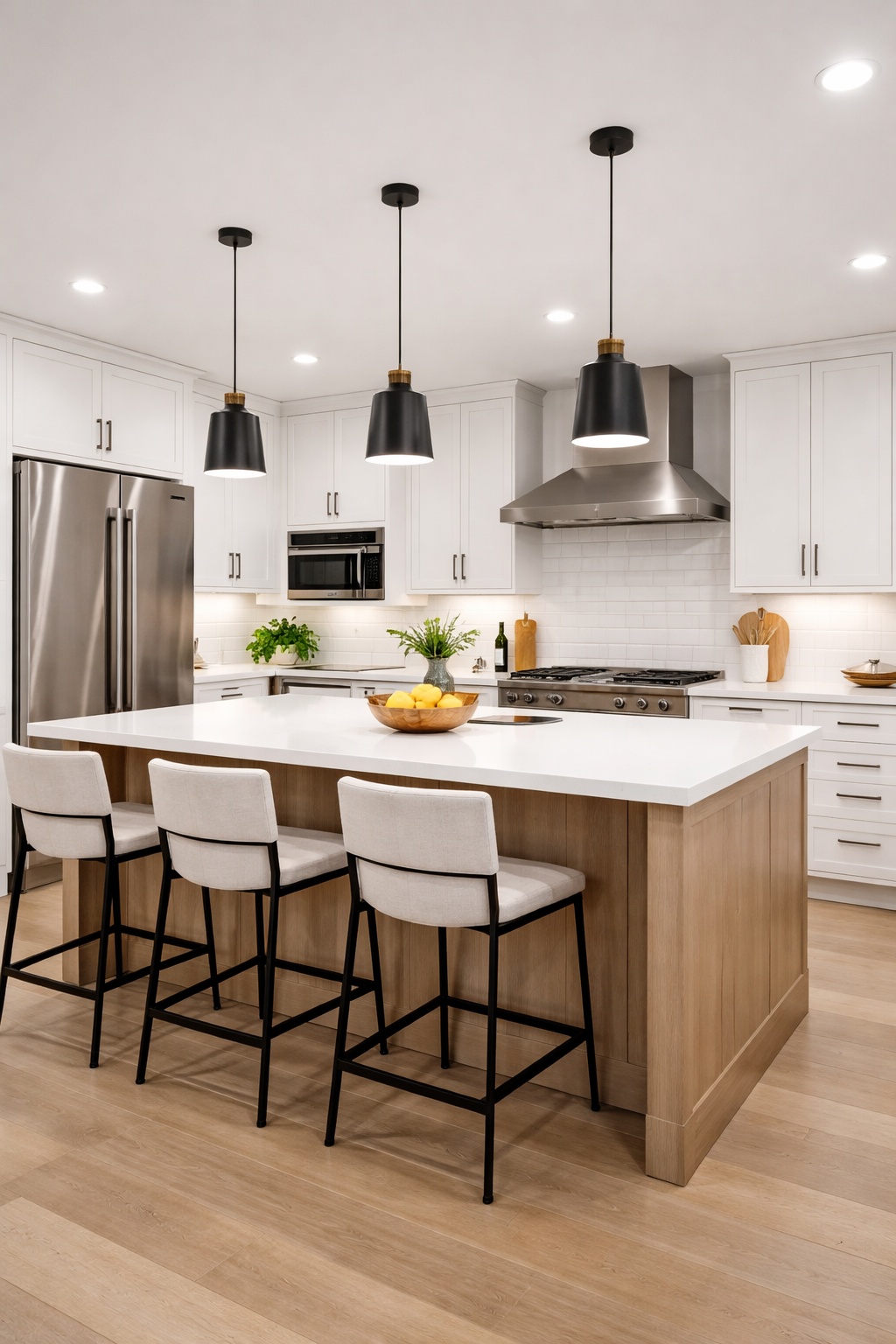
Pendants over an island are mostly about looks. Unless they’re open underneath and take bright bulbs, they won’t light a prep surface well on their own. If you prep at the island, put downlights over the working side and count them in the ceiling total, and keep the pendants on their own dimmer.
The dining end of an open-plan room
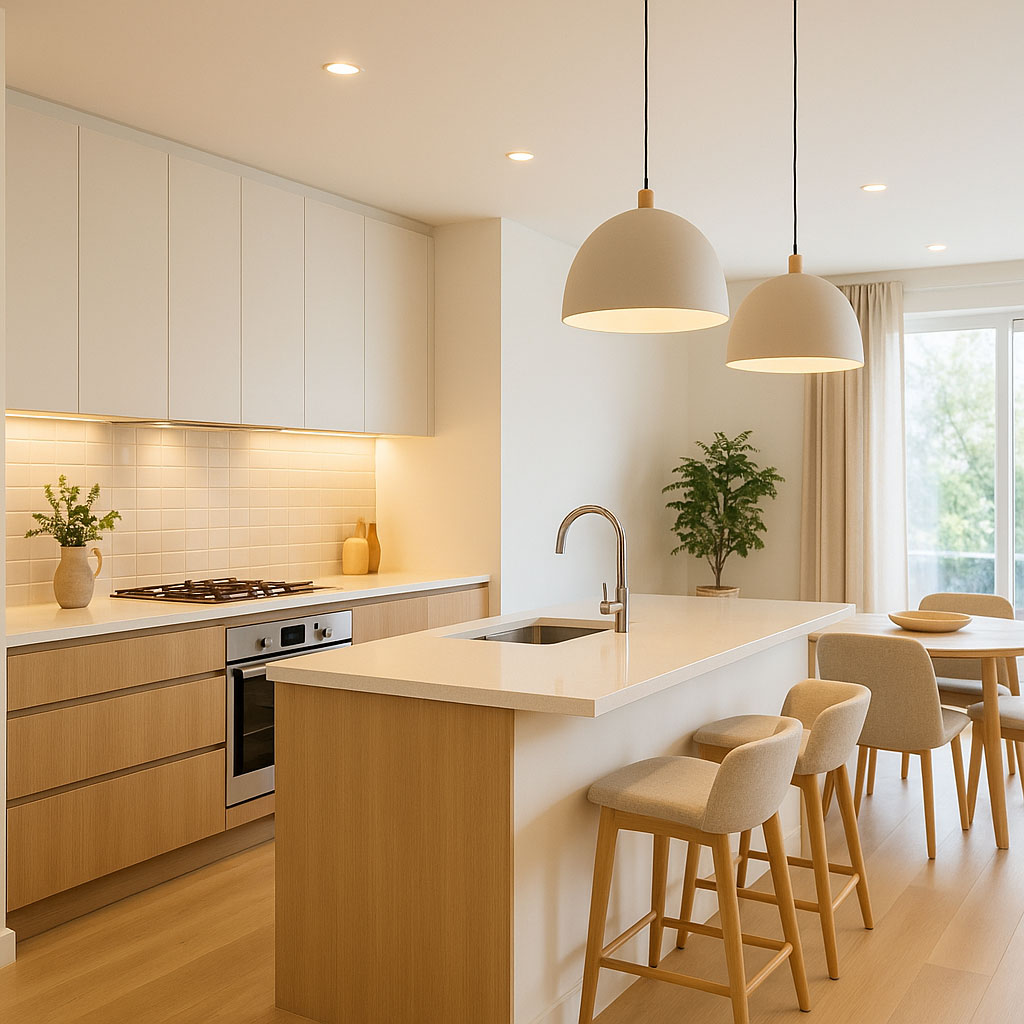
Count the dining area separately and don’t light it to kitchen levels. A pendant or two over the table, on a dimmer and in a warmer white, does the job, with the kitchen downlights turned down or off while you eat.
Examples by kitchen size
| Galley, 8 m² | Family kitchen, 12 m² | Open-plan kitchen zone, 20 m² | |
|---|---|---|---|
| Ceiling target | About 2,400 lm | About 3,600 lm | About 6,000 lm |
| Downlights | 4 × 600 lm, two lines of two | 6 × 600 lm | 10 × 600 lm, or 8 × 750 lm |
| Under-cabinet | Both worktop runs | Main prep run and the sink | Every run under wall units |
| Extras | None needed | Plinth lights on a separate switch, if you like | Pendants over the island and table, each on a dimmer |
In the galley, the strips matter more than the downlights. Two short lines of downlights over the worktops and strips under both runs give a bright, shadow-free room with only four fittings in the ceiling.
In the open-plan example, the kitchen zone gets its own downlights and switch, and the dining and living areas are lit separately. That way you can turn the kitchen down after dinner without plunging the whole room into darkness.
Which fittings get you there
| GU10 bulb | Integrated downlight | Under-cabinet strip | |
|---|---|---|---|
| Typical output | 300–500 lm | 450–800 lm | 400–600 lm per metre alongside downlights, up to about 800 as the main worktop light |
| For 3,600 lm of ceiling light | About 9 at 400 lm | About 6 at 600 lm | Not a ceiling light |
| Colour match | Can vary bulb to bulb | Consistent along a run | Consistent from one batch |
| Best for | Replacing old halogens, smart bulbs | New kitchens, fewer holes | Worktop task light |
Integrated fittings get you to the target with fewer holes in the ceiling, which is why I’d choose them for a new kitchen. GU10s are fine if your existing fittings are in the right places. The full comparison is in GU10 or integrated downlights.
Why it can still feel dark
The most common reason is position. Downlights down the middle of the room put the light behind you when you face the worktop, so you work in your own shadow however bright the fittings are.
Dark and matt surfaces are next. Navy, charcoal and black units, dark worktops and matt finishes absorb light that pale gloss surfaces would bounce back into the room. With a dark kitchen, aim for 350 lumens per m² or a little more and don’t skimp on the under-cabinet lighting.

Beam angle plays a part. Narrow downlights, under about 40°, make bright pools with dim gaps between them, so the room reads as patchy even when the total is right. For general kitchen light, 50 to 60° is better. Low ceilings make this worse, because the beams have less distance to spread before they reach the worktop; you need the fittings closer together or a wider beam.
Finally, a low CRI can make a well-lit room look dull.
Why CRI matters
CRI (colour rendering index) is how faithfully a light shows colours, on a scale up to 100. Most standard LED bulbs are CRI 80, which is fine in a hallway. In a kitchen it makes raw meat look greyish, tomatoes duller and wooden worktops flat. CRI 90 or above makes a visible difference.
Many good integrated downlights and LED strips are CRI 90 or higher. Some GU10s go further, such as the Philips Master ExpertColor GU10 at CRI 97, though it gives less light per bulb than a standard GU10, so you need more of them. There’s more in CRI vs colour temperature.
Colour temperature is a separate thing: a 3000K light and a 4000K light of the same lumens are equally bright. If you’re still choosing, the kitchen colour temperature guide covers it.
What I'd buy
Affiliate linksFAQs
How many lumens per square metre does a kitchen need?
About 300 from the ceiling lights, anywhere from 250 to 350 depending on the size of the room, the surfaces and how much you cook. The worktops then get under-cabinet task light on top.
How many lumens for a 10 m² kitchen?
About 3,000 from the ceiling: five 600-lumen downlights, or seven or eight 400-lumen GU10s. Add strips under the wall units for the worktops.
Is 3000K bright enough for a kitchen?
3000K describes the colour of the light, not how bright it is. A 3000K kitchen can be as bright as you like; brightness comes from the lumens.
Do dark kitchen units need more light?
Yes. Dark surfaces absorb light, so aim for 350 lumens per m² or a little more, and make sure the under-cabinet lighting is bright enough to carry the worktops.
Can a kitchen be too bright?
Yes, especially in the evening or in an open-plan room. Put the ceiling lights on a dimmer and on a separate circuit from the strips and pendants, so you can drop to a softer level once the cooking’s done.
What CRI should kitchen lights be?
CRI 90 or above for the downlights and worktop strips. Below that, food and natural materials look noticeably duller.
 Save
Save it for later
Pin this guide to one of your Pinterest boards so it's there when you start the job.