Patio lighting ideas for a British garden: what to use and where

Some links below are affiliate links: if you buy through them I may earn a small commission, at no extra cost to you. As an Amazon Associate I earn from qualifying purchases. How LightGuru makes money
This guide mentions Enso Lighting, a business I work with. I've flagged it wherever it comes up. More on that

Mike's quick answer
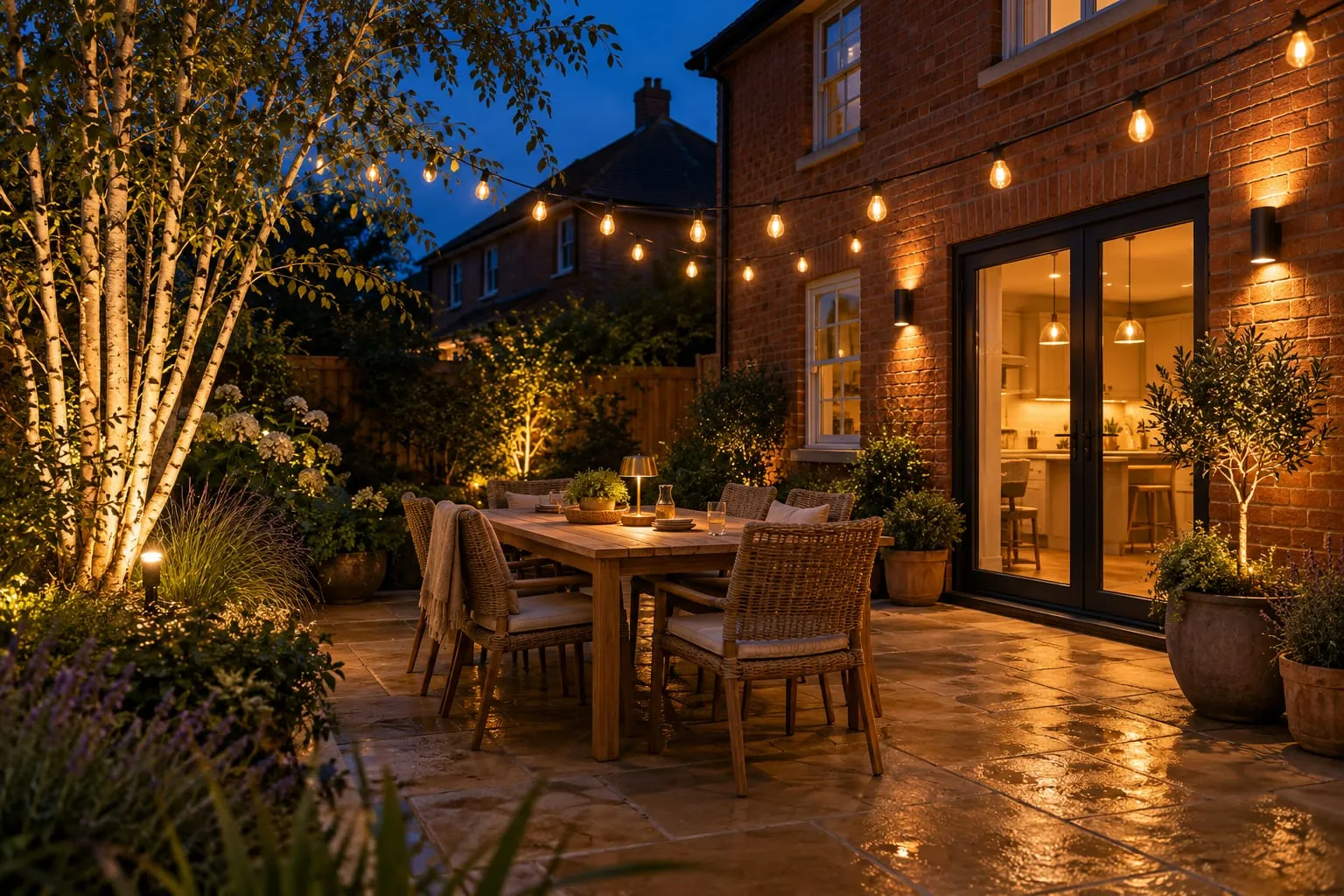
Start with a pair of warm white wall lights on the house, add festoon lights or a lamp over the table, then uplight one plant or tree beyond the patio. Keep everything at 2700K to 3000K, on a dimmer or separate switches, and IP65 for anything out in the rain.
A patio is an outdoor room, and it needs lighting the way a living room does: a few soft sources at different heights, not one bright light on the back wall. The single security floodlight that most houses come with is the worst way to light a patio. It flattens everything, throws hard shadows across faces and lights up the neighbour’s bedroom.
What you can do depends on two things: whether there’s power on the house wall already (or you’re willing to get an electrician in), and how you use the space. A patio for summer dinners needs different light from a small courtyard you mostly look at through the kitchen window.
Start with the house wall
If the patio sits against the house, the wall is your best light source. Two wall lights, one either side of the back door or spaced along the wall, give enough ambient light for most patios on their own.
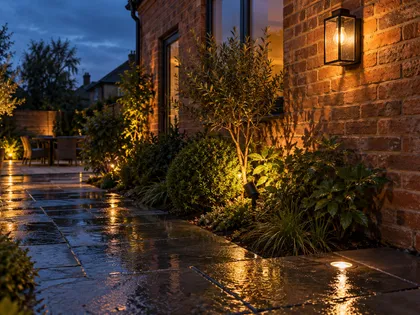
Up-and-down wall lights are the ones to look for. They throw a beam above and below the fitting, so you see two soft fans of light on the brick or render rather than a bright bulb. Mount them so the top of the fitting is around 1.8 to 2 metres up, and on a long wall space them every 2 to 3 metres so the fans of light almost meet. Downward-only lights are better right beside a window, where an upward beam would light up the room inside, and next to a neighbour’s wall. Around 300 to 600 lumens each is plenty.
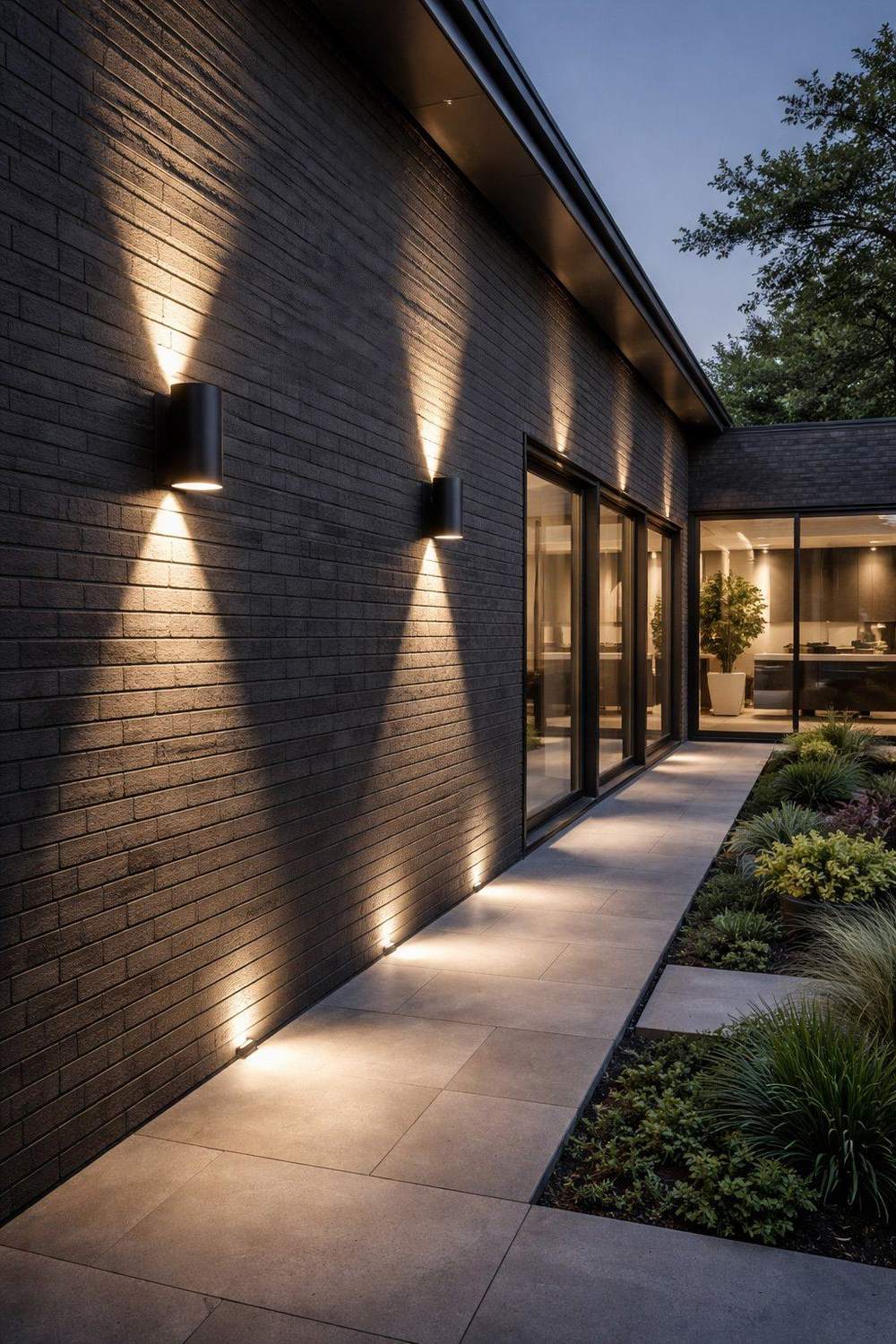
Anthracite, black and dark grey finishes disappear against most brick in the daytime. If you like that look, Enso Lighting’s Kyra up-and-down wall light in anthracite (I work with Enso Lighting) is one option; Endon, Saxby and Nordlux all make up-and-down wall lights in similar finishes, sold widely. Whichever you choose, check it’s IP44 at least, and IP65 if the wall takes driving rain. Wiring a new wall light outside is a job for an electrician (more on that below).
Put the wall lights on a switch inside the back door, separate from any security light, and fit a dimmer if the fittings are dimmable. Full brightness for clearing up, low for sitting out.
Festoon lights over the seating
Festoon lights strung over a dining table or seating area give the warm overhead glow that makes a patio feel like somewhere to stay. Because the light comes from lots of small bulbs spread along a cable, there are no harsh shadows, and it’s flattering for faces at the table.
Most plug-in festoon sets run at low voltage from a transformer, so the cable overhead is safe to handle. Look for shatterproof plastic bulbs rather than glass, warm white (around 2700K), connectable runs so you can add a second set later, and IP44 or better for the whole set including the transformer. Plug them into an RCD-protected weatherproof outdoor socket and, ideally, a smart plug or timer so they switch off without someone going outside. Sets from Lights4fun and Konstsmide are widely available; warm white connectable festoon lights cost about £30 to £80 for a 10 to 20 metre run.

Hang them high enough to walk under without ducking, roughly 2.2 metres or more, and let them dip in a gentle curve rather than pulling them tight. Zig-zag them between the house wall and a post or pergola, or run them along the edge of a pergola beam. There’s more on fixings, catenary wire and layouts in how to hang festoon lights in the garden.
Light the planting beyond the patio
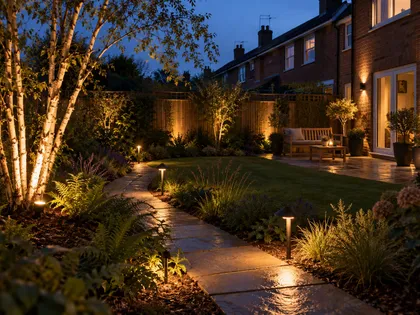
The trick that makes a small patio feel bigger is lighting something just beyond it. Uplight a tree, a large shrub or a clump of grasses at the edge of the garden and the eye travels out past the paving instead of stopping at the edge of the light.
One or two features is enough. A spike light at the base of a multi-stemmed birch or an olive tree, aimed up into the branches, makes a glowing backdrop to the whole patio. For a small tree or shrub, 200 to 500 lumens is plenty, and a narrow beam suits a tall, slim trunk. Aim it from the side the patio looks from, so you see lit bark and leaves rather than the light itself.
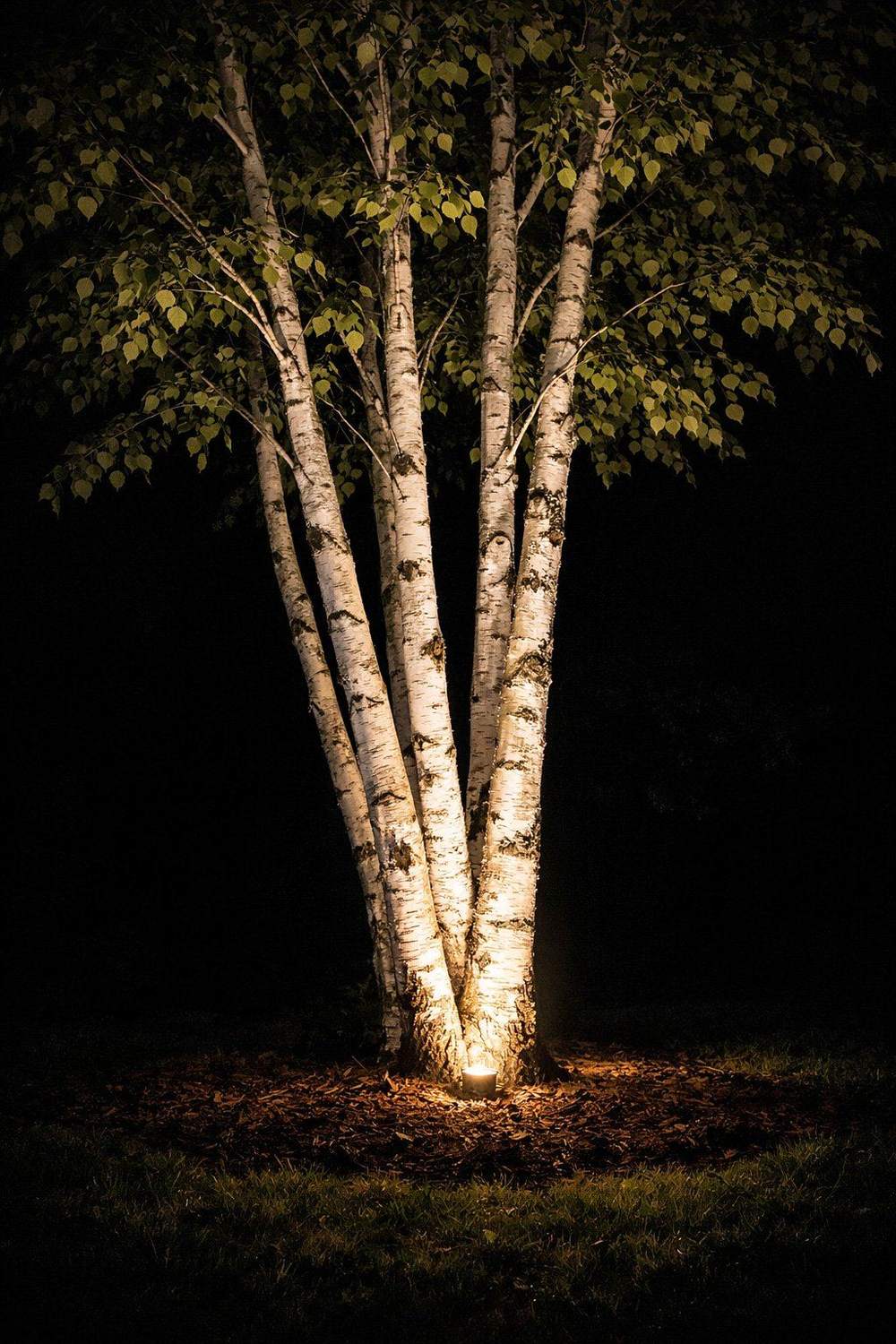
A low-voltage plug-in spike light kit is the easy way to do this without digging in mains cable: the transformer plugs into an outdoor socket and thin cable runs through the border. For borders right next to the patio, a few low path-style lights tucked into the planting give a soft edge. Solar spike lights can do this job in summer, but they’re dim and unreliable from October to March. There’s more on spacing and fittings in pathway lighting ideas, and on planning the whole garden in garden lighting ideas.
Lamps, lanterns and candles on the table
The light at table height is the one you notice most when you’re sitting outside. Rechargeable cordless table lamps have become the easy answer: they charge indoors, give a warm, dimmable glow for an evening, and come back in at the end of the night. Look for an IP44 rating so a shower doesn’t finish them off, and a battery that lasts a full evening at a useful brightness.
Floor lanterns do the same job at ground level, filling the corners of a patio and adding something to look at in the daytime. Woven or perforated ones throw patterned light across the paving.

Real candles, hurricane lamps and a fire pit add moving, flickering light that no LED quite matches. Keep naked flames well away from cushions, parasols and overhanging plants, and never leave them burning unattended. A fire pit should sit on paving or gravel with space for people to move around it.
Steps and level changes
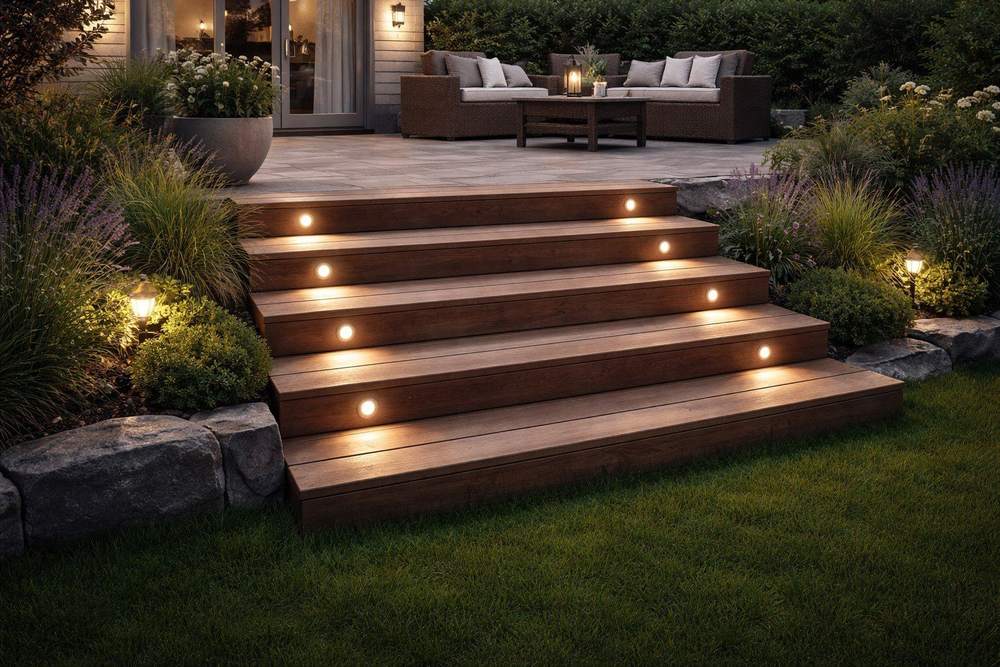
If the patio is raised or steps down to a lawn, light the steps. It’s the one patio light that is about safety rather than mood, and it makes the whole space look finished.
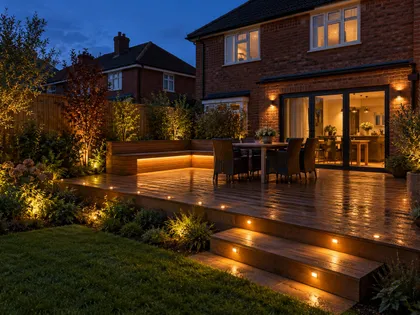
Small recessed lights in the risers, or set into the side walls, put a pool of light on each tread so you can see the edge. They only need to be dim, around 20 to 100 lumens each, on every tread or every other one on a longer flight. Fittings in the face of a riser should be IP65; anything set into a tread or the ground, where water sits, needs IP67. On timber steps and decks, low-voltage deck light kits are the simplest route, and deck lighting ideas covers them in detail.
Choosing how to power each light
Most good patios end up with a mix: mains wall lights, low-voltage festoons and uplights from an outdoor socket, and rechargeable lamps on the table.
| Mains wired | Plug-in low voltage | Rechargeable | Solar | |
|---|---|---|---|---|
| Good for | Wall lights, step lights | Festoons, spike lights | Table lamps, lanterns | Border accents |
| Brightness | Whatever you need | Plenty | Low to medium | Low |
| Winter use | Reliable | Reliable | Reliable if charged | Weak, often off by mid-evening |
| Who fits it | Electrician | You, into an outdoor socket | Nobody | You |
| Rough cost | £25–£60 per light plus fitting | £30–£150 per set | £20–£60 each | £10–£40 for a set |
If you don’t have an outdoor socket, getting one fitted is the single most useful patio upgrade. An electrician will typically charge somewhere around £150 to £350 for a weatherproof socket on the back wall, depending on how far it is from the consumer unit, and it opens up festoons, low-voltage spike lights and a smart plug without any more wiring.
Electrics and IP ratings
Outdoor sockets and outdoor lighting circuits need protection from a 30 mA RCD, which cuts the power almost instantly if current leaks through a damaged cable or a wet fitting. Most modern consumer units have this; older fuse boxes may not. NICEIC’s guide to gardens and electrics says every outdoor socket should be RCD-protected, and that’s the first thing to check before plugging anything in outside.
Wall lights, step lights and outdoor sockets wired at mains voltage are a job for a registered electrician. In England and Wales some outdoor electrical work, including any new circuit, is notifiable under Part P of the Building Regulations; a registered electrician self-certifies it for you. Plug-in low-voltage kits, festoons and solar lights are DIY.
For IP ratings, a wall light under a canopy or deep eaves can be IP44; exposed wall lights and spike lights should be IP65; anything set into the ground or a tread needs IP67. Festoons are usually IP44, which is fine outdoors, but if you plan to leave them up all year, check the maker says they’re suitable for permanent outdoor use. The details are in IP ratings for outdoor lighting, and if something keeps tripping the RCD after rain, see outdoor lighting faults.
Winter and the view from inside
From October to March you’ll see the patio far more from the kitchen or living room than from a chair outside. A dark patio turns the back windows into black mirrors that reflect the room back at you. A little light outside fixes that and makes the room feel bigger.
Leave one or two lights on a timer in the evening: an uplit tree or shrub, or the wall lights turned low. Evergreens, bare silhouetted branches and wet paving all look good lit in winter. Keep the brightest light away from the glass so it doesn’t reflect, and stick to the same warm white as the room inside so the two feel connected. The colour temperature guide explains why 2700K to 3000K works best.
Fixed fittings rated IP65 will stay out all year. Bring rechargeable lamps, battery lanterns and cushions in for the winter, and wipe solar panels and lenses clean when you put things back out in spring.
What I'd buy
Affiliate linksFAQs
What IP rating do patio lights need?
IP44 for a wall light under a canopy or deep eaves, and for festoons. IP65 for fittings fully exposed to rain, such as wall lights on an open wall and spike lights. Lights set into the ground or a step tread need IP67.
Is solar or mains better for a patio?
Mains or plug-in low voltage for the lights you rely on, like wall lights, festoons and step lights, because they work every night of the year. Solar is fine for extra accents in the borders, but on grey winter days many solar lights only manage a few hours.
How high should outdoor wall lights be?
Around 1.8 to 2 metres up to the top of the fitting, so it sits just above eye level. Beside a door, line them up with the top of the door frame or a little below. On a long patio wall, space them every 2 to 3 metres.
Can I leave patio lights out all winter?
Fixed lights rated IP65 or above are built to stay out. Bring in rechargeable lamps, battery lanterns and anything rated below IP44 to protect the batteries and finishes.
What colour light is best for a patio?
Warm white, 2700K to 3000K. It flatters stone, timber, planting and faces. Cool white (4000K and above) makes a patio look like a car park.
Do I need planning permission for patio lights?
Not for normal domestic lighting. If the house is listed, check with the council before fixing anything to the walls. Either way, aim lights down and away from neighbours’ windows to avoid a nuisance complaint.
 Save
Save it for later
Pin this guide to one of your Pinterest boards so it's there when you start the job.