Festoon and string lights for the garden: how to hang them and which to buy

Some links below are affiliate links: if you buy through them I may earn a small commission, at no extra cost to you. As an Amazon Associate I earn from qualifying purchases. How LightGuru makes money

Mike's quick answer
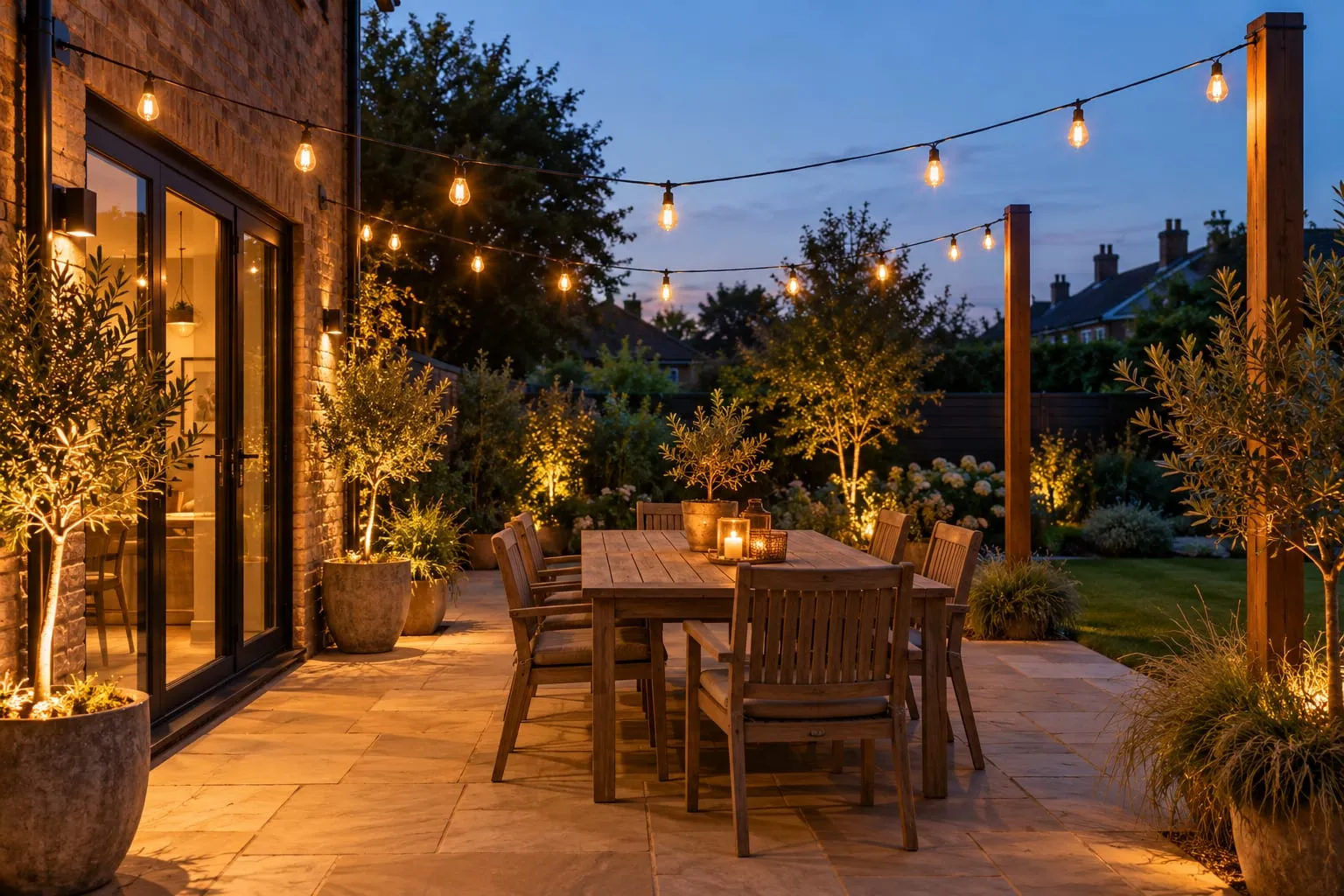
Hang festoon lights from a tensioned steel catenary wire, not their own cable, fixed into solid masonry or sturdy posts rather than a gutter, with the lowest point about 2.2 metres or more up where people walk. For most gardens, a low-voltage connectable set with shatterproof, very warm white bulbs, plugged into an RCD-protected socket, is the safe and easy choice.
Festoon lights do more for a patio than almost anything else you can plug in. A row of warm bulbs overhead turns a table outside into somewhere you stay after dark, and the light is soft and flattering because it comes from lots of small sources rather than one bright one.
What lets most sets down is how they’re hung. Strung straight off their own cable and tied to a gutter, they sag lower every week until a gale pulls them down. Hung from a tensioned wire between solid fixings, almost any decent set looks neat and lasts for years.
Beyond that, the choice comes down to how you’ll power them (a plug-in low-voltage system or mains), how far you need to span, and whether they’re up for a summer or all year round.
Festoon, string or fairy lights
“Festoon” and “outdoor string lights” mean the same thing in most shops: a cable with bulbs spaced along it, made to hang overhead. Fairy lights are something different.
| Festoon, replaceable bulbs | Integrated LED festoon | Fairy and micro lights | |
|---|---|---|---|
| Look | Proper bulbs, filament or frosted | Bulb-shaped LEDs sealed to the cable | Lots of small points of light |
| When a bulb fails | Swap the bulb | Replace that length | Replace the set |
| Power | Low voltage or mains | Usually low voltage | Low voltage, battery or solar |
| Best for | Over a table, long-term installs | Easy plug-in canopies | Trees, fences, pergola beams |
Festoons with replaceable bulbs have a holder every so often along the cable, and the bulbs screw in. On mains festoon the holders are usually standard E27 screw caps (the bulb fittings guide explains the codes); low-voltage sets with replaceable bulbs need spares from the same maker. If one bulb fails or gets broken, you swap it, and you can change the look later with different bulbs.
Integrated LED festoons have the LEDs sealed into bulb-shaped covers moulded onto the cable. They’re lighter and usually cheaper, and the better ones are well sealed against the weather. When a bulb goes, you replace that length, which is why connectable sets sold in 5-metre lengths make sense.
Fairy and micro lights, with dozens or hundreds of small LEDs, are for wrapping a tree trunk, running along a fence top or weaving through a pergola. They add sparkle, but they don’t give the overhead glow over a table that festoons do.
Low voltage or mains
For most gardens, a low-voltage connectable system is the one to buy. A transformer at the plug end turns mains into a safe extra-low voltage, often 24 V or 31 V, so the cable over your head carries only that. Each length is typically 5 metres with 10 bulbs, and the lengths join with sealed connectors. Lights4fun and Festive Lights both sell their connectable festoons this way.
One transformer can only run so many lengths. Festive Lights’ ConnectGo festoons, for example, run two lengths from the small transformer and up to 20 from the largest, so check the figure before you plan a long run. Connectors usually only fit the same maker’s range, so buy the extra lengths from the same system. A plug-in set of 10 to 20 metres costs about £30 to £80; the premium connectable ranges are more like £45 to £60 for each 5-metre length.
Read the box carefully: a set described as “mains powered” often just plugs in through a low-voltage transformer, which is fine. True mains festoon, the kind event companies and pubs use, is rubber cable at 230 V with a lampholder every 50 cm or every metre, often running for tens of metres from one supply. It’s tough and lasts, but the cable over your head is at mains voltage. To be safe outdoors, a mains festoon needs:
- rubber-sheathed cable made for outdoor use (H05RN-F, or the tougher H07RN-F), not PVC flex
- lampholders rated IP65, with their rubber seals in place and a bulb in every holder
- shatterproof LED bulbs, hanging downwards so rain runs off
- a catenary wire carrying the weight, with the cable anchored at each end so no load falls on a connector
- weatherproof connectors and plugs (some kits use 16 A industrial plugs, which need a matching outlet)
- a 30 mA RCD on the supply
A mains festoon kit that comes with a proper outdoor-rated plug, plugged into an RCD-protected outdoor socket, is something you can hang yourself. Wired permanently into the house, it’s a job for a registered electrician, and a new circuit in England is notifiable under Part P of the Building Regulations.
IP ratings: lights, connectors and transformer
Check three ratings, not one. The lights should be IP44 at least, which handles rain. For a set that’s out in the open all season, or up all year, IP65 is the better buy. The IP ratings guide explains the numbers.
The connectors are where water usually gets in. Good systems use screw connectors with rubber seals, and some ranges now have IP67 connectors; Lights4fun’s Pro Connect festoons are one. Screw every joint fully home, keep joints off the ground, and never leave an open connector at the end of a run without its cap.
The transformer is the part people forget. Many are rated IP44 for outdoor use, but some are for indoor use only and have to stay inside. Electrical Safety First’s advice on Christmas lights, which applies just as well to any plug-in string lights, is to keep the plug and transformer indoors even when the lights are rated for outdoor use. If yours has to live outside, it must be outdoor-rated, and it should hang somewhere sheltered and off the ground, never in a puddle on the patio.
Bulbs: shatterproof and very warm
Choose shatterproof plastic bulbs rather than glass. Festoons get knocked by parasols, ladders and branches, and a glass bulb dropped onto paving leaves splinters where people walk barefoot in summer. Good shatterproof filament bulbs look almost the same as glass Edison bulbs once they’re lit.
I’d go very warm. Bulbs around 2200K give the amber, candle-like glow that suits festoons best; 2700K is a little whiter and matches warm white wall lights, so either sits well on a patio. Cool white looks harsh overhead and turns a patio into a car park. If you have wall lights too, the patio lighting guide covers how to layer them.
Festoon bulbs are deliberately dim. A typical LED filament festoon bulb uses about 1 watt and gives under 100 lumens, roughly a tenth of an ordinary household bulb, so twenty of them over a table is plenty for eating outside and nothing like a floodlight. If you want more light, add bulbs rather than buying brighter ones, or the run starts to glare.
How to hang festoon lights
Use a catenary wire
Festoon cable isn’t built to carry its own weight across an open span. Left to hang from two hooks, it stretches, the bulbs swing in every gust and the strain ends up on the connectors. The fix is a catenary wire: a thin steel wire rope, tensioned between two solid fixings, that carries the load while the festoon is tied along it.
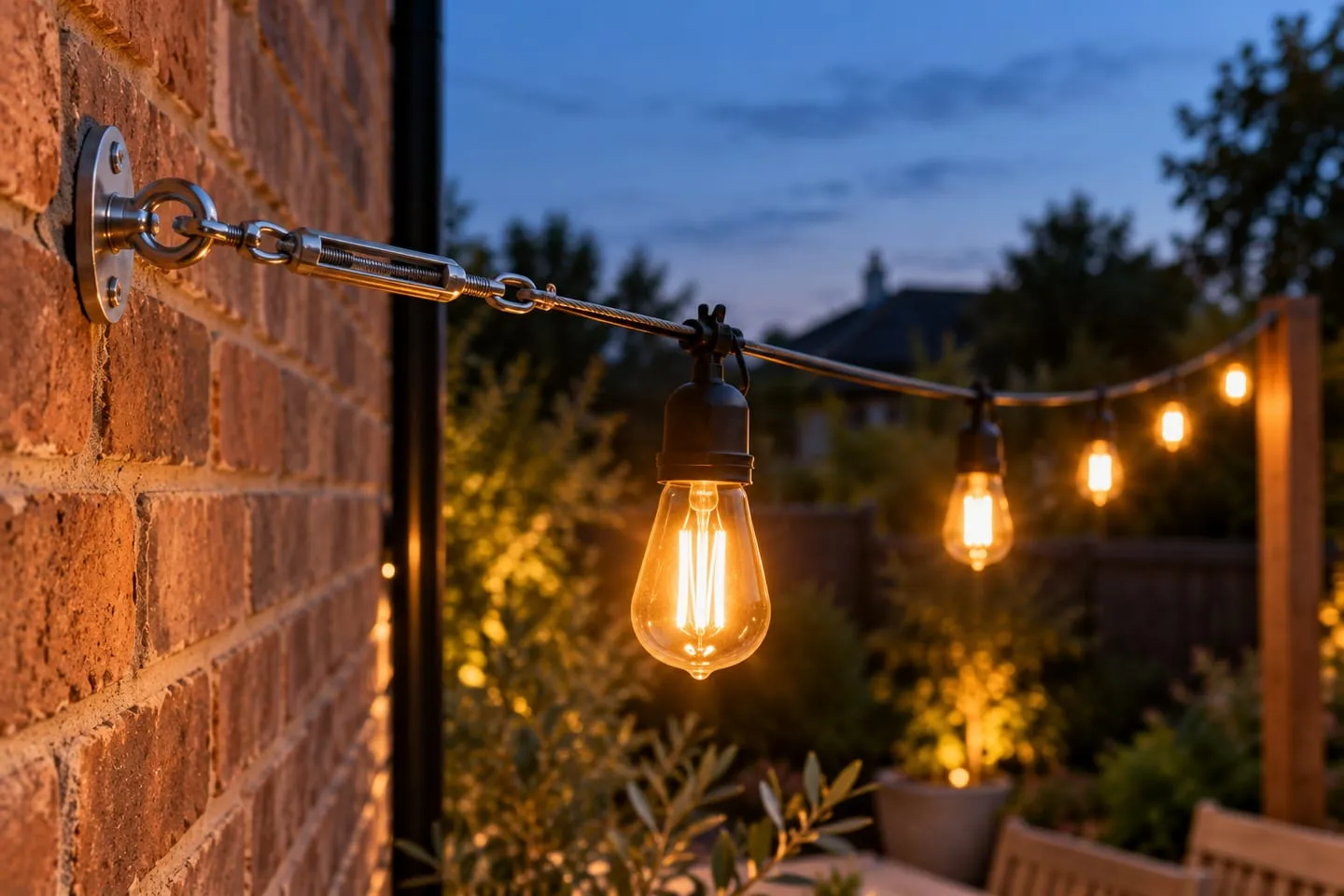
Kits make it simple. Lights4fun’s 20-metre kit, for example, has 2 mm steel wire rope, a turnbuckle to tension it, wire rope grips and thimbles, and costs about £25. Fix an eye bolt or hook plate at each end, loop the wire through with a thimble and two grips, then take up the slack with the turnbuckle. Make it firm, not bar-tight: over-tightening puts a huge pull on the fixings and the wire. Then tie the festoon to the wire every 25 to 50 cm with UV-resistant cable ties, ideally one either side of each bulb. Stainless or plastic-coated wire lasts best outside.
Fix into masonry or posts, never gutters
Each end of a tensioned wire pulls hard on its fixing, and wind adds more. Fix into solid brick or block with a stainless eye bolt in a proper anchor, going through any render into the masonry behind it, and seal round the hole with silicone so water can’t get into the wall. A sound timber post or pergola beam works too, as does a purpose-made festoon pole.
Never fix to a gutter, downpipe, fascia board, fence panel or trellis. None of them is made for a sideways pull, and a gutter will bend or come away. If one end has to go to a tree, wrap a strap round the trunk rather than screwing into it, and leave some slack, because trees move in the wind.
Where there’s nothing to fix to at the far end, use posts. Lights4fun suggests poles 2.4 to 3 metres high, which keeps the lowest point of each run above head height. A timber post needs setting in concrete or bolting down to something solid, and even then a long, tensioned span will pull it over time, so lean it slightly away from the load or brace it with a guy wire to a ground anchor. Spike-in festoon poles are fine for a summer party; for lights that stay up all season, run a catenary between solid posts.
Zigzag, straight or fan
Straight runs are the simplest: house wall to a post, along a pergola beam, or two or three parallel runs across the patio. They need the fewest fixings and the least cable.
A zigzag goes back and forth between fixings on the house and a line of posts or a fence, and makes a canopy over the table. It looks the most generous, but it needs a fixing at every turn and much more length.
A fan runs several lines from one tall post to points spread along the house wall, like the roof of a tent. It suits a square patio with a table in the middle, but the post takes all the pull, so it needs to be a strong one.
Sag and head height
A little sag looks right; too much looks tired and strains the cable. With a catenary wire the lights follow the wire’s gentle dip, so set the height at the lowest point, not at the fixings. Keep that lowest point at roughly 2.2 metres or more anywhere people walk or stand, so no one has to duck, and keep runs clear of parasols, the barbecue and the fire pit.
Planning lengths and bulb spacing
Measure each run, not the patio. A zigzag uses more than you’d think: on a patio 4 metres deep, a run that also crosses 2 metres sideways is about 4.5 metres long, not 4. Four of those make 18 metres before you’ve added the lead back to the socket and a little for the dip. Sketch the layout, add up the runs, then round up to whole lengths if you’re buying a connectable system.
Most domestic sets put a bulb every 50 cm, which looks right over a table; Lights4fun suggests 30 to 50 cm spacing for a warm glow. The one-metre spacing common on mains festoon looks sparse close up but works on long, high runs over a lawn. Spacing also sets the brightness: closer bulbs mean more light under the canopy.
Plan the plug end too. The transformer should sit by the socket, and the lead from it has to reach the first fixing without an extension lead trailing across the patio.
Power: sockets, RCDs and connections
Plug festoons into a socket with 30 mA RCD protection. Electrical Safety First says any lights plugged in outdoors must be, and NICEIC’s guide to gardens and electrics says every outdoor socket should be RCD-protected. Most modern consumer units have RCDs; if yours is an old fuse box, use a plug-in RCD adaptor at the socket.
A weatherproof outdoor socket on the back wall is the best way to power them, and an electrician will typically charge around £150 to £350 to fit one. Without one, use a socket in a garage, shed or porch with a proper route out, not a cable trapped in a window or door.
If you need an extension lead, use one made for outdoor use, unwind a cable reel fully, and never plug one lead into another; Electrical Safety First’s garden safety advice covers this. Any plug-and-socket joint outside belongs in a weatherproof connection box made for the job, raised off the ground. If the RCD trips whenever it rains, there’s water in a joint or a damaged cable; outdoor lighting faults goes through how to find it.
Solar festoons
Solar festoons need no socket and no cable to the house, and from May to September they’re lovely over a table or along a fence. Through the winter they struggle, because short, grey days don’t give a small panel enough charge; solar garden lighting explains why, and what to look for. Choose a set with a separate panel on a cable, so the panel can sit in full sun while the lights hang in the shade, plus a timer. Expect a softer, shorter glow than a plug-in set. Lights4fun’s solar festoons cost about £30 to £65, and there are solar festoon lights from other brands at similar prices.
Timers and smart plugs
Festoons rarely need to be on after bedtime, and nobody wants to go outside in slippers to switch them off. Many transformers have a built-in timer. If yours doesn’t, an outdoor smart plug (IP44 or better, about £15 to £30) puts the set on a schedule and lets you switch it from your phone. Check the set comes back on steady after the power’s been off, not in a flashing mode.
Smart festoons go further, with dimming and colour from an app. The Twinkly Festoon has 20 bulbs on 10 metres and is rated IP44, for about £70 to £130; the 40-bulb, 20-metre version is about £200. Philips Hue’s Festavia globe lights have 10 bulbs on 7 metres, rated IP65, from about £150, and need a Hue Bridge.
Switching off at bedtime also keeps the neighbours onside, and warm, low light is kinder to wildlife; garden lighting ideas covers both.
Storing them over winter
Unless the maker says a set is made for permanent outdoor use, take the festoons down at the end of the season, on a dry day. Let them dry fully indoors, wipe the bulbs, and wind each length loosely round a reel or a piece of card rather than balling it up. Store the lights and transformer together in a labelled box somewhere dry, not on a damp garage floor.
Leave the catenary wire and fixings up. Next spring, re-hanging takes minutes. Before the lights go back up, check the cable, seals and connectors, and replace any length with a cracked bulb or damaged cable rather than taping it. If your set is rated for permanent outdoor use, warm festoons over the patio can do festive duty in December too; outdoor Christmas lights covers the rest of the house.
The festoon lights I'd buy
Affiliate linksFAQs
How high should festoon lights be hung?
Keep the lowest point of each run at roughly 2.2 metres or more anywhere people walk or stand. Posts or fixings 2.4 to 3 metres high give enough room for the dip.
Can I attach festoon lights to my gutter?
No. Gutters, downpipes and fascia boards aren’t made for the sideways pull of a tensioned run and will bend or come away. Fix into the masonry or a solid post instead.
Do I need a catenary wire for festoon lights?
For anything more than a short run between close fixings, yes. The wire takes the weight and the wind, so the festoon cable and connectors aren’t strained, and the lights stay neat for years.
Can festoon lights stay up all year?
Only if the maker says the set is suitable for permanent outdoor use, and ideally IP65. Otherwise take them down for the winter and leave the catenary wire in place.
Do festoon lights need an outdoor socket?
Not necessarily, but they need an RCD-protected socket and a safe route for the cable. A low-voltage set’s transformer can stay indoors with the lead run out through a proper route. Wiring mains festoon permanently into the house is a job for an electrician.
How far apart should festoon posts be?
A few metres is normal. Festive Lights spaces its festoon poles about 3 metres apart. Longer spans need a catenary wire, taller posts and stronger fixings, because both the sag and the pull increase.
 Save
Save it for later
Pin this guide to one of your Pinterest boards so it's there when you start the job.