Security lights and PIR sensors: where to fit them so they actually work

Some links below are affiliate links: if you buy through them I may earn a small commission, at no extra cost to you. As an Amazon Associate I earn from qualifying purchases. How LightGuru makes money

Mike's quick answer
Fit the sensor about 2 to 2.5 metres up and aim it so people walk across its view, not straight at it: a PIR picks up crossing movement at nearly twice the distance. Tilt and mask it away from the road and trees, set the timer to a minute or two, and point a 1,000 to 2,000 lumen light down at the ground.
A security light that comes on for every passing car, or stays dark while someone walks right up the drive, usually isn’t faulty. It’s in the wrong place, aimed the wrong way, or set up wrong. PIR sensors are simple and cheap, but they see the world in a particular way, and once you know how, placing one properly is easy.
What decides whether it works is where the sensor sits relative to the route people actually take, how high it is, which way it’s tilted, and the small dials underneath. As for the light itself, which way it points matters more than how bright it is.
How a PIR sensor sees you
PIR stands for passive infrared. The sensor doesn’t send anything out; it watches for heat. Behind the plastic dome, a lens splits its view into a fan of separate zones, and the sensor triggers when something warm, like a person, moves from one zone into the next.
That’s why direction matters so much. Walk across the front of a sensor and you pass through zone after zone, so it picks you up early. Walk straight towards it and you stay in the same zone for longer, so it sees you late. The makers’ own figures show how big the difference is. Timeguard’s instructions for its STFL floodlights show about 10 metres for someone walking across the sensor and about 6 metres for someone walking towards it. Steinel quotes 10 metres across and 5 metres towards for its XLED home 2. Timeguard and Eterna give the same advice in their fitting instructions: aim the sensor so it looks across the likely approach, not straight down it.
Because it works on heat, a PIR can also be fooled by anything warm that moves or changes quickly, such as the plume from a boiler flue, and it tends to be less sharp on very hot days, when the ground and walls are closer to body temperature.
How high to mount a PIR light
Most manufacturers put the best height for the sensor at around 2 to 2.5 metres, and a few a little higher.
| Mounting height | Range | Angle | |
|---|---|---|---|
| JCC Niteflood PIR floodlight | 1.8–2.5 m | Up to 10 m | 180° |
| Timeguard STFL PIR floodlight | 2.5 m | 10 m across, about 6 m towards | 110° |
| Timeguard MLTP180 sensor | 2.5 m | Up to 12 m | 180° |
| Eterna 120° PIR floodlight | 2.5–3 m | Up to 9 m | About 120° |
| Steinel XLED home 2 | 2 m best, 4 m maximum | 10 m across, 5 m towards | 180° |
Higher isn’t better for the sensor. Mount it well above the makers’ figure and you have to tilt it down to cover the ground near the house, which shortens how far it reaches. Mount it too low and it’s easy to knock, cover or tamper with, and the light shines straight into people’s eyes. For most houses, 2 to 2.5 metres, out of easy reach but not up in the eaves, is right. If you want the light itself higher, use one with a separate sensor, so each goes where it works best (more below).
Aim it across the path people walk
Stand where the light will go and think about the routes someone would take: in from the pavement, up the drive, through the side gate, over the back fence. Then place and aim the sensor so those routes cross its view.
- Drive: a sensor on the front wall looking straight down the drive sees people late and sees every car on the road. On the side of the house or garage, looking across the drive, it catches anyone walking up and can’t see the street.
- Front path: above the door at the end of a straight path is the worst spot. On the corner of the house or the side of a porch, angled across the path, it picks people up far earlier, as the diagram shows.
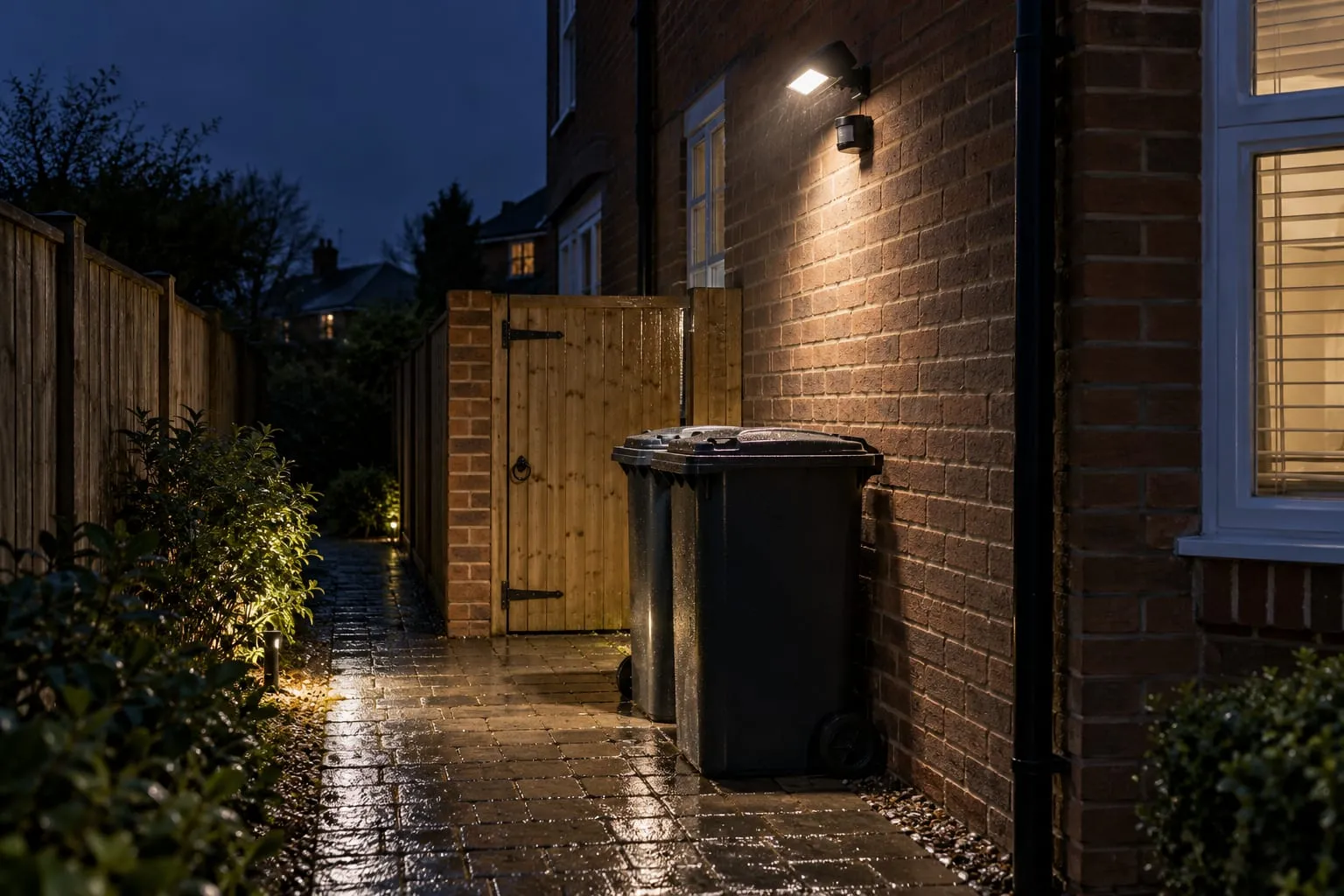
- Side return: fix it on the wall partway along, facing across the passage, so anyone walking through moves across its zones. Above the gate, looking down the passage, it only sees people once they’re close.
- Back garden: on the back wall facing down the garden, it sees people coming towards the house late. On a corner, looking diagonally across the garden, it does better.
Detection angle and range are the other half of aiming. A 180° sensor sees a lot, often including next door’s garden and the street. A narrower one, around 110°, is easier to keep where you want it. Either way, you control the range by tilting the head: point it further down and it stops short; level it up and it reaches further. Most sensor heads swivel side to side as well, and many come with a lens mask or masking strips you can cut to block off one side or the far edge.
Then walk-test it. Allow a few minutes after switching on, because some sensors take up to five minutes to settle. Most PIR lights can be set to work in daylight (the sun end of the light-level dial), which makes testing easy. Turn the timer to its shortest setting and walk every route you want covered, and the ones you don’t, like the pavement and the neighbour’s drive. Adjust the head until it picks up the first and ignores the second, then set the dials back for night-time use.
Stopping false triggers
A light that keeps coming on by itself is seeing something. These are the usual culprits:
- Cars and people on the road or pavement. Tilt the head down and mask the side that faces the street.
- Trees, shrubs and climbers moving in the wind. Aim away from them, or cut them back out of the sensor’s view.
- Cats and foxes. No outdoor PIR ignores animals completely, but lower sensitivity, a head tilted to cover only the ground you care about, and a short timer keep the flashes brief.
- Warm air from a boiler flue, extractor fan, tumble dryer vent or air-conditioning unit. Keep them out of the sensor’s view.
- Reflections and other lights. Timeguard and Eterna both warn about white walls, pools of water and other light sources, including another security light.
- A loose fitting. If the sensor can move in the wind, it sees movement everywhere. Fix it firmly.
Then come the dials, two or three on most PIR lights. Sensitivity, where there is one, sets how readily it reacts; leave it until last (see the tip below). Lux, usually marked with a sun and a moon, sets how dark it has to be before the sensor works. Set it so the light only comes on after dusk, or it fires all day and nobody notices it any more.
Time sets how long the light stays on after the last movement, and the range varies a lot between models: Timeguard’s MLTP180 sensor goes from 2 seconds to 30 minutes, JCC’s Niteflood from 10 seconds to 7 minutes. A minute or two is plenty for most drives and paths, because every new movement restarts the timer. If yours still comes on at random or stays on all day, outdoor lighting faults walks through the causes.
How bright, and which way to point it
For a typical drive, side path or back garden, 1,000 to 2,000 lumens is plenty. To put that in watts, JCC’s Niteflood range gives 1,000 lumens at 10 W, 2,100 at 20 W and 2,800 at 30 W. The big 50 W floodlights are made for yards and car parks rather than semis, and they’re the ones most likely to upset the neighbours.
Aim matters more than output. Point the light down at the ground you want lit, not out across the garden. A floodlight aimed near the horizontal dazzles anyone looking towards the house, including you looking out of the window, and leaves deep shadow behind the glare where someone can stand unseen. The government’s light pollution guidance makes the same point: lighting near or above the horizontal is usually to be avoided. Tilt the head well down and the light lands where you need it.
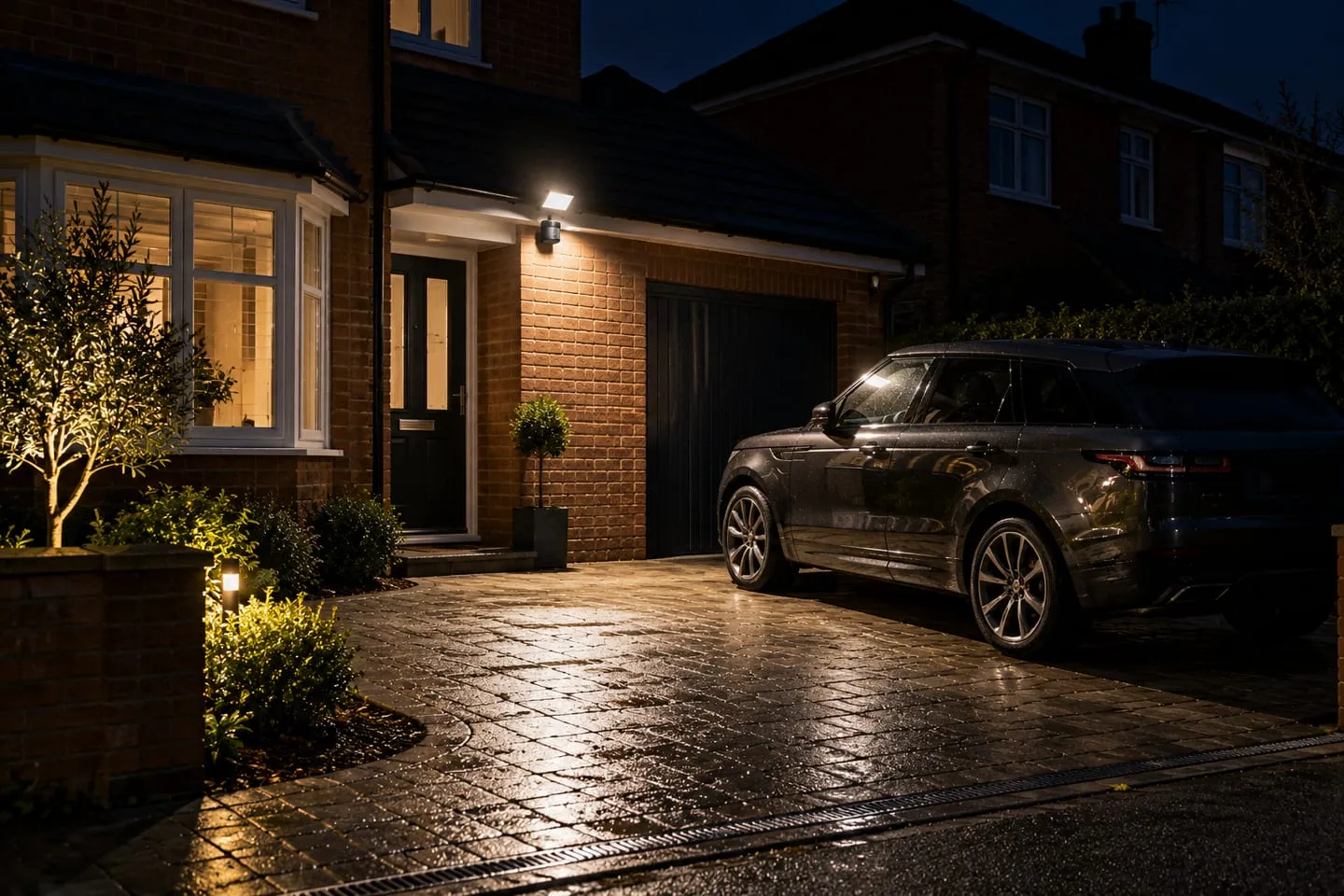
For colour, neutral white (around 4000K) suits a drive or the area by the bins. Near the house and the garden, warm white (around 3000K) sits better with the wall lights and planting. The colour temperature guide explains the numbers.
Separate sensor or built-in
| Built-in sensor | Separate sensor | |
|---|---|---|
| Position | One spot has to suit light and sensor | Each goes where it works best |
| Lights per sensor | One | Several, within the sensor’s load rating |
| Rough cost | About £20–£100 all in | About £20–£45 for the sensor, plus the light |
| When it fails | Often the whole unit | Replace only the part that failed |
| Looks | One neat unit | Two boxes on the wall |
Yellow = the better option on that line.
For most homes, a light with a built-in sensor is fine, as long as you can mount it where the sensor works. A separate sensor is worth it when the best place for the light and the best place for the sensor aren’t the same: a floodlight high under the eaves with the sensor at 2.5 metres on a corner, or one sensor by the gate switching several lights down a long drive. Timeguard’s MLTP180 is a separate 180° sensor rated to 12 metres at 2.5 metres high, with a lens mask in the box.
PIR or dusk-to-dawn
A PIR light is only on when someone’s there, so it’s cheap to run, it tells you something is moving, and it can startle someone who isn’t expecting it. A dusk-to-dawn light is on all night at low power, so there’s never a dark doorway and nothing switching on and off at three in the morning.
They suit different places. Secured by Design, the police crime-prevention initiative, shows a PIR floodlight on a house as poor practice because it spills light around and doesn’t light the doorway, and prefers a low-energy dusk-to-dawn light at the door. PIR earns its place on the drive, the side return and the back garden, where you only need light when someone’s about.
Many homes end up with both: a modest dusk-to-dawn wall light by the front door and PIR floodlights to the side and rear. Some lights do both jobs, glowing low from dusk and jumping to full brightness on movement. Running costs are small either way: a 6 W LED on from dusk to dawn uses roughly 25 kWh a year, about £7 at current prices. For lights by the door, see outdoor wall lights.
Camera floodlights
A camera floodlight puts a motion-activated floodlight and a security camera in one unit, with alerts to your phone. Ring’s Floodlight Cam Wired Plus and eufy’s Floodlight Camera E340 both give about 2,000 lumens and run off the mains, so they’re wired in like any other floodlight. Check the running costs before you buy: Ring needs a subscription to save and play back recordings, while eufy’s can record locally to a memory card or eufy’s HomeBase.
The app lets you draw motion zones, which helps, but placement still matters. A camera floodlight aimed down the drive at the road goes off for every car, just like a plain PIR.
There’s a legal side too. If the camera records beyond your boundary, onto the street or a neighbour’s property, data protection law applies, and the ICO’s guidance on home CCTV explains what that means for you. The ICO’s advice is to position cameras to capture only your own property where you can, and to use privacy filters or masking to block out the rest.
The wall switch and manual override
A PIR light needs power all the time to watch for movement, so the wall switch indoors stays on. Switch it off and you haven’t got a security light.
Most PIR lights have a manual override worked from that switch: a quick off and on, twice in a row on some models, keeps the light on for a few hours, and the same again puts it back to automatic. Timeguard’s floodlights stay on for six hours this way; on JCC’s Niteflood, switching off for ten seconds puts it back to automatic. The sequence differs between models, so keep the instructions. A light that’s stuck on is often just in override.
IP rating and wiring
A security light lives on an exposed wall, so look for IP65 unless it’s tucked under deep eaves, where IP44 will do. IP55, common on sensors, is as good as IP65 against rain; the second number is the one that counts. Plenty of good sensor lights are IP44, Steinel’s XLED home 2 among them, so check before you buy one for an open wall. The IP ratings guide explains the numbers, and near the sea, read outdoor lights for coastal homes too, because the material matters as much as the rating.
Swapping an old floodlight for a new one on the same wiring isn’t notifiable in England or Wales, but it’s mains work up a ladder, so unless you’re competent to isolate, connect and test it, use an electrician. A new circuit for outdoor lights is notifiable under Part P of the Building Regulations, and in Wales, adding a light outdoors to an existing circuit is notifiable as well, according to the Welsh Government. A registered electrician can self-certify the work for you.
Outdoor lighting should be protected by a 30 mA RCD, which cuts the power in a fraction of a second if current leaks to earth; the wiring regulations have required one on lighting circuits in homes since 2019 (BSI’s summary of the BS 7671:2018 changes, regulation 411.3.4). NICEIC’s advice on garden electrics covers the basics. And because many PIR lights have a permanent live feed, switch off at the consumer unit, not just the wall switch, before anyone works on one.
Neighbours and the law
Security lights are a common cause of complaints to councils about light; the government’s light pollution guidance names domestic security lights among them. Under the Environmental Protection Act 1990, artificial light from premises can be a statutory nuisance if it unreasonably and substantially interferes with someone’s use or enjoyment of their home, or harms their health.
The government’s guidance on artificial light nuisance says councils look at how often it happens, how long it lasts, when, and whether it’s in a town or the countryside, judged by its effect on an average person. There are no set light levels. If the council decides it’s a statutory nuisance, it must serve an abatement notice requiring whoever’s responsible to stop or restrict the light.
You don’t want to get anywhere near that, and it’s easy not to. Aim the light down, mask the side of the sensor that looks into next door, keep the timer short, and don’t buy more lumens than the space needs. If it’s a neighbour’s light that’s the problem, talking to them is usually quickest; the government’s advice on resolving neighbour disputes suggests trying informally first and mediation if that doesn’t work, with the council there for a statutory nuisance.
What I'd buy
Affiliate linksFAQs
How high should a PIR security light be?
Around 2 to 2.5 metres for the sensor. Manufacturers’ figures mostly run from 1.8 to 2.5 metres, with 2 to 2.5 metres the usual best height. Much higher means tilting it down, which shortens its reach.
Why does my security light keep coming on?
It’s seeing movement or heat: cars or people on the pavement, branches in the wind, cats, or warm air from a flue or vent. Tilt the head down, mask the side facing the problem and lower the sensitivity. If it comes on in daylight, the lux dial is set too far towards the sun.
Why doesn’t my PIR light come on until I’m close?
You’re probably walking straight towards it. PIR sensors pick up movement across their view at nearly twice the distance of movement towards them, so move or angle the sensor to look across your path.
How many lumens does a security light need?
For a typical home, 1,000 to 2,000 lumens, which is a 10 W to 20 W LED floodlight. More than that mostly adds glare and annoys the neighbours.
Can a neighbour’s security light be a statutory nuisance?
It can, if it unreasonably and substantially interferes with your use of your home. Talk to them first; if that fails, the council can investigate and serve an abatement notice.
Do I need an electrician to fit a security light?
Replacing one on existing wiring isn’t notifiable in England or Wales, but it’s mains work at height, so use an electrician unless you’re competent. A new circuit is notifiable, and in Wales so is adding a new outdoor light.
 Save
Save it for later
Pin this guide to one of your Pinterest boards so it's there when you start the job.