Outdoor wall lights: ideas, heights and IP ratings for UK homes

Some links below are affiliate links: if you buy through them I may earn a small commission, at no extra cost to you. As an Amazon Associate I earn from qualifying purchases. How LightGuru makes money

Mike's quick answer
Put up-and-down lights or a lantern by the front door, with the top of the light about 1.8 to 2 metres up, and a plain downward light or bulkhead by the back door and down the side. Buy IP65 for any wall the rain hits and IP44 only under a porch or deep eaves, in warm white at 300 to 600 lumens. Wiring a new outside light is a job for a registered electrician.
Outdoor wall lights do two jobs. They help you find the keyhole, the step and the bins after dark, and they’re the first thing anyone sees of your house at night. Most homes only need a few: one or two by the front door, one by the back door, something down the side return, and perhaps a pair on the patio wall.
What decides the right light for each spot is how exposed the wall is, how high the light can go, how it will be switched on and off, and who else will see it, including the people next door. Sort those out and choosing a style is the easy part.
The main types
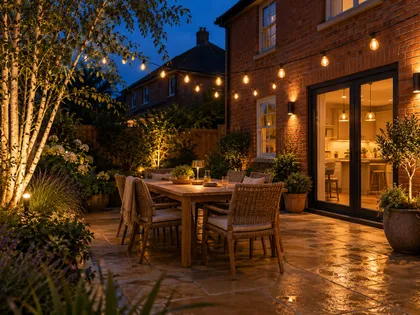
Up-and-down lights are the most popular modern choice. They throw a beam above and below the fitting, so you see two fans of light on the brick or render rather than a bright bulb, and they look smart by a front door and along a patio wall. Before you buy, look at where the upper beam will land. Under a soffit or a porch roof it’s fine; beside a bedroom window, or on a wall with nothing above it, it lights the window or the sky. Down-only versions of most designs are sold for exactly those spots.
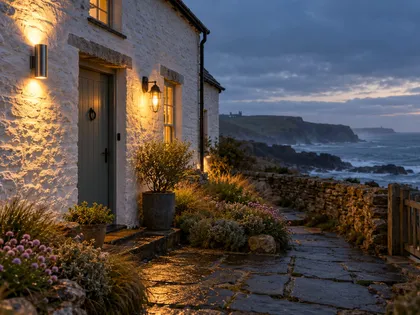
Lanterns suit period houses, cottages and porches. Most take an ordinary E27 or E14 bulb. Choose a frosted or low-glare LED bulb rather than a clear filament one, because a bright bare filament behind clear glass glares at anyone walking up the path. In a sealed lantern, use a bulb that says it’s suitable for enclosed fittings, or the heat shortens its life; outdoor lighting faults explains why.
Bulkheads are the plain, tough option for side returns, back doors, garages and outbuildings. They’re sealed, cheap and easy to wire. An eyelid or louvred bulkhead throws the light down onto the ground instead of out at eye level, and polycarbonate ones can’t rust.
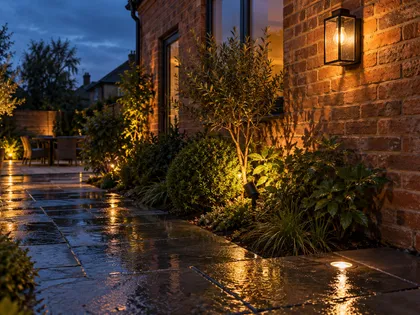
Wall-washers spread soft, even light across the wall itself rather than out into the garden. They’re good on a long rendered garden wall or a feature wall behind the patio, mounted along the top or the base. They work best on smooth surfaces; on brick and stone, a light set close to the wall that grazes up it shows off the texture better.
Brick and step lights are small fittings set into or onto a wall low down, beside steps or along a path. They mark edges rather than light an area, so they’re dim on purpose: 20 to 100 lumens is typical. Saxby’s Pilot brick guide light, for example, is a 2 W, 65-lumen, IP65 fitting.
Solar wall lights need no wiring, which makes them useful on a shed, a gate or a back fence far from any power. The catch is the small panel. In a British winter there often isn’t enough sun to charge it, so they fade by mid-evening, and the panel needs direct sun, not the shade of the eaves. The solar garden lighting guide covers which ones are worth having.
| Best for | Watch for | |
|---|---|---|
| Up-and-down | Front door, patio wall, modern brick or render | Upper beam can light windows or the sky |
| Lantern | Period houses, cottages, porches | A clear glass lantern with a bright bulb glares |
| Bulkhead | Side return, back door, garage, outbuildings | Plain looks; pick an eyelid or louvre for downward light |
| Wall-washer | Long rendered walls, a feature wall | Looks patchy on rough surfaces |
| Brick and step lights | Steps, low walls, path edges | Low output; they mark edges, not light an area |
| Solar | Sheds, gates and fences away from power | Weak in winter; the panel needs direct sun |
Front door lights: one or a pair
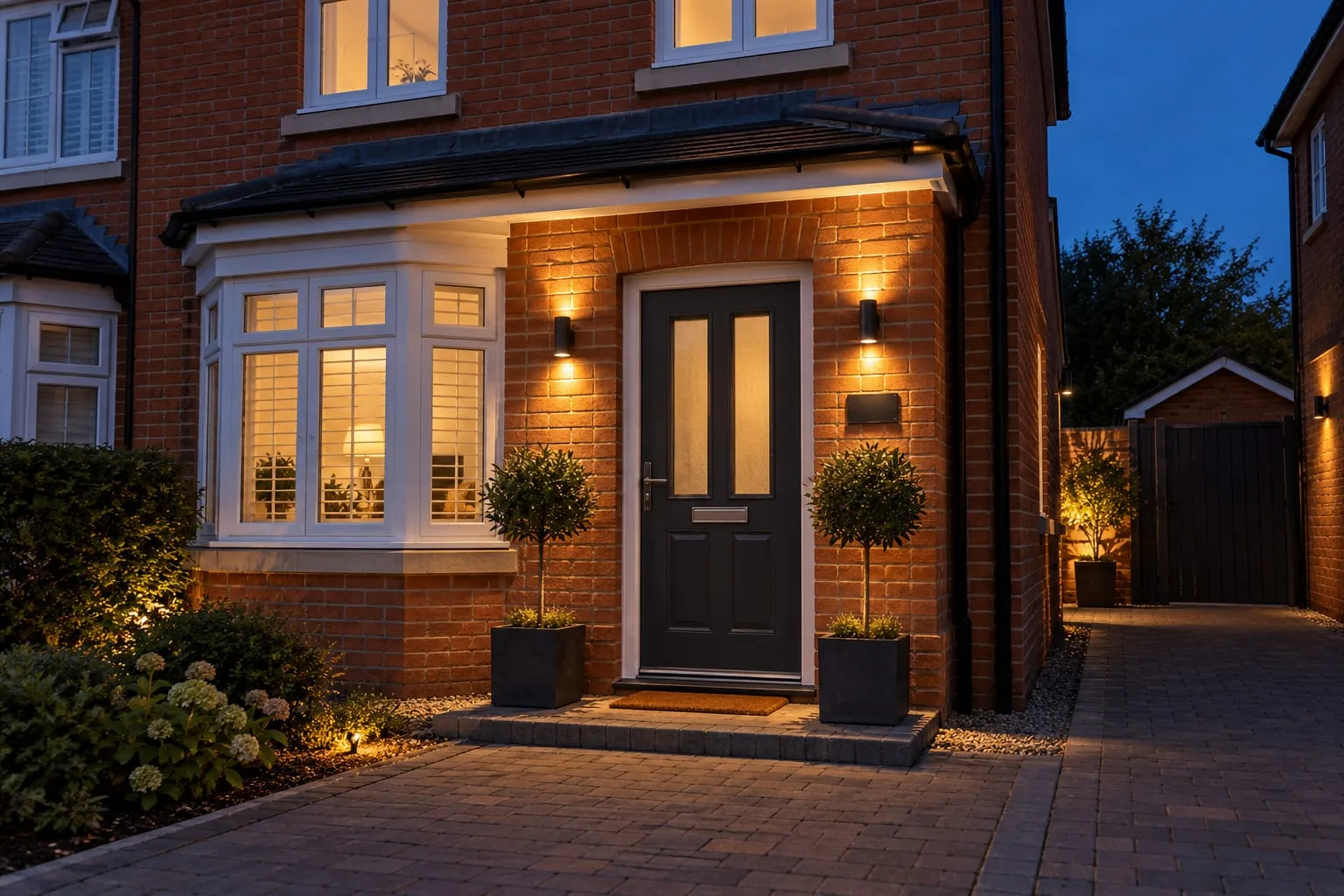
A pair, one either side of the door, looks balanced and lights the step evenly. It’s the right choice on a door with a bit of wall either side. Fit them at the same height and the same distance from the frame: close enough that the light falls on the step and the lock, but not so close that they crowd it. Retailers’ usual guide is about 15 cm between the frame and the light.
If there’s only room on one side, because the door is tucked against a wall or a bay window, a single light on the lock side does the job. Put it beside the handle and keyhole, so you can see the lock and your own hand doesn’t put it in shadow.
Most people buy front door lights too small, because a light that looks big in the box looks small on the wall. A common rule of thumb among lighting retailers is that a single light should be about a third of the door’s height and each of a pair about a quarter. On a door around 2 metres tall, that’s roughly 65 cm for one light and 50 cm for each of two. It’s a guide, not a law: a slim modern up-and-down light can look right smaller.
If there’s a canopy or an open porch, a lantern hung underneath or a small ceiling light lights the step and the door evenly from above, and under cover an IP44 fitting is fine. Whatever you choose, make sure the house number is lit, by the door lights or a small light of its own. It helps visitors and delivery drivers at night, and an ambulance crew.
How high to fit outdoor wall lights
By a door, fit them so the top of the light is around 1.8 to 2 metres from the ground, roughly level with the top of the door frame or a little below. Lower than that and it shines in your eyes as you walk up the path. Higher, and it lights the top of your head while the lock and the step fall into shadow. Retailers often quote 1.6 to 1.8 metres instead. They’re measuring to the middle of the light, and on a typical fitting that comes to the same position, just above eye level.
On a long wall, such as a patio, keep the same height and space them every 2 to 3 metres so their fans of light almost meet. Lights with a sensor have their own best height, usually a little higher; see where to fit a PIR security light.
| Light to use | Height to top of light | IP rating | |
|---|---|---|---|
| Front door, under a canopy | Lantern or up-and-down, a pair or one on the lock side | 1.8–2 m | IP44 |
| Front door, open wall | Up-and-down or down-only | 1.8–2 m | IP65 |
| Back door | Down-only light or bulkhead | 1.8–2 m | IP65, or IP44 if sheltered |
| Side return | Bulkhead or PIR light | About 2 m; a sensor at 2–2.5 m | IP65 |
| Garden wall or fence | Small shielded down-lights every couple of metres | Top of a low wall, or partway up a fence | IP65 |
| Patio wall | Up-and-down, every 2–3 m | 1.8–2 m | IP65, or IP44 under cover |
Back door, side return and garden walls
The back door needs practical light more than pretty light: enough to see the step, the bins and the way to the shed. A single down-only light or a bulkhead beside or above the door is usually all it takes. Put it on its own switch, separate from any patio lights, so you’re not lighting the whole garden to put the recycling out.
The side return is where a sensor earns its keep. You walk through with your hands full, and the light comes on without you hunting for a switch. A bulkhead or a down-only PIR light on the house wall lights a short passage; a long one may need two. Aim for light on the ground, not in the face of whoever comes through the gate.
Garden walls and fences look best with small down-lights every couple of metres, each putting a pool of light on the path or the border with darkness in between. That rhythm of light and shadow is what makes a garden look good at night; a continuous bright line makes it feel boxed in. Fix them along the top of a low wall or partway up a fence, and choose shielded fittings so you see the pool of light rather than the LED. On a shared fence, fix them to your side and aim them down so nothing spills over the top.
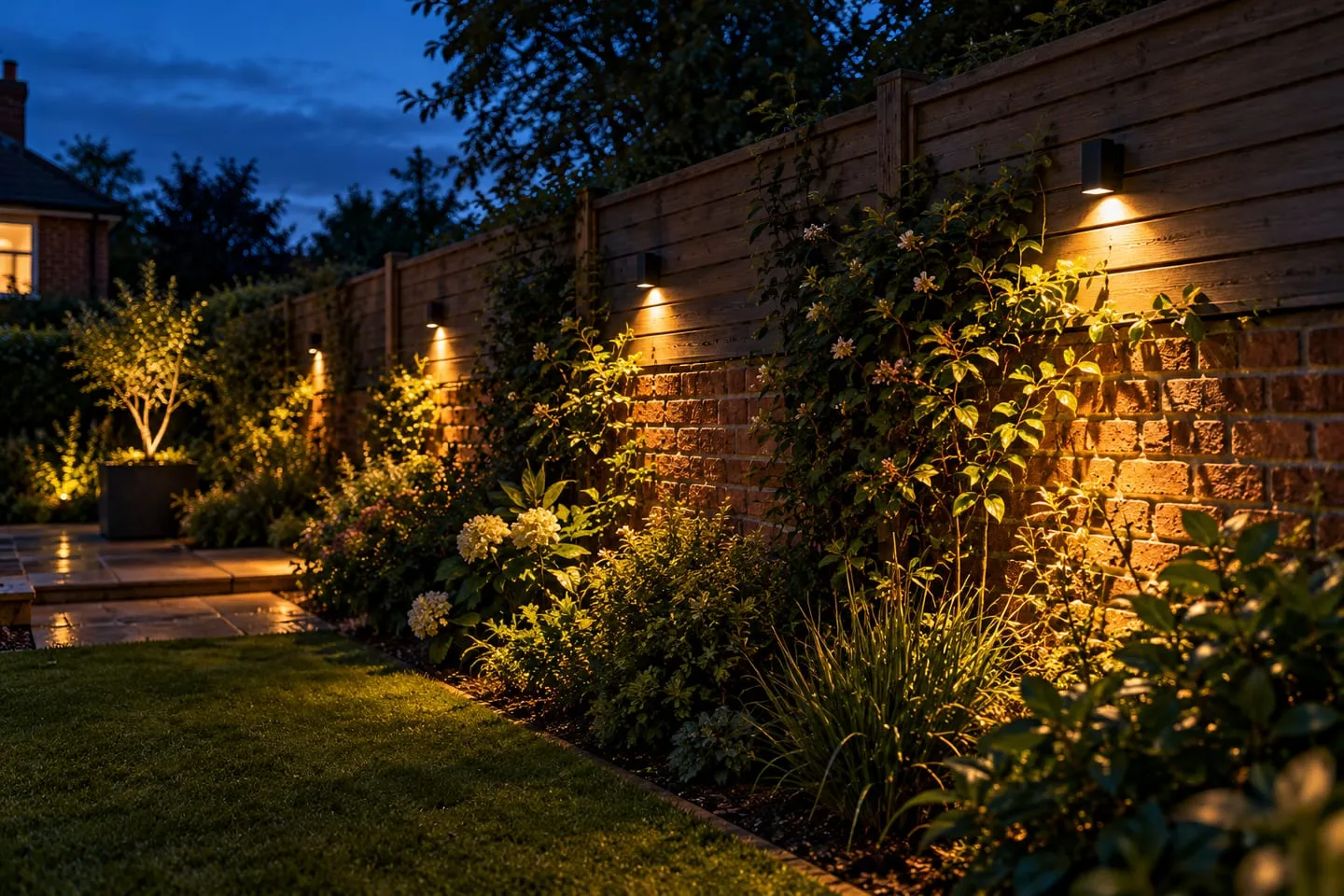
The patio wall usually wants two up-and-down lights, either side of the back door or spaced along the wall, on a switch indoors and ideally a dimmer. The patio lighting guide covers the rest of the space, from festoons to uplit planting.
IP44 or IP65: it depends on the wall
An IP rating tells you how well a fitting keeps out dust and water. On wall lights you’ll mostly see two. IP44 keeps out splashing water from any direction. IP65 is dust-tight and protected against jets of water from any direction.
IP44 is fine where rain can’t reach the light: under a porch canopy, a deep overhang or a carport roof. Anywhere rain hits the wall, buy IP65. Be honest about “sheltered”. A shallow overhang on a wall facing the prevailing wind, which is south-westerly over most of Britain, still gets rain driven under it. If the brick under the light is wet after a storm, the light gets wet too.
Gable ends, houses on high ground and anything near the coast take the worst of the weather, so treat IP65 as the minimum there. The number isn’t the whole story either. A light only keeps its rating if the gasket is seated properly and the cable comes in through a gland that suits it, ideally from below. The IP ratings guide explains each rating and where it belongs.
Materials, and homes near the sea
Most modern outdoor wall lights are powder-coated aluminium. It’s light, it doesn’t rust the way steel does, and a good coating lasts years on an ordinary wall. Its weak point is a chip or scratch, where corrosion can get under the coating, so treat the finish gently when it’s being fitted.
Stainless steel comes in grades. The common one, 304, develops brown staining in salty air; 316, sometimes called marine grade, holds up far better. If the box just says “stainless steel”, assume it’s 304. Polycarbonate can’t corrode at all, which is why it’s the safe choice for the most exposed walls, side returns and outbuildings. Make sure it’s UV-stabilised, or the sun yellows it.
By the sea, choose polycarbonate or 316 stainless for anything facing the weather, and use stainless screws. Painted steel, zinc alloy and chrome don’t last there. Outdoor lights for coastal homes goes through every material.
There’s also the choice between a fitting that takes a bulb and one with the LED built in. A GU10 or E27 fitting (many up-and-down lights take two GU10s) lets you choose the warmth and brightness and swap a failed bulb in a minute. An integrated LED fitting stays sealed and usually lasts longer, but when it fails, the whole light goes. On an exposed wall, I’d lean towards integrated from a known brand.
How bright, and what colour
Outdoor wall lights should be dimmer than most people expect. Your eyes adjust to the dark, so a light that looks feeble in the shop looks bright on the house at night. Around 300 to 600 lumens per light is plenty by a door or on a patio wall. In an up-and-down light that takes two GU10s, two modest bulbs of around 300 lumens each are usually enough.
For colour, use warm white, 2700K to 3000K. It flatters brick, stone and render, and it matches the light coming through your windows, so the house looks lived-in rather than lit up. Cool white (4000K and above) looks harsh on the front of a house; keep it for working areas like the drive or the bins if you want it at all. The colour temperature guide explains the numbers.
The beam changes the look too. Up-and-down lights with a narrow beam draw two crisp lines up and down the wall; wider beams give softer fans. Narrow beams suit render and modern houses; wider ones are more forgiving on brick.
Switching: switch, dusk sensor, PIR or smart
| How it works | Best for | |
|---|---|---|
| Indoor switch | You switch it on and off | Patio and any light you use on purpose |
| Photocell (dusk-to-dawn) | On at dusk, off at dawn | Front door and house number |
| PIR sensor | On when it detects movement, off after a set time | Side return, bins, drive |
| Smart switch or bulbs | App, voice and schedules | Lights you want on a timetable |
An indoor switch is the simplest and the most reliable. Put it by the door you actually use.
A photocell turns the light on at dusk and off at dawn, so the front of the house is never dark when you get home. With LED it costs very little: a 6 W light on from dusk to dawn uses roughly 25 kWh a year, about £7 at current prices. All night isn’t always neighbourly, though. Some fittings combine a dusk sensor with a timer that switches off at midnight, and a smart schedule can do the same.
A PIR switches the light on when it detects movement and off again after a set time. It’s ideal for the side return and the bins. By the front door it’s less good: a short timer switches off while you’re finding your keys, and a sensor that can see the pavement comes on for everyone who walks past. Some lights do both jobs, with a low glow from dusk and full brightness when someone approaches.
Smart control means a smart switch in place of the indoor switch, or smart bulbs in a fitting that takes a GU10 or E27 (Hue, WiZ and Tapo all make them). Many smart switches need a neutral wire at the switch, so check before you buy. Philips Hue also makes outdoor wall lights, such as the up-and-down Resonate, which need a Hue Bridge.
Wiring and the rules, in plain terms
Wiring an outside light is mains electrical work, and outdoors is where mistakes are most dangerous. In England, electrical work is notifiable under Part P of the Building Regulations if it involves a new circuit from the consumer unit, a new consumer unit, or work around a bath or shower. Adding a wall light to an existing circuit, or swapping an old light for a new one on the same wiring, isn’t notifiable in England, but it still has to be done properly to the wiring regulations, BS 7671. The IET’s Part P FAQs set out what counts.
Wales is stricter. Under the Welsh Government’s guidance, adding lighting points to existing circuits outdoors is notifiable too, though replacing a light fitting isn’t. Scotland and Northern Ireland have their own building regulations.
Notifiable work has to be either done by an electrician registered with a competent person scheme, who can self-certify it, or reported to building control before you start. The Planning Portal explains both routes. In practice, a registered electrician is the easy way, and you get a certificate for when you sell the house.
Whoever fits it, an outdoor light should be on a circuit protected by a 30 mA RCD, which cuts the power in a fraction of a second if current leaks to earth through a damaged cable or a wet fitting. The wiring regulations have required one on lighting circuits in homes since 2019 (regulation 411.3.4 in BSI’s summary of the BS 7671:2018 changes). If your consumer unit is old and has no RCD, get that sorted before adding anything outside; NICEIC’s advice on garden electrics is a good plain-English summary.
Being a good neighbour
A wall light that’s pleasant for you can shine straight into a bedroom next door. Near a boundary or a neighbour’s window, choose down-only or shielded fittings, where you can’t see the bulb or LED from the side, and keep to warm white and modest brightness.
Think about hours too. A low, shielded light by the front door all night bothers nobody; a bright one on the side wall, aimed across the garden, can. Councils can treat badly aimed outdoor lights as a statutory nuisance, and the government’s guidance on artificial light nuisance lists domestic security lights among the things that can cause one. Warm white aimed downwards is also kinder to bats and moths, which the garden lighting guide covers.
What I'd buy
Affiliate linksFAQs
How high should outdoor wall lights be?
By a door, the top of the light should be around 1.8 to 2 metres from the ground, roughly in line with the top of the door frame or a little below. That puts the middle of the light at about 1.6 to 1.8 metres, just above eye level. On a long wall, keep the same height and space them every 2 to 3 metres.
What IP rating do outdoor wall lights need?
IP44 under a porch canopy or deep eaves, where rain can’t reach them. IP65 anywhere the rain hits the wall, which is most walls.
Should I have one light or two by the front door?
Two if there’s wall on both sides of the door: it looks balanced and lights the step evenly. If there’s only room for one, put it on the lock side.
Are up-and-down wall lights a good idea?
Yes, on most house walls, because you see two soft fans of light rather than a bright bulb. Avoid them right beside a bedroom window or on a wall with nothing above, where the upper beam lights the window or the sky; use down-only there.
Can I fit an outdoor wall light myself?
Swapping a light on existing wiring isn’t notifiable in England or Wales, but it’s still mains work outdoors, so use a registered electrician unless you can safely isolate, connect and test it. A new circuit is notifiable, and in Wales so is adding a new light outdoors.
What colour light is best for outside the house?
Warm white, 2700K to 3000K. It flatters brick and render and matches the light from your windows. Cool white looks harsh on the front of a house.
 Save
Save it for later
Pin this guide to one of your Pinterest boards so it's there when you start the job.