Choosing the right lighting for every room: a complete guide


Mike's quick answer
Give every room at least three light sources on separate switches or dimmers: general light, task light where you work, and something low and soft for the evening. Use warm white (2700K–3000K) in living rooms and bedrooms, and save crisper 4000K light for kitchens, bathrooms and desks.
Most UK homes were wired for one light in the middle of each ceiling. That single pendant is why so many rooms feel flat: bright in the middle, gloomy in the corners, and harsh when all you want to do is sit down.
Choosing the right lighting for a room comes down to four things. What you do in it. When you use it, because a kitchen at seven in the morning needs different light from a lounge at ten at night. How big it is. And how pale or dark the walls and floor are. Get those straight and the fittings almost choose themselves.
Below is how I’d approach each room, with the brightness and colour of light I’d aim for. For exact numbers for your own room size, the lumens calculator does the maths.
The three layers of light
Every well-lit room uses a mix of three kinds of light.
Ambient light is the general light that lets you see the whole room: a ceiling pendant, downlights, a flush fitting or an LED panel. It should be even and, in most rooms, dimmable.
Task light is brighter light aimed at the place you do something detailed: under-cabinet lights over a worktop, a mirror light, a desk lamp, a reading light by a chair. It’s usually two or three times brighter than the light around it, but over a small area.
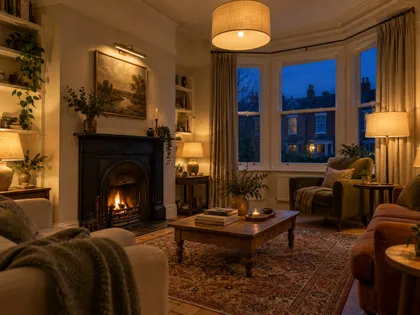
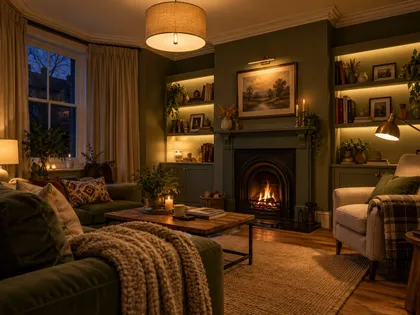
Accent light is there for atmosphere and depth: table lamps, wall lights, picture lights, LED strip in a shelf or behind the TV. It’s the layer people skip, and it’s the one that makes a room feel finished in the evening.
The practical rule I give everyone: at least three light sources in any room you spend evenings in, on separate switches or dimmers. A room with one bright light on one switch has only one mood.
Room by room at a glance
| Room | General light | Task and accent light | Colour temperature | Lumens per m² (rule of thumb) |
|---|---|---|---|---|
| Kitchen | Downlights or track | Under-cabinet strip, pendants | 3000K–4000K | 250–400, plus task light for about 300 lux on worktops |
| Living room | Pendant or downlights on a dimmer | Table and floor lamps, wall lights | 2700K–3000K | 100–150 |
| Bedroom | Ceiling light on a dimmer | Bedside lamps or wall lights | 2700K | 100–150 |
| Bathroom | IP-rated downlights | Mirror light | 3000K–4000K | 250–400, mirror included |
| Home office | Ceiling light | Desk lamp | 4000K at the desk | 300–500, desk lamp included |
| Dining area | Pendant over the table | Wall lights or a lamp | 2700K | 150–200 |
| Hallway and stairs | Ceiling or wall lights | Low-level step lights | 2700K–3000K | 75–150 |
| Outside | Wall lights by the doors | Path and spike lights | 2700K–3000K | Just enough to see by |
Multiply the room’s floor area by the figure to get the total lumens from all your lights. These are planning figures, not lux: walls and ceilings soak up some of the light, and the figures already allow for that. A 4 × 4 m bedroom (16 m²) at 100–150 lumens per m² needs about 1,600 to 2,400 lumens in total, spread across the ceiling light and lamps rather than from one bulb. Add 15 to 30% if the walls are dark. If you’re fitting downlights, here’s how many each room needs and where they go.
Kitchen
The kitchen works hardest, so it needs the most light and the most control. I plan it in three parts.
General light first. That’s usually downlights spaced in an even grid, or track where the ceiling can’t take recessed fittings. Line them up over the front edge of the worktops rather than down the middle of the floor: light from behind you throws your own shadow onto the chopping board. The kitchen downlight spacing guide has the measurements. If there’s a room above, the downlights must be fire-rated so they don’t weaken the ceiling’s fire resistance, as required by Approved Document B.
Then task light under the wall cabinets. LED strip or slim linear fittings fixed towards the front of the cabinet underside light the worktop without shadows. For the money, this is the layer that makes the biggest difference.
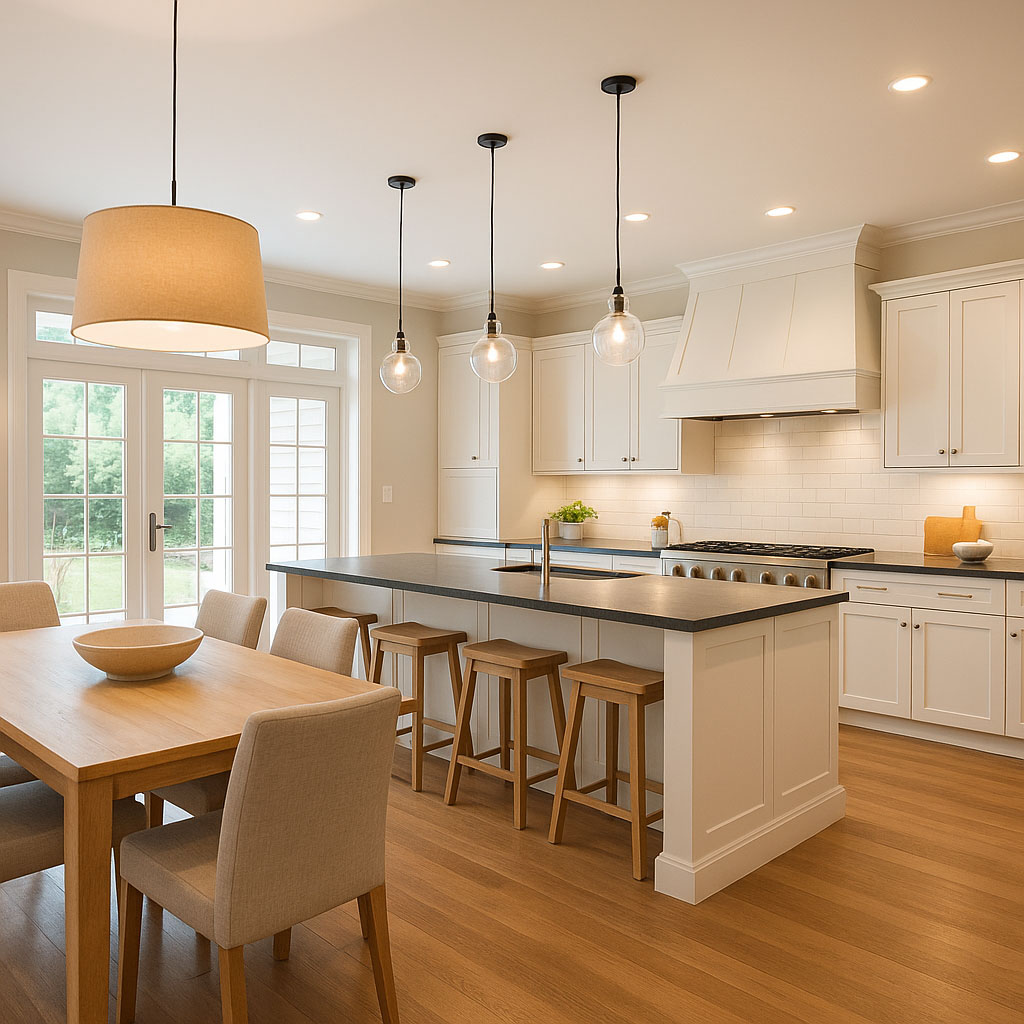
Then pendants over an island or table. They give you something to leave on when the downlights are dimmed or off, which is how most kitchens are used in the evening.
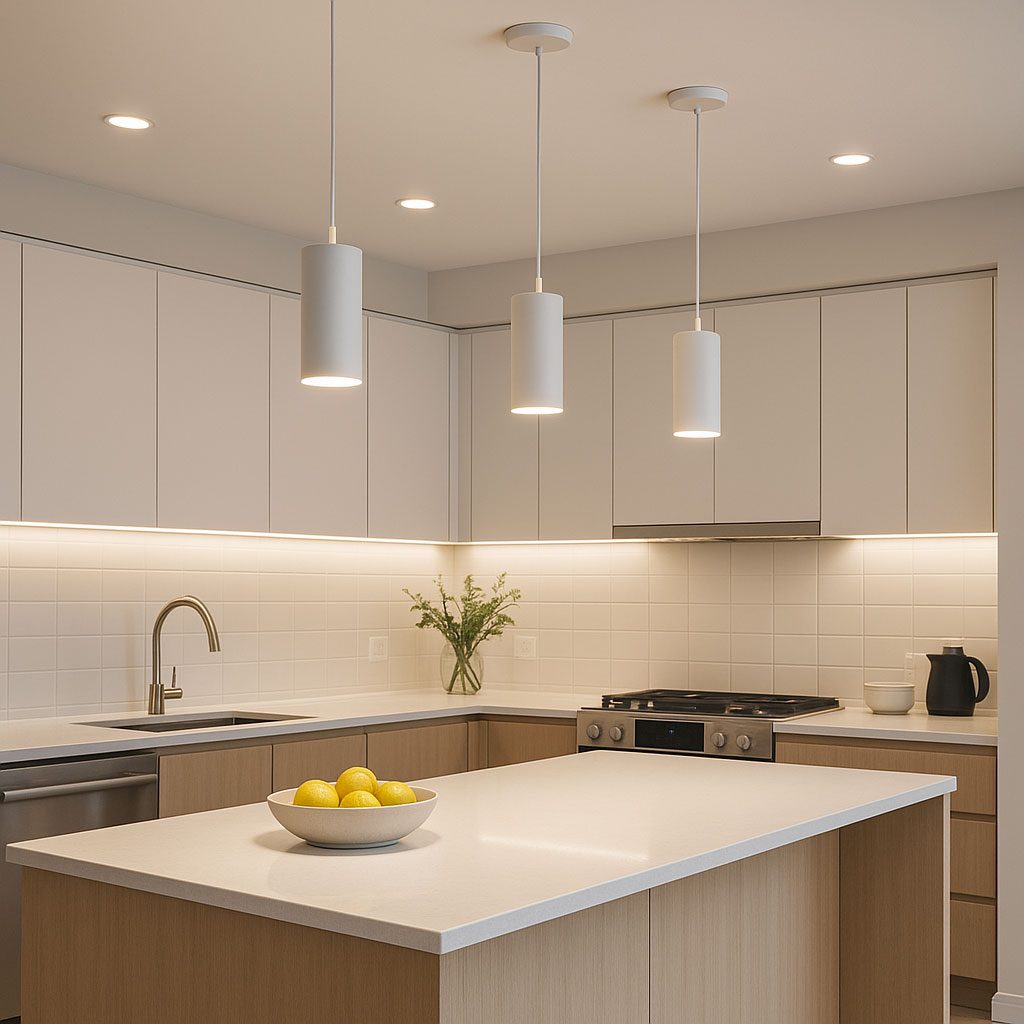
For colour, 3000K is the safe all-rounder and sits happily next to an open-plan living area. 4000K looks crisper and suits very white, modern kitchens. Whichever you pick, use it across the whole ceiling. Look for a CRI of 90 or more too, because food and worktops look washed out under poor-quality light; the CRI guide explains why. There’s much more on layouts in kitchen lighting ideas.
Living room
The living room needs the widest range of any room: bright enough to tidy up or play a board game, low enough for a film. That’s why it shouldn’t rely on the ceiling light.
Keep the pendant or downlights on a dimmer for general light, then put most of the evening light lower down: table lamps, a floor lamp by the reading chair, wall lights either side of a fireplace or in the alcoves. Light on the walls makes a room feel bigger and calmer than light pointed at the floor.
2700K is the classic cosy warm white. 3000K looks slightly cleaner if your room is very pale or modern. I wouldn’t go above 3000K in a living room; it starts to feel like an office after dark.
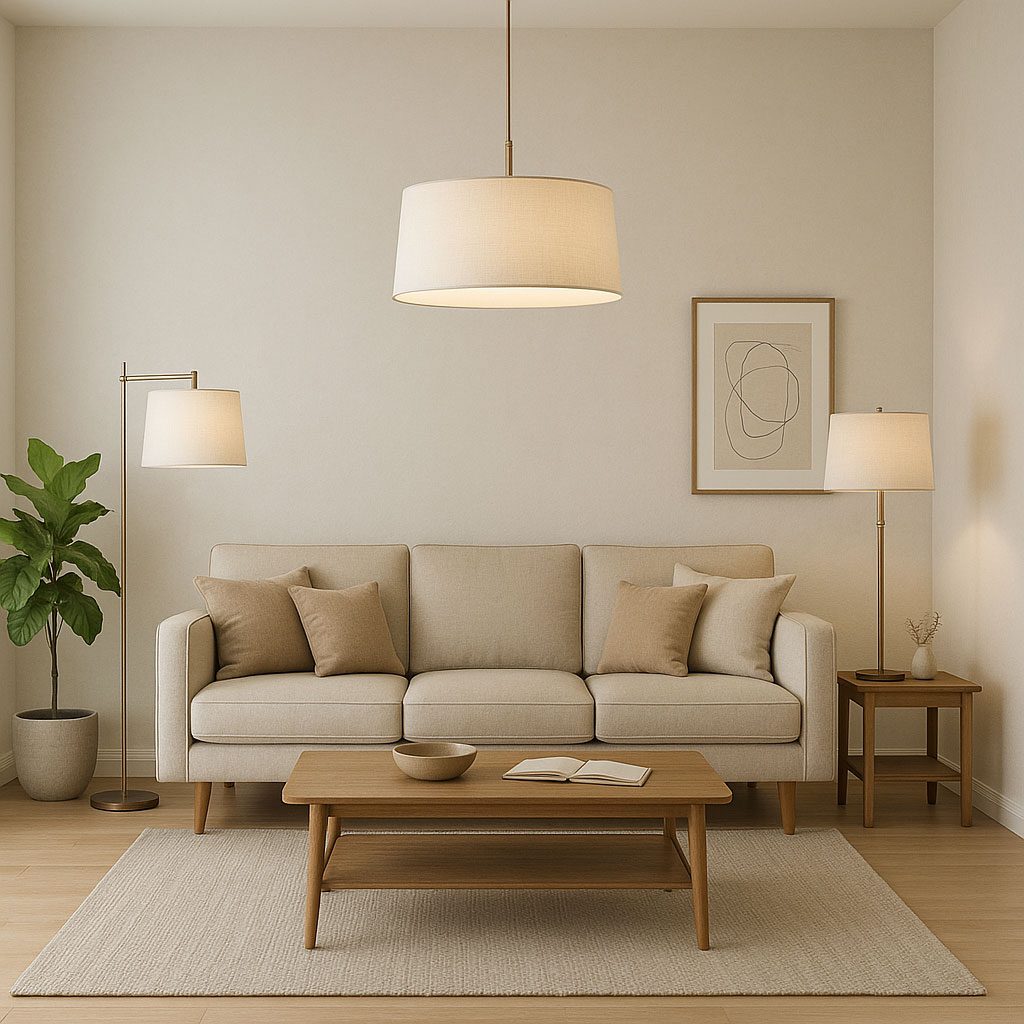
The living room lighting guide goes into placement and dimming in more detail.
Bedroom
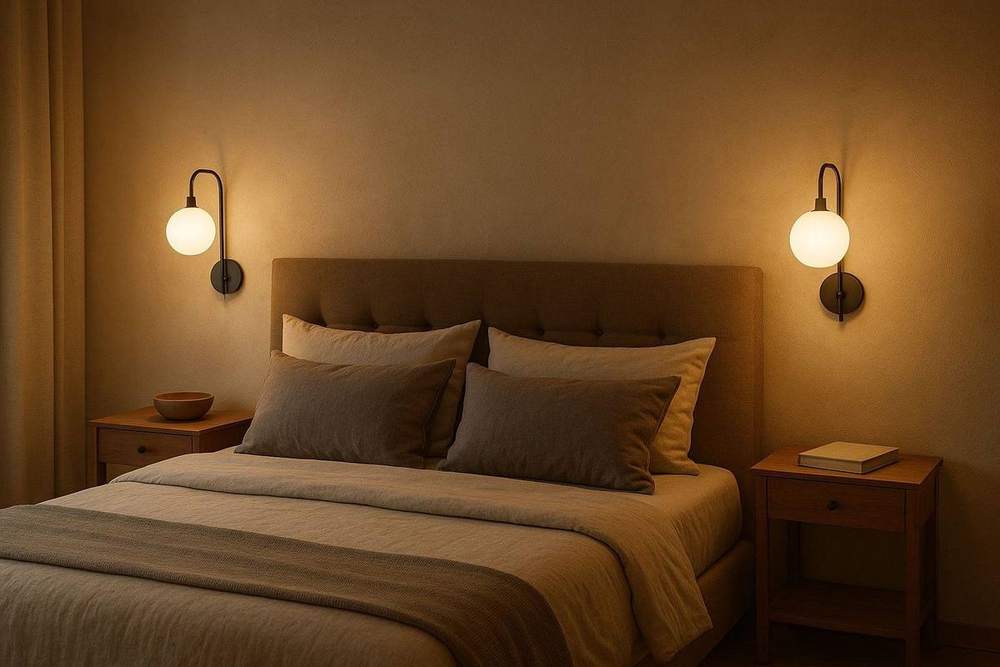
Bedrooms are mostly lit at the start and end of the day, so softness matters more than brightness. A ceiling light on a dimmer for getting dressed and cleaning, bedside lamps or wall lights for reading, and that’s most of the job.
Two things make a bedroom easier to live with. Avoid downlights directly over the bed, because lying down you look straight into them. And put the main light on two-way switching, at the door and by the bed, so nobody crosses a dark room to turn it off.
Wall-mounted reading lights with an adjustable head let one person read without lighting up the other side of the bed. Use 2700K throughout. In a wardrobe, a strip of LED on a door switch is cheap and makes a real difference. There’s more on layering a bedroom in my bedroom lighting ideas.
Bathroom
Bathrooms are where the rules come in. The wiring regulations (BS 7671, Section 701) divide a bathroom into zones around the bath and shower, and each zone needs a minimum level of water protection:
- Zone 0, inside the bath or shower tray: IPX7, and only 12 V SELV fittings.
- Zone 1, above the bath or shower up to 2.25 m from the floor: IPX4 minimum.
- Zone 2, the 0.6 m around the edge of the bath or shower, up to 2.25 m: IPX4 minimum.
Many electricians fit IP65 downlights over a shower anyway, because they’re protected against jets of water. Outside the zones, ordinary fittings are allowed, though in a small bathroom where steam gets everywhere I’d still use IP44 or better. In England, adding to or altering circuits within the bathroom zones is notifiable under Part P, so it’s a job for a registered electrician. The bathroom zones and IP ratings guide has diagrams for different layouts.
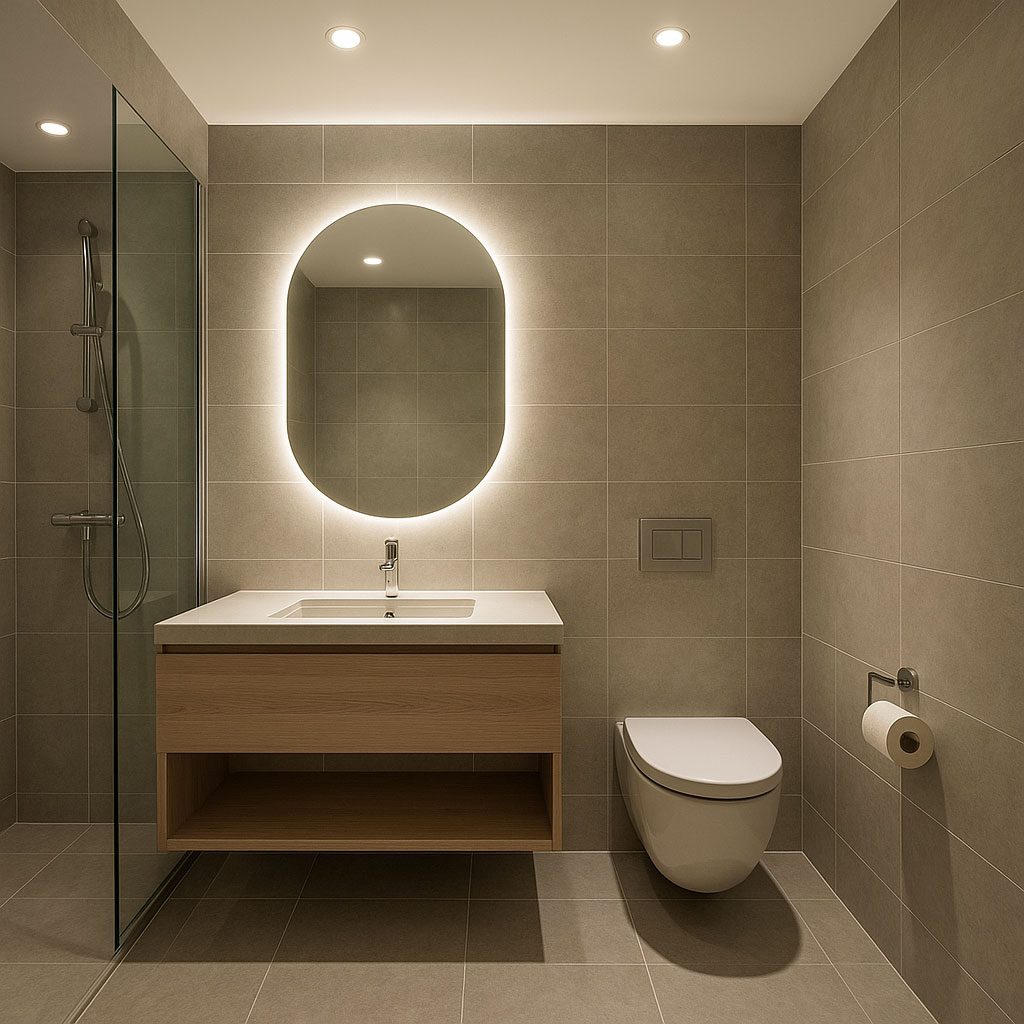
As for the light itself, ceiling lights alone throw shadows under your eyes and chin at the mirror. Light from either side of the mirror at face height, or an illuminated mirror, fixes that. A strip of LED under a floating vanity, on its own switch, makes a good low light for night-time trips. 3000K is relaxing; 4000K is better for shaving and make-up. Some mirrors let you switch between the two.
Home office
The aim is enough light on the desk without glare on the screen, and without a bright desk sitting in a dark room, which is tiring after a few hours.
Aim for 300 to 500 lux on the desk. A ceiling light gives the background; a desk lamp at around 4000K gives the task light, placed on the opposite side to your writing hand so your hand doesn’t shade the page. A light on the wall behind the screen softens the contrast between a bright monitor and a dark wall.
Where the desk goes matters as much as the lights. Put it so windows and ceiling lights sit to the side of the screen. Behind you, they reflect in it; behind the screen, you’re looking straight into them. Desk lamps, bulbs and lighting for video calls are in the home office lighting guide.
Dining areas and open-plan rooms
Over a dining table, a pendant or a row of small ones does most of the work. Hang the bottom of the shade 70 to 90 cm above the tabletop (75 to 80 cm suits most) so it lights the table without glaring in anyone’s eyes, and put it on a dimmer. A wall light or a lamp on a sideboard keeps the rest of the room from going dark when you dim the pendant.
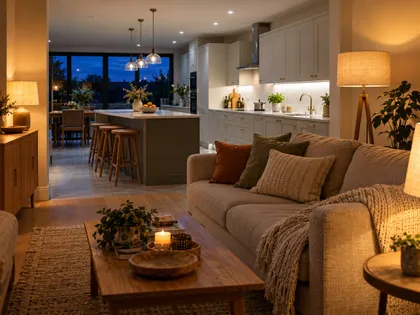
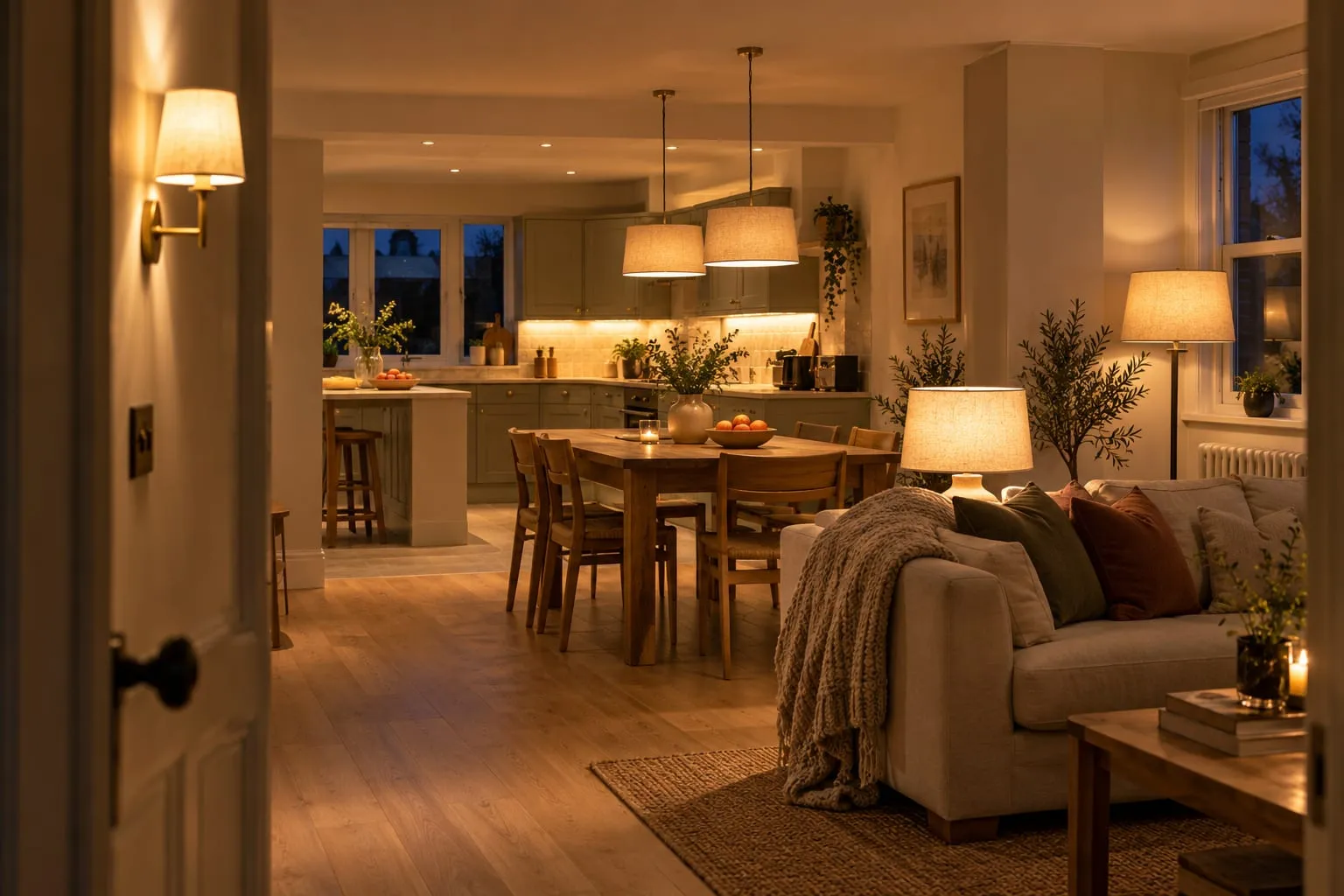
In an open-plan kitchen-diner, give each area its own circuit: kitchen downlights, under-cabinet lights, island pendants and dining light all switched separately. Then you can leave the kitchen in low light while you eat, and the room feels like two spaces instead of one big bright one. Scale matters here too. A large room needs several fittings or one generously sized focal piece; a small pendant in a big space looks lost.
Hallways, stairs and landings
These spaces are about getting through safely, so even light without glare beats anything decorative. Have two-way switching at the top and bottom of the stairs and at each end of a long hall.
On stairs, the aim is to see the edge of each step. A light over the landing shining down the flight works better than one at the bottom shining up, which puts the treads in shadow. Low-level step lights or wall lights are worth considering on a long or turning staircase. A dim night light or a motion sensor on the landing saves turning on the main light at night. Keep everything warm white, 2700K to 3000K. The hallway, stairs and landing lighting guide goes into more detail.
Outside
Start with a wall light by each door. Under a porch or canopy, IP44 is the minimum; on an exposed wall, go for IP65. Spike lights and anything near the ground should be IP65 or better, and lights set into the ground IP67. A motion sensor on the front door light is useful; a bright floodlight aimed at the neighbours’ windows isn’t.
Use warm white, 2700K to 3000K. Cool white looks harsh against brick and planting. Outdoor mains circuits need RCD protection under BS 7671, and a new outdoor circuit is notifiable work, so mains garden lighting is for a registered electrician. Low-voltage plug-in kits and solar lights are the DIY routes. For ideas beyond the basics, see garden lighting ideas.
What modern lighting looks like now
If you’re updating rather than starting from scratch, the direction in UK homes is fairly settled. Warm white has largely replaced the cold, bluish light of early LED bulbs. Rooms are lit in layers, and many modern rooms barely use the central light at all. Fittings have become smaller and quieter: slim downlights, linear lights along a hallway, LED strip hidden in shelving and joinery, so you notice the light rather than the fitting.
Natural materials soften that look: rattan, linen, paper and ceramic shades suit warm light and stop a minimal room feeling cold. Smart control has become useful rather than a novelty: dimming from a phone, lights that come on at dusk, a few scenes you actually use. Statement lighting still has a place, as long as there’s one per space. Let a big pendant over the table or stairwell stand out and keep everything around it plain.
The same thinking now runs outside. Festoon lights over a patio and wall lights that wash up and down the brickwork turn the garden into another room in the evening, rather than a dark rectangle beyond the window.
How to plan any room
- Start with what happens in the room and where the furniture goes. Lights follow the furniture, not the other way round.
- Decide on the general light and work out how bright it needs to be.
- Add task light wherever someone reads, cooks, works or shaves.
- Add one or two low, soft sources for the evening.
- Pick one colour temperature for the room and stick to it.
- Plan the switching: which lights go on together, which get dimmers, and where the switches sit.
- Check the rules: IP ratings in bathrooms and outdoors, fire-rated downlights under rooms, and whether the work is notifiable.
FAQs
What is the best colour temperature for a home?
Warm white, 2700K to 3000K, for living rooms, bedrooms, dining areas and hallways. Kitchens, bathrooms and home offices can go up to 4000K if you like a crisper light. I’d avoid 5000K–6500K daylight bulbs in living spaces; they look cold at night. The colour temperature guide shows the difference.
How many lumens does a room need?
Multiply the floor area in square metres by the lumens per m² figure for the room. A 20 m² living room at 150 lumens per m² needs about 3,000 lumens in total from all its lights. A 12 m² kitchen at 300 lumens per m² needs about 3,600 lumens, plus the under-cabinet lights. These are planning figures, not lux. Add 15 to 30% for dark walls or high ceilings.
Can I mix warm and cool white in one room?
Not within one layer: a ceiling of downlights in two different whites looks patchy. Between layers a small difference is fine, but I keep everything in one room within about 500K, such as 3000K downlights with 2700K lamps.
Do I need an electrician to change a light fitting?
Replacing a light fitting like for like isn’t notifiable in England, so a competent DIYer can do it with the circuit isolated at the consumer unit. New circuits, a new consumer unit and work within the bathroom zones are notifiable. If you’re not sure, use a registered electrician.
Do bathrooms and gardens need special lights?
Yes. In a bathroom, zones 1 and 2 need IPX4 or better and zone 0 needs IPX7 with 12 V SELV. Outside, use IP44 under cover, IP65 on exposed walls and for spike lights, and IP67 for lights set into the ground.
 Save
Save it for later
Pin this guide to one of your Pinterest boards so it's there when you start the job.