Deck lighting ideas: recessed spots, strip lights and step lights

Some links below are affiliate links: if you buy through them I may earn a small commission, at no extra cost to you. As an Amazon Associate I earn from qualifying purchases. How LightGuru makes money

Mike's quick answer
Light the edges and the steps first, then add a soft glow under a bench or rail if you want atmosphere. Use warm white (2700K to 3000K), IP67 for anything set into the boards, and a 12 V plug-in kit if you want to fit it yourself.
A deck sits a step or two above the lawn, gets slippery when it’s wet, and after dark you lose track of where it ends. Light the edges and the level changes and you’ve done the part that keeps people safe. Everything after that is atmosphere.
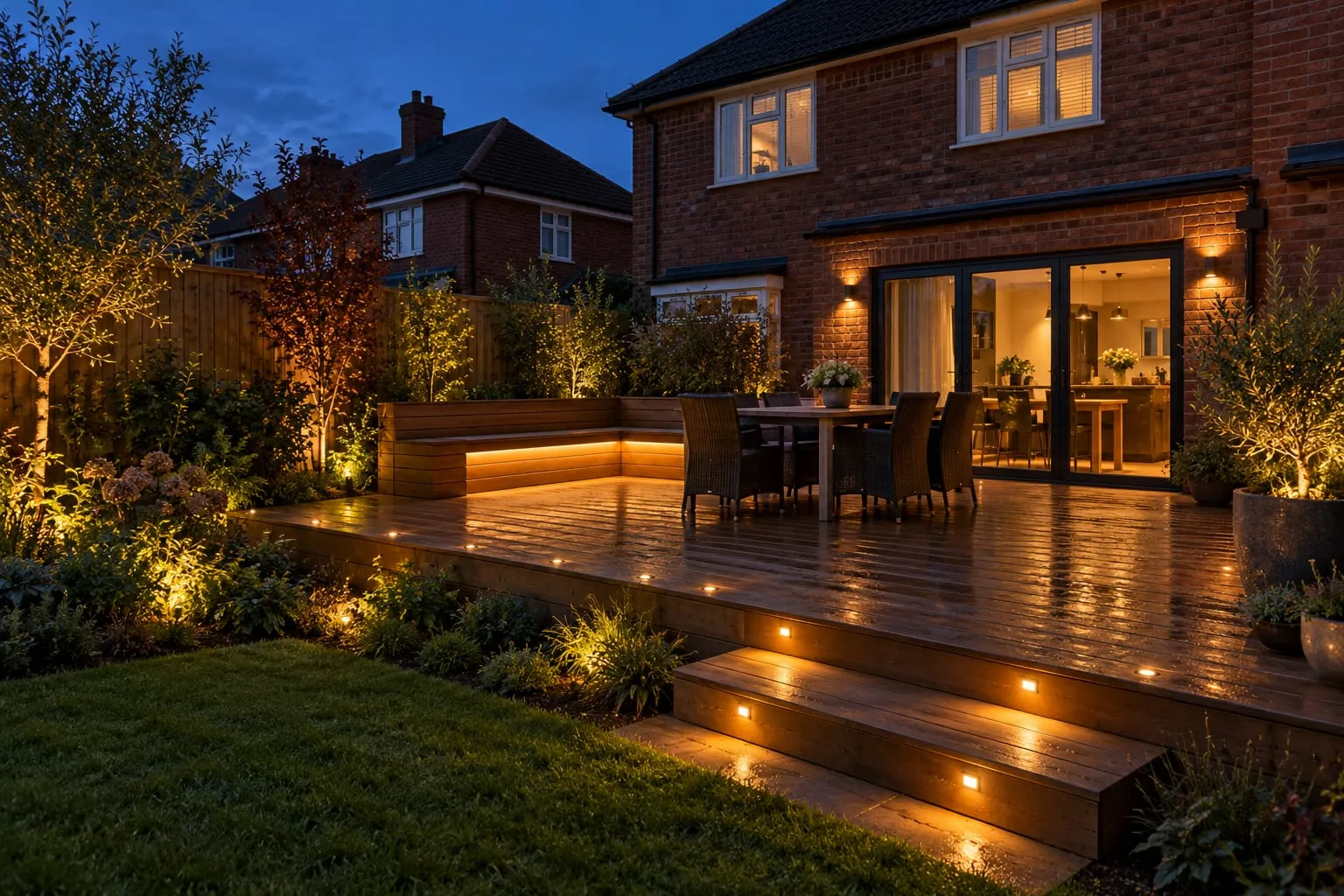
Three kinds of fitting do most of the work: recessed lights set into the boards, LED strip hidden under an edge, bench or rail, and step lights on the risers. The right mix depends on whether the deck is still being built (cable is easy to run under the joists) or already down, in which case a plug-in low-voltage kit is the usual answer.
Recessed deck lights
These are the small round lights set flush into the boards. They’re the most common choice because they disappear in the daytime and mark out the shape of the deck at night.
They work best around the perimeter, along a route across the deck, and where the edge changes direction. Space them evenly, roughly 1 to 1.5 metres apart along a straight edge and a little closer round a curve. A light in every board, or a tight grid across the middle, gives a dotted runway effect that looks busy and gets worse when the boards are wet and reflective.
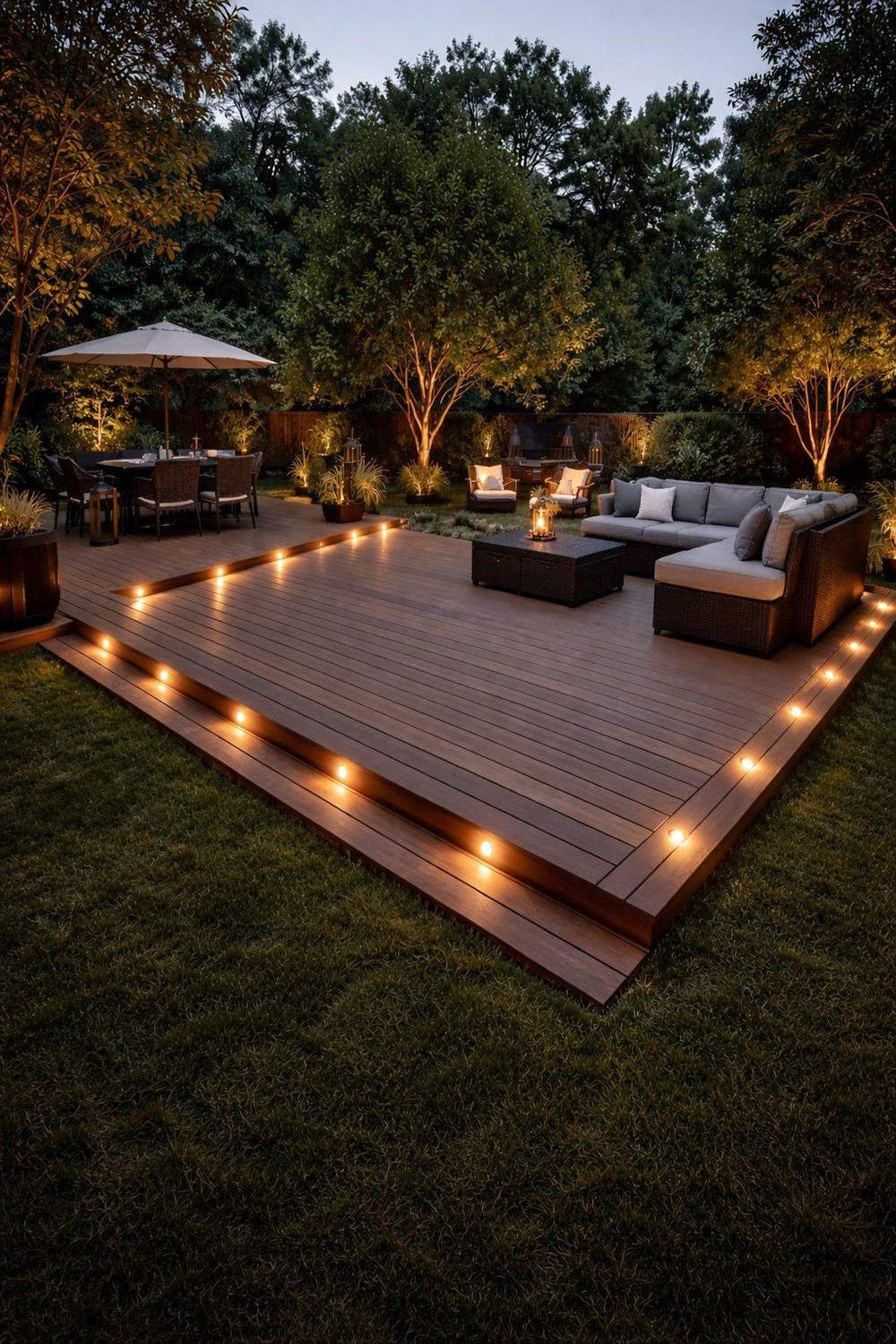
Because they shine straight up, they can catch your eye when you look down. Keep them away from where people sit or stand at a table, and choose ones with a frosted or textured lens rather than a clear one with a bare LED behind it. Check they’re rated to be walked on; most deck lights are, but not all are rated for heavy loads such as a hot tub or a car.
Fitting is a hole in the board (often 30 to 45 mm, the kit tells you) with the cable running underneath. On timber that’s easy. Some composite boards are hollow, so check with the decking maker before you drill, or put the lights in the fascia board instead.
LED strip under edges, benches and rails
Strip gives a continuous glow rather than points of light, and it suits modern decks with built-in seating. The usual places are under the lip of the deck edge, under a bench seat, beneath a handrail and along the fascia.
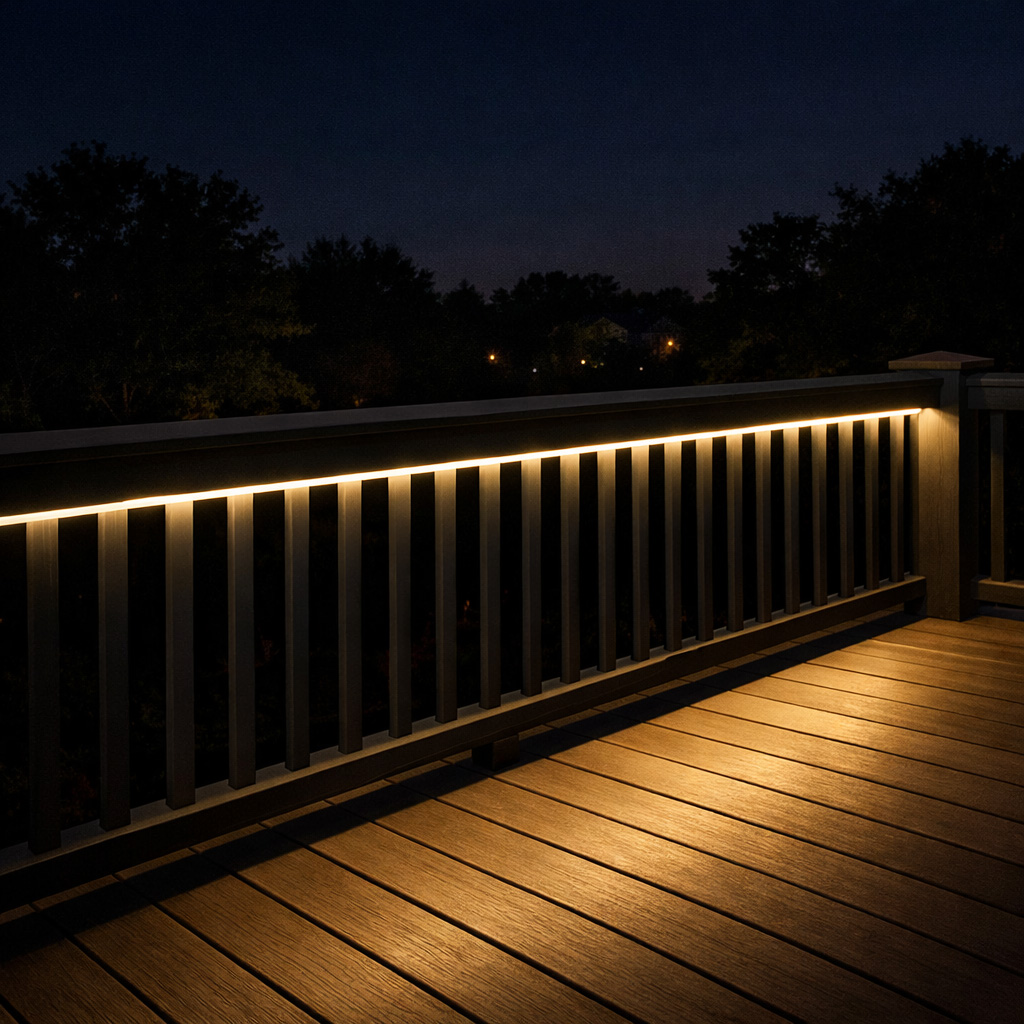
The rule is that you see the light, not the strip. Tuck it behind an overhang or into an aluminium channel with a diffuser so the individual LEDs don’t show as dots. Outdoors, use strip sealed in silicone (IP67 or IP68) rather than the bare IP20 strip sold for indoor shelves, and keep the driver somewhere dry or buy one rated for outdoor use. For runs longer than a few metres, 24 V strip holds its brightness to the far end better than 12 V.
Step lights
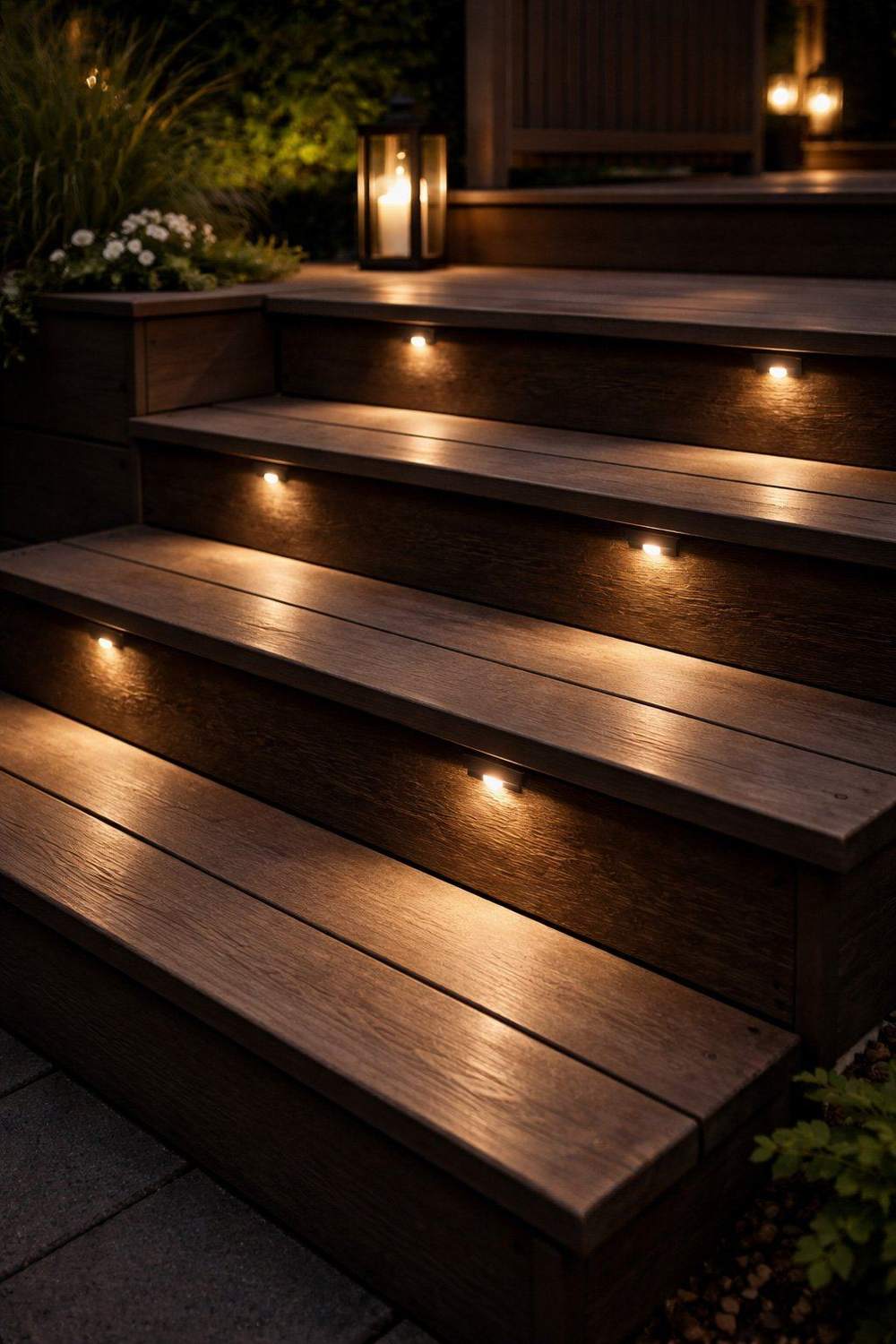
If you light one thing on a deck, light the steps. A level change you can’t see is where people trip, and wet timber makes it worse.
You have two options. Small lights set into each riser throw light down onto the tread below. A strip under each tread nosing lights the edge of every step as a line. Both work; strip looks more modern, individual lights are easier to replace. Whichever you use, keep it the same on every step, and aim the light at the tread edge rather than flooding the whole step.
Which fitting where
| Recessed spots | LED strip | Step lights | |
|---|---|---|---|
| Best for | Edges and routes | Benches, rails, deck lip | Steps and level changes |
| Effect | Points of light | Continuous soft glow | Lit treads |
| IP rating to look for | IP67 | IP67 or IP68 strip | IP65 or better |
| Fitting | Hole in the board | Hidden under an overhang | Riser or under the nosing |
| Rough cost | £30–£80 for a kit of ten | £25–£60 for 5 m with driver | £10–£25 a light |
Most good decks use two of the three: recessed spots or strip for the edges, plus step lights. All three come as 12 V kits. For light over a table on the deck, I’d add festoon or string lights strung overhead.
How bright, and what colour
Deck lighting should be low. Your eyes adjust to the dark quickly once you step outside, and a few soft lights are enough to see the edges and the steps. Indoor brightness, floodlights on the wall, or narrow beams pointed across the deck all make it glaring and flatten the garden behind.
A useful check: the deck shouldn’t be the brightest thing in the garden. If it is, the lawn and borders beyond go black and the space feels smaller. Leave some areas unlit, and light a tree or the planting just past the deck so there’s something to look at. The garden lighting ideas guide covers how the layers fit together.
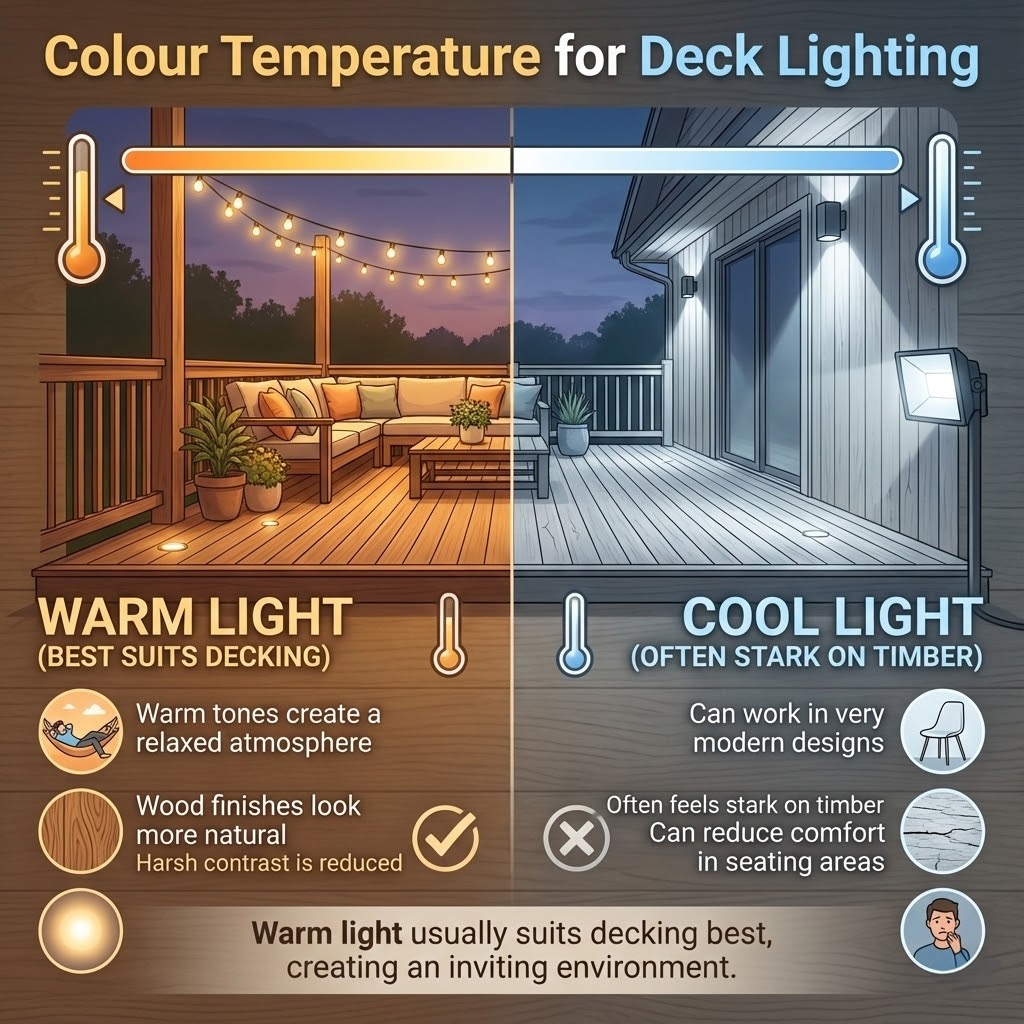
Warm white, 2700K to 3000K, suits timber and composite. Cool white (4000K and above) makes wood look grey and feels harsh in a seating area. Match the colour of everything you can see from the deck, including wall lights and any patio lighting, so it reads as one scheme. More on choosing the white in warm vs cool lighting.
Powering it: 12 V, mains or solar
12 V plug-in kits are the usual choice for decks and the one you can fit yourself. A transformer plugs into an outdoor socket, and everything after it runs at a safe low voltage, so you can cut, drill and clip the cable without an electrician. Many transformers have a dusk sensor and timer built in. Check how many lights and how much cable the transformer is rated for: on long runs the far lights get dimmer.
The socket the transformer plugs into must have 30 mA RCD protection, which the wiring regulations require for outdoor sockets. If yours is old and you’re not sure it has it, get an electrician to check before you rely on it. If you don’t have an outdoor socket, adding one is a job for an electrician too.
Mains (230 V) deck and step lights need an electrician. Buried cable has to be suitable for outdoor use, protected (usually armoured) and deep enough that a spade won’t reach it. In England, a new circuit run out to the garden is notifiable under Part P of the Building Regulations; a registered electrician can self-certify it. Adding a light to an existing circuit isn’t notifiable, but still has to be done to the wiring regulations. NICEIC’s guide to garden electrics sets this out in plain terms.
Solar deck lights need no wiring and are cheap, but most are dim, and in a British winter, with short days and low sun, many barely last the evening. They’re fine for marking an edge on a deck you can’t wire. For more on wire-free options, see lighting a garden path without wiring.
IP ratings for deck lights
Anything set into the boards sits where rain collects and puddles form, so look for IP67, which means the fitting is dust-tight and survives temporary immersion. Step lights in a riser and strip under a sheltered rail get splashed rather than soaked, so IP65 is the sensible minimum there. IP44 is the floor for any light outdoors, and only for spots under cover. The full breakdown of what the numbers mean is in IP ratings for outdoor lighting.
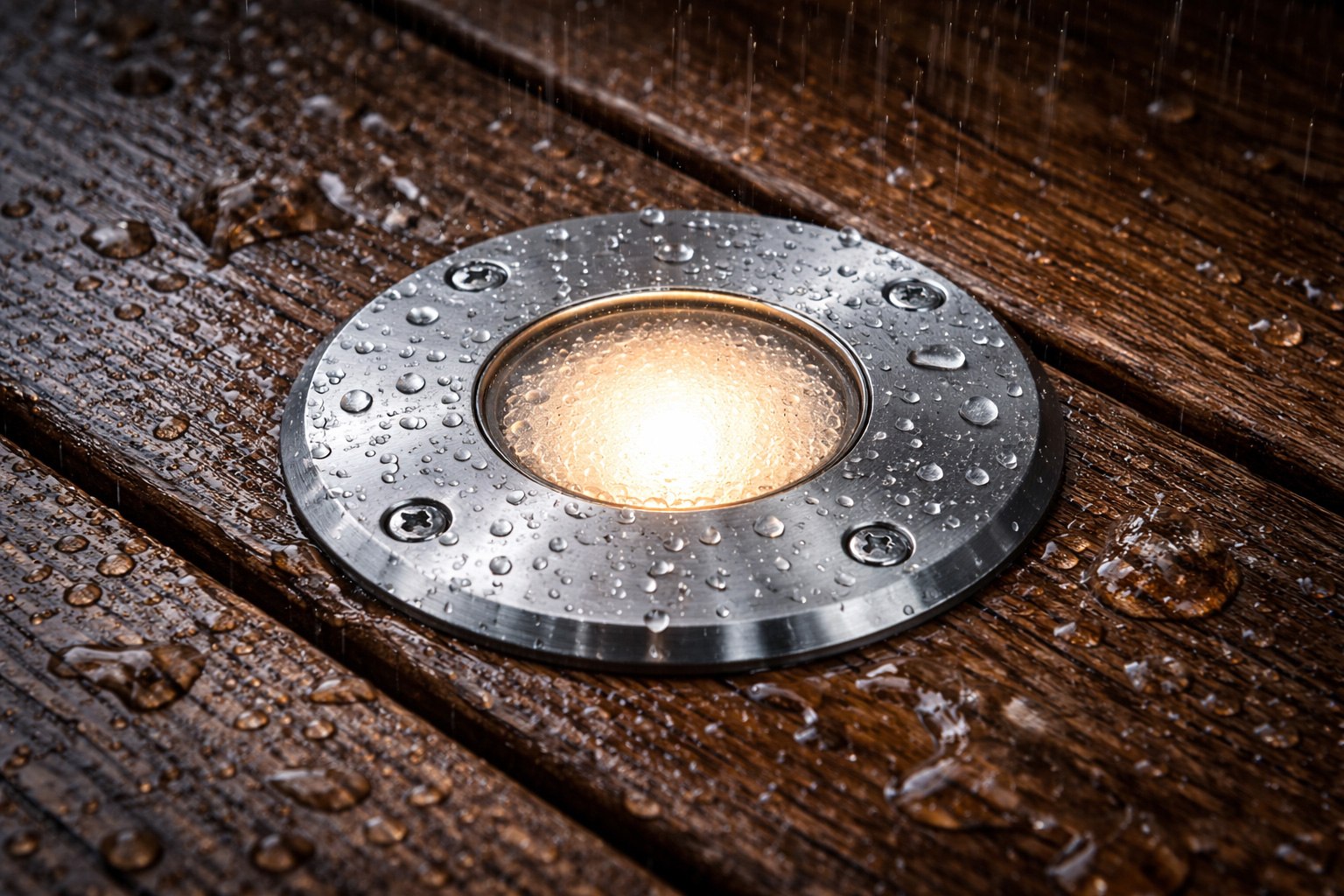
Water getting into a connector, not the light itself, is the usual reason deck lights fail. Use the sealed connectors that come with the kit, keep joints off the ground under the deck, and don’t cut and twist cables together. If some of your lights have already gone, outdoor lighting faults walks through the likely causes.
Mistakes to avoid
Too many recessed lights is the most common one. Fewer, evenly spaced lights look better than a grid, and they guide people round the edge instead of lighting the whole surface.
Next is strip you can see. If the LEDs show as a line of dots, it looks unfinished; move it further behind the lip or add a diffuser.
Then glare at seating height: lights close to benches or low walls shine straight into the eyes of people sitting down. Aim light at edges, steps and surfaces, not at where faces will be.
Last, treating the deck on its own. Deck lights that don’t match the wall lights in colour or brightness look bolted on. Plan them with the rest of the garden, and put them on a timer or dusk sensor so they’re not on all night, which your neighbours will appreciate.
What I'd buy
Affiliate linksFAQs
Are recessed deck lights safe to walk on?
Yes, if they’re sold as deck or walk-over lights and fitted flush. Check the rating before putting them anywhere heavy will sit, such as under a hot tub or planter.
Can I fit deck lights myself?
A 12 V plug-in kit, yes: the transformer plugs into an RCD-protected outdoor socket and the low-voltage side is safe to handle. Mains lights, a new outdoor socket or a new circuit are jobs for a registered electrician.
What IP rating do deck lights need?
IP67 for anything set into the boards. IP65 for step lights and strip in sheltered spots. Never less than IP44 outdoors.
Can you put lights in composite decking?
Usually, yes. Solid composite boards drill like timber. Hollow boards may not hold a recessed light, and drilling can affect the warranty, so check with the manufacturer or use the fascia instead.
Is strip better than spotlights on a deck?
Neither is better overall. Strip gives a soft glow for atmosphere; recessed spots mark edges and routes. Many decks use spots on the perimeter and strip under the seating.
Should deck lights stay on all night?
There’s rarely a reason to. A timer or dusk-to-midnight setting covers the evening, saves the lights and is kinder to neighbours and wildlife.
 Save
Save it for later
Pin this guide to one of your Pinterest boards so it's there when you start the job.