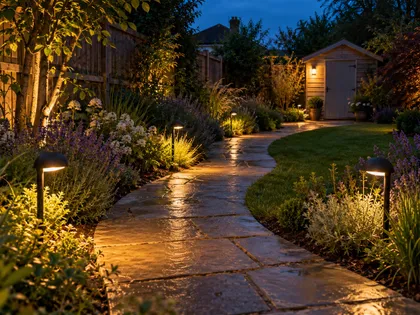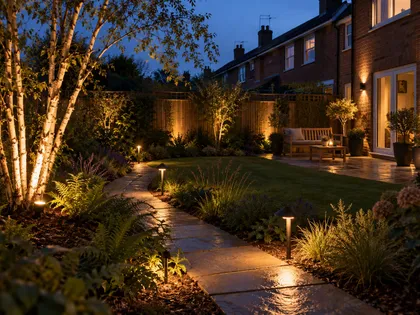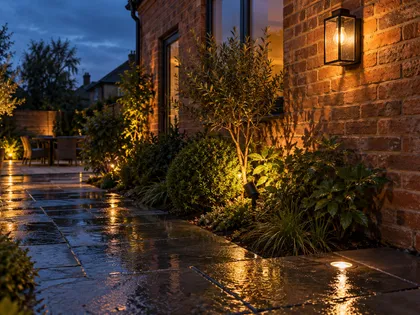
How to light a garden path without wiring: the options that work

Some links below are affiliate links: if you buy through them I may earn a small commission, at no extra cost to you. As an Amazon Associate I earn from qualifying purchases. How LightGuru makes money
This guide mentions Enso Lighting, a business I work with. I've flagged it wherever it comes up. More on that

Mike's quick answer
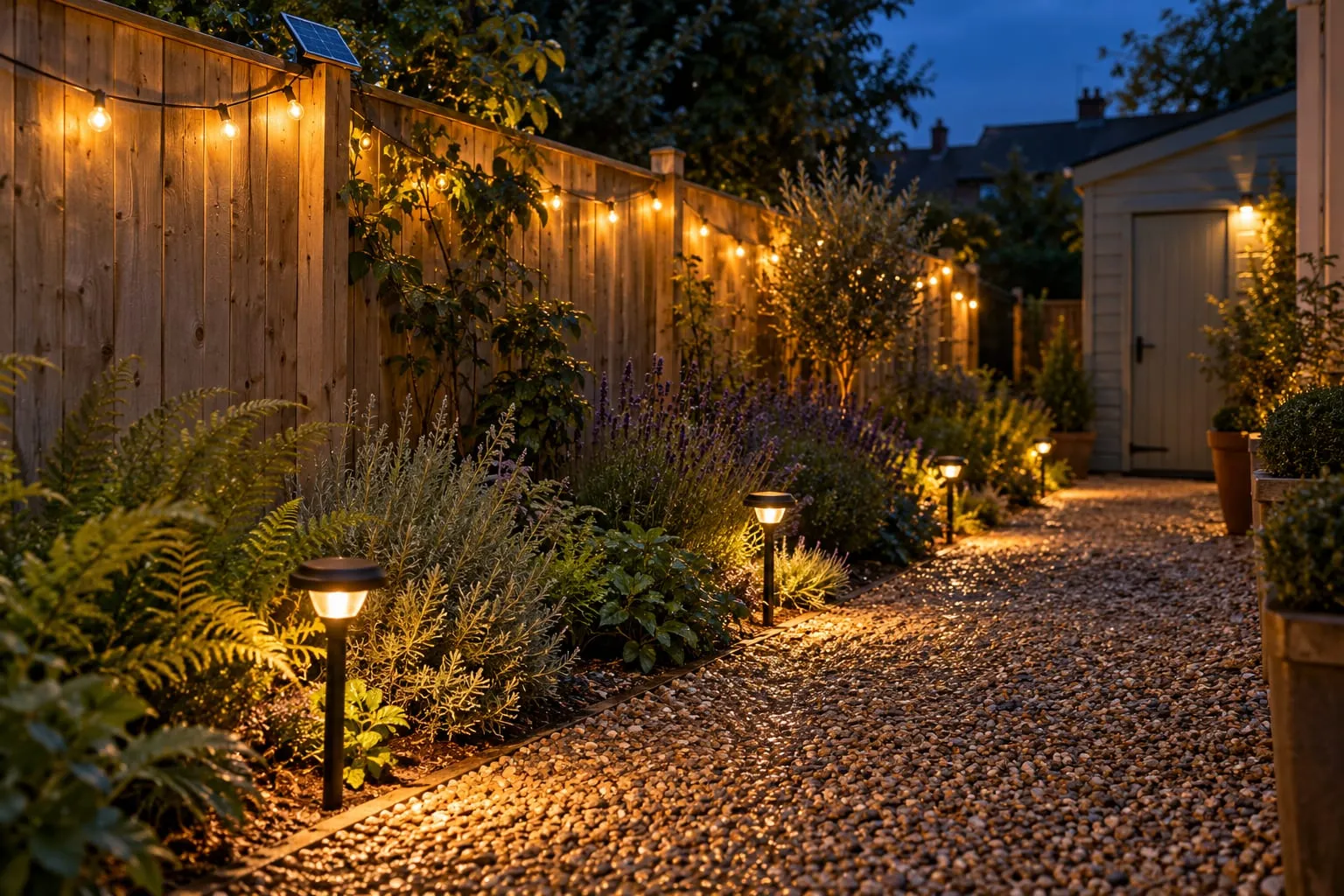
Solar stake lights are the easiest way and fine from spring to autumn, but many fade early on grey winter days. For a path you use every night of the year, a plug-in 12 V kit is the better answer: no electrician and no digging, as long as you have an RCD-protected outdoor socket. Battery or rechargeable lights fill in shady spots.
You can light a garden path without digging a trench or getting an electrician in. Solar lights push into the ground, battery lights go anywhere, and a plug-in low-voltage kit runs off a socket with its thin cable laid through the border.
What decides which one works for you is how much sun the path gets, and whether you need it lit in December or just on summer evenings. Solar is brilliant in June and often disappointing in January, which is when most people actually walk down the garden in the dark.
The options at a glance
| Solar | Battery or rechargeable | Plug-in 12 V | |
|---|---|---|---|
| Brightness | Low | Low to medium | Medium, like wired lights |
| Winter | Weak, often off early | Fine if charged | Same every night |
| Shady path | Struggles | Fine | Fine |
| Fitting | Push into the ground | Place or screw up | Lay cable, plug in |
| Needs | Direct sun | Charging or new batteries | An outdoor socket |
| Rough cost | £10–£50 for a set | £15–£50 for a few | £50–£120 for a kit |
Yellow = the better option on that line.
Solar stake lights
Solar stake lights are the cheapest and quickest option. A small panel on top charges a battery during the day and a sensor switches the light on at dusk. You can line a path in half an hour.
The trouble is that quality varies enormously. Many cheap stakes put out only a few lumens, enough to show where the path is but not to light it, and they’re often in cool, bluish white. When you buy, look for:
- A stated output in lumens. Better path lights list one, often somewhere around 10 to 50 lumens. If there’s no figure, assume it’s dim.
- Warm white, around 2700K to 3000K. It looks far better against planting and paving than the blue-white of cheap sets.
- A replaceable battery. The rechargeable cell usually gives out before the LED does. If you can swap it, the light lasts years longer.
- IP65, or IP44 at the very least, and a metal or solid housing that won’t go brittle in the sun.
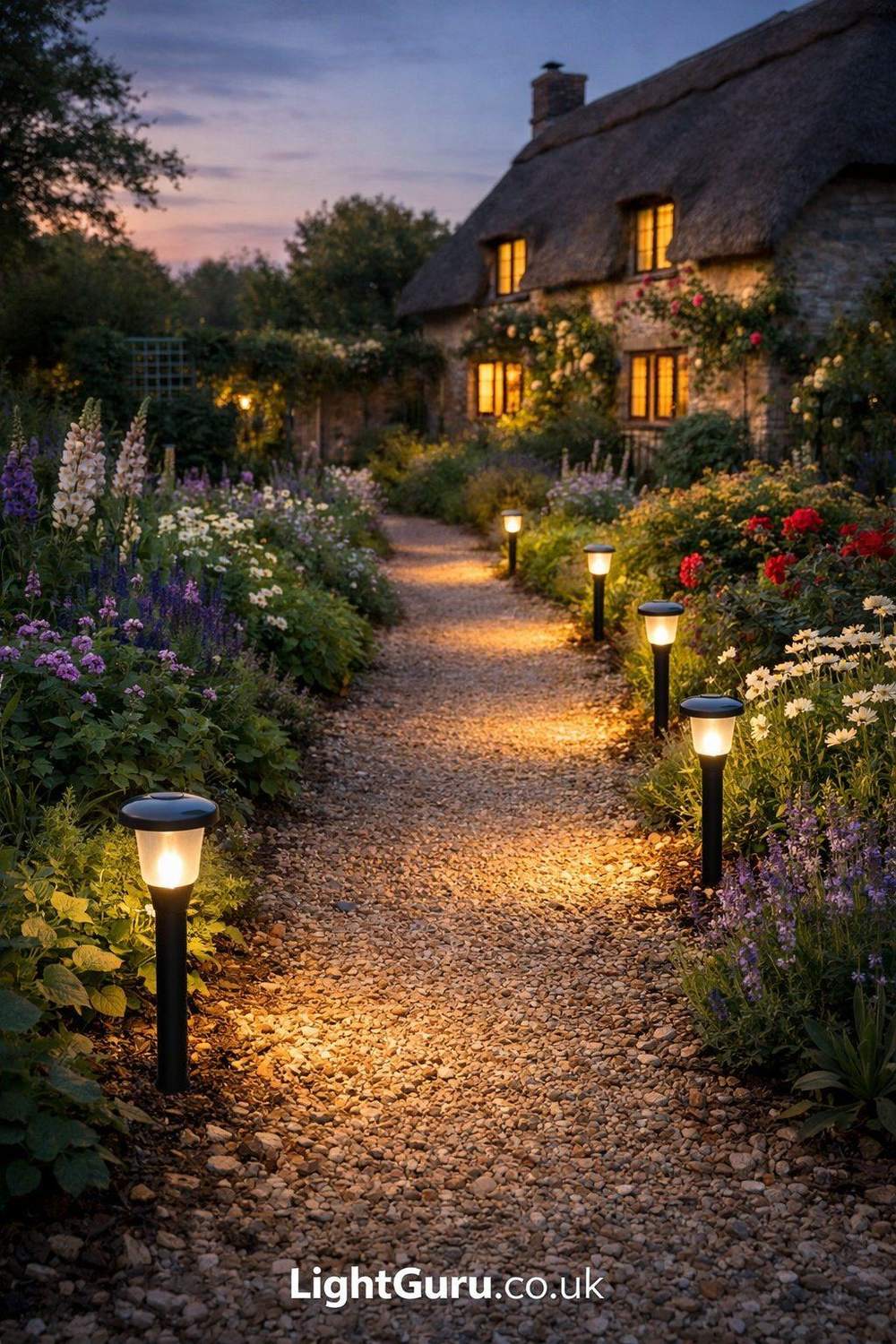
Position matters more than the light itself. Each panel needs several hours of direct sun a day, so check the path at midday: anything in the shadow of the house, a fence, a hedge or a tree will undercharge. Space stake lights about 1.5 to 2 metres apart, along one side of a narrow path or staggered on a wider one. A 10-metre path needs roughly five to seven.

Solar lights with a separate panel
If the path is shady but there’s sun nearby, choose solar lights with a separate panel on a cable. The panel goes on a fence top, shed roof or sunny bed, and the lights go where you need them. This is the best way to make solar work in a typical British garden, where the path often runs down the shady side of a fence.
The same idea applies to solar spotlights and solar string lights: a panel on a lead (usually 2 to 5 metres) gives you far more freedom than lights with the panel built in. Solar bollards, which are taller and have a bigger panel on top, are another step up. They give a wider spread of light, and because they’re dimmer than mains bollards, space them about 2 to 3 metres apart.
Battery and rechargeable lights
For paths that get no direct sun at all, battery and rechargeable lights are the answer. Battery lights run on AA or AAA cells (use rechargeables to keep costs down); rechargeable lights charge indoors by USB or on a dock and go back out fully charged, whatever the weather.
Look for a timer that switches them off after four or six hours, or a motion sensor, so a charge lasts more than a night or two. They’re also the most flexible option: move them to light the route to the patio for a party, then back to the path.
The downside is upkeep. A dozen lights at the far end of a long garden that need charging every few days soon becomes a chore, so use them to fill the shady gaps rather than for a whole path.
Motion-sensor lights for steps and gates
At a gate, a set of steps or the side passage, you only need light for the moment you’re there. Solar or battery lights with a motion sensor (PIR) stay dark until someone approaches, which means the battery lasts much longer and the light can be brighter when it’s on.
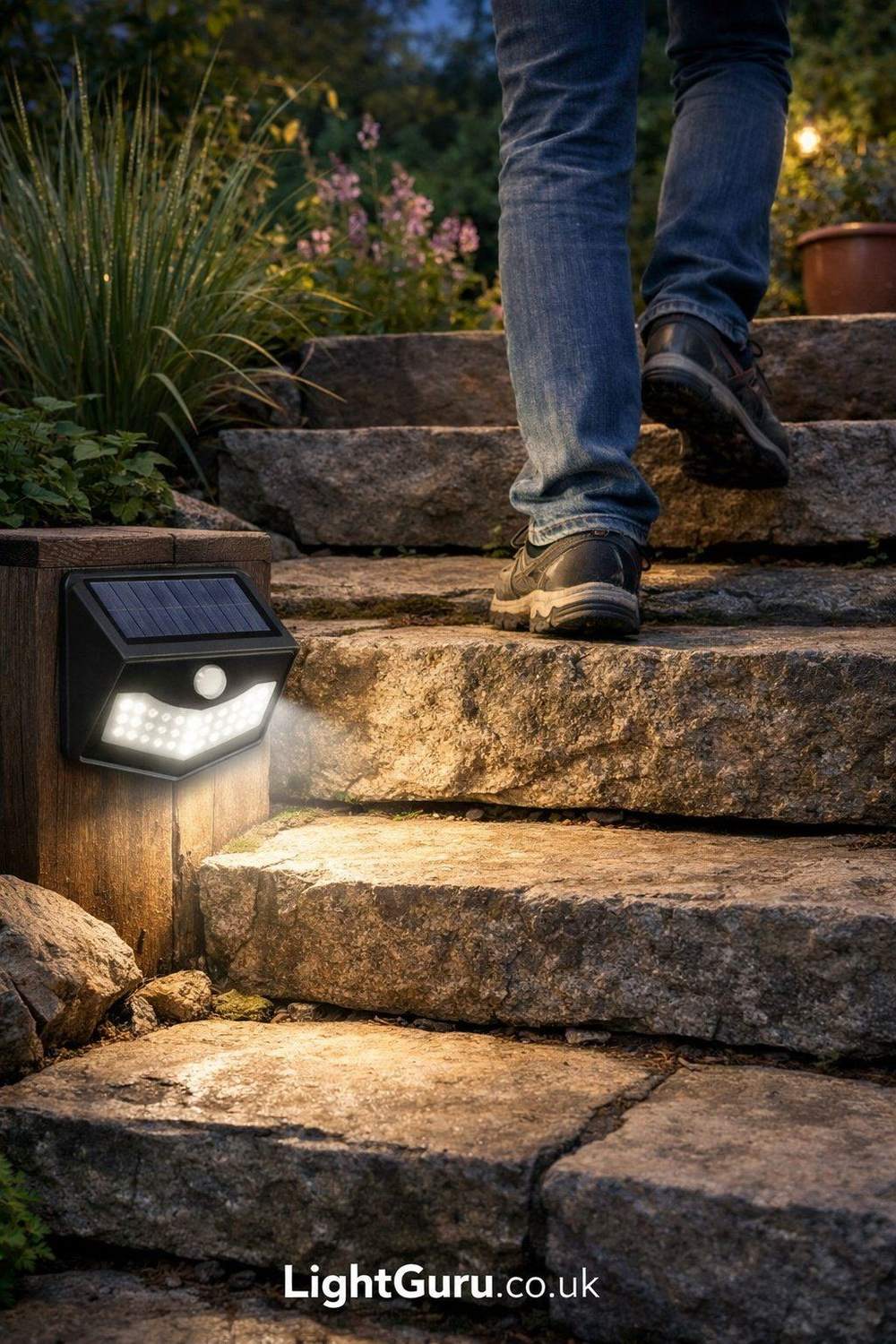
Fix them low on a wall, post or the side of a step so they light the treads, and aim the sensor at the direction people approach from rather than across a road or a neighbour’s garden. Adjustable sensitivity and on-time settings help stop the fox setting them off all night.
Lanterns and string lights
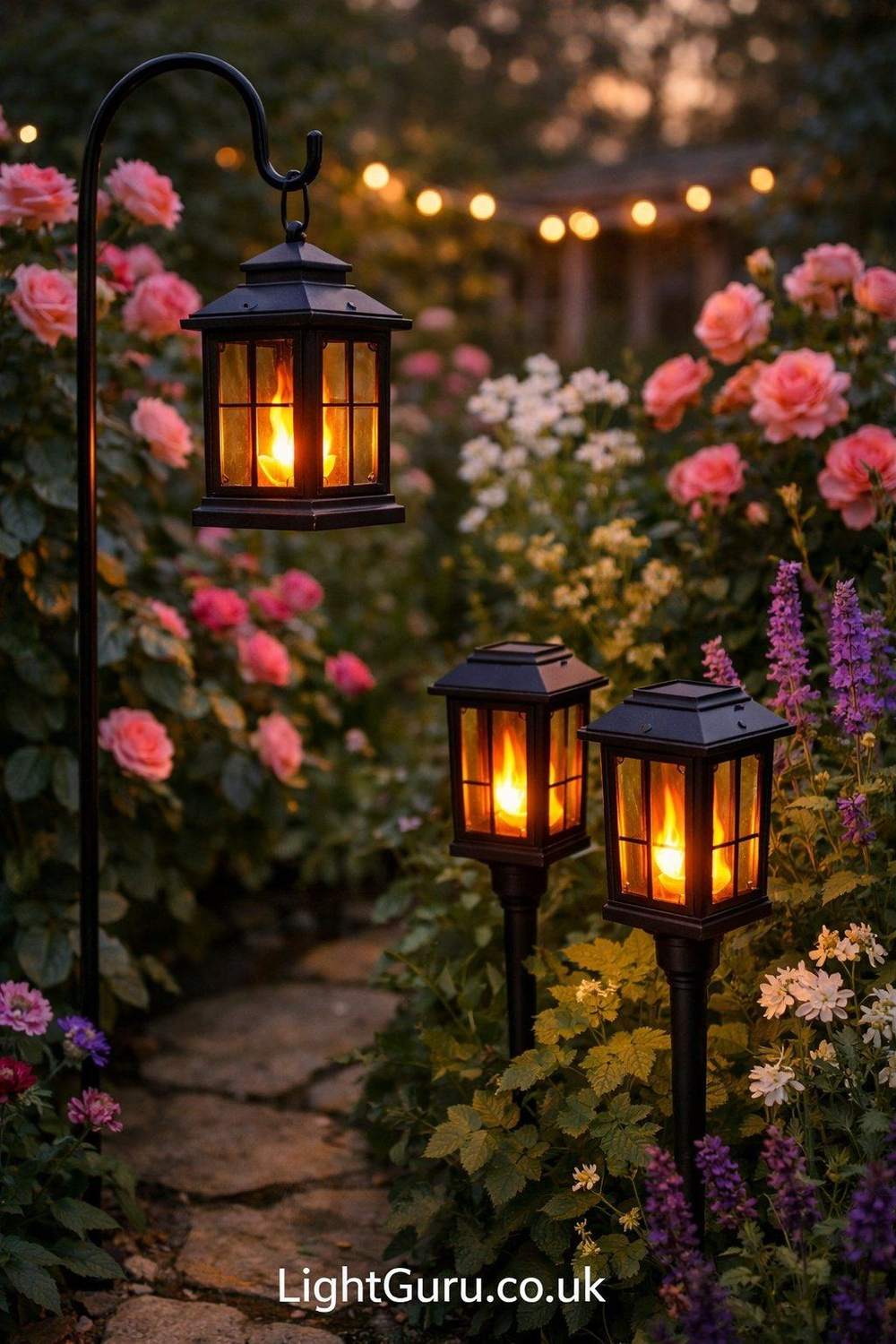
Solar lanterns on shepherd’s hooks, or set at path junctions and by a bench, add decorative light rather than practical light. They suit cottage gardens and informal paths. Warm white or a candle-effect LED looks right in a lantern; avoid anything that glows blue.
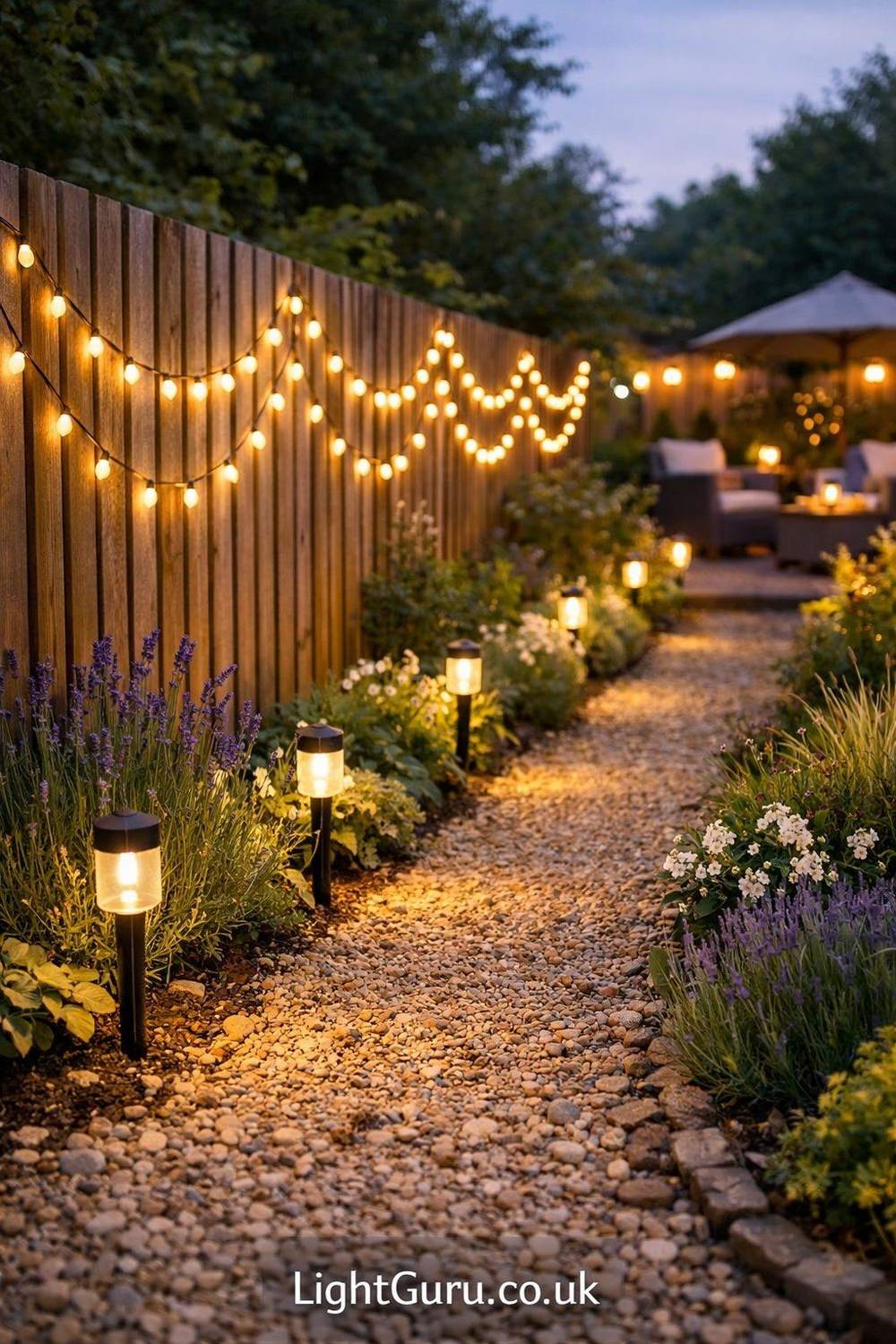
Solar string lights along a fence beside the path give a soft glow across it and look lovely in summer. Choose a set with the panel on a long lead, so it can sit in the sun while the lights run through the shade, and fix the string to the fence in gentle swags. For lighting the patio at the end of the path, see patio lighting ideas.
Plug-in 12 V kits: no electrician, no digging
If you want a path lit properly every night of the year, this is the option I’d choose. A plug-in low-voltage kit has a transformer that plugs into a socket and turns mains into 12 V. Thin, low-voltage cable runs from it through the borders, and path lights, spike lights or deck lights clip onto it. Because the cable in the garden is only 12 V, you can lay it on the soil under bark or mulch, or in a shallow slot, and move lights whenever you like.
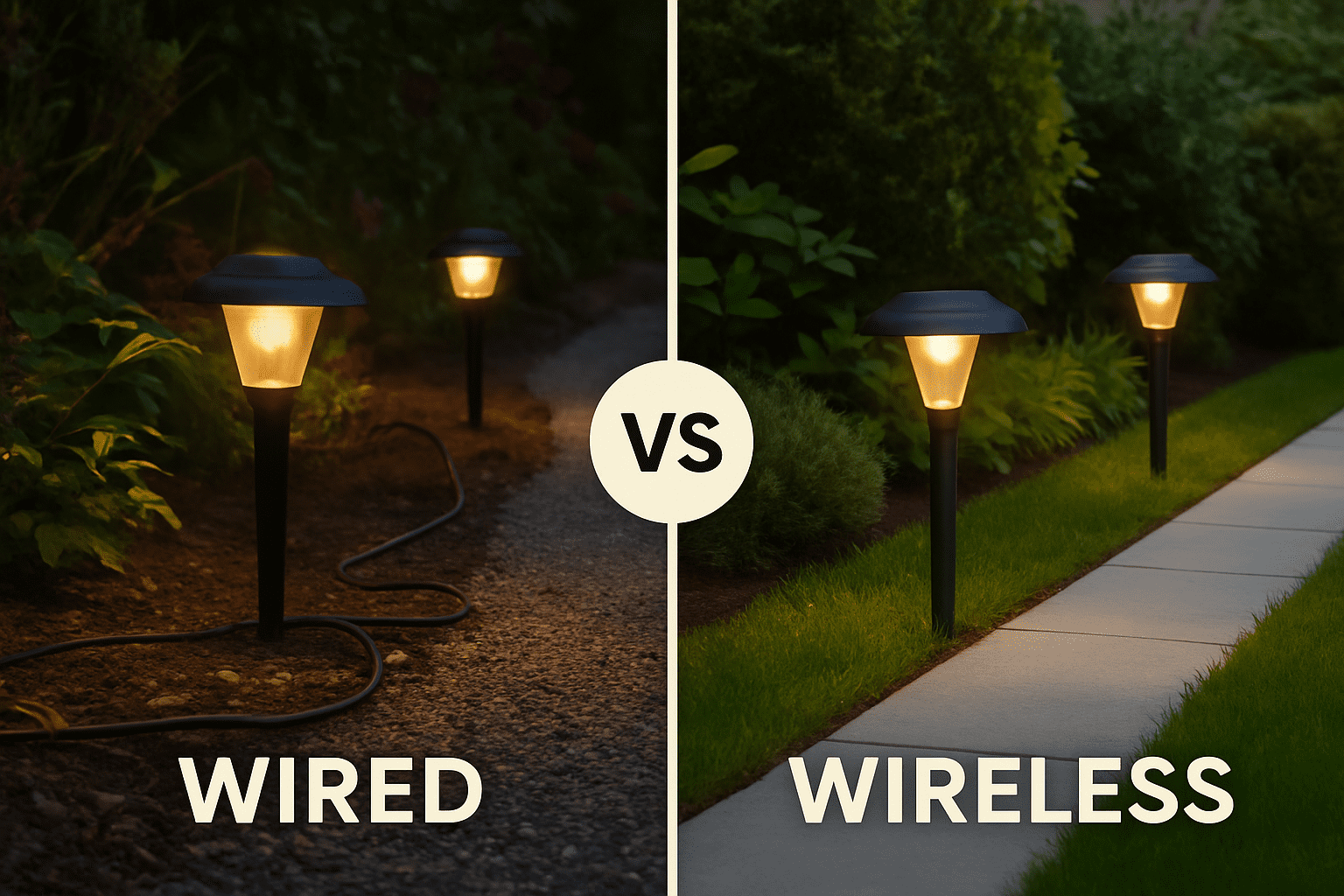
You need a socket for the transformer. An RCD-protected weatherproof outdoor socket on the back wall is ideal. If you only have indoor sockets, don’t run the cable through a window or door where it can be trapped and crushed; getting an electrician to fit an outdoor socket is a small job and opens up all sorts of garden lighting. Check the transformer is rated for outdoor use (usually IP44) if it will sit outside, and stay within its maximum load.
The output is the same as wired path lights, they work in any weather, and most kits have a dusk sensor or timer built in. For more on choosing path lights, spacing and brightness, see pathway lighting ideas.
Getting the most from solar in winter
In December much of the UK gets under eight hours of daylight, often under thick cloud, and the sun is low enough that fences and houses shade most of the garden. Solar lights that ran until midnight in July may manage a couple of hours. A few things help:
- Put panels where they get the most direct sun, ideally facing south, clear of shade from the house and evergreens.
- Wipe the panels every few weeks. Grime, bird droppings and fallen leaves cut the charge more than people expect.
- Replace tired batteries. If the lights have been getting dimmer or going off earlier for a while, the cell is usually the problem.
- If a light has an on/off switch, turning it off for a few days in deep winter lets the battery charge fully.
The solar garden lighting guide goes further into which solar lights cope with a UK winter, and when to go mains instead.
When a cable is worth it
If you try solar, find it too dim in winter and don’t fancy a 12 V kit, mains lighting is the long-term fix: brighter, reliable and lasting decades. A bollard every few metres along a main path, wired by an electrician, is the classic way. Enso Lighting’s Halden bollard in matt black (I work with Enso Lighting) is one example; Saxby, Endon and Nordlux all make outdoor bollards too, and there’s a range of IP65 garden bollard lights at most prices.
Mains outdoors is a job for a registered electrician. The circuit needs 30 mA RCD protection, the cable has to be suitable for outdoor use and buried deep enough to be clear of spades, and a new circuit is notifiable under Part P of the Building Regulations in England and Wales, which a registered electrician self-certifies. For planning a bigger scheme, see garden lighting ideas.
Fitting and looking after them
Push stakes in fully and firm the soil around them so they don’t lean or blow over; in hard or stony ground, make a pilot hole with a metal rod first so you don’t snap the stake. Live with the layout for a week before you settle on it, and move any light that shines into your eyes from the back door or leaves a dark gap.
Once a year, check for condensation inside the lenses and perished seals, which let water in. A light with water inside rarely recovers. For IP ratings and what they mean in a British garden, see IP ratings for outdoor lighting, and near the sea, outdoor lights for coastal homes explains which materials last.
What I'd buy
Affiliate linksFAQs
Do solar path lights work in winter?
Yes, but much less well. Short, grey days mean a weaker charge, so many solar lights only run for a few hours and are dimmer. Lights with a separate panel in a sunny spot, and clean panels, help. For a path you rely on in winter, a plug-in 12 V kit is more dependable.
How many solar lights do I need for a path?
Space them about 1.5 to 2 metres apart. A 10-metre path needs roughly five to seven stake lights, along one side or staggered. Solar bollards can go about 2 to 3 metres apart.
How long do solar garden lights last?
The LED lasts many years; the rechargeable battery usually fails first, often after two or three seasons. Lights with a replaceable battery and a solid metal housing last longest. Cheap all-plastic ones may only manage a season or two.
Are solar lights bright enough to be safe?
For marking the edges of a path, yes. They won’t light steps or a long path as well as wired lights, and they’re no use as security lights. On steps, a motion-sensor light that comes on brightly when you approach is the better wireless choice.
Can I fit a 12 V garden lighting kit myself?
Yes. Plug-in low-voltage kits are designed for DIY, as long as the socket you use is RCD-protected and suitable for outdoors, or the transformer stays indoors without the cable being trapped in a window or door. Only the outdoor socket itself, if you don’t have one, needs an electrician.
What IP rating do I need for path lights?
IP44 is the minimum for anything outdoors. IP65 is better for path lights out in the rain, and IP67 for anything set into the ground where water can sit.
 Save
Save it for later
Pin this guide to one of your Pinterest boards so it's there when you start the job.