Solar garden lights that still work in a British winter (and when to go mains)

Some links below are affiliate links: if you buy through them I may earn a small commission, at no extra cost to you. As an Amazon Associate I earn from qualifying purchases. How LightGuru makes money

Mike's quick answer
Most solar lights fade by November because a British winter day doesn't give a small panel enough sun. The ones that keep going have a bigger panel on a cable that you can put in full sun, a lithium battery and a modest, honest lumen figure. Use them to mark paths and light a shrub. For a path you use every winter night, fit a plug-in 12 V kit, and put security lights on mains.
Solar garden lights are brilliant in June. You push them into the border, they glow until midnight and they cost nothing to run. Then the clocks go back, and by November half of them come on at teatime, glow weakly for an hour and give up.
That usually isn’t a faulty light. A British winter gives a small panel very little to work with, and most solar lights have a panel that’s only big enough for summer. How long yours keeps going depends on how much sun the panel gets in December, how big it is, and what you’re asking the light to do. Marking a path is easy. Lighting the drive for security is not.
How solar lights work
Every solar light has the same four parts. A panel turns daylight into electricity. A rechargeable battery stores it. An LED turns it back into light. And a small circuit acts as a dusk sensor, switching the LED on as the daylight fades. On most lights the panel itself is the sensor: when its output drops at dusk, the light comes on, which is why covering the panel with your hand makes it light up.
A solar light can only give out what its panel took in, so the panel, not the LED, sets the limit. In summer there’s sun to spare. In winter it decides everything.
Why most fail in a British winter
Three things work against a solar panel from November to February, and they stack up.
The days are short. In London the shortest day has 7 hours 50 minutes of daylight, almost nine hours less than the longest. In Edinburgh it’s just under seven hours.
There’s little sunshine in those hours. On the Met Office’s 1991–2020 averages, the UK gets about 43 hours of sunshine in the whole of December, under an hour and a half a day, against about 171 hours in June. Most winter daylight comes through cloud.
The sun is low. At midday on the shortest day in London it’s only about 15 degrees above the horizon, against about 62 in June; in Edinburgh it’s about 11. Low sun hits a flat panel, the kind on top of most stake lights, at a glancing angle, so the panel catches only about a quarter of the direct sunlight it would if it faced the sun. And low sun throws long shadows. A spot that’s in full sun all summer can get none at all in December.
| June | December | |
|---|---|---|
| Daylight in London | About 16 h 40 min | 7 h 50 min |
| Average UK sunshine | About 171 h a month | About 43 h a month |
| Midday sun height, London | About 62° | About 15° |
| Midday shadow of a 1.8 m fence | Under 1 m | Nearly 7 m |
Cold makes it worse, because batteries give less when they’re cold. Put together, a panel collects a small fraction of its June charge on a December day, so a light built for summer comes on at dusk, around 4pm in midwinter, and runs flat by early evening.
What to look for
A separate panel on a cable
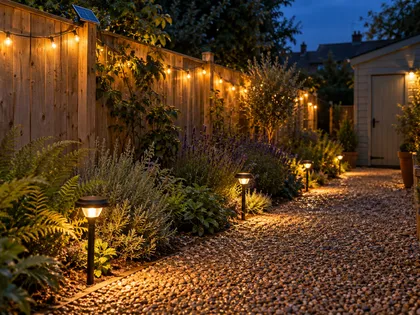
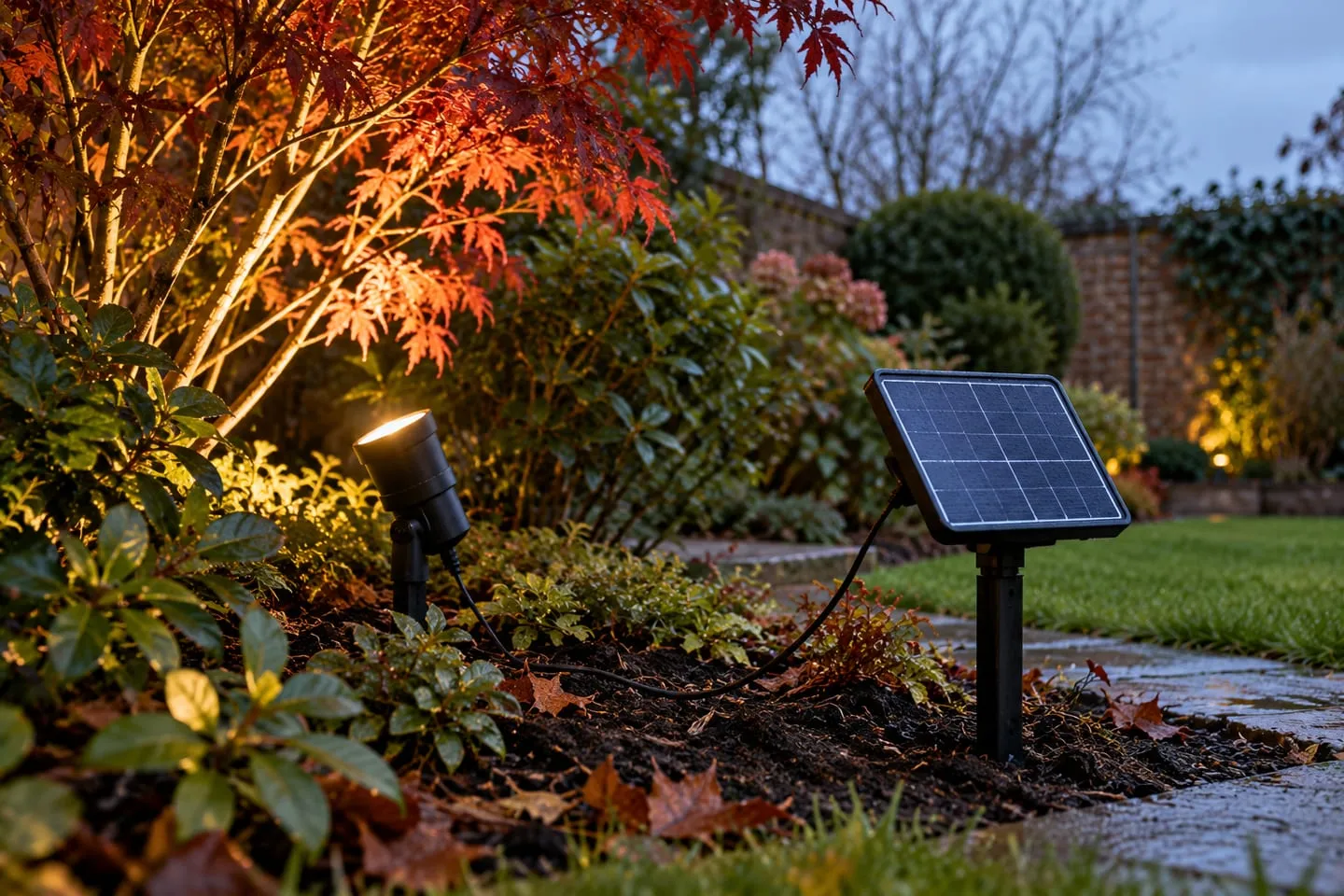
If I could pick only one feature, it would be this. On solar spotlights with a separate panel, the panel sits on a cable, usually 2 to 5 metres long, so it can go on a fence top, a shed roof or a sunny bed while the light sits in the shade where you want it. It can be angled at the low winter sun instead of lying flat, and it’s usually much bigger than the little square on top of a stake light. You can get solar spotlights with a separate panel from about £20 a pair, and string lights, festoons and wall lights come this way too.
If the maker gives the panel’s wattage, compare it between lights: more watts means more charge on a dull day. And if one panel feeds two or three lights, they share what it collects.
A lithium battery, and enough of it
Cheap stake lights usually run on a single AA or AAA nickel-metal hydride (NiMH) cell at 1.2 volts. Better lights, especially spotlights, use lithium cells, often the 18650 size at 3.7 volts. Compare them by multiplying capacity by voltage, not by the milliamp-hour (mAh) figure alone: a 600 mAh NiMH AA holds about 0.7 watt-hours, while a 2,000 mAh 18650 holds about 7.4, ten times as much.
A big battery won’t make a small panel charge any faster. What it does is carry the light through a run of grey days, banking charge from the bright ones, but only if the panel is big enough to fill it. Behind a tiny panel, a big battery sits half empty all winter.
Check the battery can be replaced, too. A standard cell behind a screwed hatch means a new battery gives the light a second life. Glued or soldered in means the light is finished when the battery is.
An honest lumen figure
Light costs charge. Double the lumens and, from the same battery, you halve the hours. That’s why big claims on small lights don’t hold up in winter: a palm-sized panel can’t refill a light that’s meant to throw hundreds of lumens all night.
The makers who state modest figures are the ones to believe. Plenty of small solar lights are sold at 3 to 5 lumens, which marks a path edge and no more. A solar spotlight of 50 to 100 lumens will pick out a small shrub or a patch of wall a metre or two away. A mains or 12 V spike light on a shrub is more like 200 to 500 lumens, which is why solar suits accents rather than features. If there’s no lumen figure at all, assume it’s dim.
IP65 and warm white
Look for IP65. A lot of solar lights are only IP44, which suits a sheltered wall but is asking for trouble on a stake in an open bed, and water inside a solar light usually means corroded contacts by spring. IP ratings for outdoor lighting explains what the numbers mean.
Choose warm white, 2700K to 3000K. Many solar lights still come in a cold, bluish white of around 6000K, which looks harsh against planting and brick. Some let you switch between the two; set them to warm.
Modes that stretch the battery
The most useful winter feature on a solar light is a setting that uses less. Look for:
- a power-saving or winter mode that runs the LED dimmer for longer
- a timer, often four, six or eight hours, so the light isn’t burning charge at 3am that it could use tomorrow evening
- a dim-until-motion mode that glows low and goes bright when someone walks past
- a USB socket, so you can top the battery up indoors during a dull spell
Where to put the panel
In my experience, placement makes more difference than the price of the light.
Face it south. Anywhere between south-east and south-west works well; a panel facing north will struggle all winter.
Check the shade in winter, not summer. Stand where the panel will go around midday in late November and look south. A fence, the house, a hedge or an evergreen throws a far longer shadow than you remember from summer. Bare deciduous trees matter less once the leaves are down.
Get it up high. The top of a fence post, a shed roof or a south-facing wall usually clears the shadows that cover a bed at ground level. Many separate panels come with both a ground stake and a wall bracket.
Tilt it steeply. In winter, set it at about 45 to 60 degrees from flat, steeper the further north you are. That gets back most of the direct sun a flat panel loses to the glancing angle, and a steep panel sheds rain, leaves and snow better. Under thick cloud the angle matters less, but it never hurts.
Keep it away from other lights. A street light, porch light or security light shining on the panel can stop the dusk sensor switching the light on.
Replacing the battery
The battery is usually the first thing to fail, often after a couple of years. The signs are a light that’s dimmer than it used to be, or one that runs only an hour or two after a sunny day. If that happens in summer, it’s the battery. In midwinter, short runs are normal.
Replacing it is cheap and easy if the light was built for it. Open the hatch and read the old cell: size (AA, AAA or 18650), type (NiMH or lithium) and voltage. Match all three. NiMH cells are 1.2 volts; lithium cells come in different voltages, with 3.2 and 3.7 both common, so read the label rather than guessing. A higher capacity of the same size and type is fine and can give longer runs. Never fit ordinary alkaline batteries, which aren’t made to be recharged. For lithium cells, buy from the light’s maker or a reputable battery brand.
Give the light a day or two in the sun, switched off, so the new battery starts full. Take the old cells to a battery recycling bin, which supermarkets and DIY shops usually have, not the household bin: crushed lithium cells can start fires in bin lorries.
Cleaning and winter care
A dirty panel loses charge it can’t spare in winter. From autumn to spring, wipe the panels every few weeks with a soft cloth and warm water, and brush off leaves, bird droppings and snow. Don’t use scouring pads or solvents; most small panels have a plastic cover that scratches and clouds. A panel that’s already gone milky or yellow with age won’t recover, and on a cheap light that’s usually the end. Once a year, check the seals and look inside the lens for condensation.
In deep winter, switch lights off for a couple of sunny days now and then so the battery fills completely, and bring in any cheap stake lights you won’t use until spring rather than leave them to run flat.
What solar is (and isn’t) good for
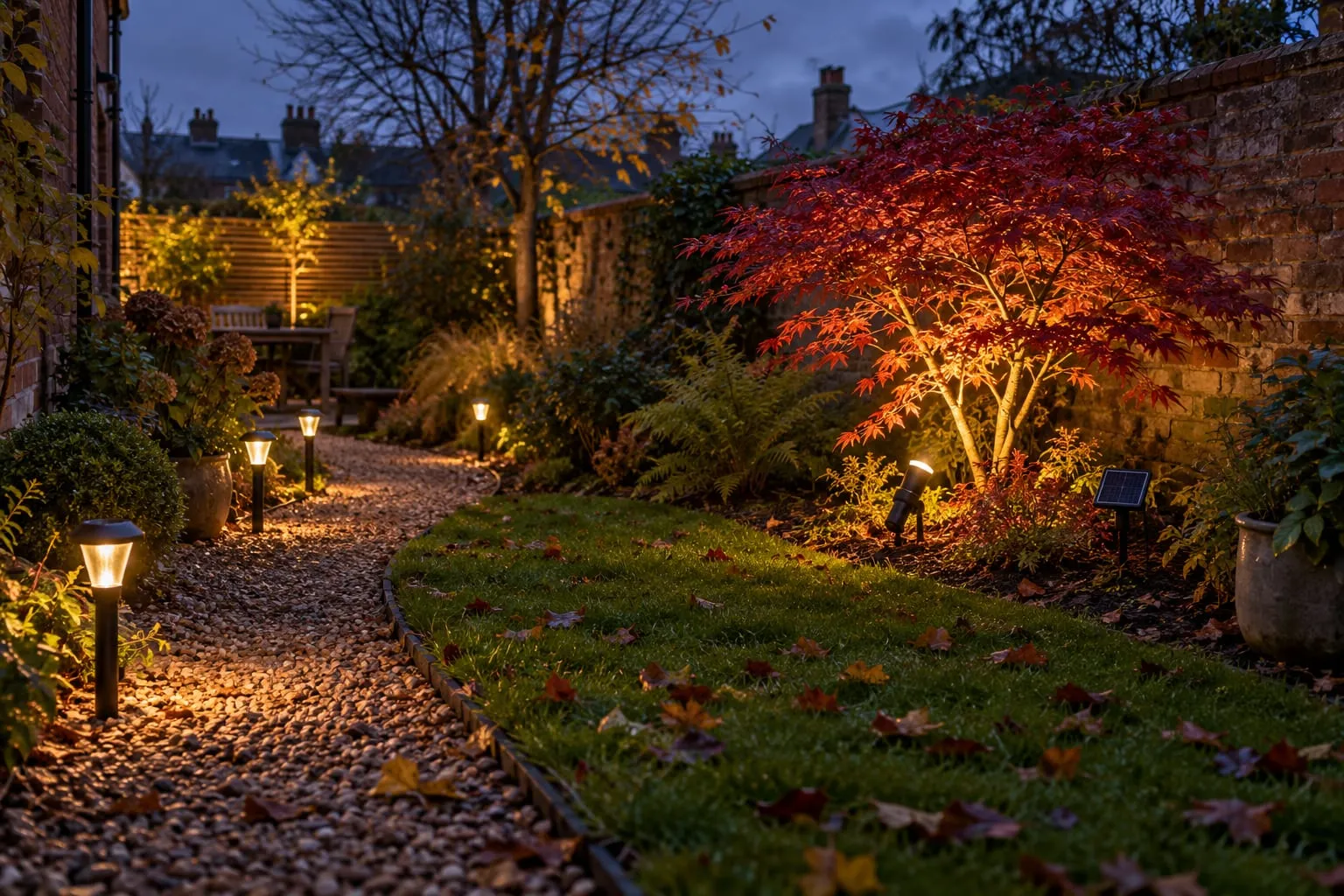
Solar is good at small, low-key jobs: marking the edges of a path you don’t depend on, lighting a small shrub or acer from a metre away, a lantern by a bench, string lights along a fence. It’s at its best in summer, when you’re out in the garden after dark anyway. Solar festoons over a patio are lovely from May to September, and festoon and string lights for the garden covers how to hang them. A solar motion light by the shed or the bins earns its keep too, because it’s only on for a minute at a time.
It’s the wrong tool for anything you rely on in winter. A security light has to come on every time, at full brightness, in January, so it belongs on mains (where to put a PIR security light covers that). Floodlighting a drive, uplighting a big tree (500 to 1,000 lumens) or lighting the path to the shed on a December evening all need more than a small panel can store; pathway lighting ideas covers what works on paths.
Plug-in 12 V or mains instead
| Solar | Plug-in 12 V | Mains | |
|---|---|---|---|
| In winter | A few hours at best, less in shade | Same every night | Same every night |
| Brightness | Low, often under 100 lm | Plenty for most gardens | As bright as you need |
| Fitting | DIY, push in or fix the panel | DIY, plugs into a socket | Registered electrician |
| Rough cost | £10–£50 a set; £20–£40 a pair of spotlights | £60–£150 for a starter kit | Fittings plus an electrician |
| Running cost | Nothing | About £2 a year for a 5 W light on 5 h a night | About £2 a year for a 5 W light on 5 h a night |
| Best for | Markers, accents, summer | Paths, spike and deck lights | Wall lights, bollards, security |
If your solar lights have let you down, a plug-in low-voltage kit is what I’d suggest next. A transformer plugs into a socket and turns mains into 12 V, and thin cable runs through the borders to spike, path or deck lights that clip on. Because the cable carries only 12 V, you can lay it under bark or mulch and move lights as the planting grows. You get the same light on 21 December as on 21 June, and many kits have a dusk sensor or timer built into the transformer. Techmar and Lightpro make expandable systems, and a 12 V plug-in garden lighting kit costs about £60 to £150 to start.
The socket needs RCD protection, ideally a weatherproof outdoor one; NICEIC’s advice on gardens and electrics is that every outdoor socket should be protected by an RCD. If the transformer sits outside, check it’s rated for outdoor use (usually IP44) and stay within its maximum load.
Go mains for lights on the house, bollards along a front path, security lights and anything you want to last for decades. That’s a job for a registered electrician. Outdoor circuits need 30 mA RCD protection, buried cable has to be suitable for outdoor use and deep enough to be clear of spades, and in England and Wales a new circuit is notifiable under Part P of the Building Regulations, which a registered electrician self-certifies. If you’re having a patio laid or a border dug, that’s the time to get cable or empty ducting in.
For a shady corner where neither a panel nor a cable will reach, battery or USB-rechargeable lights fill the gap; lighting a garden path without wiring compares them.
Solar lights not working?
Work through this checklist in order. Most dead solar lights turn out to be one of the first five.
- Check it’s switched on. Many have a switch under the head or on the panel. On new lights, pull out the battery tab and peel the protective film off the panel.
- Cover the panel in daylight. If the LED comes on, the light, battery and sensor all work, and the problem is charging or something stopping it seeing dusk. If nothing happens, go to the battery.
- Look for other lights. A street light, porch light, security light or bright window shining on the panel can stop it switching on. Move the panel or turn it away.
- Check the panel gets winter sun. At midday, is it in direct sun, or in a shadow from the fence or house that wasn’t there in summer? Move it.
- Clean the panel. A film of grime, leaves or bird mess cuts the charge.
- Give it a full charge. Switch it off and leave it in full sun for two days, then switch it on. Outdoors, not on a windowsill: the glass cuts the charge.
- Check the battery. Make sure it’s seated and the contacts are clean. If the light is dim or dies early after a good charge, fit a new cell of the same size, type and voltage.
- Check the cable. On separate-panel lights, push the plug fully home and tighten the waterproof collar, and look for cable that’s been chewed or cut.
- Look for water. Condensation or corrosion inside means a failed seal. Dry it out indoors for a couple of days; if the contacts are badly corroded, replace the light.
A light that stays on in daylight usually has a panel that’s unplugged, broken or covered, so the circuit thinks it’s night. One that flashes or flickers at dusk usually has a battery that’s nearly flat or near the end of its life.
If none of that works, a cheap light is finished. With a better one, go back to the retailer: under consumer law, goods have to last a reasonable time, and many better lights carry a warranty as well. For mains and 12 V lights that trip the electrics or fill with water, see outdoor lighting faults.
What I'd buy
Affiliate linksFAQs
Do solar lights work in winter in the UK?
Yes, but for fewer hours and less brightly. London gets under eight hours of daylight on the shortest day and the UK averages about 43 hours of sunshine in the whole of December, so a small panel can’t fill the battery. Lights with a separate panel in full sun, set to a power-saving mode, do best.
Do solar lights charge on cloudy days?
Yes, from daylight rather than only direct sun, but far more slowly. A run of grey winter days can leave them nearly flat. A bigger battery helps carry a light through, as long as the panel can fill it on the brighter days.
How long do solar lights last?
The battery usually goes first, often after a couple of years; the LED lasts far longer. A light with a standard replaceable cell (AA, AAA or 18650) can go on for years with a matching new battery. One with a sealed-in battery has to be replaced.
Are solar lights with a separate panel better?
For winter, yes. The panel can sit in full sun, angled at the low sun, while the light goes in the shade, and it’s usually bigger than a built-in one.
 Save
Save it for later
Pin this guide to one of your Pinterest boards so it's there when you start the job.