Hallway, stairs and landing lighting ideas for UK homes

Some links below are affiliate links: if you buy through them I may earn a small commission, at no extra cost to you. As an Amazon Associate I earn from qualifying purchases. How LightGuru makes money

Mike's quick answer
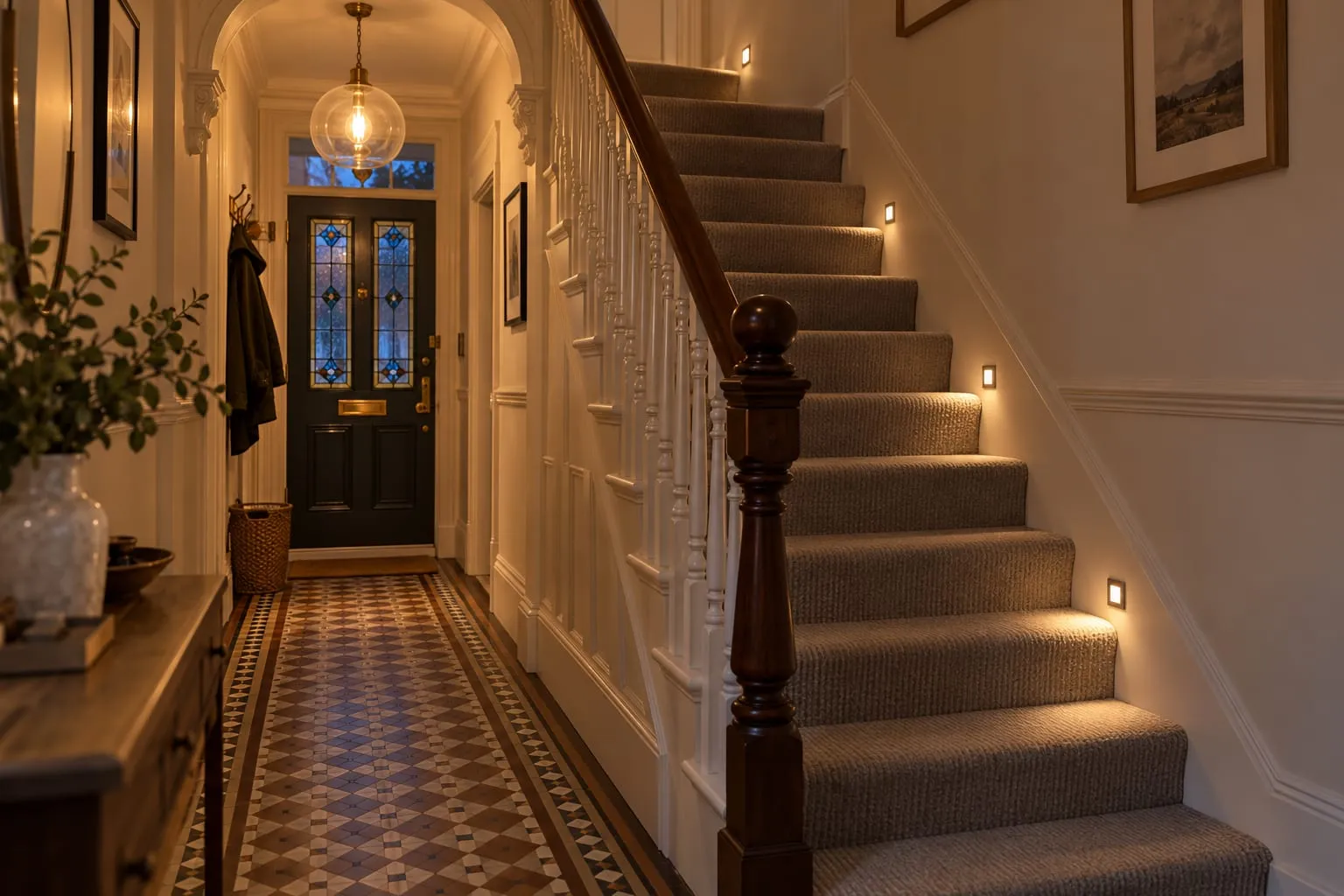
In a narrow hall, use a flush light, a single row of downlights or slim wall lights, and keep pendants for tall ceilings. On the stairs, light the treads from above or from low on the wall so every edge shows, with switches at the top and bottom. Keep it warm, 2700K to 3000K, and add a dim sensor light for night.
Hallways and stairs get less thought than any other part of the house, and more traffic than most. The usual setup is one pendant in the hall and one on the landing. That leaves the treads in shadow, puts a bright bulb in your eyes as you come down, and often means someone climbs a dark flight to reach a switch.
What you want is light that shows the floor and the edge of every step without dazzling you, a switch at each end, and something low and warm for the middle of the night. The shape of the space decides the fittings: a narrow hall under a 2.4 m ceiling needs different lights from a tall period hall with a stairwell rising through it.
Lighting a narrow hall
Plenty of UK halls are barely a metre wide once there’s a radiator and a row of coats, and anything that hangs down or sticks out gets walked into. There are four sensible ways to light one.
| Flush or semi-flush | Row of downlights | Wall lights | Pendant | |
|---|---|---|---|---|
| Best for | Most halls | Modern halls | Making a hall feel wider | Tall period halls |
| Ceiling height | Any | Any, with depth above | Any | About 2.7 m or more |
| Light | Even, from the centre | Even along the length | Soft, on the walls | Decorative |
| Wiring | Existing ceiling point | New holes and cable | Cable chased into the walls | Existing ceiling point |
| Rough cost | £20–£80 | £8–£25 per light | £25–£80 each | £30–£150 |
Flush and semi-flush lights
The simplest answer, and the right one for most halls, is a flush or semi-flush fitting on the existing ceiling point. Where people walk underneath, keep the bottom of any fitting at least about 2.1 m from the floor. Under a standard 2.4 m ceiling that leaves 30 cm for the whole fitting, so flush or a shallow semi-flush is the practical choice. Pick one with an opal or frosted diffuser, so nobody coming down the stairs looks into a bare bulb.
A hall needs less light than any room: about 75 to 150 lumens per square metre, or 400 to 750 lumens for a typical 5 m² hall. One fitting with an 806-lumen bulb, or an LED flush light of similar output, covers it. In a long hall, two matching fittings spread the light more evenly than one bright one.
A line of downlights
In a modern hall, a single row of downlights down the middle gives the cleanest ceiling and the most even light along the length. On a 2.4 m ceiling, space them about 1.2 to 1.8 m apart, with the end lights about half a spacing from the front door and the far wall. That’s three in a typical 4 to 5 m hall. Choose low-output fittings of 250 to 400 lumens with a wide beam, and fire-rated ones, because there’s almost always a room above a hall. The downlight layout guide has a hallway plan and the spacing rules, including where the smoke alarm goes.
Wall lights
Wall lights make a narrow hall feel wider, because they light the walls you see as you walk through rather than the floor. Fit them about 1.5 to 1.8 m from the floor to the middle of the fitting, all at the same height, and about 2.5 to 3 m apart down a long wall. In a narrow hall, choose slim fittings that don’t stand far off the wall, so nobody catches a shoulder or a bag on them. Each one needs a cable chased into the wall, so they’re easiest to add while you’re redecorating; living room wall lights covers the rules for running cables in walls, and the same apply here.
A pendant in a tall hall
Victorian and Edwardian halls often have the height for a pendant or a lantern, and a glass lantern or globe suits a period hall better than a row of downlights. Keep the bottom at least about 2.1 m above the floor, size the fitting to the hall rather than to the ceiling height, and fit a long-life LED bulb so you’re rarely up a stepladder in a narrow space.
Lighting the stairs
Stairs are where hall lighting becomes a safety matter. The aim is to see the edge of every step, going up and coming down.
The best place for the main stair light is above the flight, usually on the landing ceiling, shining down the stairs. Light from above falls on the treads and leaves the risers a little darker, so each edge stands out. A single light at the bottom shining up does the opposite: it lights the risers and leaves the treads in shadow.
Two things spoil it. One is glare: a bare bulb or bright downlight in your line of sight as you come down makes the steps harder to see, so use diffused fittings or downlights with the LED set back inside. The other is your own shadow. With one light behind you on the way down, your body throws a shadow onto the steps ahead. Switching the hall light on with the landing light, or adding wall or step lights along the flight, fills that in.
On a long or turning staircase, add wall lights along the flight, about 1.6 to 1.8 m above the treads and 2 to 3 m apart, each at the same height above the stair so the row follows its line. Or light the treads directly with step lights low on the wall, which I come to next. Around 400 to 800 lumens from the main stair light is usually enough, in warm white. More than the total, what matters is that the light is even, with no dark patch halfway up the flight.
Step lights and LED strips
Low-level step lights
Step lights are small fittings set into the wall beside the treads, low down, so their light skims across each step with nothing in your eyeline. Turned down low, they make a good night light.
One beside every step gives the most even light, every other step suits most stairs, and every third step is about the minimum if they’re mainly there to guide you at night. Set each one the same height above its tread, so the row follows the stair. Choose fittings with a louvre or a deep-set LED that throws the light down onto the tread, not a bright dot that shines out across the stairwell.
Most indoor step lights run from the mains lighting circuit and sit in a back box in the wall, often a standard single-gang box. That means chasing a cable to each one and making good, so it’s a job for an electrician, best done before you decorate. They go on the wall side; on a flight with an open balustrade, that side alone is enough.
LED strip under the nosings
On a modern staircase, a warm white LED strip tucked under the nose of each tread puts a line of soft light under every step edge, so the whole flight is outlined. Lighting designers use it on oak and other timber stairs, where the profile tucks out of sight under each nose.
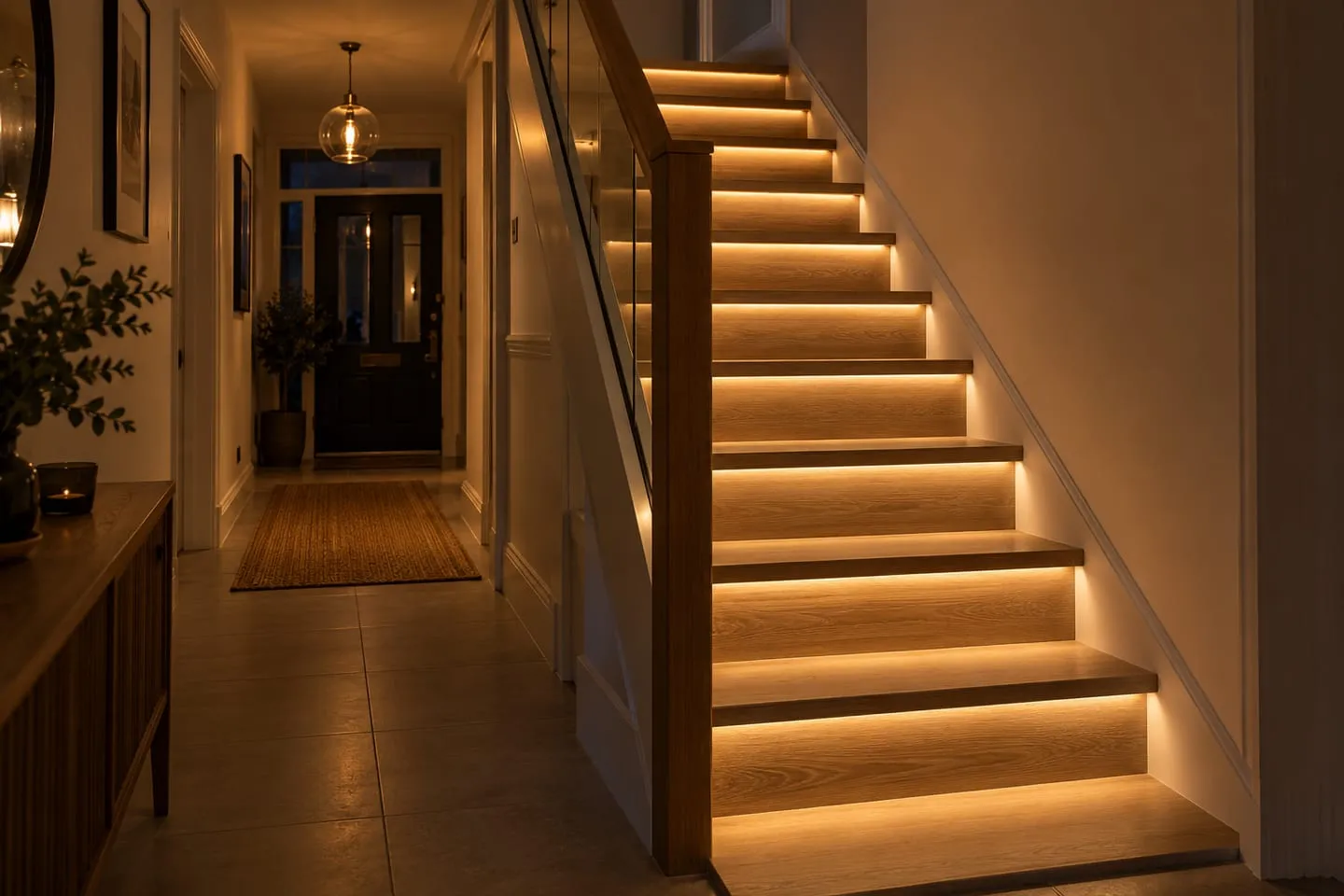
It’s neater than it is simple. The strip sits in a slim aluminium profile with a diffuser, set into a groove routed under each nosing, and every step needs a low-voltage cable run back to a driver. Put the driver somewhere you can reach later, such as the cupboard under the stairs. Use 24 V strip in warm white, ideally COB strip so you see a continuous line rather than dots, on a dimmer or a sensor. It suits a new staircase or a full refurbishment. On a carpeted stair, where the carpet wraps over the nose, there’s usually nowhere to put it.
Plug-in and battery options
If you rent, or don’t want to cut into the walls, there are lights that stick on. Battery motion-sensor stair lights fix to the wall beside the stairs and come on as you pass. Most give somewhere around 10 to 40 lumens each, enough to see the treads at night, and multipacks cost about £10 to £30. There are also stair strip kits with a sensor at the top and the bottom that light the steps one after another, powered from a plug-in adaptor. Neither is as bright or as tidy as wired lights, and batteries need recharging or replacing, but either is a big improvement on a dark staircase.
Landing pendants over a stairwell
A pendant hanging through the stairwell is the one place in most houses where a big, decorative light makes sense, because it’s seen from the front door, the stairs and the landing. Three things decide whether it works.
First, the drop. Keep the bottom of the fitting at least about 2.1 m above the landing floor where people walk, and about 2.2 m above the step directly below it, measured from that step rather than from the hall floor. In England, Approved Document K asks for at least 2 m of headroom over a stair, measured from the pitch line that joins the front edges of the steps. Over the back of a tread that line sits up to a full step, as much as 220 mm, above the tread, and a light hanging into that space defeats the point. In a double-height hall, bringing the fitting down to about first-floor level hangs it in the space rather than up under the roof.
Second, how it looks from above. From the landing you look into the top of the fitting, so choose a closed globe, an opal shade or a lantern that hides the bulb from above as well as below.
Third, the fixing. A heavy pendant needs fixing to a joist or a timber noggin, not just the plasterboard.
Changing the bulb safely
Decide how you’ll reach the bulb before you choose the light. Never stand a stepladder on the stairs or lean out over the banister. The easy answer is to hang it where you can reach it from a stepladder on the flat landing. Failing that, fit a good LED bulb, typically rated for 15,000 hours or more, or an integrated LED fitting with no bulb to change, and hire an access tower with adjustable legs for stairs when it needs attention. High ceiling lighting has more on reaching lights in tall spaces.
Lighting for night-time
At night you don’t want the main lights. A blast of bright light on the landing at 3 am wakes everyone, and your eyes struggle on the way back to bed. What works is a low, warm light at floor or step level that looks after itself.
The cheapest is a plug-in night light with a dusk sensor in a landing socket, which costs very little to run. On the stairs, battery motion-sensor lights or step lights on their own dimmer, turned right down, do the same job. With smart bulbs, a motion sensor such as the Philips Hue motion sensor can bring the landing lights on at a low level late at night and brighter in the evening; it needs a Hue Bridge.
Keep night lights below eye level and warm, 2200K to 2700K, so they don’t dazzle. There’s some evidence that bluer light late at night can delay sleep, one more reason to keep it warm; the colour temperature guide explains the scale.
Colour temperature
Use 2700K or 3000K and match the rooms either side, so you don’t step from warm light into cold; a 4000K hall looks clinical in the evening. If the hall has pictures or a strong wallpaper, CRI 90 or above keeps the colours true. A dimmer on the main hall and landing lights is worth having too.
Switching and wiring
Every light that serves the stairs should switch from the top and the bottom, and a long hall from both ends. Council standards for rented homes and HMOs ask for switches on each level (Gateshead’s and Hammersmith and Fulham’s are typical), and at home it’s what stops people climbing in the dark.
Two-way switching uses two switches joined by a three-core and earth cable, so either one turns the light on or off, whatever position the other is in. For a third switch, on a half landing or outside a bedroom, an intermediate switch goes between the two. You can fit a dimmer at one end, but only one unless you use a multi-way dimming system, as the LED dimmer switch guide explains.
Adding a second switch to a landing light that has only one means a new cable between the two switch positions, which usually means chasing a wall. Without new cable, the answer is wireless: smart bulbs with a battery switch stuck to the wall at the other end, such as the Philips Hue dimmer switch, or a smart dimmer with a companion switch. Timer and motion-sensor switches suit stairs too, as long as they stay on long enough to get up the stairs and into a room.
In England, adding lights or switches to an existing lighting circuit isn’t notifiable building work, but a new circuit is, under Part P; the Planning Portal sets out what counts. Downlights cut into a hall or landing ceiling with a room above must be fire-rated, as Approved Document B requires. Keep smoke alarms on the flat hall and landing ceilings at least 300 mm from light fittings and walls, as Aico’s siting guidance advises. New wall lights, step lights and downlights mean new cable and cut plaster, which is a job for a registered electrician.
What I'd buy
Affiliate linksFAQs
What is the best light for a narrow hallway?
A flush or shallow semi-flush fitting with an opal diffuser, or a single row of low-output downlights down the middle. Slim wall lights add warmth. Keep the bottom of anything you walk under at least about 2.1 m from the floor.
How do I light stairs safely?
Put the main light above the flight, usually on the landing ceiling, so it shines down onto the treads. Add wall lights or step lights on a long or turning stair, avoid bare bulbs in your eyeline, and switch the lights from the top and the bottom.
How far apart should stair step lights be?
One beside every step gives the most even light, every other step suits most stairs, and every third step is about the minimum for night-time guidance. Keep them all the same height above the treads.
How high should a pendant hang over the stairs?
About 2.2 m above the step directly below it, and at least about 2.1 m above the landing floor. Building regulations ask for at least 2 m of headroom over a stair, measured from the line joining the front edges of the steps, so nothing should hang into that.
Do stairs need two-way switching?
They should have it, so the light can be switched at the top and the bottom. Many councils’ standards for rented homes ask for it. An electrician can add it with a new cable between the switch positions, or you can use a smart bulb with a wireless switch.
What colour light is best for a hallway?
Warm white, 2700K to 3000K, matching the rooms either side. Avoid 4000K and daylight bulbs, which look cold in the evening.
 Save
Save it for later
Pin this guide to one of your Pinterest boards so it's there when you start the job.