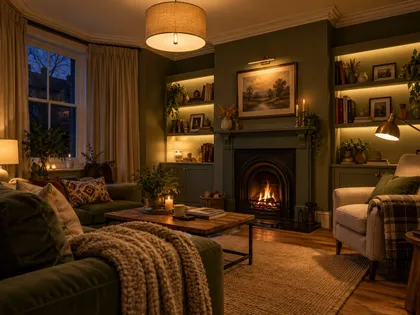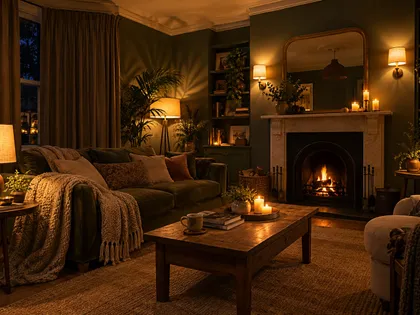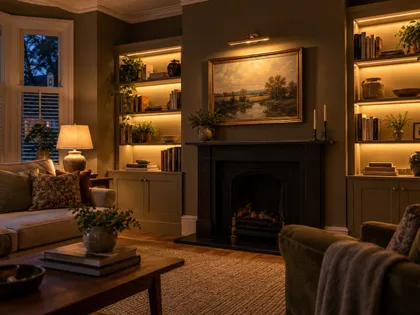
Living room wall lights: ideas, height and spacing

Some links below are affiliate links: if you buy through them I may earn a small commission, at no extra cost to you. As an Amazon Associate I earn from qualifying purchases. How LightGuru makes money

Mike's quick answer
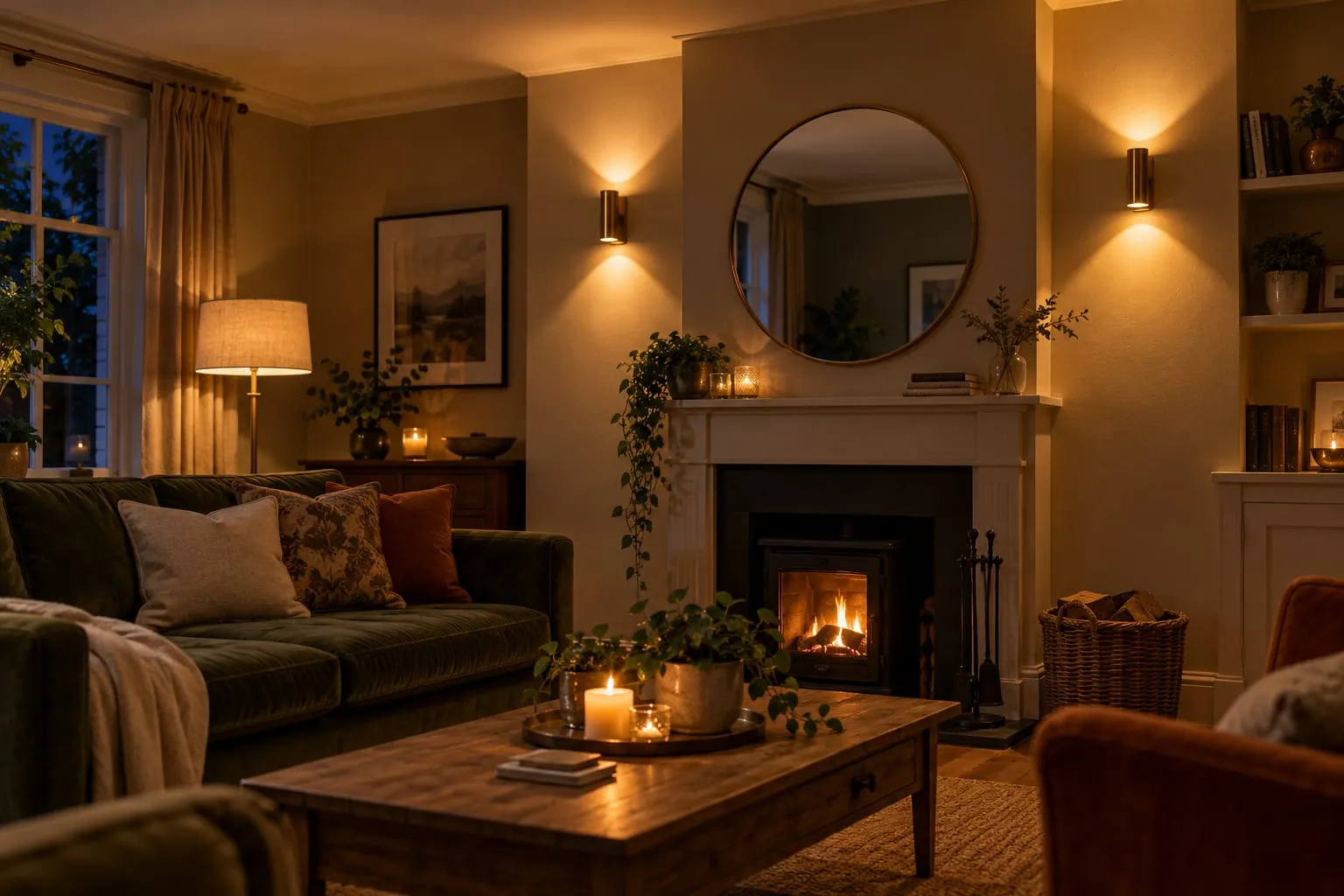
Fit them about 1.5 to 1.8 m from the floor to the middle of the fitting, and space them about 2.5 to 3 m apart along a wall, or as a matched pair either side of a sofa, chimney breast, mirror or TV. Use warm white (2700K) dimmable bulbs on their own switch. If you don't want to chase cables into the wall, plug-in wall lights do the same job.
Most UK living rooms have a light in the middle of the ceiling, a lamp or two, and nothing in between. Wall lights fill that gap. They put light at the height you sit and look, spread it across the wall, and make the room feel wider and warmer once the ceiling light is off.
The questions are nearly always the same: which style, how high, how far apart, and whether to chase cables into the plaster or buy plug-in ones. The short version: a pair rather than one, fitted 1.5 to 1.8 m off the floor, warm white on a dimmer, and plug-in is a perfectly good answer if you’re not redecorating.
Why wall lights work
Ceiling light comes from above, so it flattens faces and leaves the walls dim, and lamps make pools around the seats. Wall lights work in the band in between, and most of what they give lands on the wall itself or bounces off the ceiling. Your eye reads a lit wall as the edge of the room, so the room looks bigger and finished rather than gloomy at the edges.
In the layered scheme in the living room lighting guide, wall lights do part of the background job and part of the accent job, and they free up table space that lamps would otherwise take. In a small room, a pair of wall lights and two lamps is often all you need in the evening.
Wall light styles
| Up-and-down | Shaded sconce | Picture light | Swing-arm | Uplighter | |
|---|---|---|---|---|---|
| Where the light goes | Beams up and down the wall | Soft glow all round | Down onto a picture | Aimed where you want it | Up the wall onto the ceiling |
| Glare | Low | Low with a good shade | Low | Low if aimed down | Low above eye level |
| Best for | Chimney breasts, either side of a TV | Cosy rooms, either side of a mirror | Art and prints | Reading by a chair or sofa end | Low ceilings, tall rooms |
| Usual bulb | GU10 or G9 | E14 or B15 candle | Integrated LED | E14 or E27 | E27, G9 or integrated |
Up-and-down lights throw a beam up the wall and another down, making two scallops of light with the fitting between them. They suit modern and industrial rooms, look good in pairs on a chimney breast, and keep light off the TV screen because it all goes onto the wall. The bulb decides the look: a narrow-beam GU10 gives crisp scallops, a wider one a softer wash.
Shaded sconces, single or twin-arm with small fabric shades, are the traditional choice and the cosiest. The shade glows and hides the bulb, which makes them the easiest style to place over a sofa or either side of a mirror.
Picture lights are accent lights rather than room lights. Choose one about half to two-thirds the width of the frame; there’s more in accent lighting for art, shelves and alcoves.
Swing-arm lights are reading lights on the wall. They’re the answer when there’s no room for a floor lamp beside a chair, and plenty come as plug-in versions.
Uplighters, often a bowl or half-cylinder against the wall, send light up the wall and off the ceiling. In a room with a low ceiling that wash makes the ceiling feel higher, and in a tall room it lights the upper walls that lamps never reach.
How high to fit wall lights
Fit living room wall lights about 1.5 to 1.8 m from the floor, measured to the middle of the fitting. UK lighting retailers quote figures inside that range, and they all come back to the same idea: around standing eye level or a little above. At that height the shade or the fitting body hides the bulb when you’re standing, the light lands on the part of the wall you actually look at, and nobody knocks into it. The type of fitting and the room move you up or down within it.
| Height to the middle of the fitting | Why | |
|---|---|---|
| Most living room walls | 1.5–1.8 m | Around eye level, bulb out of sight |
| Above a sofa | 1.5–1.7 m | People are sitting, and the light stays close to them |
| Chimney breast, mirror or TV | 1.5–1.8 m, both the same | Level with the middle to upper part of the mirror or picture |
| Uplighters | 1.8 m or a little above | So you can't see into the top when standing |
| Swing-arm reading light | Lower; test it seated | Shade just above the shoulder of the reader |
Under a low ceiling, around 2.3 m or less, stay in the lower part of the range so an up-and-down light’s upper beam has room to spread before it hits the ceiling. In a room with a tall ceiling, go to the top of the range; lighting high ceilings covers rooms where even that isn’t enough.
Measure from the finished floor, and set the second light from the first with a laser level rather than measuring it separately. Floors in older houses are rarely level, and a pair that’s a couple of centimetres out shows straight away on a chimney breast.
Wall lights above a sofa
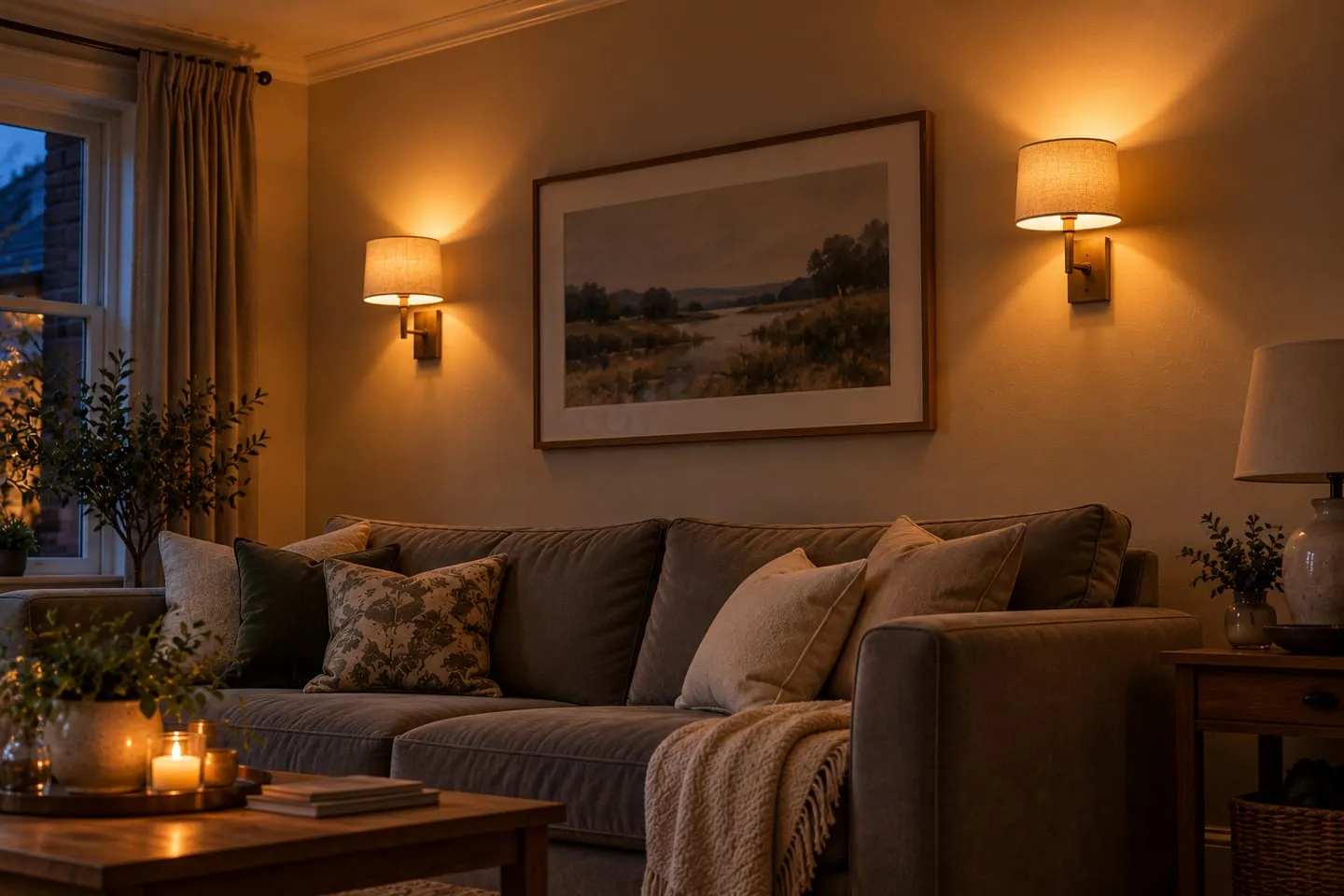
A pair over the sofa puts soft light right where people sit. I’d line them up with the arms of the sofa or a little inside them, with a picture or mirror centred between, and keep them in the lower part of the height range, about 1.5 to 1.7 m, so the light stays close to the seats rather than floating high above them.
Shades matter more here than anywhere else in the room. Someone sitting on the other side of the room looks straight at those lights, so a bare bulb becomes glare in their eyes. Fabric shades or opal glass that hide the bulb are the safe choice. Check how far the fitting sticks out from the wall, too: a deep fitting at the lower end of the range can catch the head of someone getting up from the sofa.
If the picture between them deserves light of its own, a picture light above the frame does a better job than wall lights either side.
Chimney breast, mirror or TV
A matched pair either side of a chimney breast is the classic British layout, and it works in almost any style of room. You have two choices. Lights on the face of the breast frame the fireplace and a mirror or painting above it. Lights on the back walls of the alcoves light the alcoves, which are often the darkest part of the room, and leave the breast to an accent light. Both look right; the face of the breast is the more traditional look.
On the face, centre each light in the strip of wall between the edge of the mirror and the edge of the breast, so it doesn’t look squeezed against either. Mirrors double whatever’s in front of them, which suits shaded lights and up-and-down fittings. A bare bulb next to a mirror shows twice.
Chimney breasts are often solid brick and there’s a flue inside, so the cable route needs thought before anyone starts cutting. Ordinary cable buried less than 50 mm deep in a wall has to run straight up, down or across from the light or switch it serves, or within 150 mm of the ceiling or a corner, and in a home it also needs 30 mA RCD protection. That’s from the IET’s guidance on cables in walls, and it’s why the cable to a wall light usually runs straight up to the ceiling. It’s also why you should never drill directly above or below a wall light or a switch.
Either side of a TV, put the lights beside the screen, never above it, and keep them clear of its edges. Up-and-down fittings are good here because their light goes onto the wall rather than across the screen. Keep them dim while you watch: the idea is to take the edge off the dark, not compete with the picture. Check from the sofa that neither light shows as a reflection in the screen. The TV section of the living room lighting guide has more on viewing comfort.
How far apart to space them
Along a long wall, space wall lights about 2.5 to 3 m apart. Much closer and the wall starts to look busy; much further and you get a dark gap between them. As a rule of thumb I keep the end lights roughly half the spacing from the corners, so the wall looks evenly lit from end to end. On a typical 4 to 5 m living room wall, that means a pair, each about a quarter of the wall’s length in from its end.
A pair framing a feature follows the feature, not the wall. Centre the pair on the chimney breast, the sofa or the TV, even if that puts them off-centre on the wall as a whole. Your eye checks the symmetry of the pair against what’s between them.
In a long or knock-through room, use two pairs, or spread the lights across two walls. Light on a single wall makes a room feel lopsided, and it leaves the opposite wall looking dark.
Uneven spacing is the commonest giveaway of wall lights fitted in a hurry. Before the electrician cuts anything, mark the positions with masking tape, put the mirror, picture and TV where they’ll live, and look at the wall from the doorway and from the sofa.
Brightness and warm white
Wall lights don’t need much output. For background light, something around 400 to 500 lumens per fitting, about what an old 40 W bulb gave, is plenty. A twin-arm sconce with two small 25 W-equivalent candle bulbs lands in the same range. An up-and-down fitting with two GU10s gives more, around 600 to 1,000 lumens, which is why it wants a dimmer. Fabric shades swallow some light, so a heavily shaded fitting can take a slightly brighter bulb.
Across the whole room, aim for the ceiling to give about 40 to 50% of the light and lamps and wall lights the rest. The lumens guide works out the total for your room.
Use warm white, 2700K, to match your lamps; 3000K is the coolest I’d go in a living room. Keep every light in the room within about 500K of the others, because one 4000K wall light among 2700K lamps makes both look wrong. Dim-to-warm bulbs such as Philips WarmGlow go from 2700K to about 2200K as you turn them down, which suits wall lights you’ll mostly use low. If you can see the bulb, a frosted one, or an amber filament LED around 2200K kept dim, looks better than a bright clear one. The colour temperature guide explains the scale.
Check the cap before you buy bulbs: wall lights use GU10, G9, E14 or B15 candles, and E27 or B22, and the light bulb fittings guide shows how to tell them apart. Many G9 LED capsules aren’t dimmable, so check the box if your wall lights will be on a dimmer.
Dimming and switching
Give wall lights their own switch, separate from the ceiling light. That’s what makes them useful: in the evening the ceiling light goes off, the wall lights go on low, and the room changes completely. On the same switch as the ceiling light, you’ll rarely see them that way. A two-gang dimmer by the door, one gang for the ceiling and one for the walls, is the neat way to do it.
Use a trailing-edge dimmer made for LEDs and bulbs or fittings marked dimmable. Two small LED wall lights are a very light load, and some dimmers won’t run that little smoothly, which shows up as flicker or lights that won’t go low. Check the dimmer’s minimum load against what you’re fitting; LED dimmer switches explains how.
If you’re rewiring, ask the electrician to put 5 A round-pin sockets for your lamps on the same switched circuit as the wall lights. Then one switch by the door brings on the wall lights and every lamp together, which is the whole evening layer in one go, on a dimmer if all the bulbs are dimmable. Plug-in wall lights can go on those sockets too.
Smart bulbs work in wall lights that take an ordinary cap, with dimming and scenes from your phone, but leave the wall switch on and never put them behind a dimmer. For hard-wired lights, a smart dimmer switch on the circuit is the cleaner route.
Wired or plug-in wall lights
| Wired in | Plug-in | |
|---|---|---|
| Look | No cable on show | Flex down to a socket, hidden in a cover |
| Switching | From the door, with the other lights | Switch on each light, unless on a 5 A lamp circuit |
| Mess | Chasing, filling and redecorating | A few screw holes |
| Who fits it | An electrician | You |
| Renters | Rarely an option | Yes |
Yellow = the better option on that line.
Wired wall lights are the tidy answer, and the time to fit them is when you’re decorating or rewiring anyway. In a finished room, chasing the cable in means making good and redecorating the wall.
Plug-in wall lights screw to the wall like any other fitting, with a flex that runs down to a socket and usually an inline switch. Put them near a socket, run the flex straight down in a slim cable cover painted to match the wall, and they look nearly as good as wired ones for about £20 to £50 each. Battery wall lights with a remote are the other no-wiring option, but they’re dimmer than wired ones and need recharging.
There’s a middle way too. An electrician can run cable to wall lights in slim surface trunking from the ceiling rather than chasing it in, which is far less mess and can be painted out.
Wall lights and Part P
In England, adding wall lights to an existing lighting circuit in a living room isn’t notifiable under Part P of the Building Regulations. Notifiable work means a new circuit, replacing the consumer unit, or any addition or alteration to circuits in a special location such as the area around a bath or shower. So a new circuit just for your wall lights is notifiable; taking them off the lighting circuit you already have isn’t. Wales works the same way for a living room, though its list of special locations also takes in kitchens and outdoors, according to the Planning Portal. Scotland and Northern Ireland have their own building regulations, so check locally there.
Not notifiable doesn’t mean anything goes. The work still has to be done safely, to the wiring regulations, with the cable routes and RCD protection described above. If you’re not confident, use a registered electrician, who can also self-certify notifiable work so you don’t have to deal with building control.
A plug-in wall light involves no electrical work at all. Fix it securely, and use a cable and pipe detector before you drill.
What I'd buy
Affiliate linksFAQs
How high should wall lights be in a living room?
About 1.5 to 1.8 m from the floor to the middle of the fitting. Go towards the lower end over a sofa, and towards the top for uplighters and in rooms with high ceilings.
How far apart should wall lights be?
About 2.5 to 3 m apart along a wall, with the end lights roughly half that from the corners. A pair framing a chimney breast, mirror, sofa or TV is spaced to suit the feature, centred on it.
Should wall lights be on a separate switch?
Yes. On their own switch or dimmer, you can turn the ceiling light off in the evening and run the wall lights low.
Can I have wall lights without chasing the wall?
Yes. Plug-in wall lights run from a socket, with the flex hidden in a paintable cable cover. An electrician can also run cable to wired lights in slim surface trunking instead of chasing it in.
Do I need an electrician to fit wall lights?
For plug-in ones, no. For wired ones, it’s a job for someone competent. In England and Wales, adding wall lights to an existing lighting circuit in a living room isn’t notifiable under Part P, but a new circuit is, and a registered electrician can self-certify it.
What bulbs should I use in living room wall lights?
Warm white, 2700K, dimmable if they’re on a dimmer, and around 400 to 500 lumens per fitting for background light. Use a frosted bulb or a shade if you can see the bulb, and match the colour of your lamps.
 Save
Save it for later
Pin this guide to one of your Pinterest boards so it's there when you start the job.