Bedside and reading lights: heights, wall lights vs lamps and the right bulb

Some links below are affiliate links: if you buy through them I may earn a small commission, at no extra cost to you. As an Amazon Associate I earn from qualifying purchases. How LightGuru makes money

Mike's quick answer
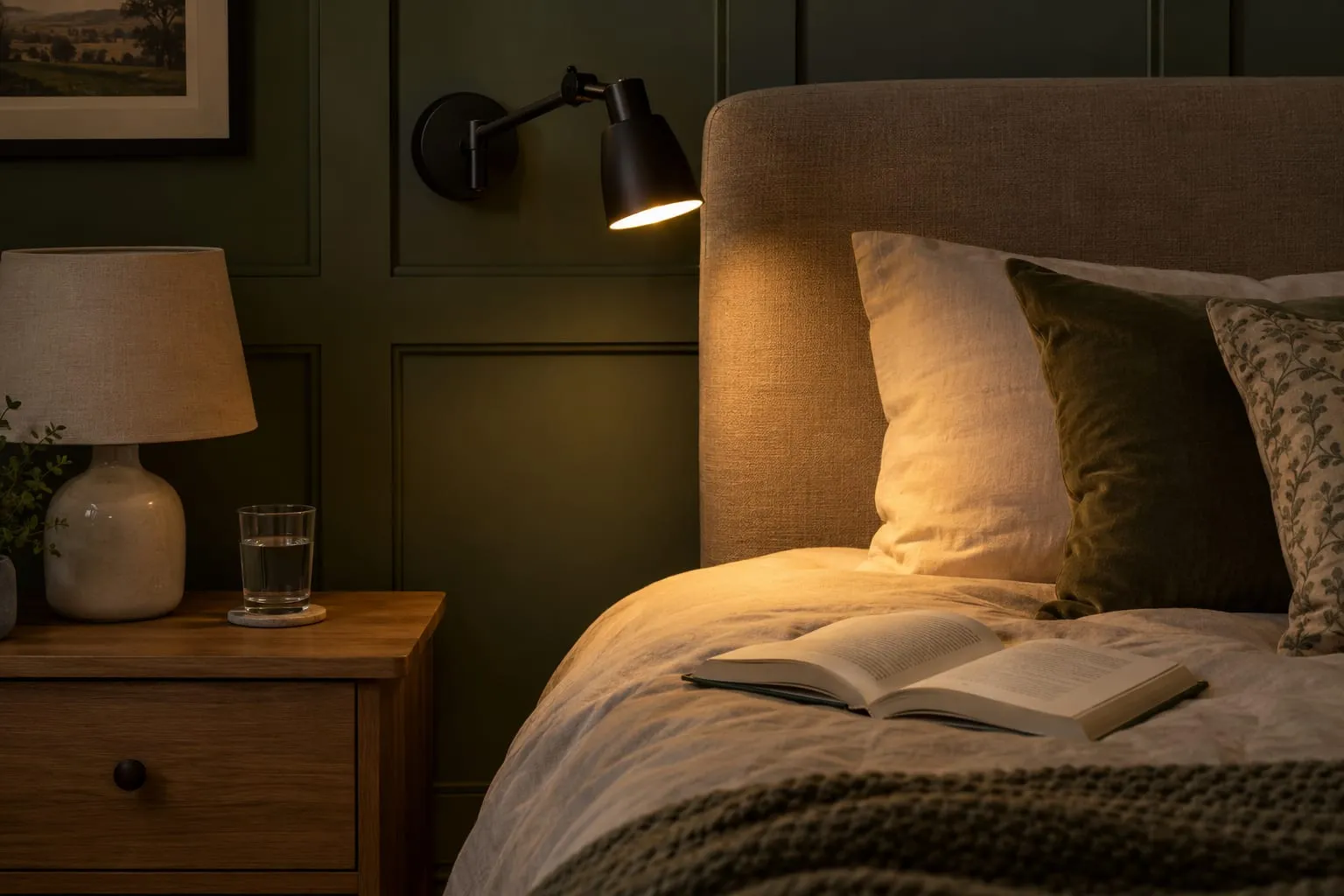
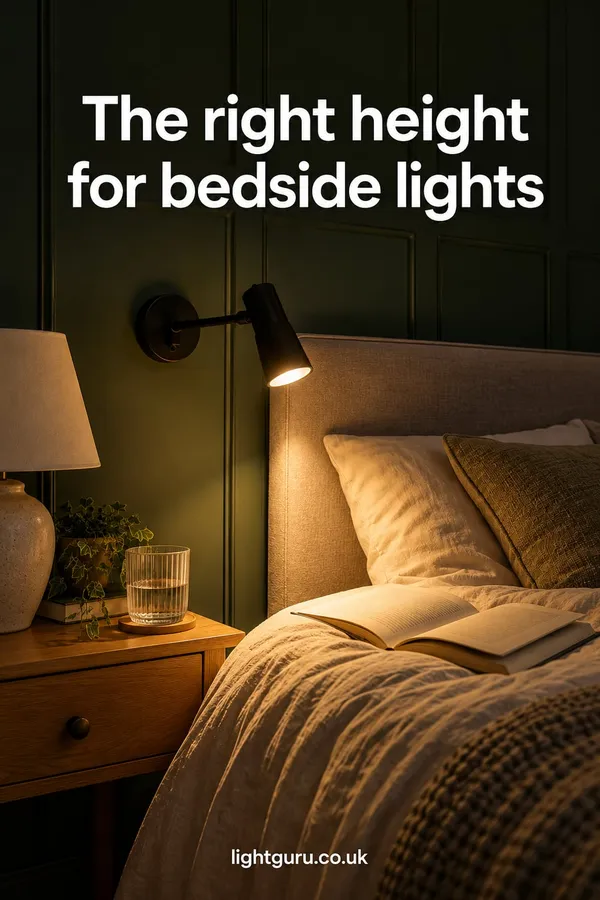
Fit bedside wall lights at about shoulder height when you're sitting up in bed: roughly 50–70 cm above the top of the mattress, or about 1.1–1.3 m from the floor on a bed 60 cm high. On a bedside table, a lamp about 60–70 cm tall puts the bottom of the shade between shoulder and eye level. For reading, use a swing-arm or directional light so your partner stays in the dark, with a 2700K bulb of about 470 lumens.
A good bedside light does two jobs. It lights the page when you’re sitting up reading, and it gives a soft glow for the last few minutes before you switch off. Get the height wrong and it does neither: you see the bare bulb, or read in your own shadow, or light up your partner’s pillow as well as your book.
What decides it is where your head and shoulders are when you’re sitting up in bed. Everything else, from the height of the wall light to the size of the lamp and the bulb inside it, follows from that.
Lamp, wall light or pendant?
| Table lamp | Wall light | Pendant | |
|---|---|---|---|
| Bedside table | Takes up space | Left free | Left free |
| Reading | Good with an open-bottomed shade | Best with a swing arm or adjustable head | Fine if hung low enough |
| Your partner | Can spill across the bed | An aimed head keeps it on your side | Spills unless well shaded |
| Wiring | None, it plugs in | Hardwired or plug-in | Ceiling point, or plug-in on a hook |
| Moving the bed | Easy | Light stays put | Light stays put |
Yellow = the better option on that line.
Lamps are the easy choice: no wiring, nothing to plan, and they move with the bed. Wall lights win in small rooms, on narrow bedside tables and for serious readers, because an adjustable head puts the light exactly where you want it. Pendants hung beside the bed look striking and free up the table, but they need the most planning.
How high to fit bedside wall lights
There’s no single official height, and UK retailers’ advice varies, from shoulder height up to head height when you’re sitting up in bed. For a light you read by, I’d go with shoulder height. For most adults that’s about 50 to 70 cm above the top of the mattress. On a bed that’s 60 cm from the floor to the top of the mattress, it works out at around 1.1 to 1.3 m from the floor.
Measure from the mattress, not the floor. Bed heights vary a lot, from low platform beds to tall divans and ottomans, and a deep mattress or topper moves the right height up with it. That’s also why bedside lights go lower than the 1.5 to 1.8 m that suits wall lights in a living room: you’re sitting lower.
The type of fitting fine-tunes it. With a shaded wall light, aim for the bottom of the shade just above your shoulder, so the light falls onto your lap and you can’t see the bulb. With an exposed bulb or a glass globe, go a little higher, around seated eye level, so you’re not looking into it. Sideways, about 30 cm out from the edge of the bed puts the switch where your hand falls.
For a swing-arm light, the head should end up between your head and the page, a little above and to the side. Check the reach of the arm against the depth of your headboard and pillows. On a deep upholstered headboard, a short arm ends up lighting the headboard rather than the book.
The best test takes five minutes. Sit up in bed with a book in your usual reading position, get someone to hold the light against the wall, and move it until the page is lit and you can’t see the bulb. Mark it, then set both sides at the same height. If you and your partner sit differently, split the difference so the pair looks even.
The right height for a bedside lamp
Start with the table. A UK bedside table is usually 50 to 70 cm tall, and it works best roughly level with the top of the mattress, give or take 10 to 15 cm.
Then choose a lamp that puts the bottom of the shade somewhere between shoulder and eye level when you’re sitting up. Too low and the light falls on the table, not the book. Too high and you look straight at the bulb. On a table at mattress height, that usually means a lamp about 60 to 70 cm tall. Another rule of thumb designers use is about two-thirds the height of the headboard.
Keep the lamp’s widest point to about a third of the table’s width so there’s still room for a book, a glass of water and your phone. For reading, a shade that’s open at the bottom and lined or opaque at the sides throws light down onto the page and keeps the glare off your partner. A thin, translucent shade gives a lovely glow but a softer reading light.
Bedside pendants
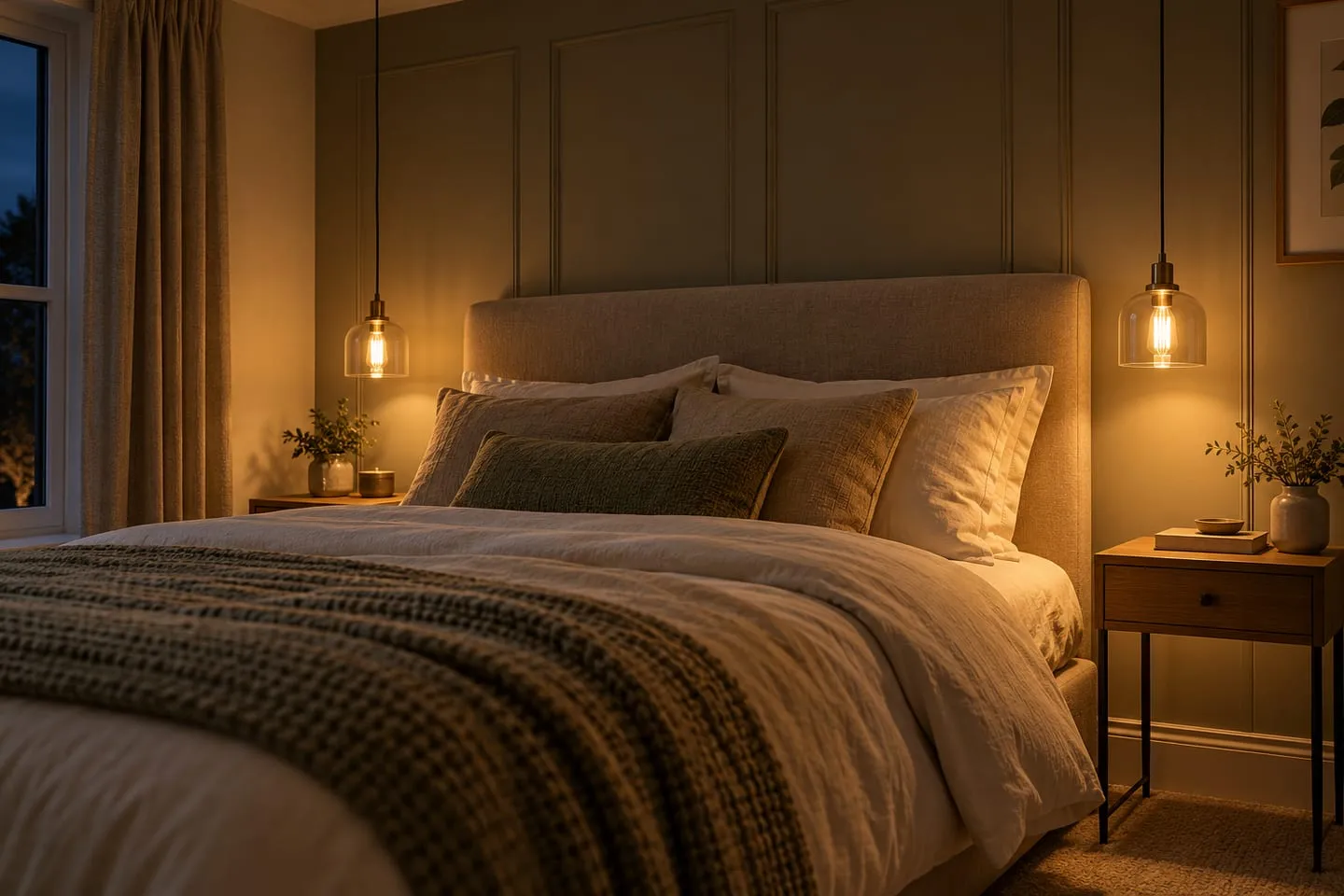
A pair of pendants hung low either side of the bed instead of lamps looks good and clears the bedside tables completely. Makers usually suggest hanging the bottom of the shade about 60 to 90 cm above the bedside table. For reading, stay at the lower end, which on a table level with the mattress puts the shade at about shoulder height when you’re sitting up, much like a wall light. Higher looks elegant but gives more of a glow than a reading light.
Hang each pendant over the middle of the table, not over the edge of the bed where your head comes up when you sit up or swing your legs out. Choose a small shade that’s frosted, opal or solid enough to hide the bulb from the pillow. A clear glass globe with a bare filament bulb is the one to avoid at this height.
Wiring is the catch. Two pendants beside the bed need two new ceiling points and somewhere to switch them, usually from the bedside. Plug-in pendants on a ceiling hook, with the cable looped across and down the wall, avoid the electrician, but you’ll see the cable.
Reading without waking your partner
The trick is a narrow, aimed beam. A swing-arm light or an adjustable spot lets you point the head down at the page so the light lands on your lap and not across the bed. Dedicated LED reading lights take this further. Astro’s Digit LED reading light, for example, gives about 130 lumens in a beam of about 30 degrees, so the page is well lit and the rest of the room stays dim.
A lamp with a solid shade that’s open at the bottom does a similar job, as long as it’s at the right height. Translucent shades, glass globes and uplighters light the whole wall, which is lovely for winding down and no good if someone is trying to sleep.
Each person needs their own light and their own switch. If one of you reads late, that matters more than any fitting.
Plug-in or hardwired?
| Plug-in | Hardwired | |
|---|---|---|
| Electrician | Not needed | Needed |
| Looks | Cable runs down the wall | Clean, no cable |
| Switch | Inline or on the fitting | On the fitting or a wall switch by the bed |
| Rentals | Just a couple of screw holes | Needs the landlord to agree |
Yellow = the better option on that line.
Plug-in wall lights screw to the wall and run a cable down to a socket, usually with a switch on the cable or the fitting. There’s no rewiring, so they suit rentals and anyone who isn’t redecorating. A slim cable cover painted the wall colour hides most of the flex. The Anglepoise Type 75 Mini wall light comes in a plug-in version with a long cable and inline switch, and there are plenty of cheaper plug-in swing-arm lights at £25 to £60.
Hardwired wall lights look neater, and you can have a proper switch by the bed. In England and Wales, adding a light to an existing circuit in a bedroom isn’t notifiable under the building regulations, according to the Planning Portal, but it still involves chasing cable into the wall, so it’s a job for a registered electrician and best done before you decorate. The living room wall lights guide covers more plug-in and wired options.
Switches: on the fitting or by the bed
Whatever you choose, you should be able to reach the switch lying down, without sitting up or leaning over.
A switch on the fitting is the simplest: a rocker on the base, a button on the head or an inline switch on the cable. A button on the head of a reading light is the easiest to find, because your hand is already there when you angle it. Lamps with a touch base are easy to find in the dark too.
A wall switch by the bed is neater for hardwired lights, and it can sit next to a two-way switch for the ceiling light so everything is in one place. Smart bulbs and remotes are the no-wiring version of the same idea; more on those below.
Brightness and colour for reading
For a bedside lamp with an ordinary bulb, 470 lumens (a 40 W equivalent) is enough to read by at close range, and it doubles as a soft glow when you’re not reading. If you read a lot, or your eyes need more light than they used to, go up to 806 lumens (a 60 W equivalent) and put it on a dimmer so you can turn it down afterwards. Dedicated LED reading lights quote much lower figures because the light is focused on the page. The lumens guide explains the difference between the lumens on the box and the light that lands on the page.
Use 2700K warm white for reading in bed. If warm light makes print look a little soft, 3000K is crisper. It’s a small step from 2700K, but keep both sides of the bed the same so the pair matches. Save 2200K for the wind-down glow; it’s lovely late in the evening but a little orange for small print. CRI 90 or above shows the colours in photos and magazines more truly, though for plain print it matters less than brightness. More on choosing a white in the colour temperature guide.
Bulbs and fittings: E14, E27 and G9
Bedside lights use a handful of fittings. Take the old bulb out and check the base, or look at the label inside the fitting.
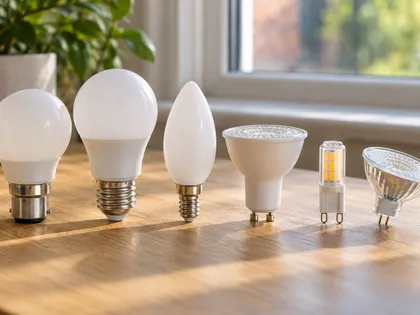
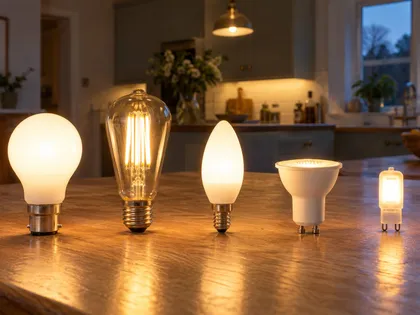
E14, the small Edison screw, is the usual fitting in small lamps, candle shades and many wall lights. Some UK fittings use B15, the small bayonet, instead. Larger bedside lamps take E27, the standard screw, or B22, the standard UK bayonet. Compact modern wall lights often use G9, the tiny capsule with two loops. LED G9s are often longer or fatter than the halogens they replace, so measure the space in the fitting before you order. Spotlight-style swing arms sometimes take a GU10.
Some reading lights have the LED built in, with no bulb to change. Check the colour temperature and CRI on the spec before you buy, because you can’t swap the bulb later. The light bulb fittings guide shows each cap and how to tell them apart.
Choose frosted bulbs rather than clear for anything at eye level, so you don’t see the bright point of the LED. If the lamp has a dimmer or a touch base, use a dimmable LED bulb. If it flickers, try a dimmable bulb from a different brand before blaming the lamp. My picks for each fitting are in the best LED bulbs guide.
Smart bulbs at the bedside
Bedside lamps are where smart bulbs earn their keep. You can dim from your phone or a remote without leaning over, set a slow fade at bedtime and a gentle brighten in the morning, and switch both lamps off with one tap.
Philips Hue White Ambiance comes in E27 and as an E14 candle; the current candle gives about 470 lumens and runs from a warm 2200K to a cool 6500K. Pair it with a Hue dimmer switch on the bedside table as a remote. WiZ and TP-Link Tapo bulbs run on Wi-Fi with no hub and cost much less. Leave the lamp’s own switch on, because smart bulbs need power all the time, and don’t put them on a dimmer. If you only want lamps on a timer, a smart plug is cheaper, though it won’t dim.
If dark winter mornings are the real problem, a wake-up light does the sunrise and the bedtime fade in one box. Lumie’s wake-up lights run from about £50 to £230.
Children’s rooms
The same heights apply to an older child reading in bed, scaled to a smaller bed and a shorter body: sit them up with a book and mark the wall. A swing-arm wall light keeps the bedside table free for the clutter and is harder to knock over than a lamp. A smart plug or smart bulb on a schedule can switch the reading light off at lights-out, which saves an argument.
For young children, mount lights out of reach and keep lamp flexes well away from a cot. LED bulbs run far cooler than old filament or halogen bulbs, which matters within reach of small hands. For sleep, a separate dim amber night light placed low down works better than leaving a reading lamp on; there’s more on night lights in the bedroom lighting ideas guide.
What I'd buy
Affiliate linksFAQs
How high should bedside wall lights be?
At about shoulder height when you’re sitting up in bed: roughly 50 to 70 cm above the top of the mattress, or around 1.1 to 1.3 m from the floor on a bed 60 cm high. Go a little higher for exposed bulbs.
How tall should a bedside lamp be?
About 60 to 70 cm on a table that’s roughly level with the mattress. The bottom of the shade should sit between shoulder and eye level when you’re sitting up.
How bright should a reading light be?
About 470 lumens in a bedside lamp, or 806 if you read a lot or need more light. A focused LED reading light can manage with 100 to 150 lumens because the beam is narrow.
What is the best colour temperature for reading in bed?
2700K warm white. 3000K is fine if you prefer a crisper page. Avoid cool white and daylight bulbs in a bedroom.
Can I have bedside wall lights without rewiring?
Yes. Plug-in wall lights screw to the wall and plug into a socket, with a switch on the cable or the fitting. A painted cable cover hides most of the flex.
How far from the bed should bedside wall lights be?
Fit one on each side, about 30 cm out from the edge of the bed, at the same height. That puts the switch within reach and keeps the pair symmetrical.
 Save
Save it for later
Pin this guide to one of your Pinterest boards so it's there when you start the job.