Bedroom lighting ideas: warm, layered and easy to control from bed

Some links below are affiliate links: if you buy through them I may earn a small commission, at no extra cost to you. As an Amazon Associate I earn from qualifying purchases. How LightGuru makes money

Mike's quick answer
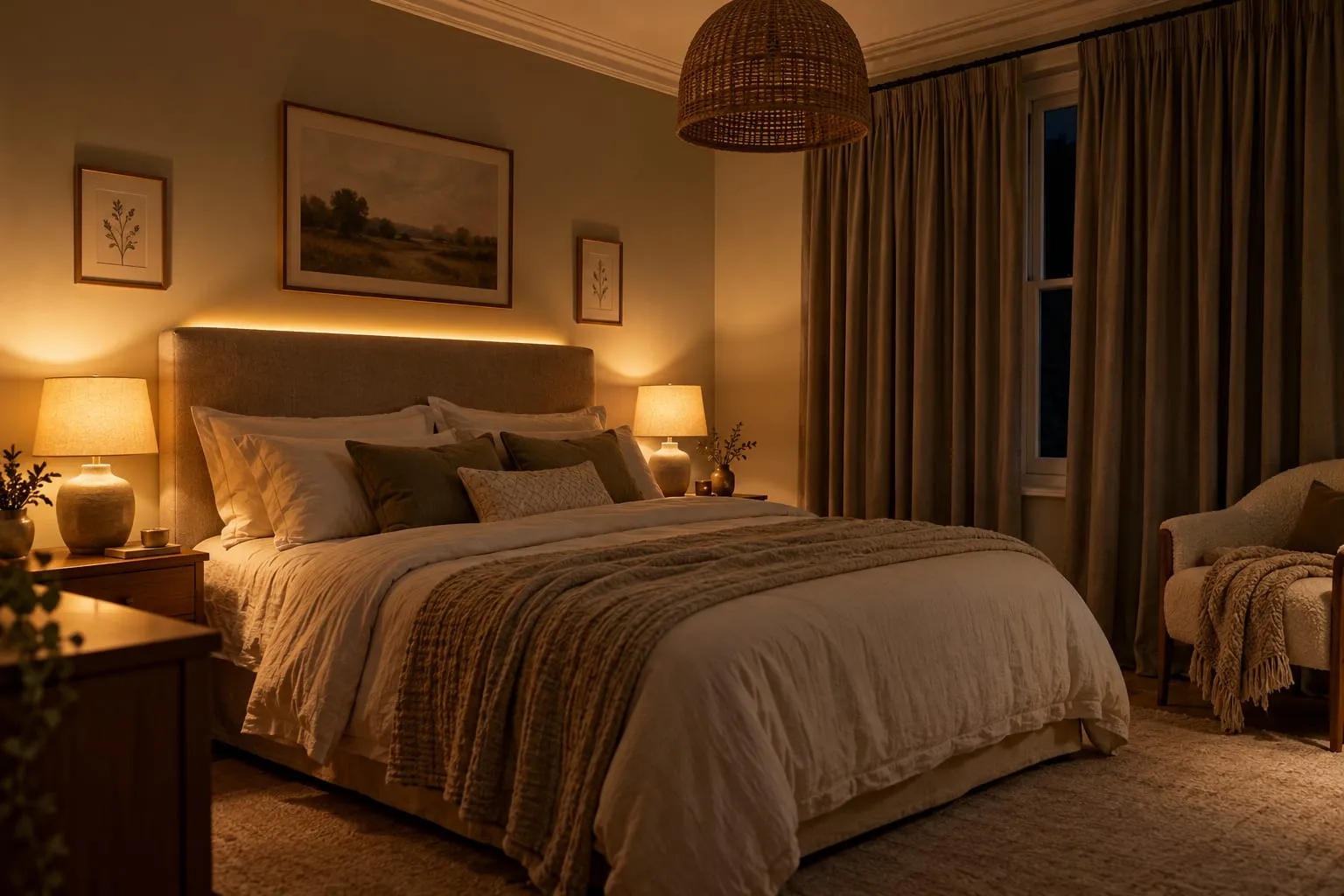
Light a bedroom in layers: a soft ceiling light on a dimmer, bedside lamps or wall lights for reading, and a low glow such as a strip behind the headboard, all in 2700K warm white. Keep downlights off the bed, make sure you can switch the main light from bed, and aim for about 1,200–1,800 lumens in total in a 12 m² double bedroom.
A bedroom is the one room you look at from lying down, and that should decide how it’s lit. A ceiling light that seems fine when you walk in is shining straight into your eyes once you’re in bed, and the switch by the door is on the wrong side of a dark room at midnight.
Most of what makes a bedroom work is simple: warm light, several small sources instead of one big one, everything dimmable, and switches you can reach without getting up. Much of it plugs in, so you can sort a lot of it this weekend and leave the wiring for when you next decorate.
Start with layers
Think of a bedroom in four layers. You won’t use them all at once, which is the point.
The ceiling light is for cleaning, making the bed and finding things; most evenings it’ll be off. Bedside light is the one you’ll use most, for reading and the last half hour before sleep. Wardrobe and dressing light lets you see what you’re putting on, which a brighter ceiling light can’t do because it puts your own shadow in the way. Accent light is the low glow that makes the room feel calm, such as a strip behind the headboard or a lamp on a chest of drawers, and it doubles as a night light.
Ceiling lights that don’t glare
From the bed, you see the underside of the ceiling light. Whatever you choose, make sure the bulb is hidden from below.
| Pendant | Flush or semi-flush | Downlights | |
|---|---|---|---|
| Seen from the bed | Fine if the shade hides the bulb | Opal diffuser hides it | Glare if over the pillows |
| Low ceilings | Short drop only | Best choice | Yes, with enough void |
| Wiring | Existing ceiling point | Existing ceiling point | New holes and cable |
| Feel | Warmest with fabric or rattan | Even, a little plain | Even, can feel flat |
Yellow = the better option on that line.
Pendants
A pendant on the existing ceiling point is the easiest bedroom light to get right. Choose a shade that’s closed or diffused at the bottom, such as fabric, rattan, paper or opal glass, so you see a glow from the pillow, not a bulb. A clear glass shade with a bare filament bulb looks lovely in the shop and glares every night.
Keep a pendant out of the way of the door and the wardrobe, and don’t hang it low over the bed. A low pendant gets in the way every time you change the duvet cover.
Flush and semi-flush lights
With a ceiling much under 2.4 m, a flush or semi-flush light with an opal diffuser is the sensible choice. It gives even, glare-free light and nothing to walk into. In a longer room, two smaller fittings spread the light better than one big one.
Downlights in a bedroom
Downlights can work in a bedroom, but they are the easiest way to get it wrong. The rule is simple: none over the bed, and above all none over the pillows. Lying down, you’d be staring straight up into them.
Put them around the bed instead: beside its lower half and beyond the foot, in front of the wardrobe, by the door. Space them more widely than in a kitchen, 1.5 to 2 m apart, with wide beams of 60 degrees or more and 2700K bulbs, and put them on a dimmer. A typical 3 × 4 m bedroom rarely needs more than three or four. Fittings with the LED set back inside the housing cut glare further. Under a loft, choose fittings rated to be covered by insulation (often marked IC), and with a room above they must be fire-rated. The downlight layout guide has bedroom plans.
How bright a bedroom should be
Bedrooms need less light than people think: about the same per square metre as a living room, while a kitchen needs two to three times as much. As a rule of thumb, plan on 100 to 150 lumens per square metre with every light on. A 3 × 4 m double bedroom (12 m²) needs about 1,200 to 1,800 lumens in total; a 4 × 4 m main bedroom about 1,600 to 2,400.
In practice that’s a ceiling light of around 800 to 1,000 lumens on a dimmer, plus two bedside lamps of about 470 lumens each. In a small single room of up to about 8 m², an 806-lumen ceiling bulb on its own is enough. Add about 15% if the walls are a mid tone and about 30% if they’re dark, and if you have dimmers, aim at the top of the range. The lumens guide has a calculator for your exact room.
Warm white and dimming for winding down
Use warm white, 2700K, for every light in a bedroom. You use the room at the start and end of the day, and warm light is what makes it feel restful. For bedside lamps late in the evening, 2200K is warmer still, more like candlelight. Avoid 4000K and daylight bulbs here; they look cold and clinical after dark. More on the scale in the colour temperature guide.
Brightness matters as much as colour. Fading light in the evening is one of the cues your body uses to start making melatonin, the hormone that helps you sleep, and NHS sleep advice, such as this sleep hygiene leaflet from the Royal Berkshire NHS Foundation Trust, suggests dimming the lights during the evening. That’s the case for dimmers in a bedroom: full light for finding a sock, a low glow for the last hour.
The bulbs I’d use on a bedroom dimmer are dim-to-warm, such as Philips WarmGlow. They get warmer as they dim, from 2700K at full to about 2200K, the way old filament bulbs did. On the wall, fit a trailing-edge dimmer made for LEDs; an old dimmer is the usual reason LEDs flicker or won’t go low. The LED dimmer switch guide explains how to match them.
Switches you can reach from bed
The most useful upgrade in many bedrooms isn’t a light at all. It’s being able to turn the main light off without crossing a dark room.
The wired answer is two-way switching: one switch by the door and one by the bed, both controlling the ceiling light. If you want a switch on each side of the bed as well as by the door, an intermediate switch adds the third. One of the switches can be a dimmer, but only one, or the lights will flicker. In England and Wales, adding to an existing lighting circuit in a bedroom isn’t notifiable building work, according to the Planning Portal, though it still has to be done safely to the wiring regulations, and a registered electrician is the right person for it. Scotland and Northern Ireland have their own rules.
The no-wiring answer is smart. A smart bulb in the ceiling light with a wireless remote does the same job: the Philips Hue dimmer switch sticks to the wall by the bed or lifts off as a remote, and works with up to 10 Hue lights without the Hue Bridge. Leave the wall switch on, though; smart bulbs need power all the time and shouldn’t go on a wall dimmer. Bedside lamps can go on smart bulbs or smart plugs, so one tap turns everything off.
Bedside lamps and wall lights
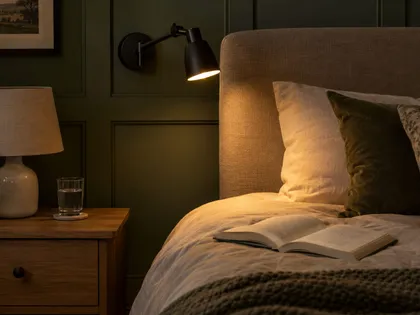
A lamp or wall light either side of the bed, each with its own switch, lets one person read while the other sleeps.
Wall lights free up the bedside table and suit small rooms. Swing-arm and directional reading lights put the light on your book rather than across the bed. Lamps are the easy route with no wiring. The height matters with all of them: get it wrong and you see the bulb or read in your own shadow. Heights, lamp sizes and the right bulbs are in the bedside and reading lights guide.
Headboard and accent lighting
A soft glow behind the headboard is one of the nicest bedroom lighting ideas, and one of the simplest. An LED strip fixed to the back of the headboard, or along a shelf above it, washes the wall with light and gives the room a calm, low background with nothing in your eyes.
Use warm white, 2700K or 2200K, and keep it dim: accent strip at 150 to 300 lumens per metre is plenty. A COB strip, where the LEDs sit close enough together to make a continuous line, avoids the spotty look on a pale wall, and an aluminium channel with a diffuser helps too. Put it on its own switch or a remote dimmer so it can be the only light on.
The same idea works lower down: a strip under the bed frame on a motion sensor lights the floor for night-time trips to the loo without waking anyone.
Wardrobes and dressing
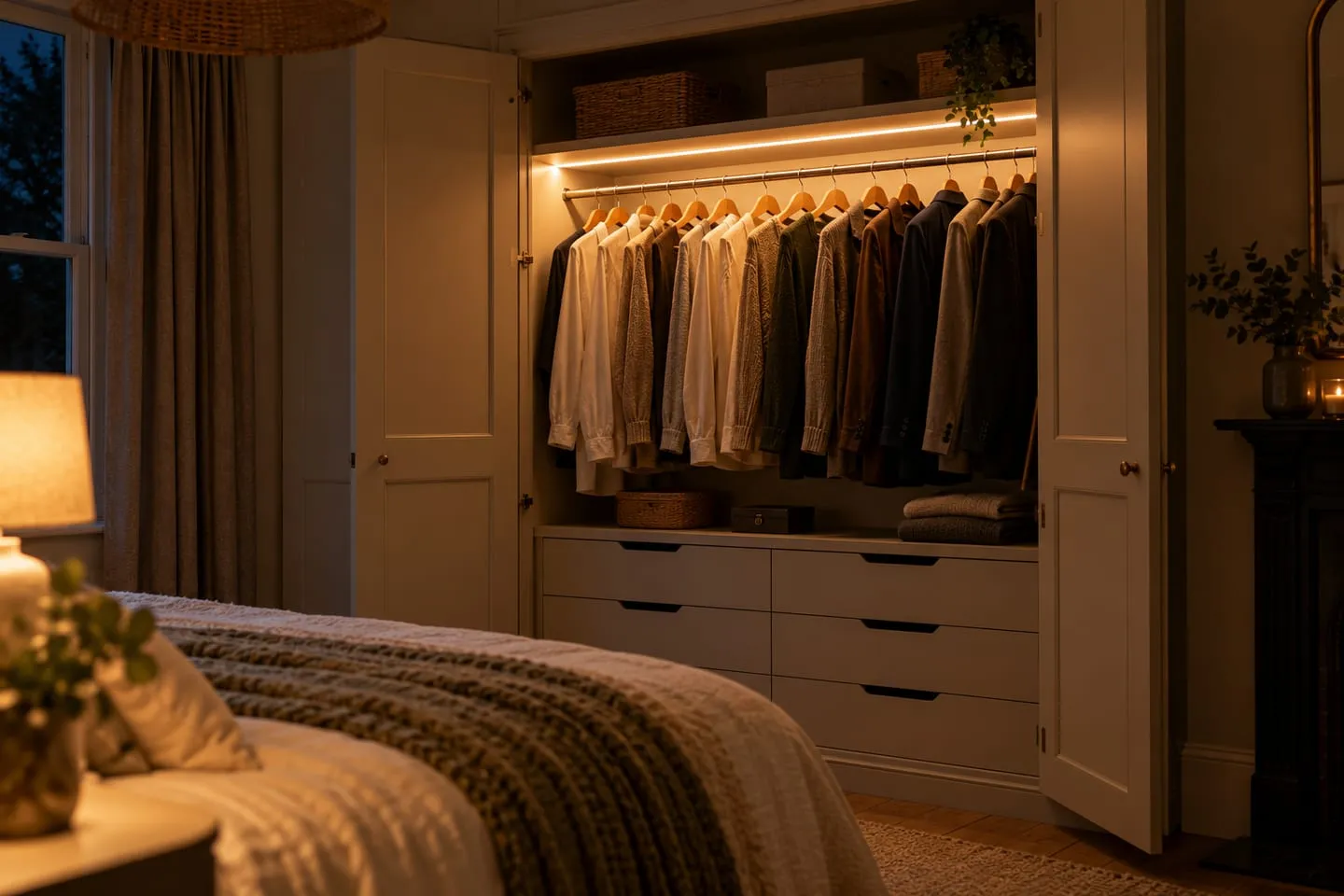
Wardrobes are where most bedroom lighting falls short. The ceiling light is behind you, so you look into a dark box with your own shadow on the clothes.
An LED strip along the top of the inside, just behind the front frame and angled back onto the clothes, lights everything evenly. In a fitted wardrobe, an electrician can run it from a small driver with a door switch, so it comes on when the door opens, or a motion sensor for sliding doors. Keep the driver somewhere ventilated, not buried under a pile of jumpers. If you don’t want any wiring, rechargeable motion-sensor light bars stick inside with magnets or tape and charge by USB.
Here colour rendering matters more than anywhere else in the bedroom. Under a cheap strip, navy and black can be hard to tell apart. Look for CRI 90 or more on the box, in 2700K to match the room or 3000K if you want the clothes to look a little crisper. The CRI vs colour temperature guide explains the difference.
At a dressing table or mirror, light your face from either side, at face height, with a pair of wall lights or a lit mirror. Light from directly above casts shadows under your eyes and chin. With a full-length mirror, make sure the light is in front of you, not behind.
Small bedrooms and low ceilings
A small bedroom needs light in more places, not more light. Wall lights either side of the bed save table space, a flush ceiling light keeps the room feeling taller, and a lamp in the far corner lights the edges of the room so it reads as bigger. A mirror opposite a lamp bounces its light back into the room.
Under a low ceiling, nothing should hang where people walk. Keep the bottom of any fitting at least about 2.1 m from the floor, which on a standard 2.4 m ceiling leaves room for little more than a short semi-flush drop, and less under a lower one.
A spare room needs the same basics so guests aren’t hunting for a switch in the dark: a lamp by the bed and a way to turn the main light off from it, which a smart bulb and a stick-on remote solve without wiring. If it’s also your office, keep the ceiling light warm and put cooler light in the desk lamp; home office lighting covers the desk.
Loft bedrooms and sloping ceilings
Sloping ceilings make bedroom lighting awkward. A fixed downlight in a slope shines across the room at the angle of the roof rather than down, often straight at the pillows, and there’s often very little depth between the rafters once the insulation is in.
Put recessed downlights on the flat part of the ceiling where you can. On the slope, use adjustable downlights that tilt so the beam points down, or surface spots and slim track, which need no depth. A fitting set into an insulated slope should be rated to be covered by insulation (often marked IC) and designed to seal, so it doesn’t leave a gap in the roof’s insulation. Check the depth and the rating before you buy. A pendant needs a sloped-ceiling canopy so the cable hangs straight.
Wall lights do a lot of the work in a loft room. A pair on the low knee wall either side of the bed, or reading lights on the gable wall, put light where you need it without fighting the slope. If the bed sits under the eaves, watch your head: use a slim wall light or a lamp rather than anything that sticks out. The high and sloping ceilings guide covers vaulted rooms in more detail.
Children’s rooms
A child’s bedroom needs to switch between bright for playing and very dim for sleep. A dimmable ceiling light and a lamp do most of it. A colour smart bulb in the lamp can be set to a dim amber at bedtime and brighter white in the morning, on a schedule.
For a night light, warm and dim is the advice. Children’s occupational therapists at Aneurin Bevan University Health Board in Wales say a soft red or orange glow promotes sleep, and that a night light shouldn’t be too bright. I’d put it low down, near the skirting, so it lights the floor rather than the ceiling. Many plug-in night lights have a dusk sensor, and some fade off on a timer.
For homework, a desk lamp of 500 to 800 lumens gives enough light on the page. Switch to the warm lamps in the hour or two before bed.
Safety comes first in a young child’s room. Wall-mounted lights are harder to pull over than lamps. Keep lamp flexes and plug-in cables well out of reach of a cot, and use LED bulbs, which run far cooler than old filament and halogen bulbs. Battery fairy lights that use button cells should be kept away from small children.
What I'd buy
Affiliate linksFAQs
What is the best lighting for a bedroom?
A soft, dimmable ceiling light you can switch from the bed, a lamp or wall light each side of the bed, and a low accent glow, all in 2700K warm white.
Should I have downlights in a bedroom?
They’re fine if they’re kept away from the bed. Place them around it and towards the edges of the room, 1.5 to 2 m apart, with wide beams, 2700K and a dimmer, and never over the pillows.
How many lumens does a bedroom need?
About 100 to 150 lumens per square metre with everything on. For a 12 m² double bedroom that’s 1,200 to 1,800 lumens: an 800 to 1,000 lumen ceiling light plus two bedside lamps of about 470 lumens each.
What colour temperature is best for a bedroom?
2700K warm white for every light, and 2200K for bedside lamps late in the evening if you like. Avoid 4000K and daylight bulbs in a bedroom.
How do I control the bedroom light from bed without rewiring?
Put a smart bulb in the ceiling light and stick a wireless remote switch by the bed, such as a Hue dimmer switch. Leave the wall switch on so the bulb always has power.
What is the best night light for a child’s room?
A dim red, orange or amber light placed low down. Avoid bright white and blue night lights; a dusk sensor or a fade-off timer saves you remembering to switch it on and off.
 Save
Save it for later
Pin this guide to one of your Pinterest boards so it's there when you start the job.