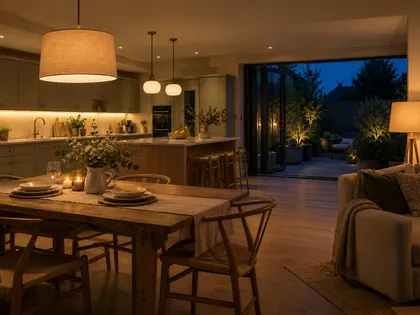
Dining table pendant height: how high to hang lights over a table, and what size

Some links below are affiliate links: if you buy through them I may earn a small commission, at no extra cost to you. As an Amazon Associate I earn from qualifying purchases. How LightGuru makes money

Mike's quick answer
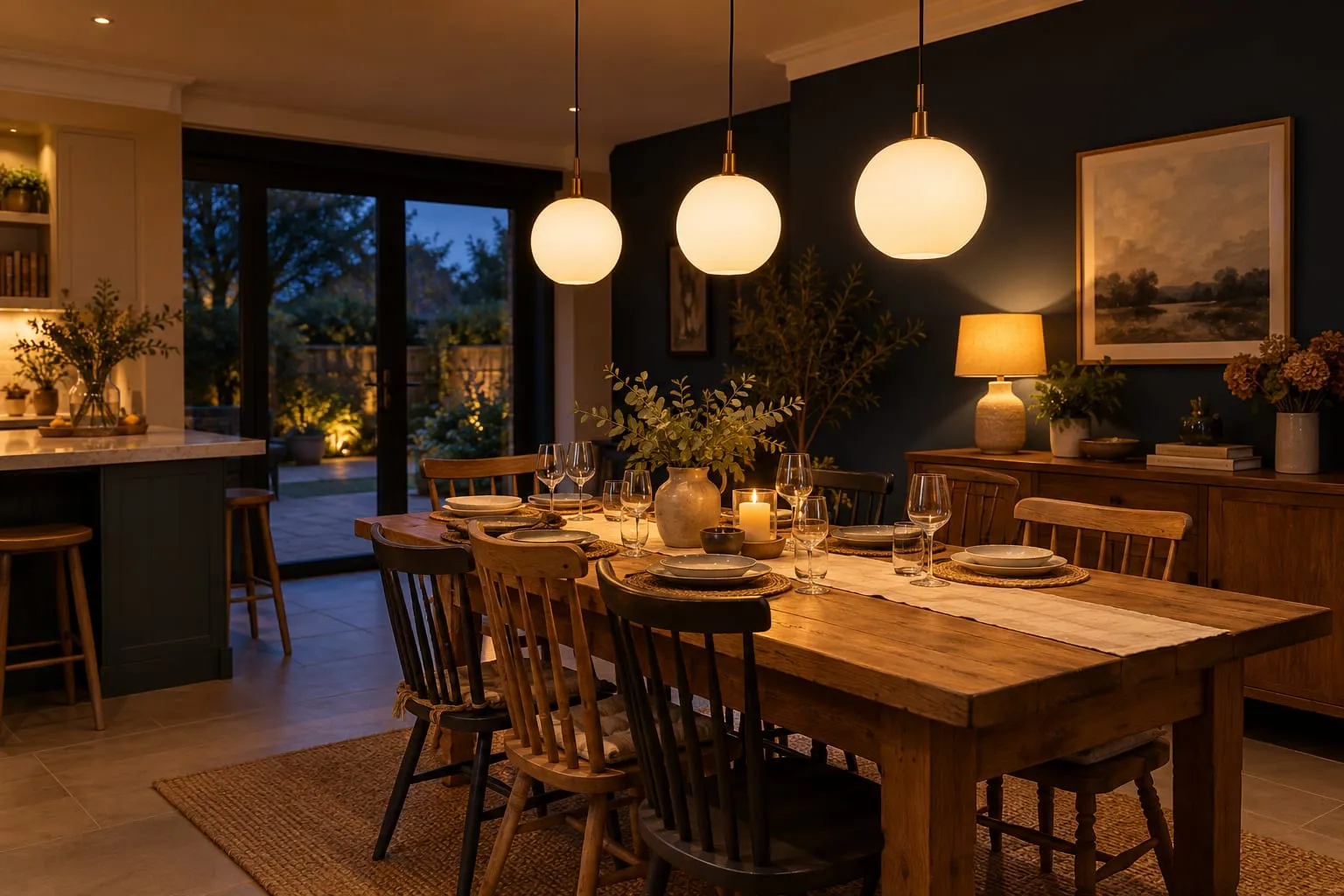
Hang it so the bottom of the shade is 70–90cm above the tabletop; under a standard 2.4m ceiling, start at 75–80cm. Choose one shade about half to two-thirds the width of the table, or two or three smaller ones spaced evenly along a longer table, and centre the light on the table, not the room.
A pendant over a dining table is the light that makes a room feel like somewhere to eat. Hung at the right height, it puts a warm pool of light on the table and leaves the faces around it softly lit. Hung too high, it lights the room instead of the meal, and everyone at the table can see up into the bulb.
Three measurements decide whether it works: the gap between the shade and the tabletop, the size of the shade against the size of the table, and, for longer tables, how many pendants you use and how far apart they hang. After that comes the problem a lot of dining rooms have: the ceiling point isn’t where the table is.
How high to hang a pendant over a dining table
Hang it so the bottom of the shade is 70 to 90cm above the tabletop. Under a standard 2.4m ceiling, start at 75 to 80cm. Measure from the table up to the lowest point of the shade, not from the ceiling down: ceilings are rarely level, and it’s the table your eye compares the light with.
That range works because of where your eyes are when you sit down. At a typical 75cm-high table, a seated adult’s eyes are roughly 40 to 55cm above the tabletop, depending on their height and the chair. A shade 75cm up sits comfortably above that, so you can see the person opposite under it, while the light is still close enough to land on the table rather than spread across the room.
A dining table is a little different from a kitchen island. Everyone is sitting, nobody is standing at it to chop vegetables, and the table itself stops anyone walking into the shade. So the lower half of the range usually feels right: it makes the table feel more intimate and keeps the light where the food is. Go towards the top of the range for a big or deep shade, which blocks more of the view across the table, or if the tallest person in the house finds it in their eye line when they sit.
Hanging it too low is easy to spot: you’re peering round the shade to talk, and someone knocks it passing the dishes. Too high is common too, often because the pendant has been left on whatever length of flex it came with, and it causes glare. The higher the shade, the steeper the angle you look up at it from your chair, and the more of the bulb you see.
Adjusting for your ceiling height
The gap above the table changes much less than people expect, because it’s set by the table and your eyes, not the ceiling. These are the same figures I use for kitchen island pendants, measured from the tabletop instead of the worktop.
| Bottom of shade above table | What changes | |
|---|---|---|
| Under 2.3m | About 75cm | Shallow shades or a semi-flush fitting |
| 2.3–2.4m | 75–80cm | The standard starting point |
| About 2.7m | 80–85cm | Go up a size in shade |
| 3m and over | 85–90cm | Bigger fittings, rods, clusters or a longer drop |
A low ceiling is less of a problem over a table than anywhere else in the house. Elsewhere, a pendant has to clear people’s heads; over a table, nobody walks underneath, so even a low room can usually take one. Choose a shade that is wide rather than deep, so it doesn’t fill the whole gap between table and ceiling, and keep it inside the footprint of the table so nobody catches it walking past.
In tall rooms, period houses and extensions with 3m or more, the temptation is to hang the pendant higher because there’s space. Don’t. Keep it within the range and fill the height with the fitting instead: a bigger shade, a rod, a cluster of drops or a tiered fitting. A small shade on a long, thin flex looks lost in a tall room. With a lot of height, add some light higher up too, such as wall lights, or the ceiling becomes a dark void above a bright table. The high ceiling lighting guide covers that.
What size pendant for your table
The rule of thumb is a shade about half to two-thirds the width of the table. Lighting brands such as Tala in London and Golden Lighting in the US give the same proportion. For a round table, use the diameter.
On a 90cm-wide table, that’s a shade of 45 to 60cm. On a 1m-wide table, 50 to 65cm. On a 120cm round table, 60 to 80cm, which sounds huge until you see how small a 40cm shade looks over a table that size. On a 90cm table, a two-thirds shade still leaves 15cm between the shade and each long edge, the same clearance I use over islands, so don’t go bigger than that.
The look of the shade moves you within that range. Open, airy shades, such as rattan, wire cages or clear glass, look lighter than their size, so they can go to the larger end. Solid metal domes and dark fabric drums look heavier, so stay nearer half the width. If you’re between two sizes, the bigger one is usually right; undersized pendants are much more common than oversized ones.
With two or more pendants, each shade gets smaller, because the row as a whole has to fit the table.
| Pendants | Shade size | |
|---|---|---|
| Round or square | 1, centred | Half to two-thirds of the table width |
| Under 150cm | 1, or 2 small | 40–60cm for one; about 30cm for two |
| 150–180cm | 1 large or 2 | 50–60cm for one; 30–40cm for two |
| 180–240cm | 2 large or 3 | 40–45cm for two; for three, 25–30cm at 180cm, up to 40cm from 210cm |
| Over 240cm | 3 or a linear bar | 30–40cm for three; a bar about two-thirds of the table |
Sizes vary a lot between makers, so measure your own table, but as a rough guide a rectangular four-seater is often 120 to 140cm long, a six-seater 140 to 180cm and an eight-seater 180cm or more, mostly 75 to 100cm wide.
One, two, three or a linear bar
One pendant is the simplest and often the best. It suits round and square tables, four-seaters and any six-seater where you’d like one statement shade. It also needs only one ceiling point.
Two pendants suit a six-seater well and look calm and modern. Three give the classic look on longer tables, with the middle shade as the focal point. Past about 2.4m, three or a single linear bar is tidier than four or five separate shades.
To space them, divide the table’s length by the number of pendants and hang one in the middle of each section. Two pendants on a 160cm table land 40cm in from each end and 80cm apart. Three on a 180cm table land 30cm in and 60cm apart, as in the diagram above; three on 2.1m land 35cm in and 70cm apart. On most tables that puts the centres 60 to 90cm apart, and it keeps the row even without any fiddly maths.
Then check two things. The outer shades should finish at least 15cm in from the ends of the table, and every shade should sit at least 15cm inside the long edges. If either check fails, use fewer or smaller pendants.
A linear bar settles all of this in one fitting. Make it about two-thirds the length of the table: around 120cm over a 180cm table, leaving 30cm clear at each end. Most bars use integrated LEDs, so check they’re dimmable and quote a CRI of 90 or more, which keeps food and faces looking natural. A three-light bar, with three shades hanging from one long canopy, gives the look of separate pendants from a single ceiling point.
Round, square and extending tables
Round and square tables want one pendant, centred, sized at half to two-thirds of the table’s width. This is where a big statement shade earns its place: a large rattan, paper or opal pendant over a round table is hard to beat. A cluster pendant, with several small shades hanging at different drops from one canopy, also suits a round table. Measure the height to the lowest shade in the cluster.
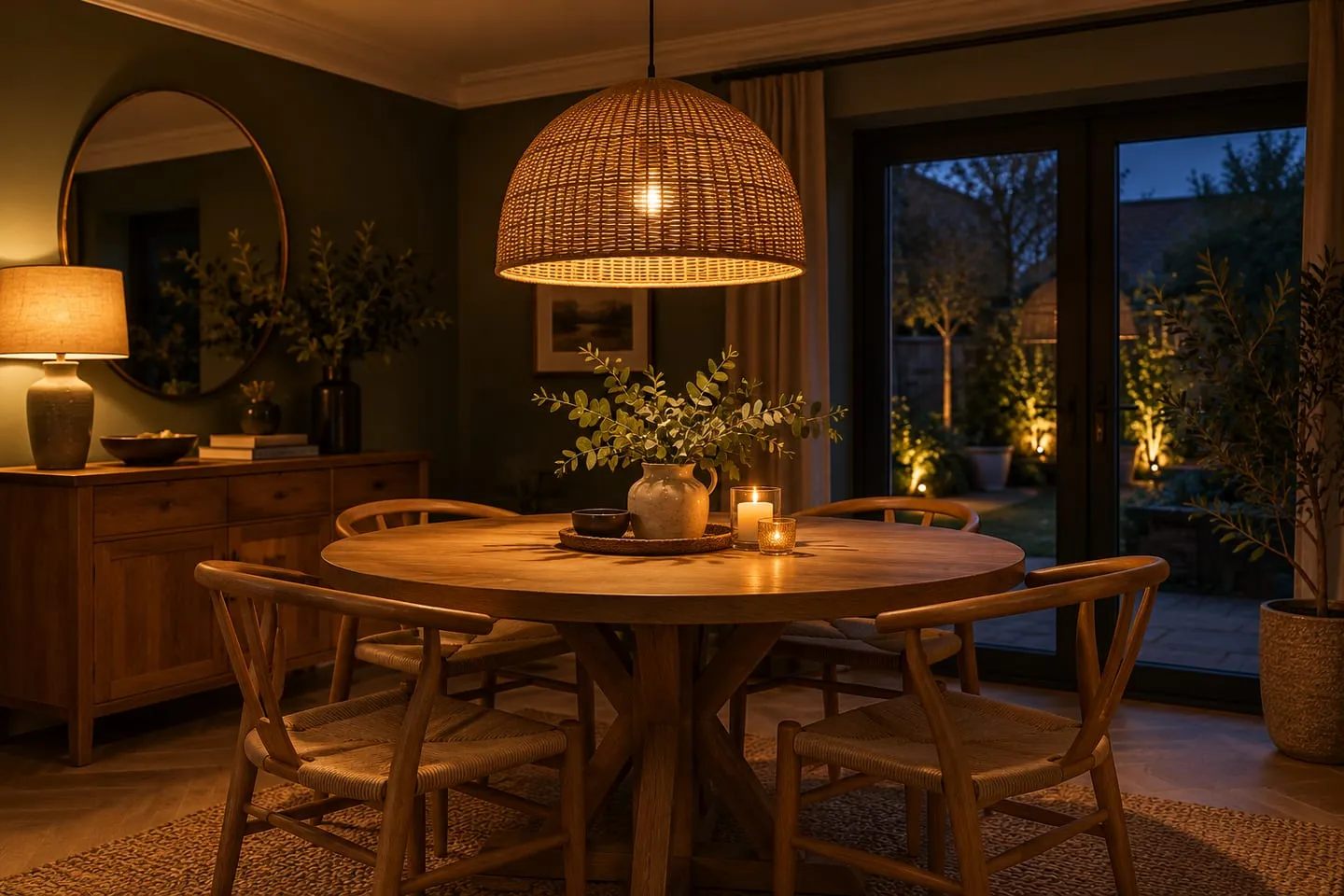
Extending tables are best lit for the length you use most days. Many extending tables open from the middle, with a leaf that drops into the centre, so if both ends come out evenly, a light centred on the closed table stays centred when it’s opened. If yours pulls out at one or both ends, centre the light on the closed table anyway. Size and space the pendants for the closed table, and accept that the extra places at each end get a little less light on the few days a year it’s fully out. A lamp on the sideboard or a few candles make up the difference.
If you often switch between a family dinner and a table covered in homework or a jigsaw, a rise-and-fall pendant lets you pull the shade down for eating and push it up when you need the light spread wider.
When the ceiling point isn’t over the table
This catches out a lot of dining rooms. The ceiling point is in the middle of the room, and the table isn’t, because it’s been pushed over to leave a walkway past a sideboard or a door. A pendant hanging from the old point lights the floor beside the table and looks wrong for as long as you live there. There are four ways round it.
Move the point. An electrician extends the cable from the existing point to a new one over the table, usually by lifting a floorboard in the room above or working through a small hole in the ceiling. In England, extending an existing lighting circuit in a dining room isn’t notifiable under Part P of the Building Regulations (a new circuit would be), but the work still has to meet the wiring regulations, BS 7671. It’s the neatest answer, and the cheapest time to do it is before you redecorate.
Use a swag hook. Leave the ceiling point where it is, fix a hook in the ceiling above the centre of the table, run the flex across the ceiling and let the pendant drop from the hook. It looks deliberate with a good fabric flex, and it’s one of the most common fixes for an off-centre point. You’ll usually need a longer flex than the pendant came with, and replacing it is electrical work, so use an electrician if you’re not confident doing it. Keep the run to one loop. A plasterboard fixing is fine for a light shade; anything heavier should hang from a joist or a timber batten fixed between joists.
Fit an offset canopy. These are ceiling plates where the flex leaves from the side, with small fixings that hold it tight along the ceiling to the point where it drops. They’re tidier than a swag; expect to pay around £40 for one from a specialist lighting shop. They suit modern rooms where a looping flex would look out of place.
Use a plug-in pendant. In a rented home, a pendant with a long flex and a plug, swagged from ceiling hooks and plugged into a wall socket, avoids any wiring at all. Keep the flex tidy down the wall so nobody trips on it.
Before any of these, check whether the table can simply move. Sometimes 20cm in one direction is all it takes.
Open-plan kitchen-diners
In a kitchen-diner, the table light has to work as a separate zone. Give it its own switch, ideally on its own dimmer, so you can turn the kitchen down and leave the table lit when you sit down to eat. Use a trailing-edge dimmer made for LED and bulbs marked dimmable; the LED dimmer switch guide explains what to buy. The open-plan kitchen-diner guide covers how the zones work together.
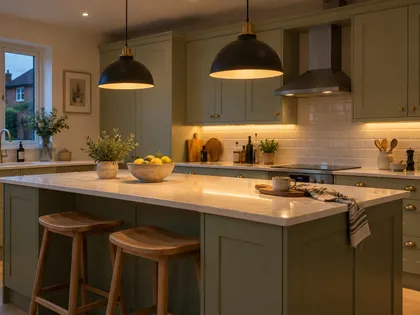
If the room also has island pendants, they don’t need to match the dining ones, but they should be related: the same finish, the same shape in a different size, or the same glass. Measure each set from its own surface. A kitchen worktop is usually about 90cm off the floor and a dining table about 75cm, so with the same gap above each, the dining pendants hang about 15cm lower than the island ones. That’s correct, not a mistake, so don’t line them up from the ceiling.
Keep the table a touch warmer than the kitchen: 2700K over the table works well next to 3000K kitchen downlights. And if there are downlights in the ceiling around the table, put them on a different switch and avoid one directly above a pendant, which casts the shade’s shadow onto the table.
Brightness and glare
How bright the pendant needs to be depends on what else lights the room. A dining room needs about 150 to 200 lumens per square metre in total, so a 12 m² room needs roughly 1,800 to 2,400 lumens from all its lights. The lumens guide has the figures for other rooms. A single pendant over the table with a bulb of about 800 lumens (a 60 W equivalent) is plenty for eating, with wall lights or a lamp making up the rest. With two or three pendants, 400 to 470 lumens in each is usually enough. Then dim them: dinner wants a lot less light than homework.
Use warm white, 2700K, and a CRI of 90 if you can find it, so food and faces look as they should. Dimmable bulbs that get warmer as they dim, such as Philips WarmGlow, give the soft, slightly golden light that suits a dining table late in the evening. My bulb picks are in the best LED bulbs guide.
The shade decides how much glare you get.
| Opal or frosted | Clear glass | Solid metal or fabric | |
|---|---|---|---|
| Light | Soft glow in all directions | Sparkle; the bulb is on show | Pool on the table, darker above |
| Glare from your chair | Very little | Can be high | Low if the bulb sits high inside |
| Best bulb | Any warm white | Warm filament, dimmed | Frosted, set well up in the shade |
| Suits | Family tables, dark rooms | Rooms with other light sources | A focused, dramatic look |
Yellow = the better option on that line.
Opal glass gives the softest light and spreads some sideways onto faces and some up to the ceiling, which suits a family table and dark-painted rooms. Clear glass looks lovely but puts the bulb on show to everyone at the table, so use a good warm filament bulb and keep it dimmed. With open-bottomed metal or fabric shades, sit in every chair and look up: if you can see the bulb, lower the pendant a little, fit a frosted bulb, or choose a deeper shade.
What I'd buy for a dining table
Affiliate linksFAQs
How high should a pendant hang over a dining table?
With the bottom of the shade 70 to 90cm above the tabletop. Under a standard 2.4m ceiling, start at 75 to 80cm and measure from the table, not the ceiling.
What size pendant suits a six-seater table?
A six-seater is usually 140 to 180cm long and 80 to 90cm wide. One shade of half to two-thirds its width suits it, so 45 to 60cm on a 90cm table, or two of 30 to 40cm, each hung over the middle of its half of the table.
How far apart should pendants be over a dining table?
Divide the table’s length by the number of pendants and hang one in the middle of each section. That usually puts the centres 60 to 90cm apart, with the outer shades at least 15cm in from the ends.
Should the pendant be centred on the table or the room?
On the table, always. If the ceiling point is off-centre, move it, swag the flex from a hook above the table, or use an offset canopy.
Can I hang a pendant over a table with a low ceiling?
Usually, yes. Nobody walks under the table, so the pendant only has to clear the people sitting at it. Choose a wide, shallow shade, keep the bottom about 75cm above the table, and keep it inside the table’s edges.
Should dining pendants be lower than kitchen island pendants?
Yes, about 15cm lower measured from the floor, because a table is lower than a worktop. Both should sit 70 to 90cm above their own surface.
 Save
Save it for later
Pin this guide to one of your Pinterest boards so it's there when you start the job.