Ceiling lighting ideas for living rooms: flush, pendant or track?

Some links below are affiliate links: if you buy through them I may earn a small commission, at no extra cost to you. As an Amazon Associate I earn from qualifying purchases. How LightGuru makes money
This guide mentions Enso Lighting, a business I work with. I've flagged it wherever it comes up. More on that

Mike's quick answer
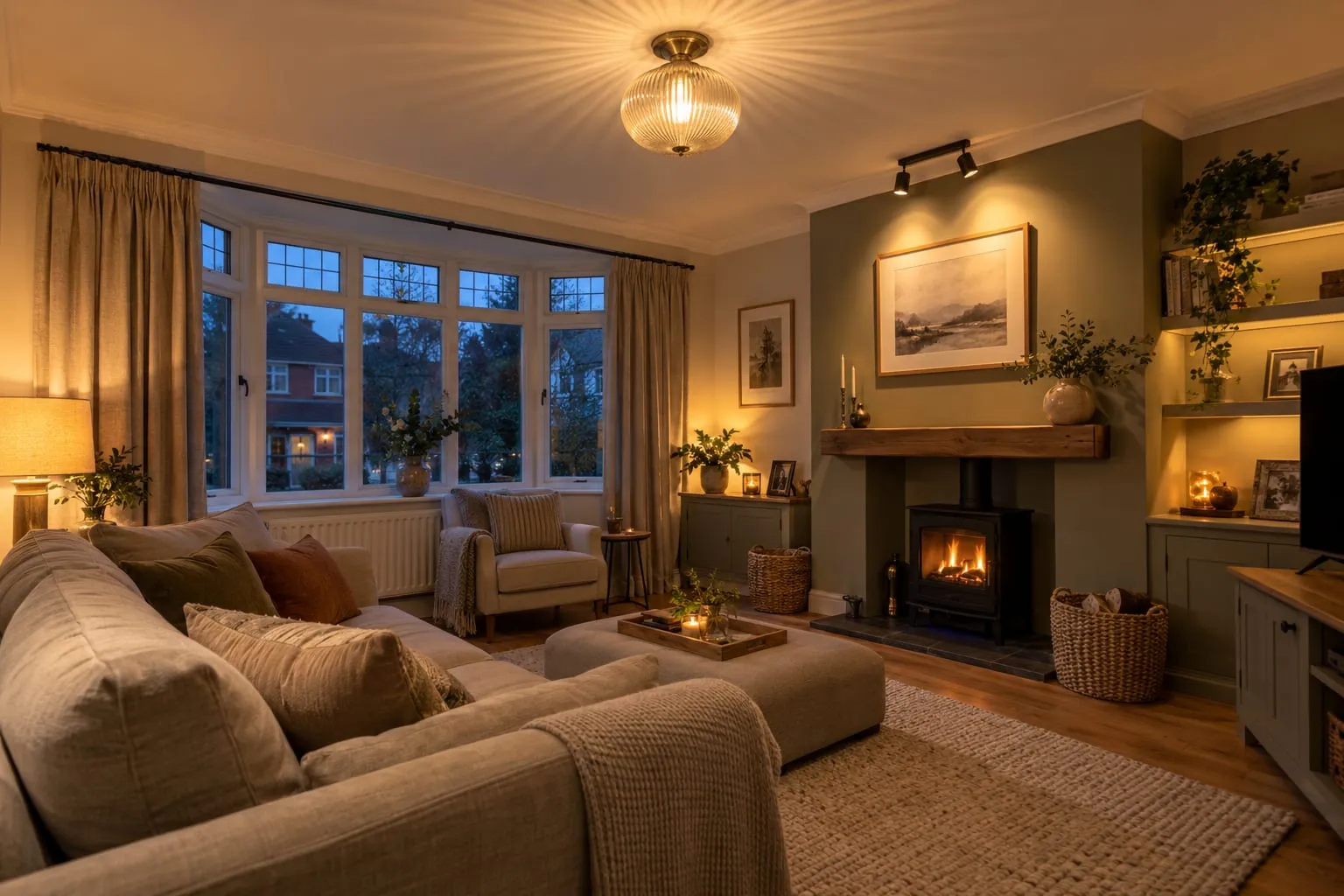
Choose by ceiling height first. Under about 2.4 m, go flush or semi-flush; with more height, a pendant over the seating; in open-plan or modern rooms, track spotlights aimed at the walls. Whichever you pick, make it dimmable and warm white, and back it up with lamps.
Most UK living rooms have one light point in the middle of the ceiling, and what hangs from it shapes the room more than people expect. The style of the fitting matters less than how it behaves: how much light it gives, where that light goes, and whether you can turn it down.
Three things decide the right choice: the height of the ceiling, the size and shape of the room, and what else lights it. A ceiling light that is the only light in the room will always be a compromise, however good it is. Plan it as the background layer, with lamps and wall lights doing the rest, and you have far more freedom in what you pick. The living room lighting guide covers the other layers.
Flush, pendant or track at a glance
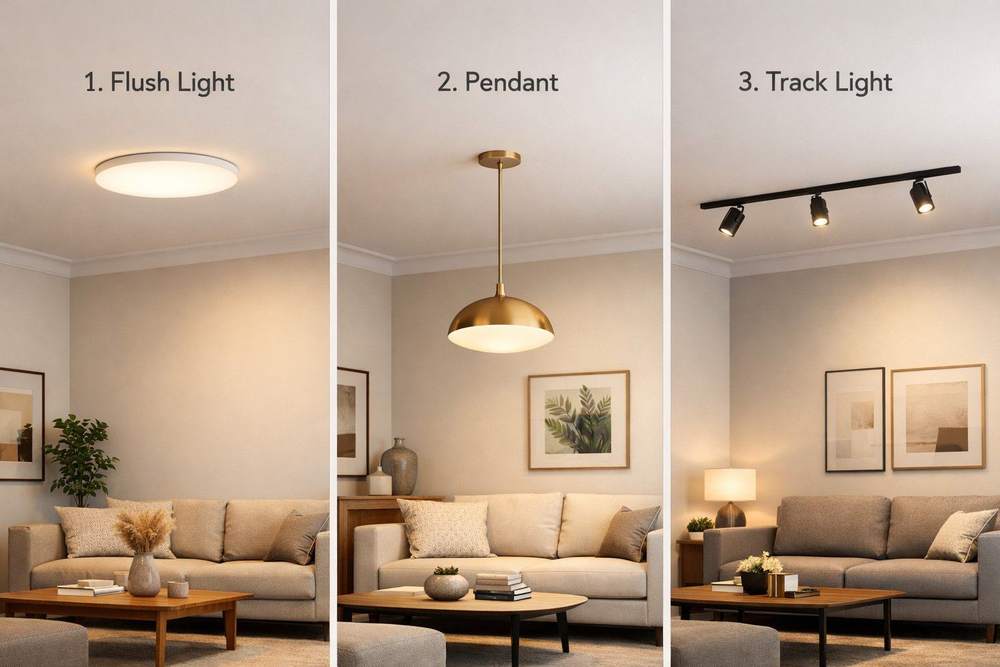
| Flush or semi-flush | Pendant | Track or spotlight bar | |
|---|---|---|---|
| Ceiling height | Any; best under 2.4 m | 2.4 m and above | Any |
| Light spread | Wide and even | Depends on the shade | Aimed where you point it |
| Glare | Low | Low with a shade, high with bare bulbs | High if aimed at seats |
| As a feature | Quiet | Strong | Architectural |
| Best for | Small and low rooms | A defined seating area | Open plan, art, modern rooms |
| Smart bulbs | Only if it takes bulbs | Usually | Yes, GU10 heads |
Yellow = the better option on that line.
None of the three is better overall. A flush light is the safe choice in an ordinary room with a standard ceiling. A pendant is the one to choose if you want the light itself to be a feature and you have the height. Track suits rooms where you want to light walls and objects rather than the middle of the room.
Flush and semi-flush lights
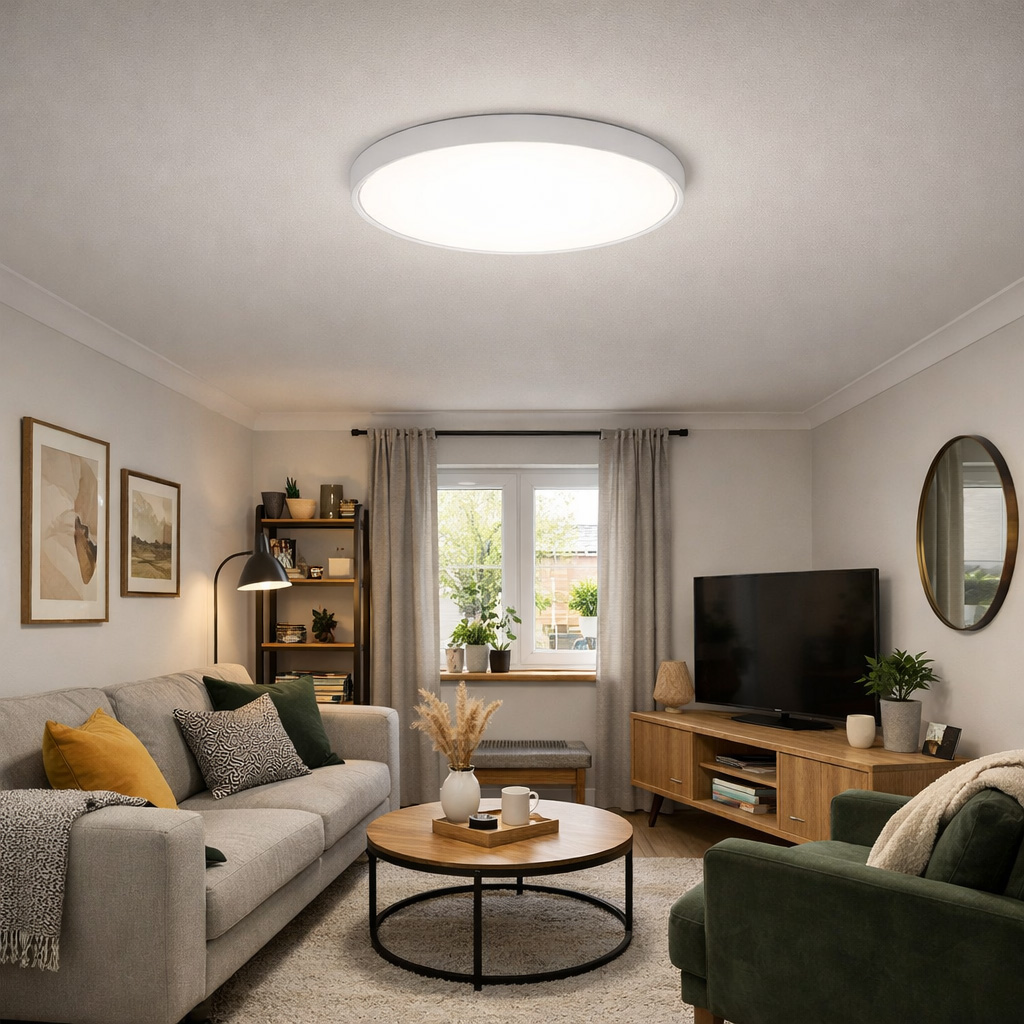
A flush light sits tight to the ceiling; a semi-flush hangs a short way below it on a stem or chains. Both keep head height clear, which matters in the many UK homes with ceilings around 2.4 m or lower, and both spread light widely and evenly.
The thing to watch with modern integrated LED flush lights is output. Many give 1,500 to 2,500 lumens, which is more than a living room’s ceiling layer needs, and a lot of them are sold in 4000K “natural white”. In a living room that combination looks like an office. Look for 2700K or 3000K, or a fitting with a colour switch, and check the box says dimmable, because plenty of cheap LED discs aren’t.
A flush light doesn’t have to be a plain white disc either. Ribbed or reeded glass breaks the light into soft bands across the ceiling and still looks good switched off. Enso Lighting’s Halo flush light (I work with Enso Lighting) in ribbed glass and antique brass is one example, and there are plenty of other ribbed glass flush ceiling lights at a range of prices. A fitting that takes ordinary bulbs gives you more choice later: you can change the colour, the brightness or go smart without changing the light.
Pendants
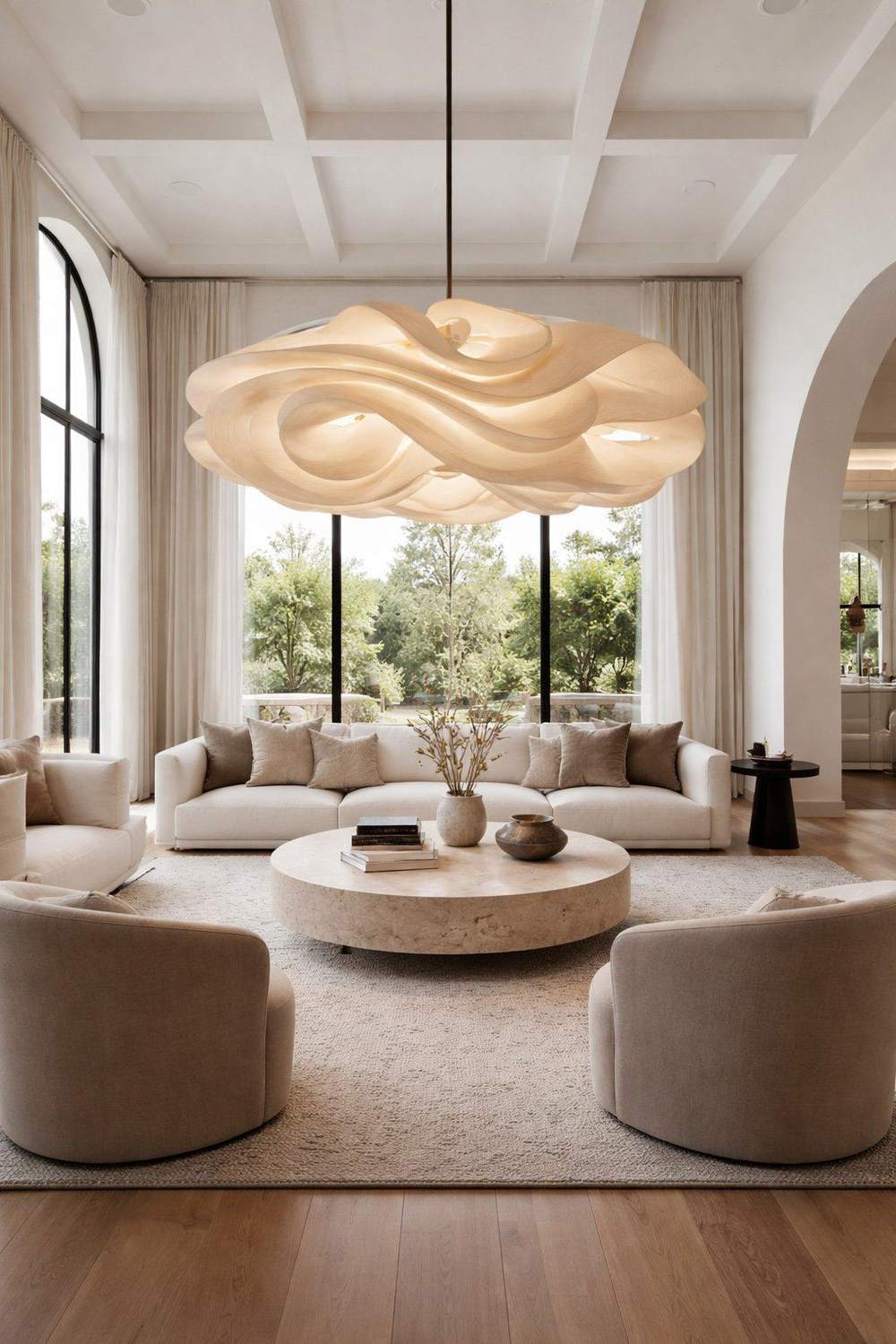
A pendant makes a statement, and in a room with the height for it, it’s the most characterful option. It’s also the one most often got wrong.
Height is the first thing. Where people walk under it, keep the bottom of the pendant at least about 2.1 m from the floor. With a standard 2.4 m ceiling that leaves only around 300 mm for the drop and the fitting together, which is why long pendants rarely work in ordinary living rooms. Over a coffee table, where nobody walks, it can hang lower, but check the sightlines from the sofa: a pendant that hangs in front of the TV or across the view of someone sitting opposite soon gets annoying. For a double-height room or a vaulted ceiling, how low to hang a pendant under a high ceiling has its own guide.
The shade decides the light. Fabric drums and opal glass diffuse it softly, which is what you want in a living room. Open metal domes push light down onto the coffee table and leave the ceiling dark. Clear glass with bare filament bulbs looks lovely in photos and throws glare in real life, so keep them dim or save them for over a dining table. With a multi-arm fitting, add up the bulbs: six 470-lumen candle bulbs is over 2,800 lumens, which is a lot for one fitting in a living room, so put it on a dimmer.
Long knock-through living rooms often have two ceiling points, one in each half. Two matching pendants or flush lights on separate switches let you light the end you’re using.
Track and spotlight bars

Track lighting is a rail on the ceiling with adjustable spotlight heads, usually taking GU10 bulbs. A spotlight bar is the short version, a straight or curved bar with three or four heads that fits straight onto an existing ceiling point. Either lets you put light exactly where you want it, which makes them good for open-plan rooms, rooms with art or a brick chimney breast, and modern or industrial interiors.
The rule with track is to aim the heads at walls, pictures and features, never at the seating. A spotlight pointed at the sofa shines straight into the eyes of anyone sitting there. Use a 36 to 40 degree beam for pictures and features, and wider 60 degree bulbs on heads that give general light. Fewer heads, well aimed, beat a dozen pointing everywhere. For lighting art and shelves properly, see accent lighting for art, shelves and alcoves.
What about downlights?
Recessed downlights are the other common choice, especially in new builds and extensions. They give clean, even light and disappear into the ceiling, but in a living room they’re easy to overdo, and in most two-storey houses they need to be fire-rated. If you’re weighing them up, the living room downlights guide covers how many, where and which type. If you’d rather put some of that light on the walls, living room wall lights covers how high and how far apart to fit them.
Small and large living rooms
In a small living room, keep the ceiling light quiet. A flush or semi-flush fitting with modest output, on a dimmer, plus a couple of lamps, will feel better than a powerful ceiling light. A big fitting in a small room dominates it, both switched on and switched off.

In a large living room, split the ceiling lighting into zones rather than relying on one central fitting. A pendant anchors the seating area, track or spots light the walls and art, and each group has its own switch. In an open-plan space, keep the living zone separate from the kitchen and dining lights so you can dim one while using the other; open-plan kitchen-diner lighting goes into that.
How bright should a living room ceiling light be?
The ceiling layer should give about 40 to 50% of the room’s light, with lamps and wall lights giving the rest. That works out at roughly 600 to 1,000 lumens for a small living room up to 12 m², 800 to 1,500 lumens for a medium room of 12 to 20 m², and 1,200 to 2,250 lumens for a large one. If you want a figure for your own room, the lumens calculator works it out.
Going over isn’t a disaster if the fitting dims. Going under means the room never feels properly lit when you need it to be, such as when you’re cleaning or looking for something.
Warm white and a dimmer

Use warm white, 2700K or 3000K. A ceiling light lights more of the room than anything else, so if it’s cool white, the whole room feels cool, however warm the lamps are. The colour temperature guide explains the scale.
And put it on a dimmer. Even a well-chosen ceiling light is too much at full brightness on a winter evening. Use an LED-compatible trailing-edge dimmer, and check that the bulbs or the fitting say dimmable. With an integrated LED fitting, check the manufacturer’s list of compatible dimmers, because a mismatch causes flicker and buzzing. If the fitting takes bulbs, smart bulbs are the other route: dimming, colour and scenes from your phone, but then leave the wall switch on and don’t put them behind a dimmer.
What I'd buy
Affiliate linksFAQs
Is a flush light or a pendant better in a living room?
Neither is better overall. With a ceiling under about 2.4 m, a flush or semi-flush light is usually the practical choice. With more height, or over a seating area nobody walks through, a pendant gives the room more character.
How low should a living room pendant hang?
Where people walk under it, keep the bottom at least about 2.1 m from the floor. Over a coffee table it can hang lower, as long as it doesn’t block the view of the TV or of the people sitting opposite.
Can track lighting replace downlights?
Often, yes. A track or spotlight bar on an existing ceiling point can light the walls and features that would otherwise take several downlights, with no new holes in the ceiling. It looks more industrial, though, and it still needs lamps for comfort.
Does a ceiling light have to be in the middle of the room?
No, but moving the point means new cable in the ceiling, which is a job for an electrician. For a pendant, a swag hook lets you loop the flex and hang the light where you want it, such as over the coffee table rather than the middle of the room.
Can I change a living room ceiling light myself?
In England, replacing a light fitting on an existing point isn’t notifiable under Part P of the Building Regulations, but a new circuit is. The work still has to be done safely, with the power off at the consumer unit and the earth connected. If you’re not confident, use a registered electrician.
What colour temperature should a living room ceiling light be?
Warm white: 2700K for a cosy feel, 3000K if you want it a little crisper. Avoid 4000K in a living room.
 Save
Save it for later
Pin this guide to one of your Pinterest boards so it's there when you start the job.