
Safety notice: Outdoor lighting faults often involve electricity, moisture, and fixed wiring. This guide provides general information and covers basic visual checks homeowners can safely perform. Always isolate power before inspecting any fitting. If faults persist, a qualified electrician should be consulted.
Outdoor lighting faults are one of the most common issues homeowners run into, and they often show up at the worst time. You install a new wall light, everything works for a few weeks, then the circuit trips after rain. Or the lights begin flickering, a PIR sensor starts acting erratically, or a ground light fills with water and stops working altogether.
Outdoor systems fail more often than indoor lighting because they live in harsher conditions. Moisture, frost, heat, UV, wind driven rain, insects, and even garden tools all take their toll. The good news is that most outdoor lighting faults fall into predictable categories, and you can usually narrow down the likely cause by the symptom and the timing.
This guide focuses on one specific aspect of lighting design. For full garden planning, layout, and safety guidance, see our complete Garden & Outdoor Lighting Guide.
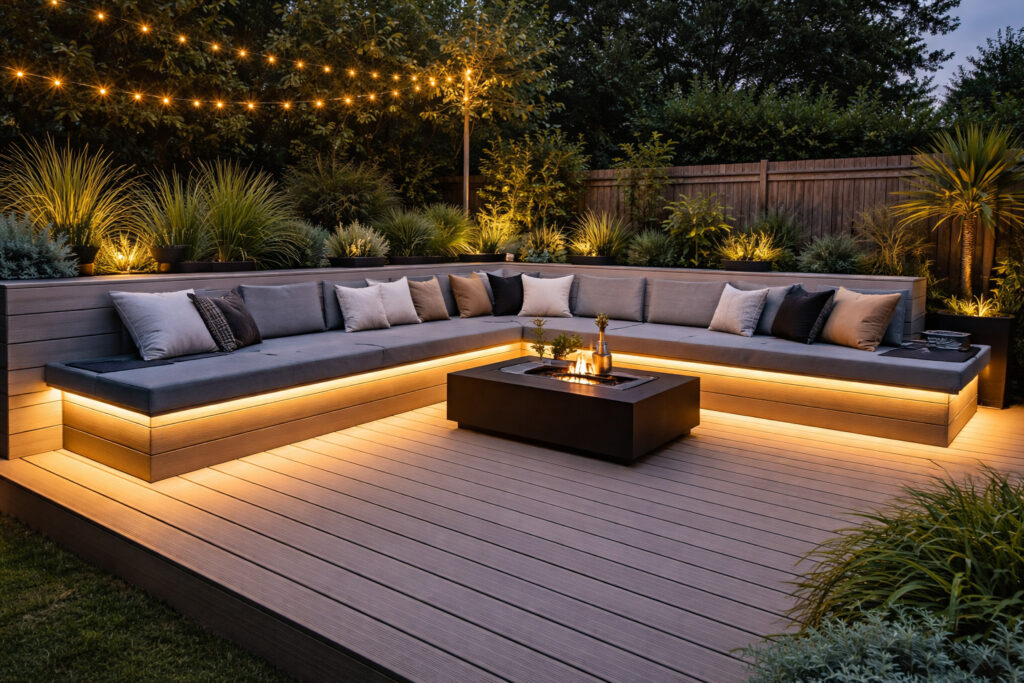
Table of Contents
How Outdoor Lighting Systems Are Wired (Plain English Overview)
Most outdoor lights are supplied from the home’s main electrical installation. In the UK, power is commonly taken from an internal lighting circuit or a fused spur, then routed to an outdoor switch, sensor, timer, or smart controller before feeding the fitting. Some systems are very simple, for example one external wall light controlled by an indoor switch. Others are more complex, especially when garden lighting is involved.
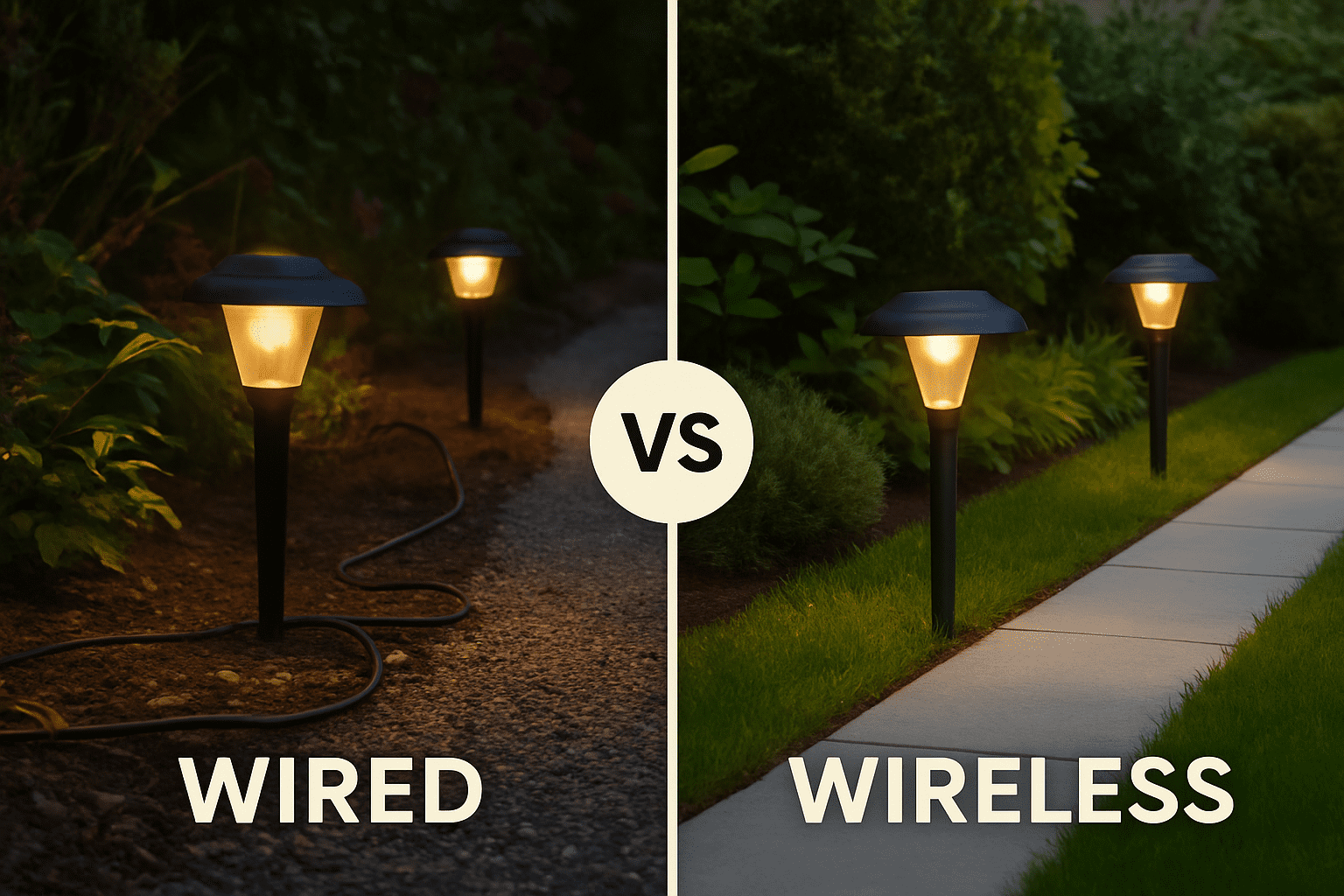
Garden lighting installations often use LED drivers or transformers, particularly when multiple low voltage fittings are used. In those cases, the mains supply feeds a driver, and the driver supplies multiple lights via low voltage cable runs.
Outdoor circuits should be protected by an RCD. An RCD monitors current flow and trips if it detects leakage to earth, which is exactly what can happen if water gets inside a fitting or a cable is damaged. This protection is essential outdoors because moisture increases shock risk.
Wiring routes matter. Outdoor cables may pass through walls, run externally in conduit, or be buried underground. Most faults happen at the points where cables join, enter a fitting, or pass through a seal. Those are the weak spots that suffer from poor sealing, movement, corrosion, and weather exposure.
Why Outdoor Lighting Fails More Than Indoor Lighting
Outdoor lighting failures are not simply bad luck. The environment creates predictable stresses.
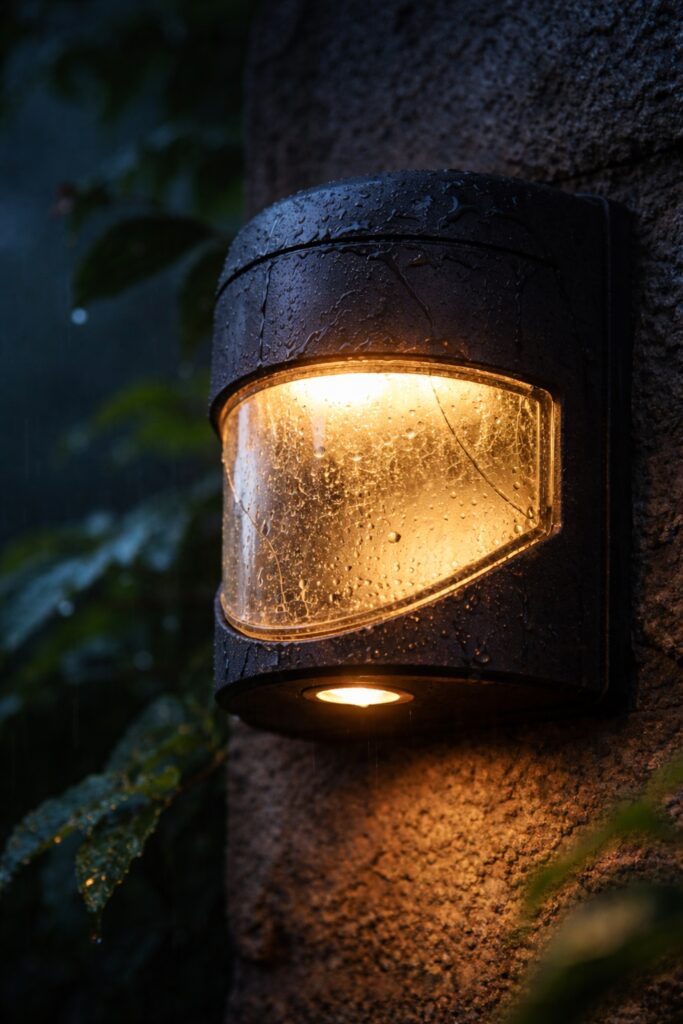
Moisture is the main culprit. Even “weatherproof” fittings can admit water if gaskets age, cable glands are not sealed properly, or housings crack. Water can also track along a cable and enter the fitting at the rear.
Temperature changes matter too. Outdoor lights warm up when on and cool quickly when off. Repeated expansion and contraction slowly deforms seals and can loosen internal connections. In winter, freezing temperatures can worsen the problem because trapped moisture expands.
UV exposure degrades plastics and insulation. Cheaper materials become brittle, crack, or warp. Once a fitting cracks, moisture problems are only a matter of time.
Outdoor contamination adds another layer. Insects can enter small gaps, bringing moisture and dirt. Algae and grime build up around seals, and leaves can trap dampness around cable entries and junction boxes.
Finally, physical damage is common. Spades, lawn edging tools, fence posts, and even pressure washers can damage cables and fittings. Underground cable faults are especially common where burial depth is shallow or ducting was never used.
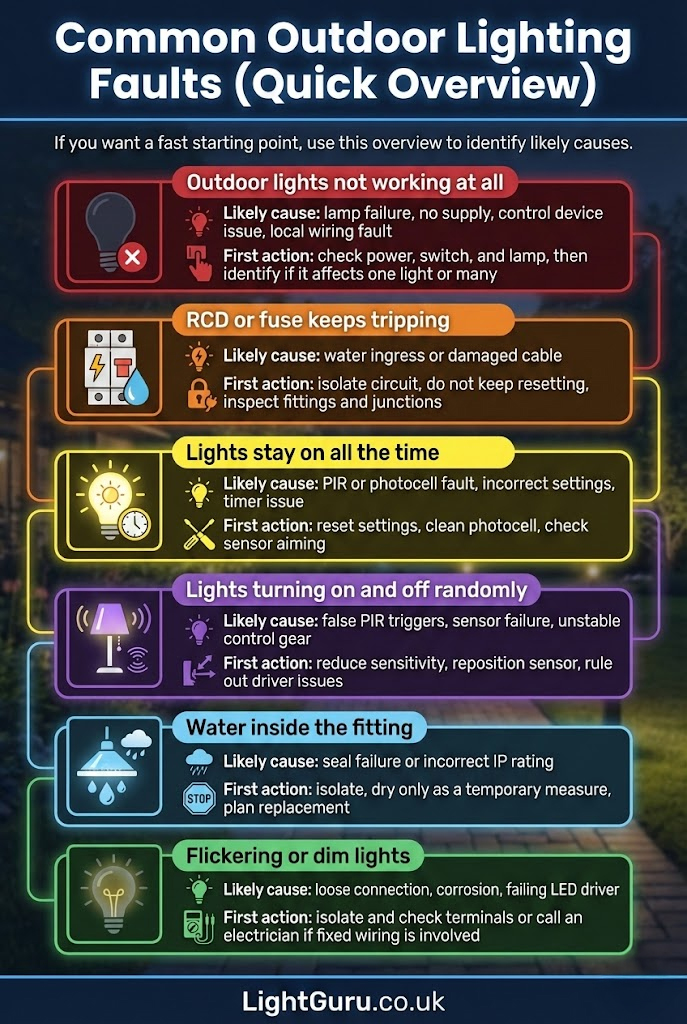
Common Outdoor Lighting Faults (Quick Overview)
If you want a fast starting point, use this overview to identify likely causes.
Outdoor lights not working at all
Likely cause: lamp failure, no supply, control device issue, local wiring fault
First action: check power, switch, and lamp, then identify if it affects one light or many
RCD or fuse keeps tripping
Likely cause: water ingress or damaged cable
First action: isolate circuit, do not keep resetting, inspect fittings and junctions
Lights stay on all the time
Likely cause: PIR or photocell fault, incorrect settings, timer issue
First action: reset settings, clean photocell, check sensor aiming
Lights turning on and off randomly
Likely cause: false PIR triggers, sensor failure, unstable control gear
First action: reduce sensitivity, reposition sensor, rule out driver issues
Water inside the fitting
Likely cause: seal failure or incorrect IP rating
First action: isolate, dry only as a temporary measure, plan replacement
Flickering or dim lights
Likely cause: loose connection, corrosion, failing LED driver
First action: isolate and check terminals or call an electrician if fixed wiring is involved
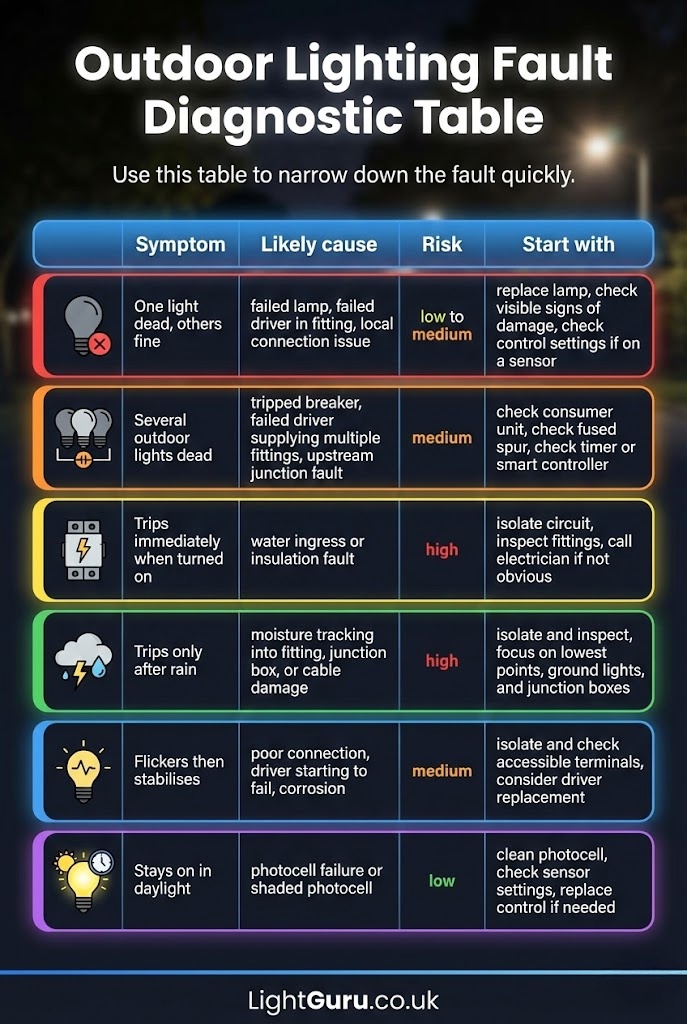
Outdoor Lighting Fault Diagnostic Table
Use this table to narrow down the fault quickly.
| Symptom | Likely cause | Risk | Start with |
| One light dead, others fine | failed lamp, failed driver in fitting, local connection issue | low to medium | replace lamp, check visible signs of damage, check control settings if on a sensor |
| Several outdoor lights dead | tripped breaker, failed driver supplying multiple fittings, upstream junction fault | medium | check consumer unit, check fused spur, check timer or smart controller |
| Trips immediately when turned on | water ingress or insulation fault | high | isolate circuit, inspect fittings, call electrician if not obvious |
| Trips only after rain | moisture tracking into fitting, junction box, or cable damage | high | isolate and inspect, focus on lowest points, ground lights, and junction boxes |
| Flickers then stabilises | poor connection, driver starting to fail, corrosion | medium | isolate and check accessible terminals, consider driver replacement |
| Stays on in daylight | photocell failure or shaded photocell | low | clean photocell, check sensor settings, replace control if needed |
When to Stop and Call an Electrician
Some issues should not be pushed past basic checks.
Stop and call a qualified electrician if:
- The RCD trips repeatedly or instantly every time
- You suspect an underground cable fault
- There is water inside a junction box or behind a fitting where fixed wiring sits
- You see scorching, melting, or smell burning
- You are unsure which circuit supplies the outdoor lighting
- The system involves armoured cable, buried joints, or multiple spurs
Outdoor faults can be dangerous because moisture and damaged insulation can make metal parts live. If anything feels uncertain, professional testing is the safe route.
Safety note: If a fault involves fixed wiring, underground cables, or repeated RCD tripping, diagnosis and repair should always be carried out by a qualified electrician.
Following recognised UK electrical safety guidance for outdoor lighting helps homeowners understand where DIY checks end and professional work must begin. Knowing when electrical work should be carried out by a qualified electrician protects both safety and compliance with UK regulations.

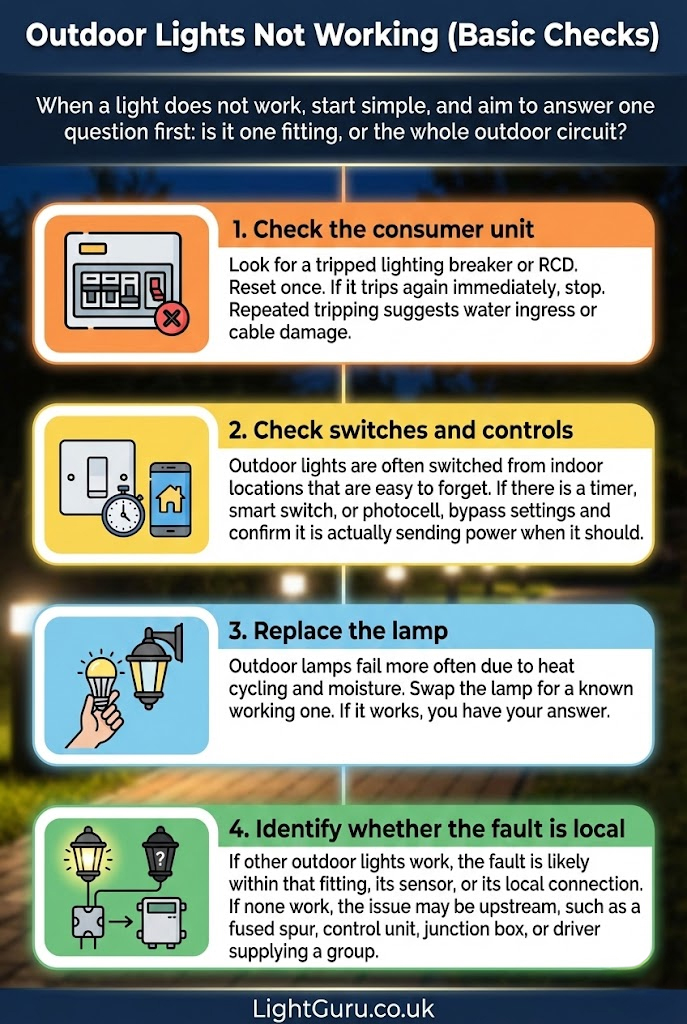
1. Outdoor Lights Not Working (Basic Checks)
When a light does not work, start simple, and aim to answer one question first: is it one fitting, or the whole outdoor circuit?
Step 1: Check the consumer unit
Look for a tripped lighting breaker or RCD. Reset once. If it trips again immediately, stop. Repeated tripping suggests water ingress or cable damage.
Step 2: Check switches and controls
Outdoor lights are often switched from indoor locations that are easy to forget. If there is a timer, smart switch, or photocell, bypass settings and confirm it is actually sending power when it should.
Step 3: Replace the lamp
Outdoor lamps fail more often due to heat cycling and moisture. Swap the lamp for a known working one. If it works, you have your answer.
Step 4: Identify whether the fault is local
If other outdoor lights work, the fault is likely within that fitting, its sensor, or its local connection. If none work, the issue may be upstream, such as a fused spur, control unit, junction box, or driver supplying a group.
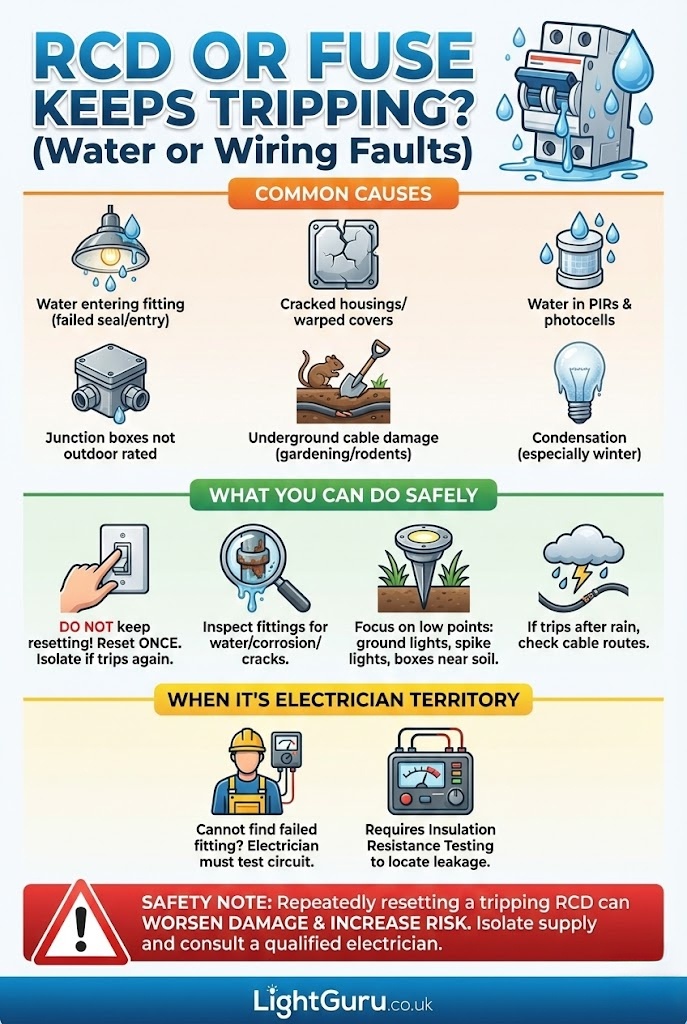
2. RCD or Fuse Keeps Tripping (Water or Wiring Faults)
This is the fault most people worry about, and for good reason.
An RCD trips when current leaks to earth. Outdoors, that is commonly caused by moisture bridging connections inside a fitting, water inside a junction box, or damaged insulation in a cable.
Safety note: Repeatedly resetting a tripping RCD can worsen damage and increase risk. If a circuit trips more than once, isolate the supply and consult a qualified electrician.
Common causes
- Water entering a fitting through a failed seal or rear cable entry
- Cracked housings or warped covers
- Water inside PIR sensors and photocells
- Junction boxes not rated for outdoor use
- Underground cable damage from gardening or rodents
- Condensation inside fittings, especially in winter
What you can do safely
- Do not keep resetting the RCD. Reset once. If it trips again, isolate the circuit.
- Inspect fittings for water, corrosion, cracks, or loose cable entries.
- Focus on the lowest points: ground lights, spike lights, and any junction boxes near soil level.
- If the circuit only trips after rain, pay attention to cable routes where water can track.
When it is electrician territory
If you cannot identify a clearly failed fitting or flooded unit, an electrician should test the circuit. Proper diagnosis often requires insulation resistance testing to locate leakage paths.
Understanding what an RCD does and why it trips explains why moisture related faults are so common with outdoor lighting.
3. Lights Stay On All the Time (Sensor and Timer Faults)
When lights stay on constantly, the wiring is usually fine. The issue is often the control device.
PIR sensor causes
- Sensitivity set too high
- Detection zone facing a road, footpath, or moving foliage
- Nearby heat sources triggering it
- Sensor lens dirty or damaged
- Water ingress inside the sensor housing
Photocell causes
- Photocell covered in dirt or algae
- Photocell shaded by a new feature such as a plant, trellis, or overhang
- Photocell failure, especially with cheap integrated units
Timer causes
- Lost settings after a power cut
- Incorrect schedule or seasonal change not updated
- Manual override left on
Fix approach
Start by cleaning the sensor and photocell, then reset settings to a sensible baseline. If it still stays on in full daylight, the photocell or sensor is likely faulty and should be replaced.

4. Outdoor Lights Turning On and Off Randomly
Random switching is usually false triggering, but can also be a sign of unstable control gear.
Most common reasons
- PIR sensor triggered by moving branches, pets, or passing cars
- Sensitivity too high
- Sensor positioned too close to reflective surfaces
- Flickering power or failing driver causing resets
- Loose connection causing brief power drops
How to narrow it down
If it triggers mostly when windy, foliage is a prime suspect. If it triggers at consistent times, a timer or smart routine may be causing it. If it flickers and resets, suspect connections or drivers.
Reducing sensitivity and repositioning sensors solves many random trigger problems. If it continues, the sensor may be failing internally.

5. Water Inside the Fitting (Condensation and Ingress)
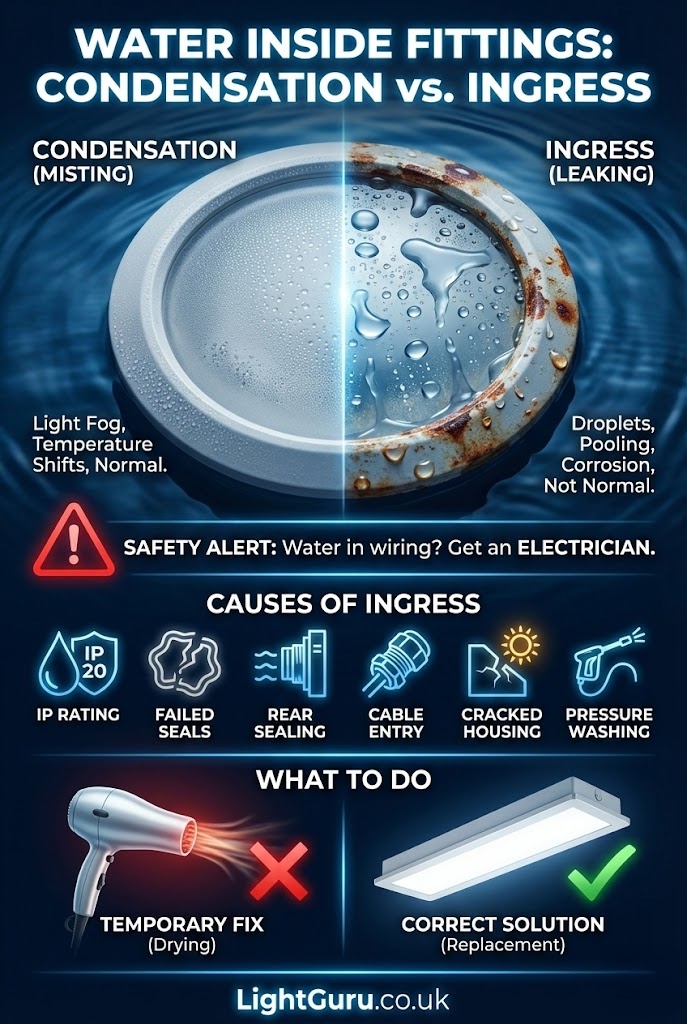
A small amount of misting can be normal, but visible droplets or pooled water is not.
Safety note: If water has entered wiring or junction points, drying alone is not a safe long term solution. A qualified electrician should assess whether replacement or rewiring is required.
Condensation vs ingress
Condensation tends to look like a light fogging that appears and disappears with temperature shifts. Water ingress often leaves droplets, pooling, corrosion marks, or water lines.
Causes of water ingress
- Incorrect IP rating for the exposure level
- Failed gaskets and seals
- Poor rear mounting sealing, letting water enter behind the fitting
- Cable entries not sealed properly with glands
- Cracked housings from UV damage or impact
- Pressure washing forcing water into weak points
What to do
Drying a fitting can be a temporary fix, but it rarely lasts. Once corrosion starts, failures accelerate. In most cases, replacement with a higher quality fitting and correct sealing is the right solution.
Many manufacturers explain the difference between condensation versus water ingress in outdoor light fittings, which helps determine whether drying or replacement is the right response.
6. Flickering or Dim Outdoor Lights
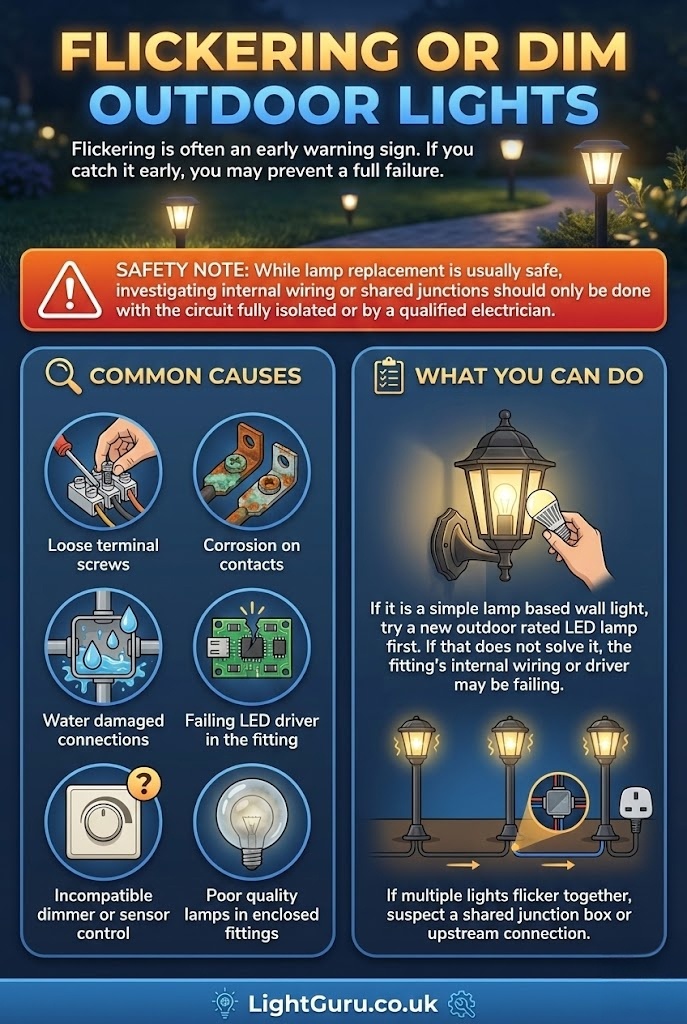
Flickering is often an early warning sign. If you catch it early, you may prevent a full failure.
Safety note: While lamp replacement is usually safe, investigating internal wiring or shared junctions should only be done with the circuit fully isolated or by a qualified electrician.
Common causes
- Loose terminal screws
- Corrosion on contacts
- Water damaged connections
- Failing LED driver in the fitting
- Incompatible dimmer or sensor control
- Poor quality lamps in enclosed fittings
What you can do
If it is a simple lamp based wall light, try a new outdoor rated LED lamp first. If that does not solve it, the fitting’s internal wiring or driver may be failing.
If multiple lights flicker together, suspect a shared junction box or upstream connection.
7. Outdoor Lights Keep Blowing Bulbs
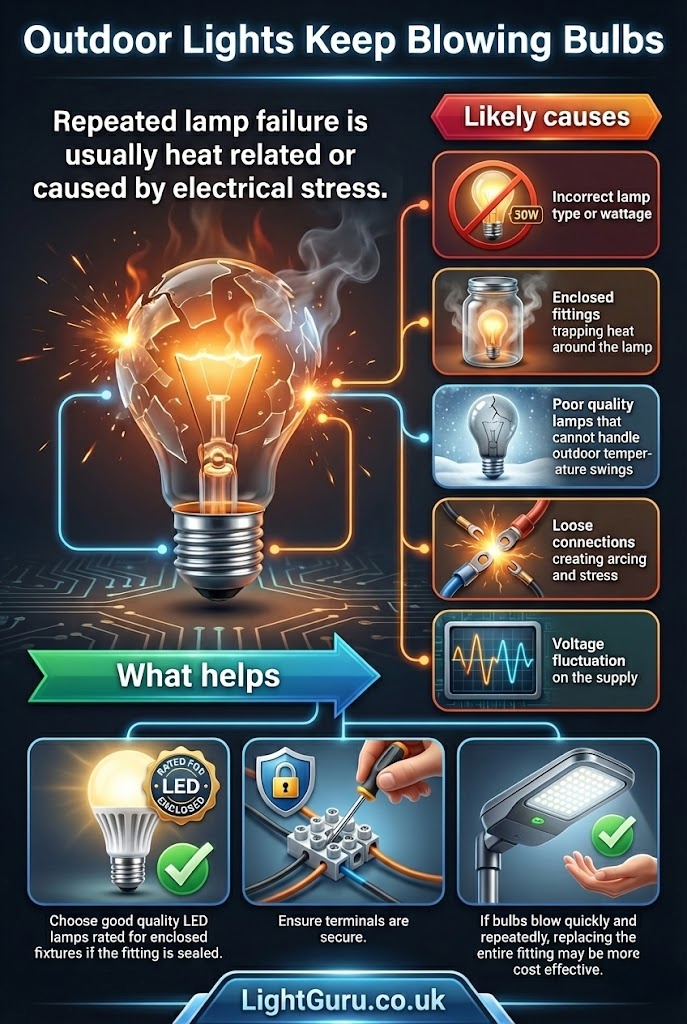
Repeated lamp failure is usually heat related or caused by electrical stress.
Likely causes
- Incorrect lamp type or wattage
- Enclosed fittings trapping heat around the lamp
- Poor quality lamps that cannot handle outdoor temperature swings
- Loose connections creating arcing and stress
- Voltage fluctuation on the supply
What helps
Choose good quality LED lamps rated for enclosed fixtures if the fitting is sealed. Ensure terminals are secure. If bulbs blow quickly and repeatedly, replacing the fitting may be more cost effective than endless lamp replacements.
8. Solar Lights Not Charging or Staying On
Solar lights are popular because they avoid wiring, but they fail for predictable reasons.
Common causes
- Dirty or shaded solar panels
- Battery degradation after a season or two
- Poor placement, especially north facing or shaded spots
- Cheap internal electronics
Fix approach
Clean panels, move lights to a brighter position, and replace rechargeable batteries if possible. If performance remains poor, upgrading to better quality solar units or switching to low voltage wired lighting is usually the long term answer.

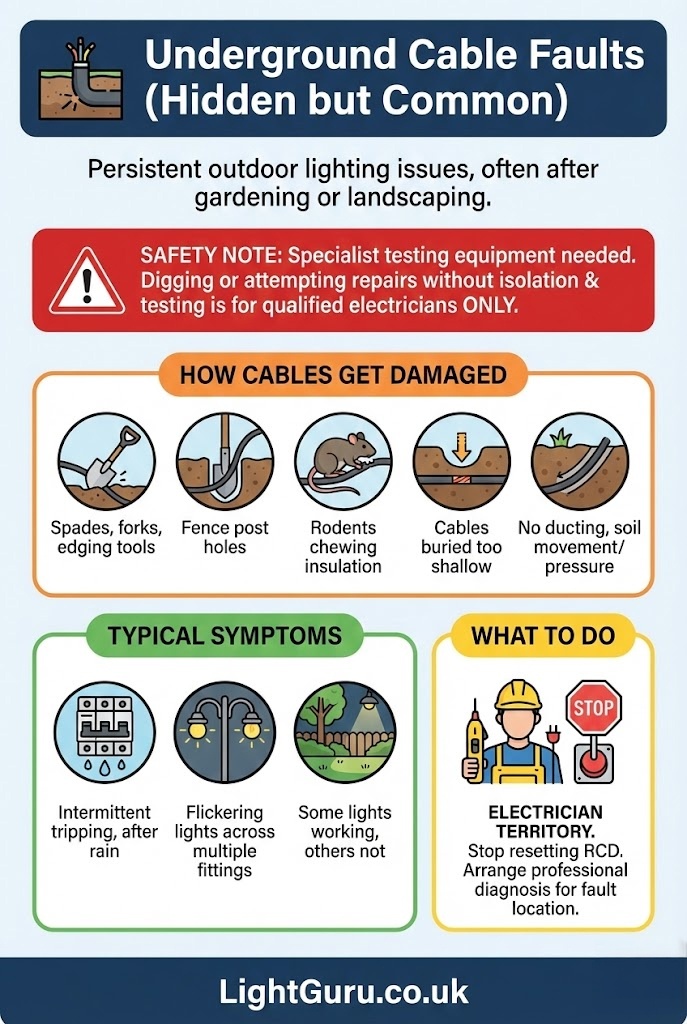
Underground Cable Faults (Hidden but Common)
Underground cable faults are a top cause of persistent outdoor lighting issues, especially when problems appear after gardening or landscaping.
Safety note: Underground cable faults require specialist testing equipment. Digging or attempting repairs without proper isolation and testing should be left to a qualified electrician.
How cables get damaged
- Spades, forks, and edging tools nicking insulation
- Fence post holes cutting through cable routes
- Rodents chewing insulation
- Cables buried too shallow
- No ducting used, allowing soil movement and pressure
Typical symptoms
- Intermittent tripping, especially after rain
- Flickering lights across multiple fittings
- Some lights working, others not, depending on the damage location
What to do
This is electrician territory because locating the fault requires testing and sometimes cable tracing. If you suspect an underground fault, stop resetting the RCD and arrange professional diagnosis.
Following safe outdoor cable installation and burial depth guidance greatly reduces the risk of accidental cable damage and water related faults.
Junction Boxes, Gel Connectors, and Failure Points
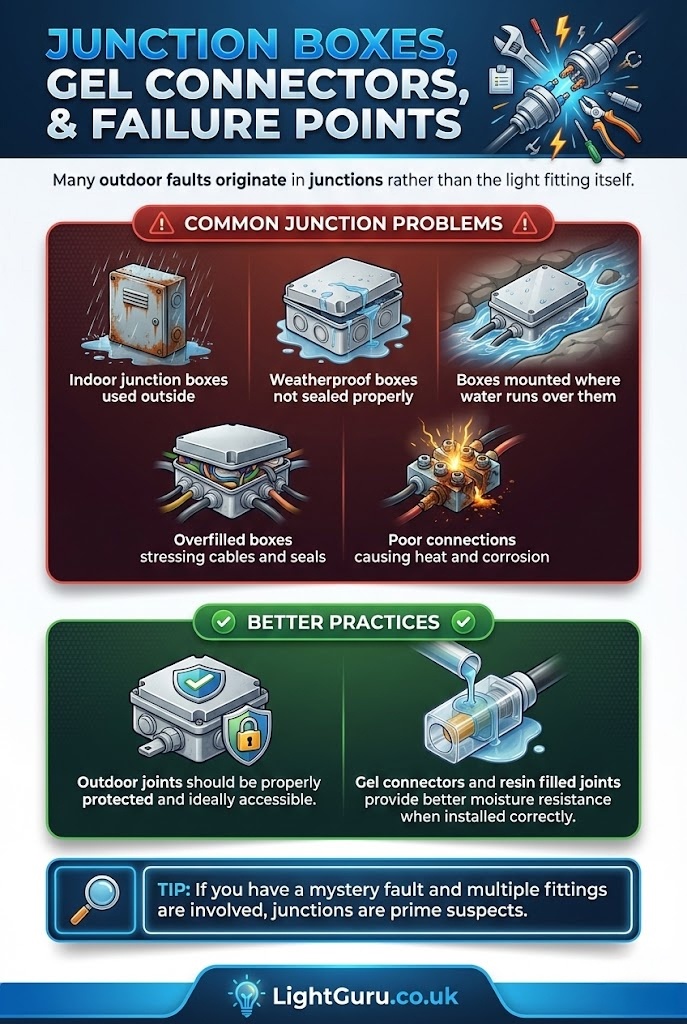
Many outdoor faults originate in junctions rather than the light fitting itself.
Common junction problems
- Indoor junction boxes used outside
- Weatherproof boxes not sealed properly
- Boxes mounted where water runs over them
- Overfilled boxes stressing cables and seals
- Poor connections causing heat and corrosion
Better practices
Outdoor joints should be properly protected and ideally accessible. Gel connectors and resin filled joints provide better moisture resistance when installed correctly. If you have a mystery fault and multiple fittings are involved, junctions are prime suspects.
IP Ratings Explained for Outdoor Fault Prevention
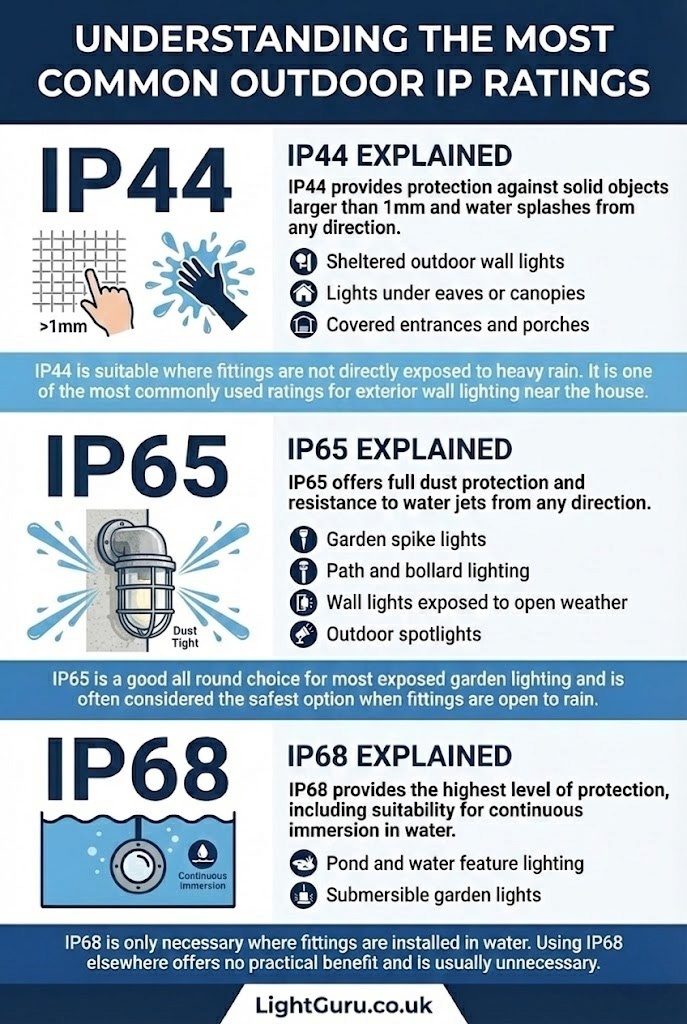
IP ratings tell you how resistant a fitting is to dust and water.
- IP44 suits sheltered areas such as porches and protected doorways
- IP65 is more appropriate for exposed walls and typical UK driving rain
- IP67 and above is often used for ground lights or areas where water may pool
Many outdoor problems happen because the fitting is technically outdoor rated, but not rated enough for the actual exposure. A wall light under an eave may survive at IP44, but the same fitting on an exposed elevation may fail quickly.
If the numbers feel confusing, this breakdown of IP ratings explained for outdoor lighting shows how dust and water resistance are defined.
Outdoor Lighting Faults by Light Type
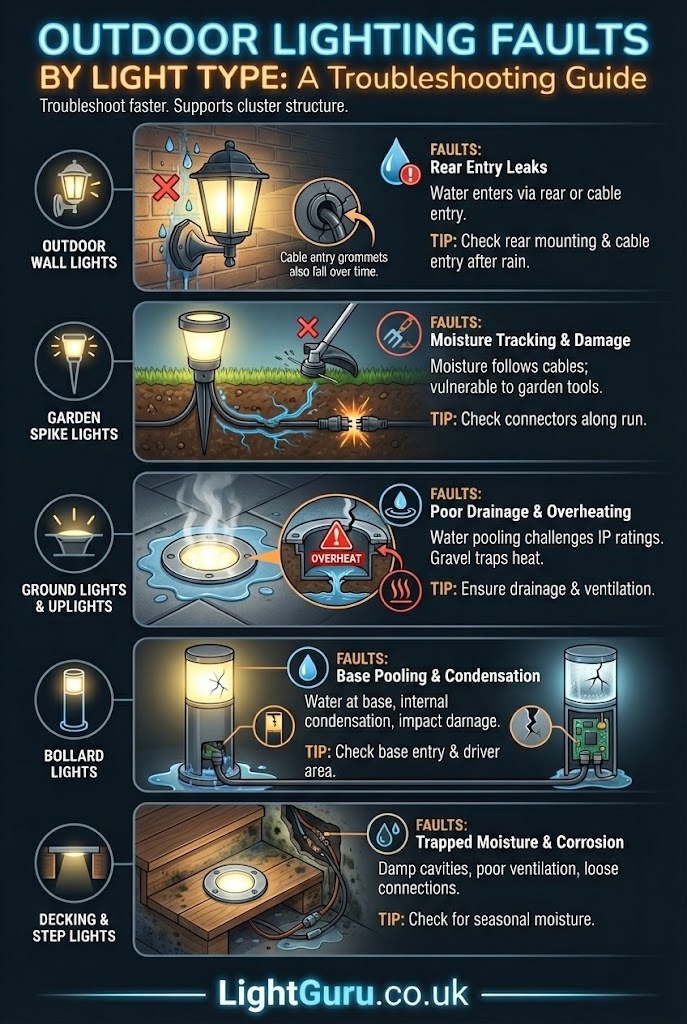
Different outdoor lights fail in different ways. This section helps you troubleshoot faster and supports your cluster structure.
Outdoor wall lights
Wall lights commonly fail through rear entry leaks. Water can enter behind the fitting where it meets the wall, especially if the mounting surface is uneven or sealant is missing. Cable entry grommets also fail over time. If a wall light trips after rain, check the rear mounting area and cable entry.
Garden spike lights
Spike lights sit close to soil level and often suffer from moisture tracking along cables. They are also vulnerable to damage from gardening and strimmers. Faults are commonly found at connectors along the run rather than the spike head itself.
Ground lights and uplights
Ground lights are among the highest failure rate outdoor fittings. Drainage is crucial. If water pools around the fitting, even high IP ratings can be challenged over time. Uplights can also overheat if enclosed in gravel or placed where heat cannot dissipate.
Bollard lights
Bollards often fail due to water pooling at the base, condensation inside tall housings, or impact damage. If a bollard flickers or trips, check the base entry point and any internal driver area.
Decking and step lights
Deck and step lights often sit in damp cavities where moisture is trapped. Poor ventilation accelerates corrosion. Loose connections under decking are common. If faults appear seasonally, trapped moisture and poor drainage under the deck is often the root cause.
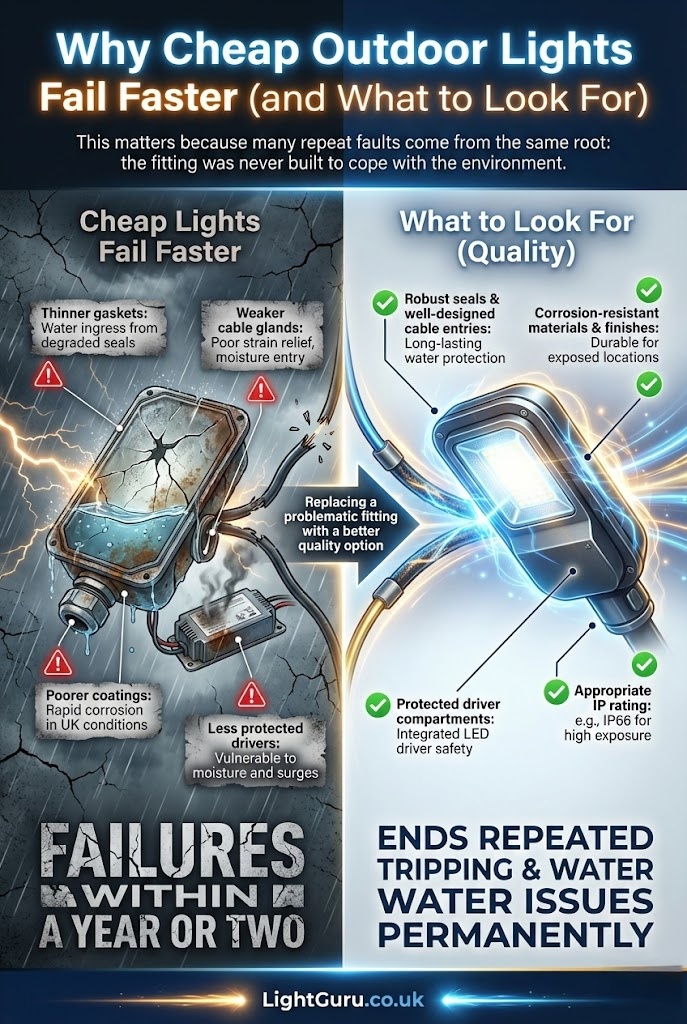
Why Cheap Outdoor Lights Fail Faster (and What to Look For)
This matters because many repeat faults come from the same root: the fitting was never built to cope with the environment.
Cheaper fittings often have thinner gaskets, weaker cable glands, poorer coatings, and less protected drivers. They may look fine initially, but failures can appear within a year or two in exposed UK conditions.
When evaluating outdoor lights, look for:
- robust seals and well designed cable entries
- corrosion resistant materials and finishes
- protected driver compartments for integrated LEDs
- appropriate IP rating for the exposure
In many cases, replacing a problematic fitting with a better quality option ends repeated tripping and water ingress issues permanently.
LED Drivers and Transformers (A Major Failure Point)
LED drivers fail more often outdoors than many people expect, especially when they are integrated inside a compact fitting with limited ventilation.
Safety note: Driver replacement often involves fixed wiring connections. If access is restricted or wiring is unclear, the work should be carried out by a qualified electrician.
Why drivers fail
- heat build up inside sealed housings
- moisture and condensation entering driver compartments
- poor quality components in cheaper drivers
- electrical stress from unstable supplies or poor connections
Signs a driver is failing
- flickering that gradually worsens
- lights turning off then coming back on
- dim output even when power is stable
- random behaviour that looks like sensor faults
Better driver placement
Where possible, drivers last longer when installed in a protected, ventilated, accessible location. For multi light setups, using a quality driver housed indoors or in a weather protected enclosure often improves long term reliability.
Industry research into common causes of LED driver failure highlights why heat and moisture dramatically shorten lifespan outdoors.

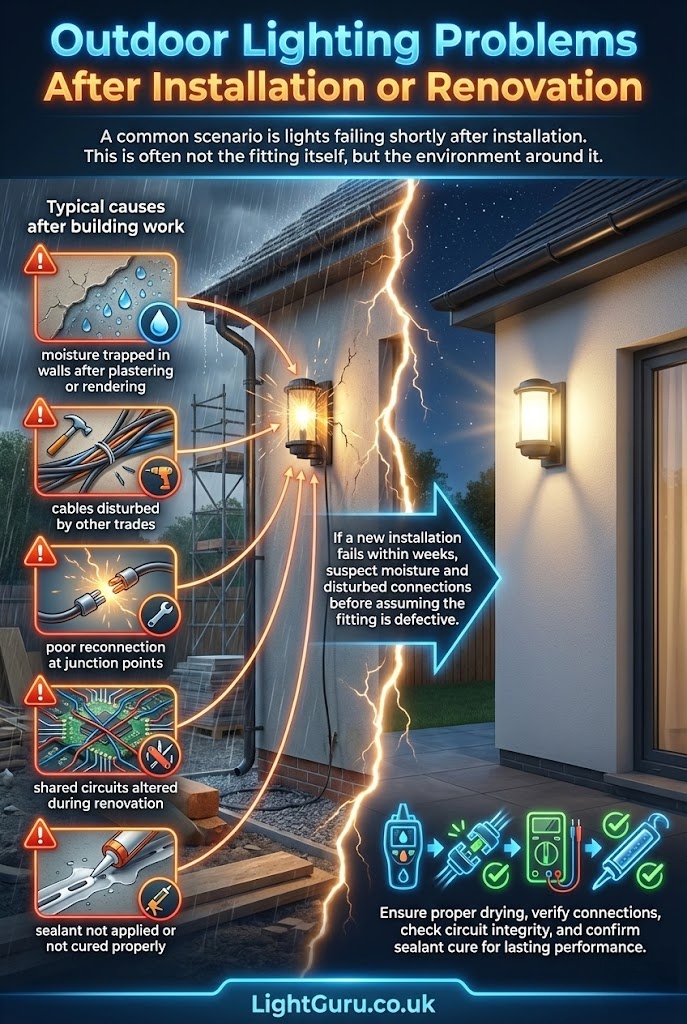
Outdoor Lighting Problems After Installation or Renovation
A common scenario is lights failing shortly after installation. This is often not the fitting itself, but the environment around it.
Typical causes after building work
- moisture trapped in walls after plastering or rendering
- cables disturbed by other trades
- poor reconnection at junction points
- shared circuits altered during renovation
- sealant not applied or not cured properly
If a new installation fails within weeks, suspect moisture and disturbed connections before assuming the fitting is defective.
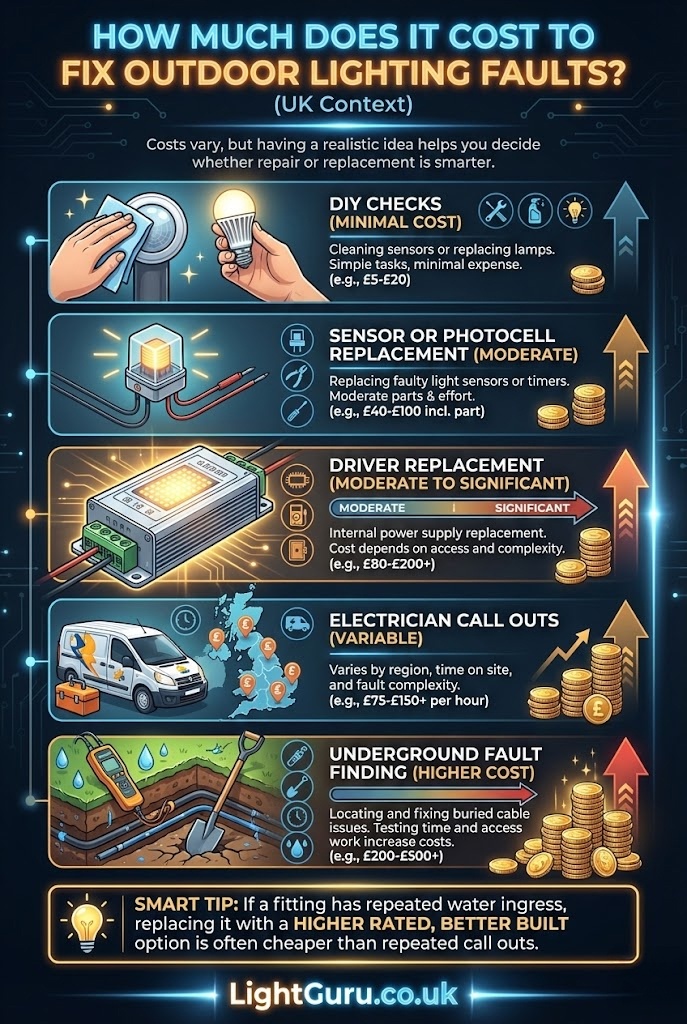
How Much Does It Cost to Fix Outdoor Lighting Faults (UK Context)
Costs vary, but having a realistic idea helps you decide whether repair or replacement is smarter.
- DIY checks such as cleaning sensors or replacing lamps are minimal cost
- Sensor or photocell replacement is usually moderate
- Driver replacement can range from moderate to significant depending on access
- Electrician call outs vary by region and complexity
- Underground fault finding can cost more due to testing time and access work
If a fitting has repeated water ingress, replacing it with a higher rated, better built option is often cheaper than repeated call outs.
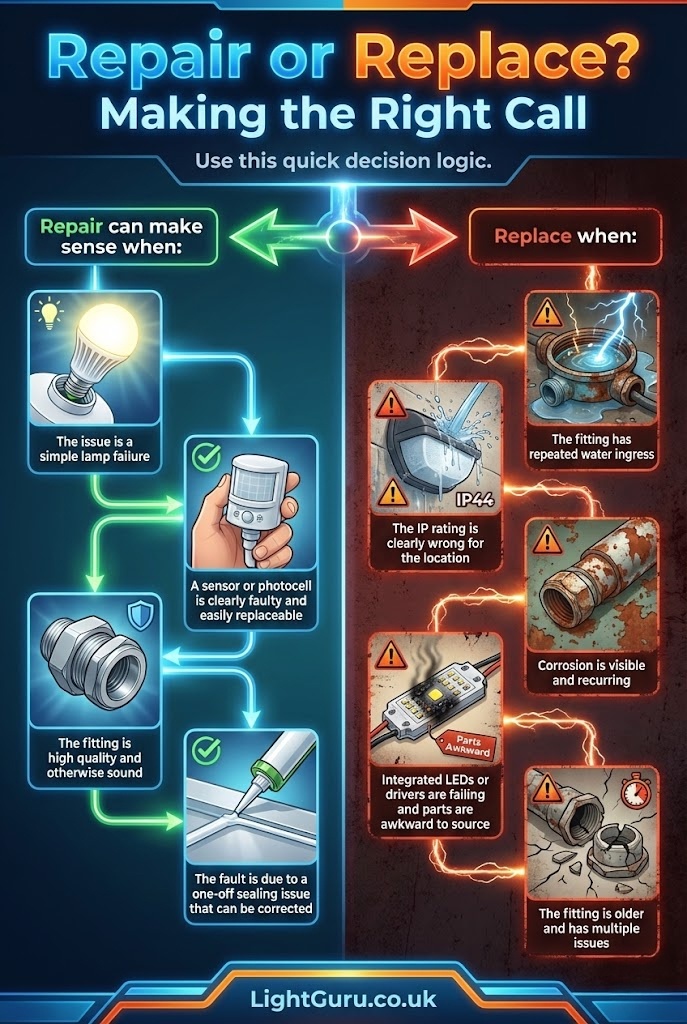
Repair or Replace? Making the Right Call
Use this quick decision logic.
Replace when:
- the fitting has repeated water ingress
- the IP rating is clearly wrong for the location
- corrosion is visible and recurring
- integrated LEDs or drivers are failing and parts are awkward to source
- the fitting is older and has multiple issues
Repair can make sense when:
- the issue is a simple lamp failure
- a sensor or photocell is clearly faulty and easily replaceable
- the fitting is high quality and otherwise sound
- the fault is due to a one off sealing issue that can be corrected
Planning Outdoor Lighting Layouts to Minimise Future Faults
Pillar content needs planning advice, because many faults are created at design stage.
Reduce exposure where possible
Mount wall lights in positions that reduce direct rain exposure, or choose higher IP ratings for exposed elevations.
Avoid splash zones
Near ground level, splashback from rain can soak fittings and cable entries repeatedly. For low level lighting, choose fittings designed for that purpose.
Plan cable routes properly
Route cables away from likely digging areas. If cables must be buried, ensure correct depth and protection. Keep junctions accessible.
Allow for maintenance
Outdoor lighting needs inspection. Design the system so key components like drivers and junctions can be accessed without dismantling half the garden.

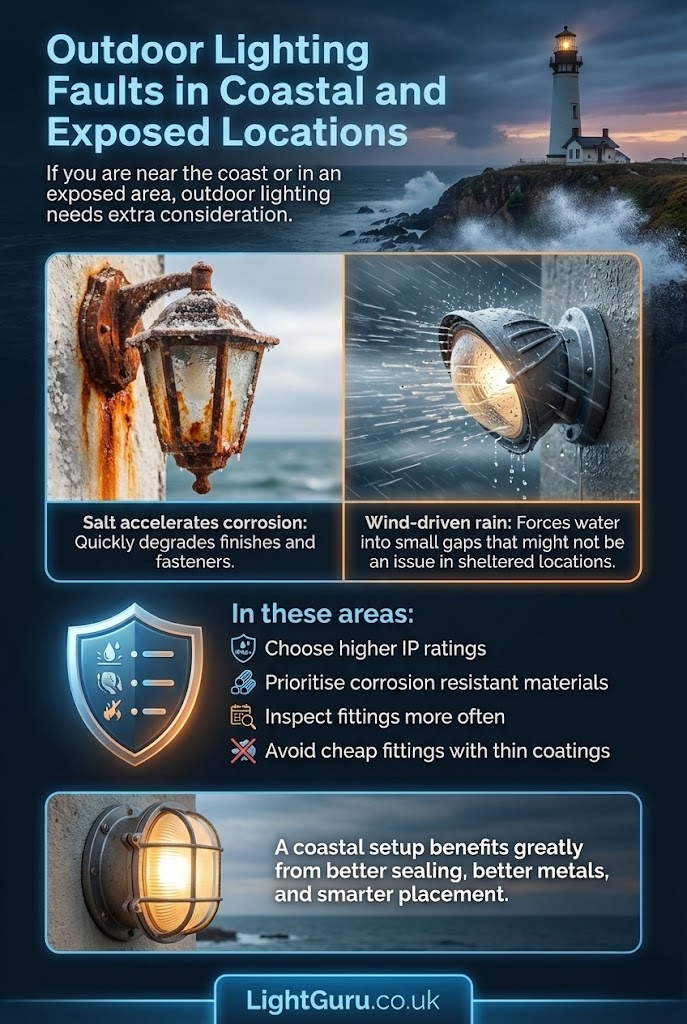
Outdoor Lighting Faults in Coastal and Exposed Locations
If you are near the coast or in an exposed area, outdoor lighting needs extra consideration.
Salt accelerates corrosion and can quickly degrade finishes and fasteners. Wind driven rain forces water into small gaps that might not be an issue in sheltered locations.
In these areas:
- choose higher IP ratings
- prioritise corrosion resistant materials
- inspect fittings more often
- avoid cheap fittings with thin coatings
A coastal setup benefits greatly from better sealing, better metals, and smarter placement.
Safe Visual and Isolation Checks Homeowners Can Do
You can safely do the following, provided you isolate power at the consumer unit and confirm the circuit is off:
Safety note: If at any point isolation cannot be confirmed or wiring is unclear, stop and consult a qualified electrician before proceeding.
- visual inspection for cracks, corrosion, and water
- replacing lamps with known working ones
- cleaning PIR sensors and photocells
- checking for loose accessible screws and cable glands
- resetting timers and smart controls
If you have to open fixed wiring junctions or you cannot confidently isolate and test safely, stop and call an electrician.

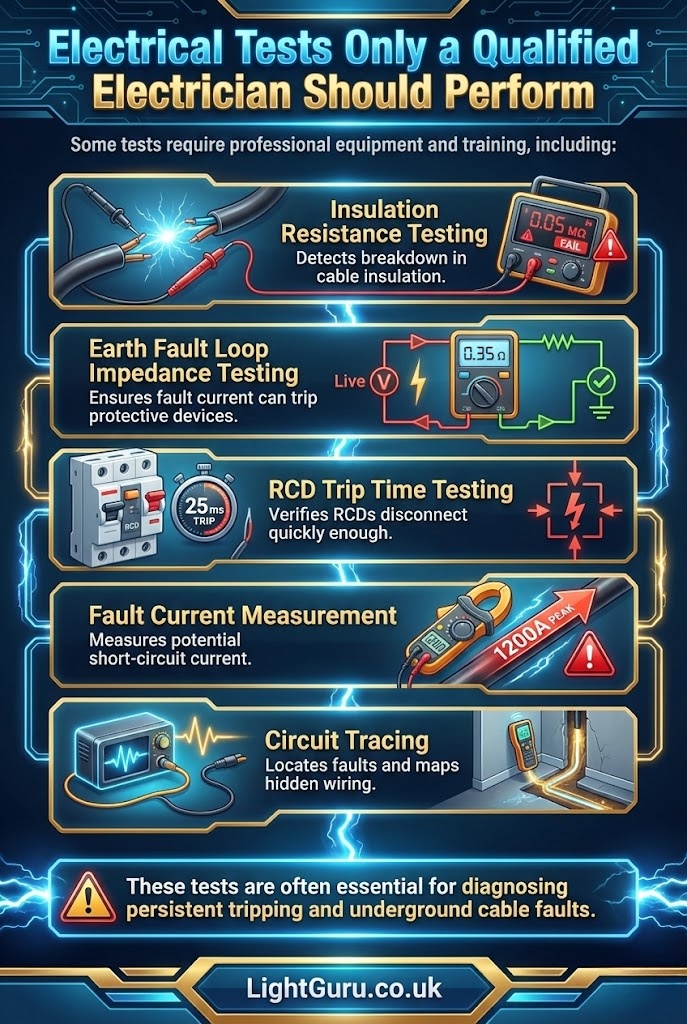
Electrical Tests Only a Qualified Electrician Should Perform
Some tests require professional equipment and training, including:
- insulation resistance testing
- earth fault loop impedance testing
- RCD trip time testing
- fault current measurement and circuit tracing
These tests are often essential for diagnosing persistent tripping and underground cable faults.
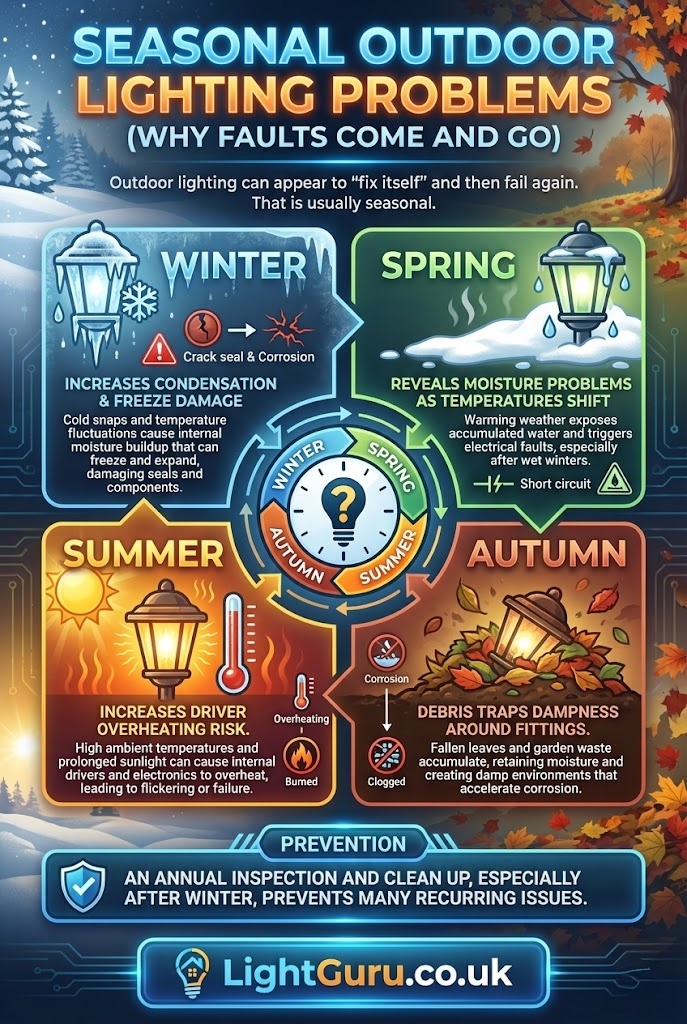
Seasonal Outdoor Lighting Problems (Why Faults Come and Go)
Outdoor lighting can appear to “fix itself” and then fail again. That is usually seasonal.
- winter increases condensation and freeze damage
- spring reveals moisture problems as temperatures shift
- summer increases driver overheating risk
- autumn debris traps dampness around fittings
An annual inspection and clean up, especially after winter, prevents many recurring issues.
How to Design Outdoor Lighting That Does Not Fail (Best Practice)
If you are installing or upgrading outdoor lighting, these principles help prevent most faults.
- choose fittings with appropriate IP ratings for exposure
- use corrosion resistant materials in harsh areas
- seal cable entries properly using correct glands
- keep junctions dry, protected, and ideally accessible
- place drivers in ventilated, protected areas
- protect underground cables with correct depth and ducting
- design for inspection and maintenance
A reliable outdoor lighting system is not about one feature. It is about combining correct product selection with correct installation details.

Outdoor Lighting Fault FAQs
Can I fix outdoor lights myself?
You can do basic checks like lamp replacement, cleaning sensors, and confirming switches and timers. Fixed wiring faults, repeated tripping, and underground faults should be handled by an electrician.
Why do outdoor lights trip after rain?
Rain often exposes water ingress points, allowing moisture to bridge electrical connections or track along damaged insulation.
Do outdoor lights need their own circuit?
Not always, but larger installations often benefit from a dedicated circuit for safer fault isolation and easier troubleshooting.
Do smart outdoor lights fail more often?
Smart controls add complexity. The lighting itself does not fail more often, but control devices can introduce new points of failure if placed in exposed areas.
Should outdoor lighting be low voltage?
Low voltage garden systems can be safer and easier to expand, but they still require good drivers and moisture protection. They are not automatically fault free.
Why do new outdoor lights fail quickly?
The most common reasons are poor sealing at cable entry, installation in an exposed location with too low an IP rating, or moisture from fresh building work.
Can outdoor lighting cause house wide tripping?
Yes, if outdoor lighting is on a shared RCD, a fault can trip other circuits protected by the same device.
Is condensation inside outdoor lights normal?
Light misting can be normal, but repeated droplets, pooling, or corrosion indicates ingress or poor ventilation.
Can insects cause outdoor lighting faults?
Yes. Insects can enter fittings and bring moisture and contamination, accelerating corrosion and causing leakage paths.
How deep should outdoor cables be buried?
Depth depends on location. Cables under lawns should be buried deep enough to avoid gardening damage, and deeper where vehicles or heavy loads are involved. If unsure, consult an electrician or follow current guidance.
What IP rating do I need for outdoor lights?
IP44 is often fine for sheltered locations. IP65 is better for exposed walls. Ground lights typically need higher ratings and good drainage.
When is replacement better than repair?
When a fitting has repeated water ingress, corrosion, or an unsuitable IP rating for its location, replacement is usually the smarter long term option.
Final Thoughts
Outdoor lighting faults are rarely random. They are usually caused by moisture exposure, environmental stress, or installation weaknesses that gradually develop over time. Many issues can be narrowed down by symptom patterns and weather timing, but repeated tripping, water ingress, and suspected cable damage are not faults to ignore.
With quality fittings, correct IP ratings, well protected cable routes, accessible junctions, and sensible maintenance, outdoor lighting can be reliable for years. Use this guide to diagnose issues intelligently, but also to prevent them by improving how outdoor lighting is chosen, installed, and maintained.