This guide is reader-supported. When you buy through our links, we may earn a commission at no additional cost to you.
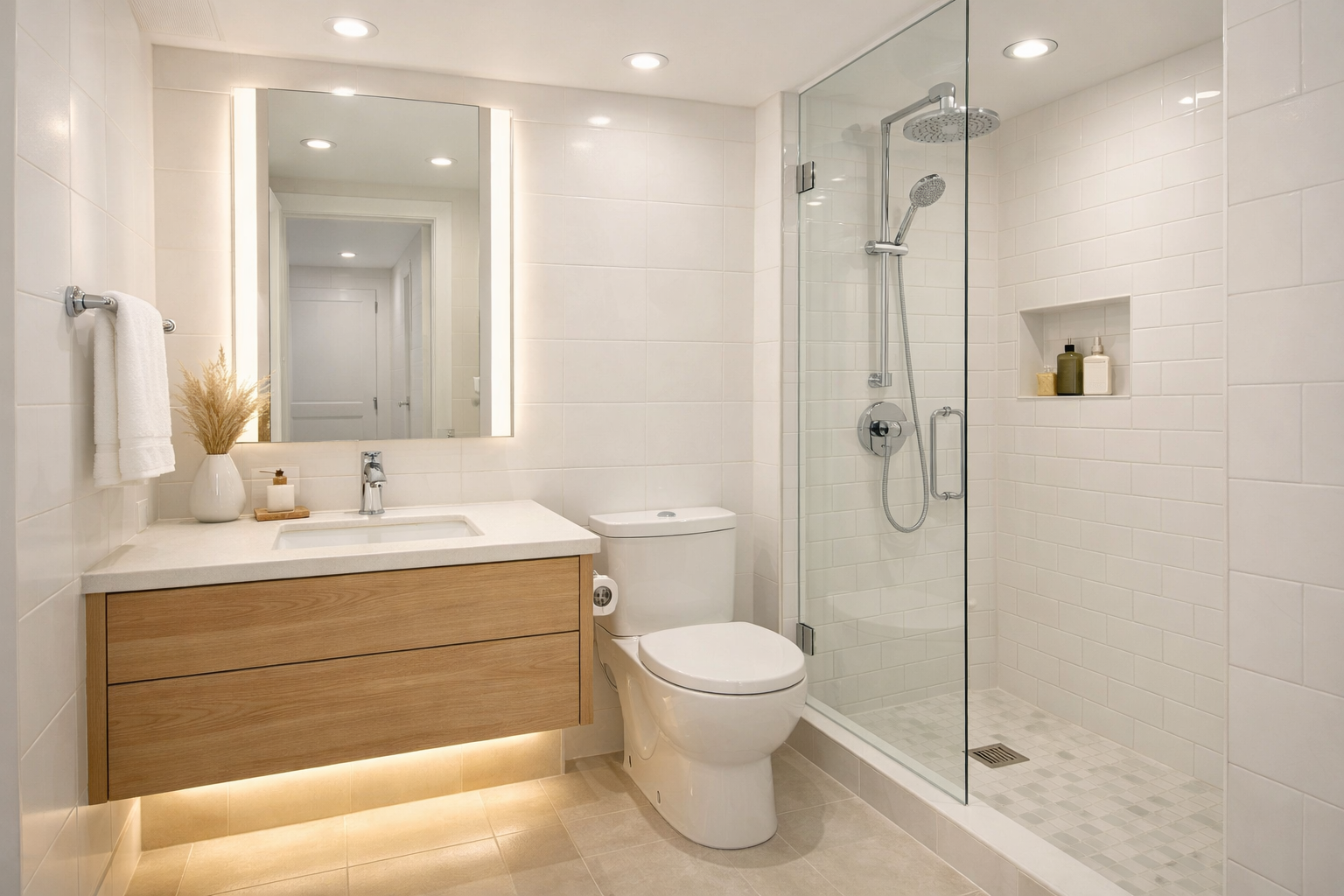
Small bathrooms are tricky to light well. Get it wrong and the space feels cramped, shadowy and claustrophobic. Get it right and even the tiniest ensuite can feel open, airy and surprisingly spacious.
The good news is that lighting is one of the most effective tools for making a small bathroom feel larger, and it does not require knocking down walls or expensive renovations. A few smart choices about fixture placement, light direction and colour temperature can completely transform how the room feels.
This guide focuses on one specific aspect of bathroom lighting design. For full room planning, layout, and safety zones, see our complete Bathroom Lighting Guide.
Small Bathroom Lighting at a Glance
Ceiling: IP65 recessed downlights, 60° beam angle, 500-700 lumens each, 3000K
Mirror: LED backlit mirror or vertical strips, 4000K
Accent: IP65 LED strip under floating vanity, 2700-3000K
Quantity: 2-4 downlights for rooms under 4m²
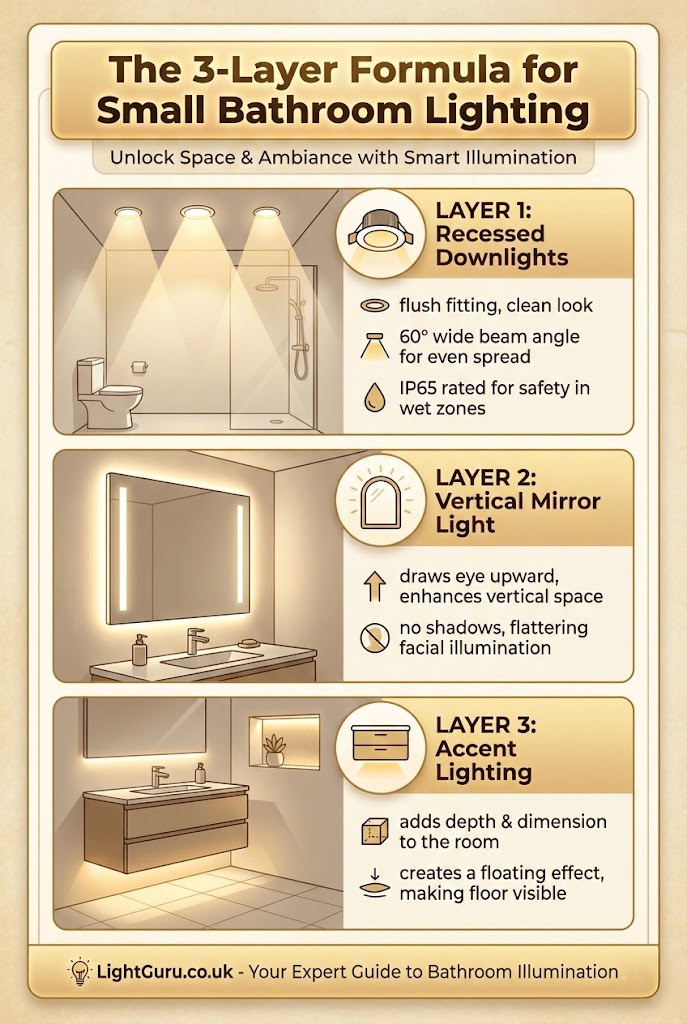
The most effective small bathroom lighting uses a simple three layer approach. Recessed ceiling lights provide even ambient light, vertical mirror lighting improves task visibility and emphasises height, and subtle accent lighting adds depth so the space feels larger than it is.
Table of Contents
Why Small Bathrooms Need Different Lighting
Standard bathroom lighting advice does not always apply to small spaces. What works in a large family bathroom can make a compact ensuite feel worse.
The main challenges are:
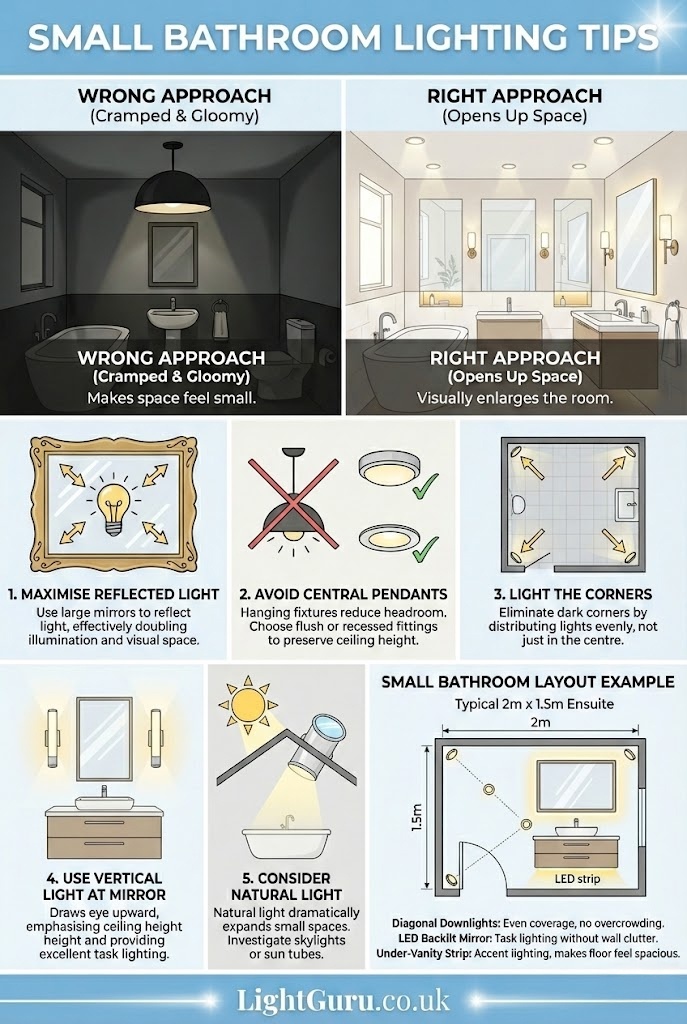
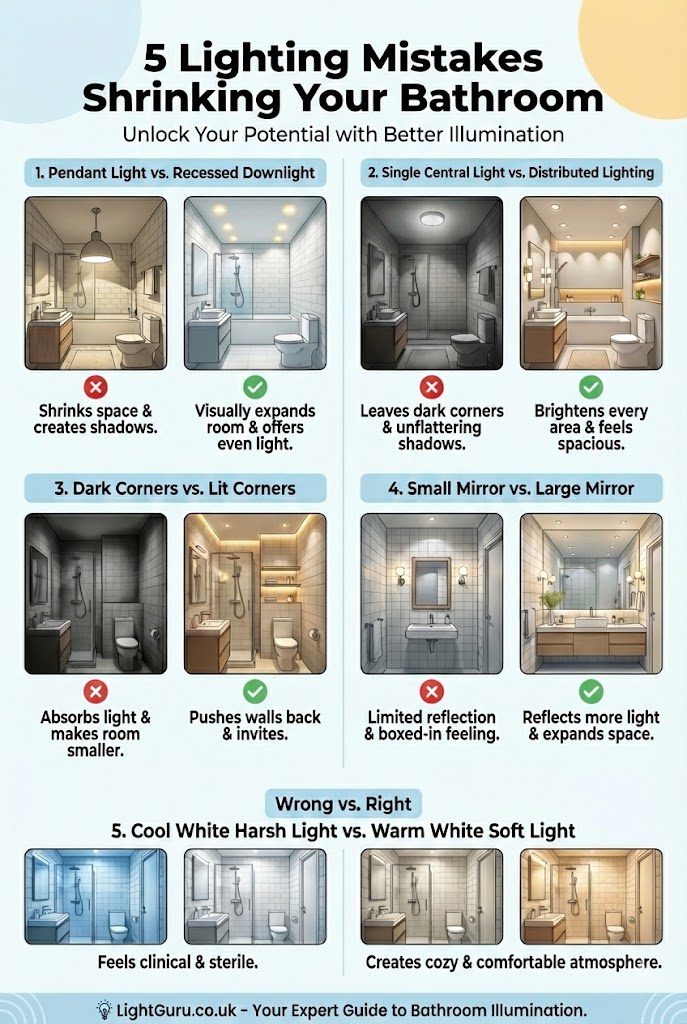
Limited ceiling height. Many small bathrooms have standard 2.4m ceilings or lower. Pendant lights and hanging fixtures eat into headroom and make the space feel cramped. You need fittings that preserve every centimetre of height.
Fewer placement options. With less ceiling area to work with, you cannot simply add more downlights to solve brightness problems. Each fitting needs to earn its place.
Reflective surfaces everywhere. Small bathrooms pack tiles, mirrors and glass into a tight area. Poor lighting choices create harsh glare and unflattering reflections. Good choices use those same surfaces to bounce light around and amplify brightness.
Multiple zones in close proximity. The shower, toilet and basin might all be within arm’s reach. You still need to meet IP rating requirements for each zone, but the zones overlap more than in larger rooms.
The key principle is this: in a small bathroom, you are not just lighting the room. You are using light to reshape how the room feels.
The Best Lighting Strategy for Small Bathrooms
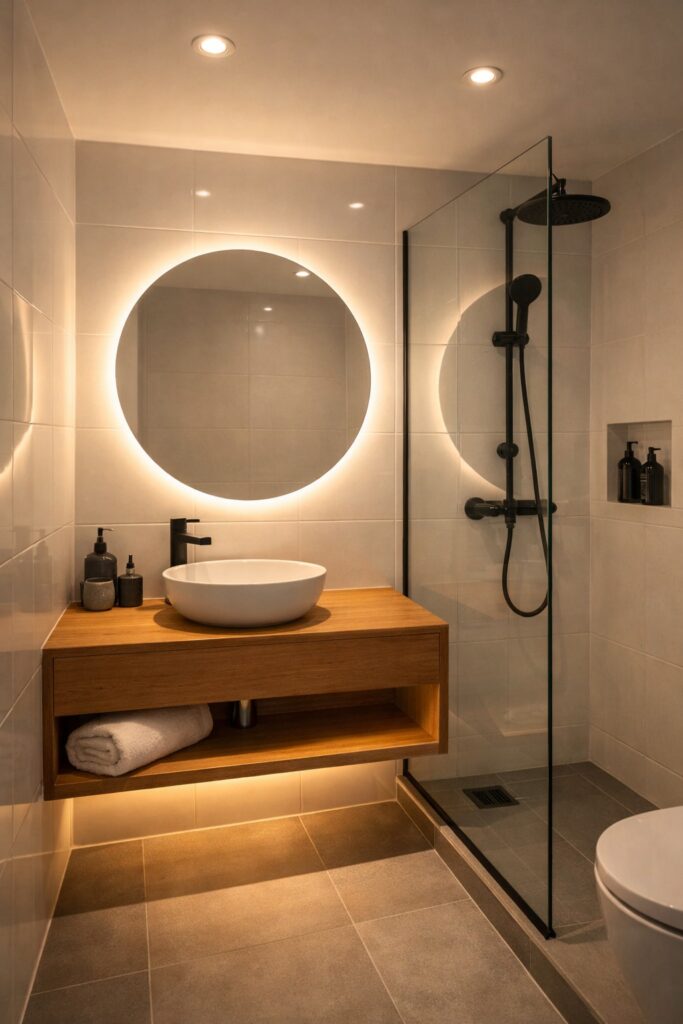
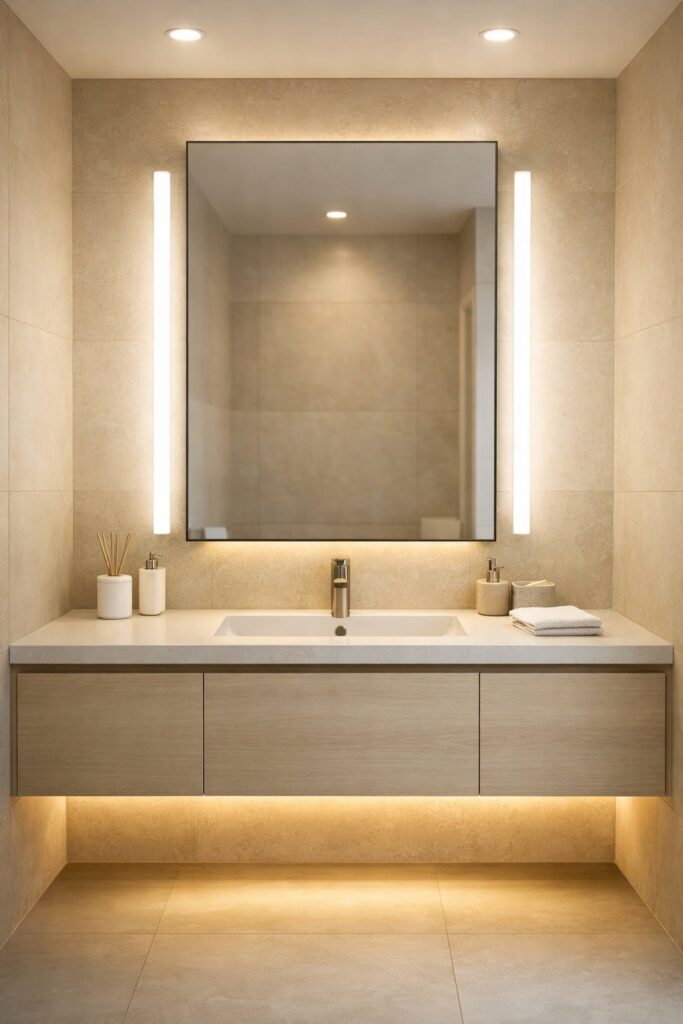
The most effective approach combines three elements: recessed ceiling lights, vertical mirror lighting, and strategic accent lighting. Each serves a specific purpose.
Recessed downlights form the ambient layer, sitting flush with the ceiling to preserve headroom. They are the foundation of small bathroom lighting.
Vertical mirror lighting eliminates shadows on your face for grooming tasks while drawing the eye upward, which emphasises ceiling height.
Accent lighting adds depth and visual interest, making the room feel more layered and spacious rather than flat and boxy.
You do not necessarily need all three, but combining them creates the most dramatic improvement.
Typical Costs (2026)
- Budget setup (2 downlights + basic LED mirror): £80-£150
- Mid-range setup (3 downlights + quality backlit mirror + dimmer): £150-£300
- Premium setup (dimmable downlights + large backlit mirror + under-vanity accent): £300-£500
- Electrician installation: £150-£300 depending on complexity and location
For complete guidance on bathroom lighting layers, see our [Bathroom Lighting Ideas: Complete UK Guide].
Choosing the Right Ceiling Lights
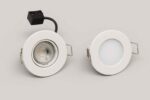
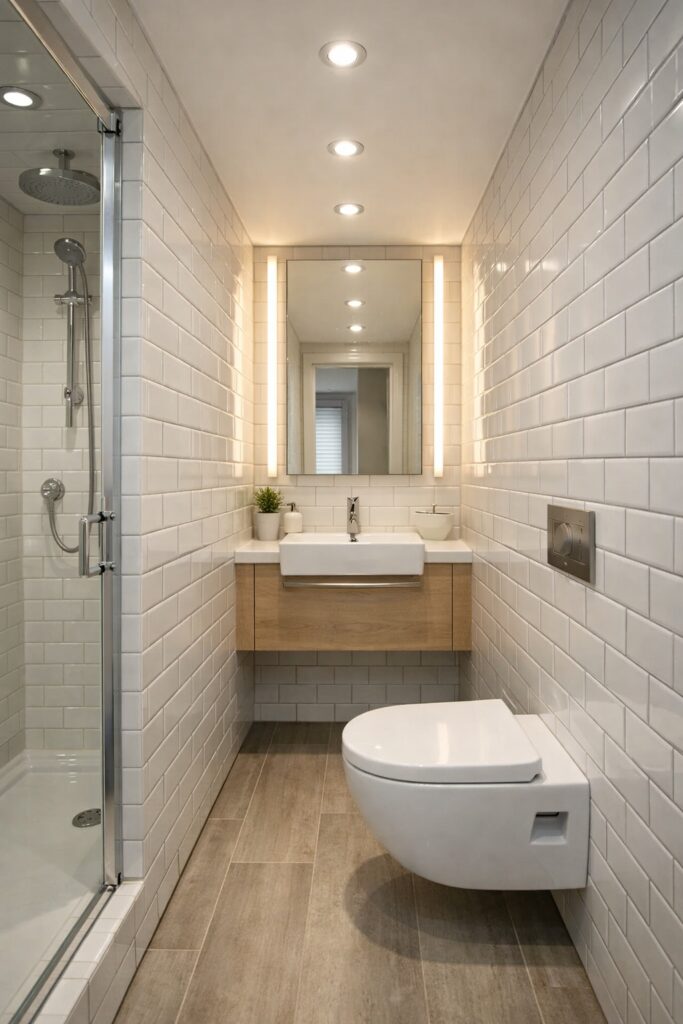
Recessed downlights are the best choice for small bathroom ceilings. They sit flush, take up no visual space, and provide clean, even illumination.
What to look for:
Choose IP65 rated downlights for simplicity. This rating covers all bathroom ceiling zones, so you do not need to worry about which zone each light falls into. See our [Bathroom Zones and IP Ratings Guide] for full details.
Select a beam angle of 60 degrees or wider. Wider beams spread light more evenly across the ceiling and walls, reducing harsh shadows and dark corners. Narrow beam angles (under 40 degrees) create pools of light with dark areas between them, which makes small rooms feel smaller.
Aim for 500 to 700 lumens per downlight. This provides good brightness without needing lots of fittings. Two or three quality downlights often outperform four or five dim ones.
How many downlights for a small bathroom?
For a typical small bathroom or ensuite (under 4 square metres):
A 1.5m x 1.5m space (2.25 sqm) needs 2 downlights.
A 2m x 1.5m space (3 sqm) needs 2 to 3 downlights.
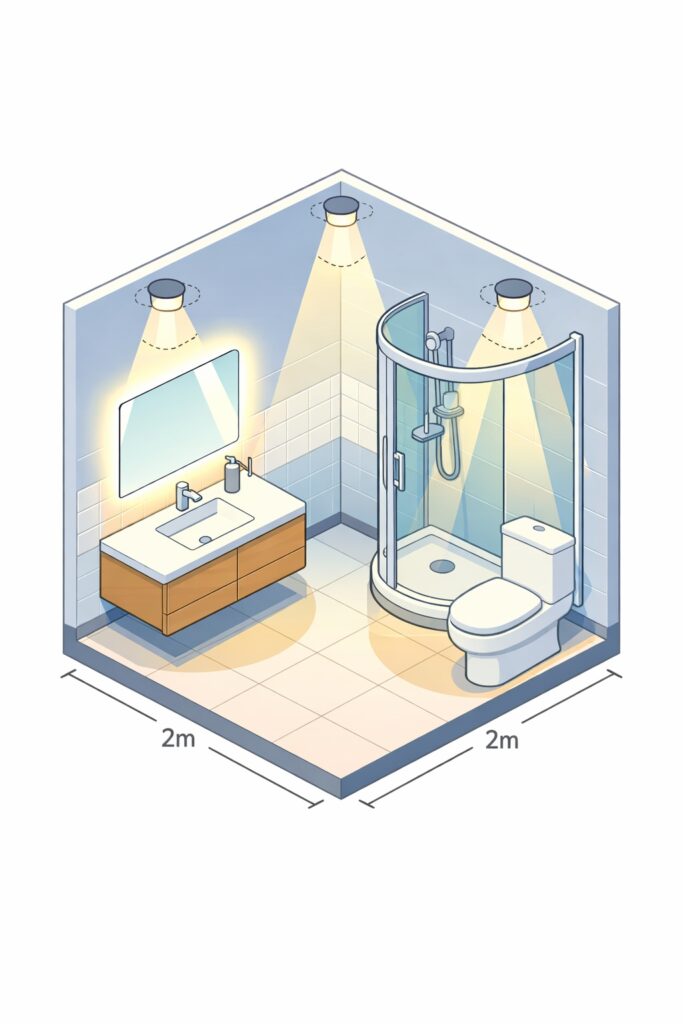
A 2m x 2m space (4 sqm) needs 3 to 4 downlights.
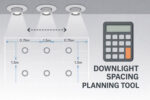
These figures assume 500 to 600 lumen downlights with 60 degree beam angles. Use our [Downlight Spacing Calculator] to plan the exact layout for your room dimensions.
Positioning tips:
Place downlights away from walls, at least 500mm from each edge. Light hitting walls at a steep angle creates harsh shadows and wastes output.
Position one downlight in front of where you stand at the mirror. This provides essential face lighting to complement your task lights.
If you have a separate shower cubicle, ensure at least one downlight illuminates the shower area. Dark showers feel oppressive in small bathrooms.
Arrange downlights in an asymmetric pattern rather than a rigid grid. In rectangular rooms, a diagonal arrangement often provides better coverage than a straight line.
Mirror Lighting That Opens Up the Space
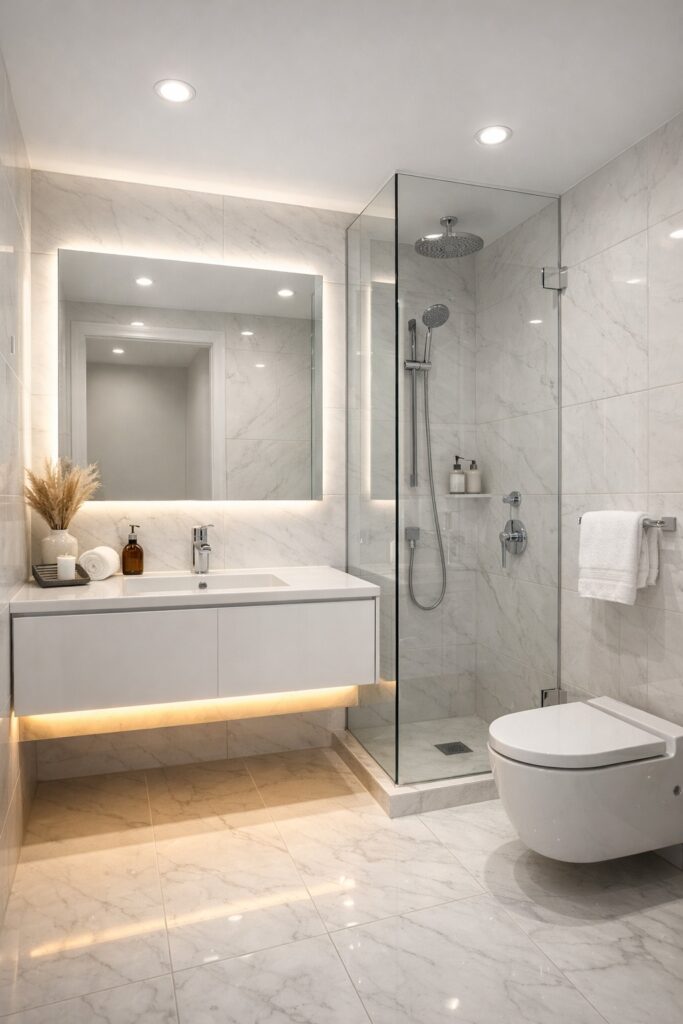
Mirror lighting does double duty in small bathrooms. It provides task lighting for grooming, and it visually expands the space by emphasising vertical height.
Why vertical beats horizontal:
A single light bar above the mirror creates shadows under your eyebrows, nose and chin. It also does nothing to enhance the sense of height.
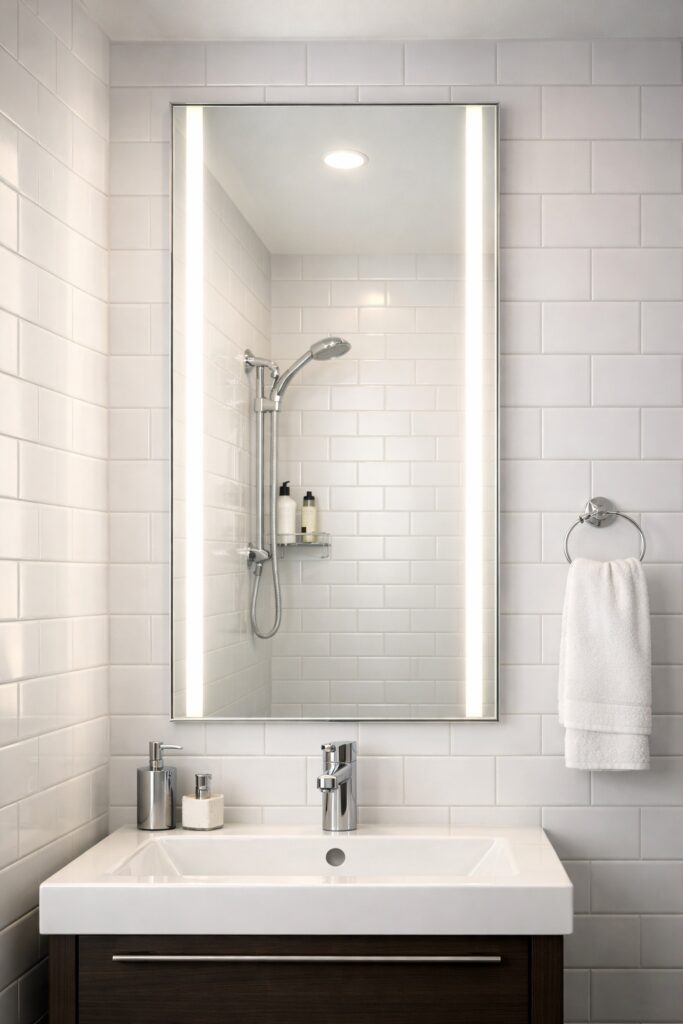
Lights positioned either side of the mirror, or a backlit mirror with vertical illumination, eliminate shadows and draw the eye upward. This simple change makes ceilings feel higher and the room feel taller.
Best options for small bathrooms:
LED bathroom backlit mirrors are ideal for compact spaces. They combine mirror and lighting in one fitting, saving wall space. The perimeter glow adds a floating effect that feels modern and spacious. Look for mirrors with 4000K colour temperature for accurate task lighting.
Vertical strip lights mounted beside the mirror achieve a similar effect. They work well if you already have a mirror you want to keep.
Wall lights either side of the mirror provide excellent task lighting but take up more visual space. In very small bathrooms, they can feel crowded. If you choose this option, select slim, low-profile designs.
For detailed guidance on mirror lighting heights and placement, see our [Bathroom Mirror Lighting Guide].
Mirror size matters:
In a small bathroom, go as large as you can with the mirror. A bigger mirror reflects more light back into the room, effectively doubling the impact of your fittings. It also creates a sense of depth that makes walls feel further apart.
If possible, extend the mirror across most of the wall above the basin. A wall to wall mirror has a dramatic effect on perceived space.
Using Accent Lighting to Add Depth
Accent lighting might seem like a luxury in a small bathroom, but it is actually more valuable here than in larger rooms. Strategic accent lighting creates layers and depth, preventing the flat, boxy feeling that plagues compact spaces.
Under vanity lighting:
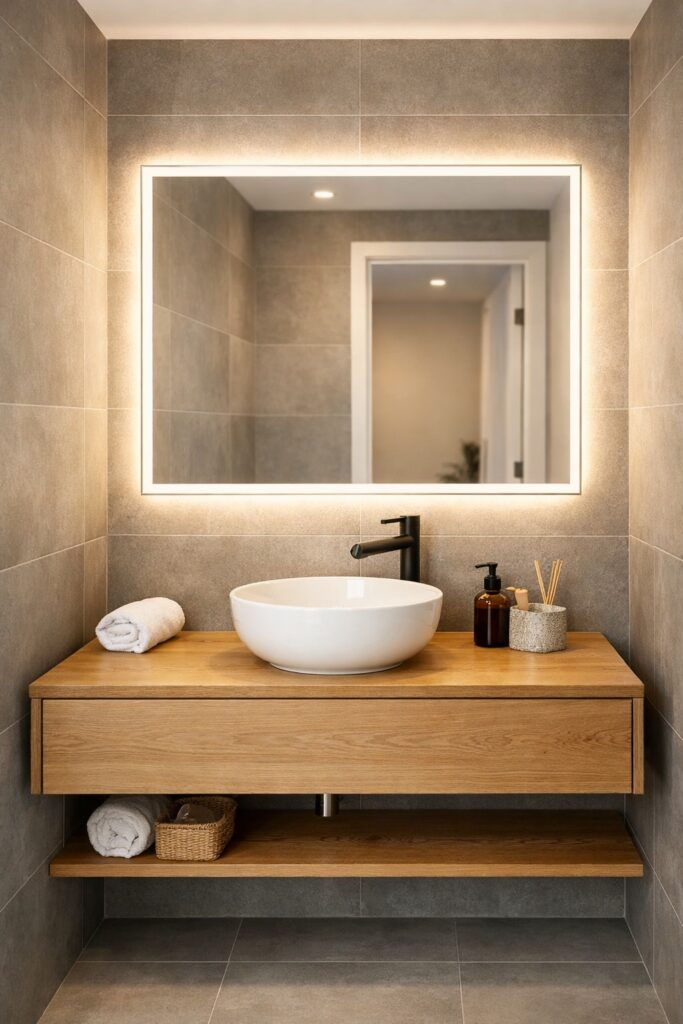
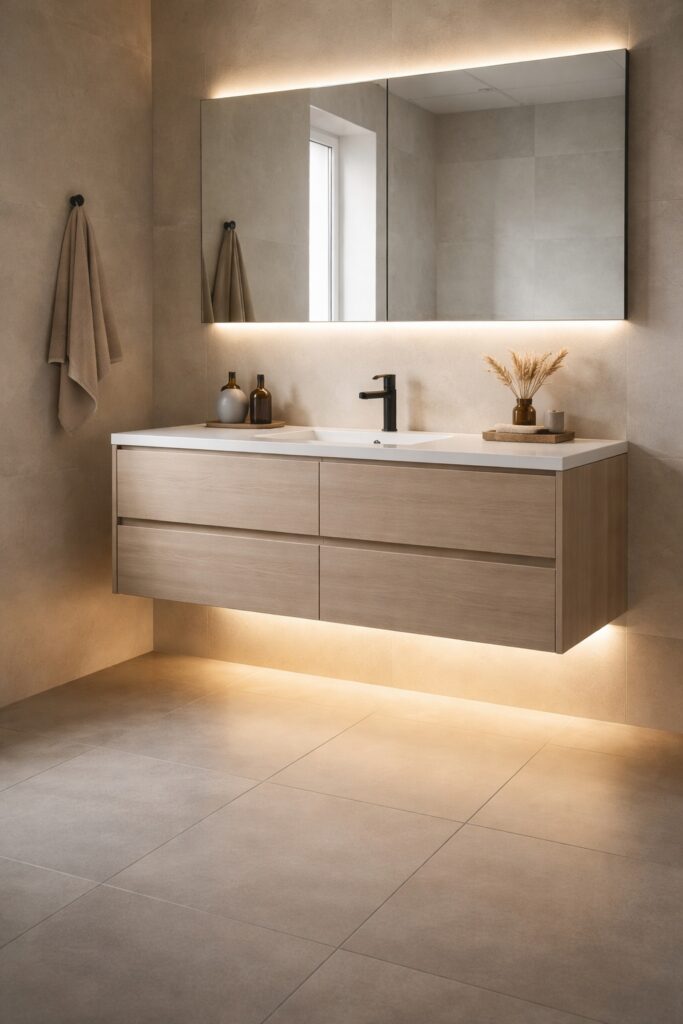
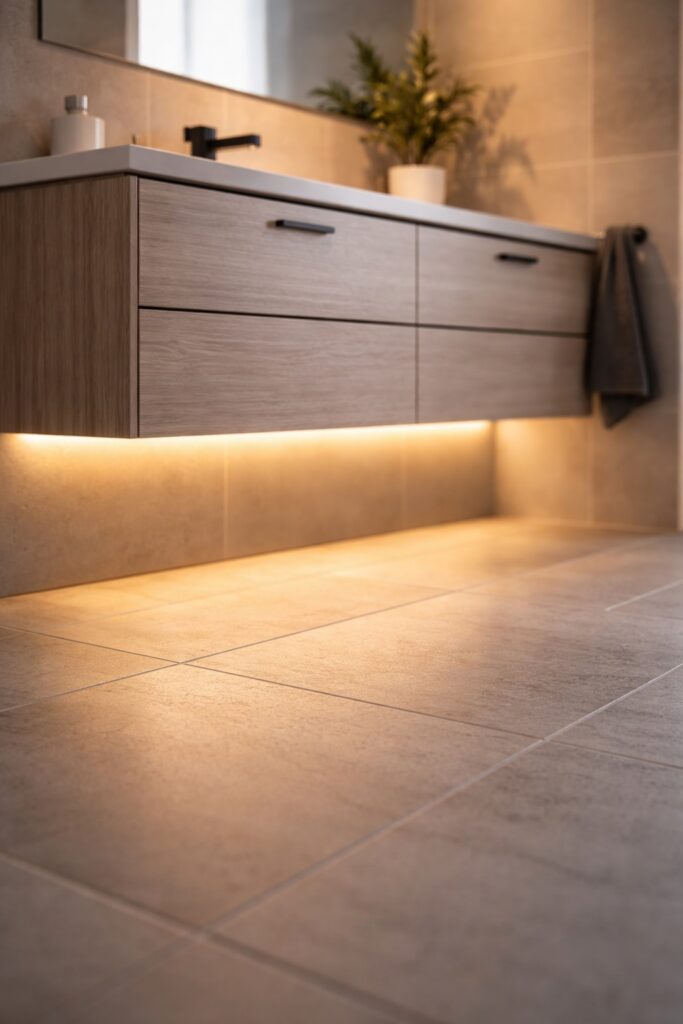
IP65 LED strip lighting beneath a floating vanity unit is one of the most effective tricks for small bathrooms. The glow makes the vanity appear to hover, which visually lightens the room and makes the floor area feel more spacious.
Use warm white (2700K to 3000K) strip lighting for a soft, welcoming effect. Install the strip towards the back of the vanity base so the light washes across the floor without glare.
This works best with wall mounted vanity units that have clear space beneath them. If your vanity sits on the floor, this option is not available.
Shower niche lighting:
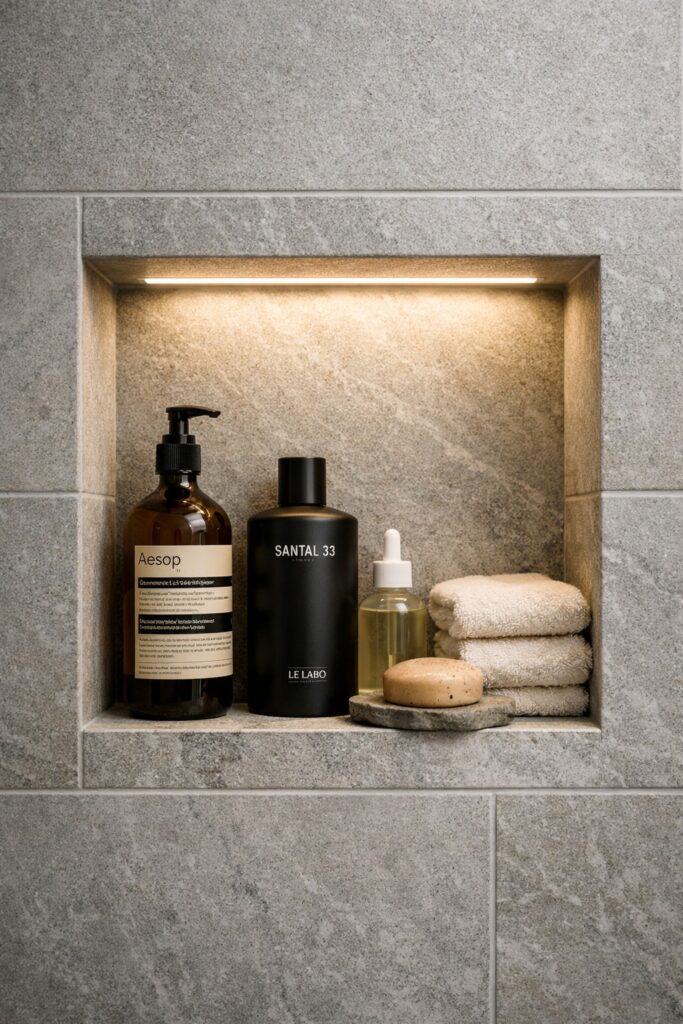
If your shower has a recessed niche for toiletries, adding a small LED strip inside creates a focal point and adds depth to the shower area. Use IP65 rated strip lighting and keep it subtle. The goal is a soft glow, not a bright feature.
Avoid these accent lighting mistakes:
Do not add too many accent sources. One or two subtle accents add depth. Five or six create visual clutter that makes small rooms feel chaotic.
Avoid coloured lighting. RGB strips might seem fun, but they make small bathrooms feel gimmicky rather than spacious. Stick to warm or neutral white.
Do not position accent lighting where it creates glare on tiles or glass. Test the position before fixing permanently.
Colour Temperature: Warmer Feels Larger
Colour temperature affects how spacious a room feels more than most people realise.
The rule for small bathrooms:
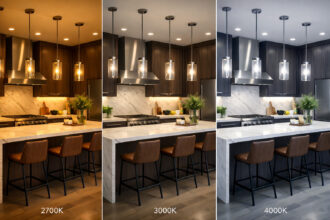
Warmer colour temperatures (2700K to 3000K) make small spaces feel more comfortable and less clinical. Cooler temperatures (4000K and above) can feel harsh and sterile in compact rooms.
However, task lighting at the mirror benefits from slightly cooler light (4000K) for accurate colour rendering when grooming.
The best compromise:
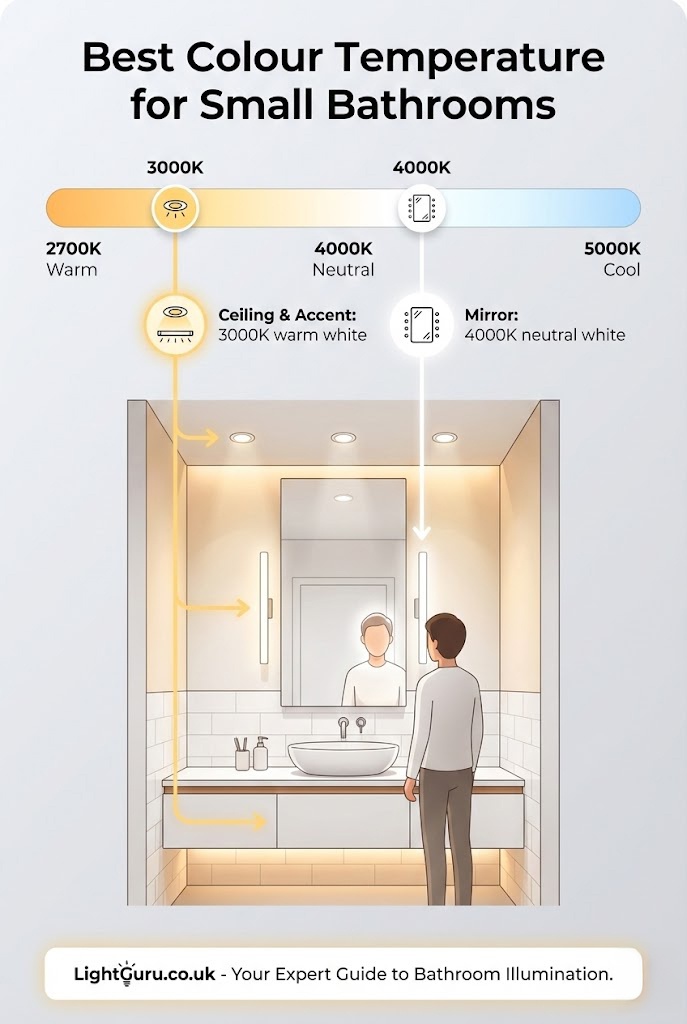
Use 3000K for ceiling downlights and accent lighting. This creates a warm, inviting atmosphere.
Use 4000K for mirror lighting. This provides clearer task lighting without feeling too cold.
The slight difference between layers is not noticeable in practice, but you get the benefits of both warm ambience and clear task lighting.
Use our [Colour Temperature Selector] to compare different temperatures and see how they look.
Common Mistakes That Make Small Bathrooms Feel Smaller
Using a central pendant or hanging light. Any fixture that drops below ceiling level reduces perceived height. In a small bathroom, this is the opposite of what you want. Stick to flush or recessed fittings.
Too few lumens. Dim lighting makes any room feel smaller and more enclosed. Small bathrooms need at least 300 lumens per square metre for ambient lighting, and more at the mirror.
Forgetting the corners. Dark corners shrink a room visually. Ensure your downlight layout provides coverage into the corners, not just the centre of the ceiling.
Only lighting from above. Downlights alone create a flat, shadowy effect. Adding vertical mirror lighting and low level accent lighting introduces layers that create depth and visual interest.
Wrong beam angle. Narrow beam downlights (under 40 degrees) create spotlit pools with dark areas between them. In a small bathroom, this makes the space feel choppy and disjointed. Use wider beams (60 degrees) for smoother, more even illumination.
Ignoring the mirror opportunity. A small mirror wastes one of your best tools for expanding the space visually. Use the largest mirror that fits the wall.
Small Bathroom Lighting Ideas by Layout
Compact ensuite (under 3 sqm):
Ceiling: 2 recessed downlights, IP65, 600 lumens each, 60 degree beam, 3000K. Position diagonally from door corner to opposite corner.
- Mirror: LED backlit mirror, 4000K. Choose the largest size that fits above the basin.
- Accent: LED strip under floating vanity if wall mounted, warm white.
- This minimal setup provides everything you need without overcrowding the space.
Narrow galley bathroom:
- Ceiling: 2 to 3 downlights arranged in a single line along the length of the room. Avoid placing them in a row down the centre. Offset slightly towards the basin side.
- Mirror: Vertical strip lights or slim wall lights either side of mirror to emphasise height and balance the narrow proportions.
Accent: Consider a small niche with integrated lighting in the shower area to add depth.
Small square bathroom:
- Ceiling: 3 downlights in a triangular arrangement, with one positioned near the mirror.
- Mirror: Backlit mirror or wall lights. The square shape handles wall mounted fixtures better than narrow layouts.
- Accent: Under vanity lighting works well here as the square floor plan benefits from the added depth.
Making the Most of Natural Light
If your small bathroom has a window or skylight, make the most of it. Natural light is the single most effective way to make any room feel larger.
Keep windows clear. Avoid heavy blinds or dark window treatments. Use frosted glass or lightweight voile if privacy is needed.
Position mirrors to reflect natural light. If possible, place the main mirror opposite or adjacent to the window. The reflection will bounce daylight deeper into the room.
Consider a sun tube. If your bathroom is on the top floor but has no window, a sun tube (also called a light pipe) can bring natural light through the roof without the complexity of adding a window. This is worth considering during renovations.
Layer artificial light with natural light. Even with good natural light, you still need artificial lighting for evenings and dull days. Plan your electric lighting to match the quality and warmth of daylight.
Dimming: Essential for Small Bathrooms
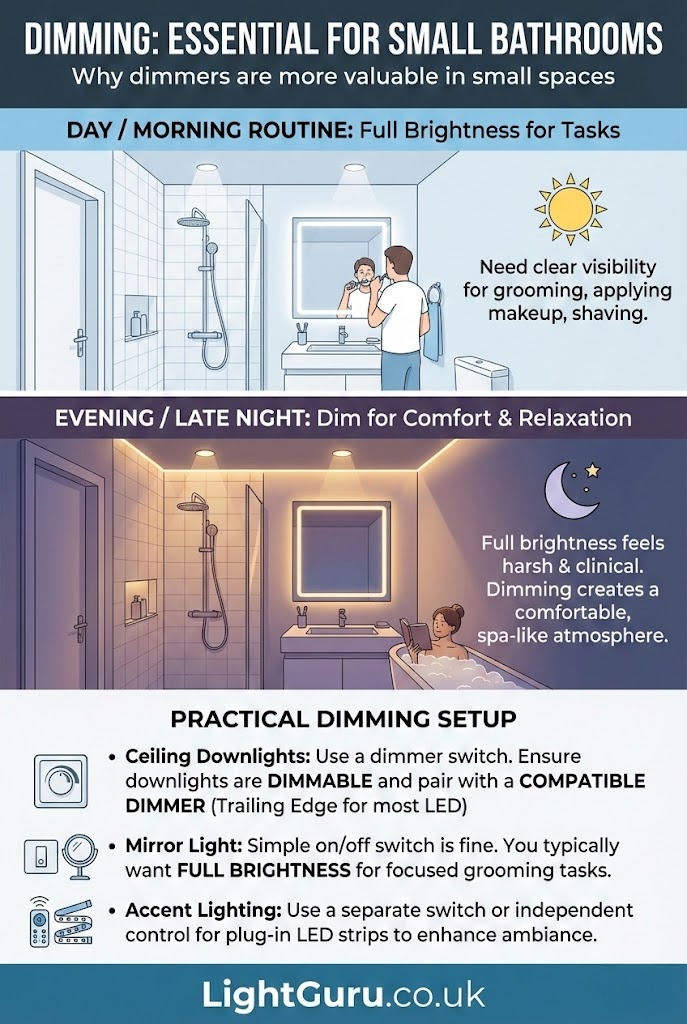
Dimmers are more valuable in small bathrooms than large ones. Here is why:
During the day or morning routine, you need full brightness for tasks. But in the evening, a small bathroom at full brightness feels harsh and clinical. Being able to dim the lights transforms the same space into somewhere comfortable for a relaxing bath or late night visit.
Practical dimming setup:
Put ceiling downlights on a dimmer switch. Check that your chosen downlights are dimmable and pair them with a compatible dimmer (trailing edge for most LED downlights).
If your mirror light is separate, a simple on/off switch is fine since you typically want full brightness for grooming tasks.
Accent lighting can be on a separate switch or controlled independently if using plug in LED strips.
Put ceiling downlights on a dimmer switch. Check that your chosen downlights are dimmable and pair them with a compatible dimmer (trailing edge for most LED downlights). Bathroom lighting installation is notifiable electrical work, so unless you are Part P certified, you will need a registered electrician. Find one at NICEIC or ELECSA.
Frequently Asked Questions
What is the best light for a small bathroom?
Recessed LED downlights with a wide beam angle (60 degrees) and high lumen output (500 to 700 lumens each) are the best choice for small bathroom ceilings. Combine with an LED backlit mirror for task lighting and optional under vanity strip lighting for accent.
How many lights do I need in a small bathroom?
Most small bathrooms (under 4 square metres) need 2 to 4 ceiling downlights plus mirror lighting. The exact number depends on room shape and lumen output of each fitting. Use our [Downlight Spacing Calculator] for a precise layout.
Do LED lights make a bathroom look bigger?
Yes, when used correctly. LED lighting with wide beam angles, warm to neutral colour temperatures, and proper layering can make a small bathroom feel significantly more spacious. The key is even coverage, vertical emphasis at the mirror, and avoiding dark corners.
Should I use warm or cool light in a small bathroom?
Warm white (3000K) for ambient and accent lighting creates a comfortable, spacious feeling. Neutral white (4000K) at the mirror provides better task lighting. Using both temperatures in the same room gives the best results.
Can pendant lights work in a small bathroom?
Generally no. Pendant lights reduce perceived ceiling height, which makes small bathrooms feel more cramped. Stick to recessed or flush mounted ceiling lights. The only exception might be a very compact mini pendant positioned away from the main activity areas, but this is rarely worth the trade off in a small space.
Next Steps
Good lighting transforms small bathrooms from cramped and gloomy to bright and surprisingly spacious. The combination of flush ceiling lights, vertical mirror lighting and subtle accents creates depth and visual height that the room does not physically have.
Start by planning your ceiling layout with our [Downlight Spacing Calculator]. Check IP rating requirements for your specific layout using the [Bathroom Zone IP Rating Calculator]. Then add mirror lighting and consider accent options based on your vanity and shower setup.
Done well, the same small bathroom can feel bright in the morning, calm in the evening, and far more spacious than its dimensions suggest.
UK wiring regulations (BS 7671) require appropriate IP ratings for bathroom zones.
For complete bathroom lighting guidance including zones, styles and planning steps, see our main [Bathroom Lighting Ideas: Complete UK Guide].
LEDs use up to 90% less energy than traditional bulbs (Energy Saving Trust)
Related guides: