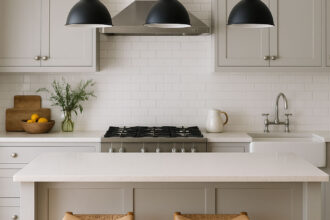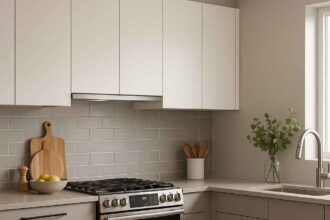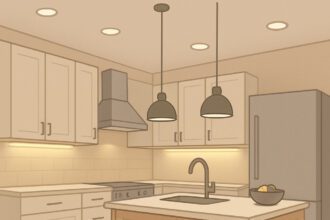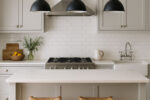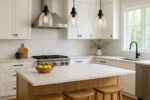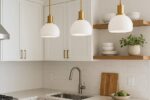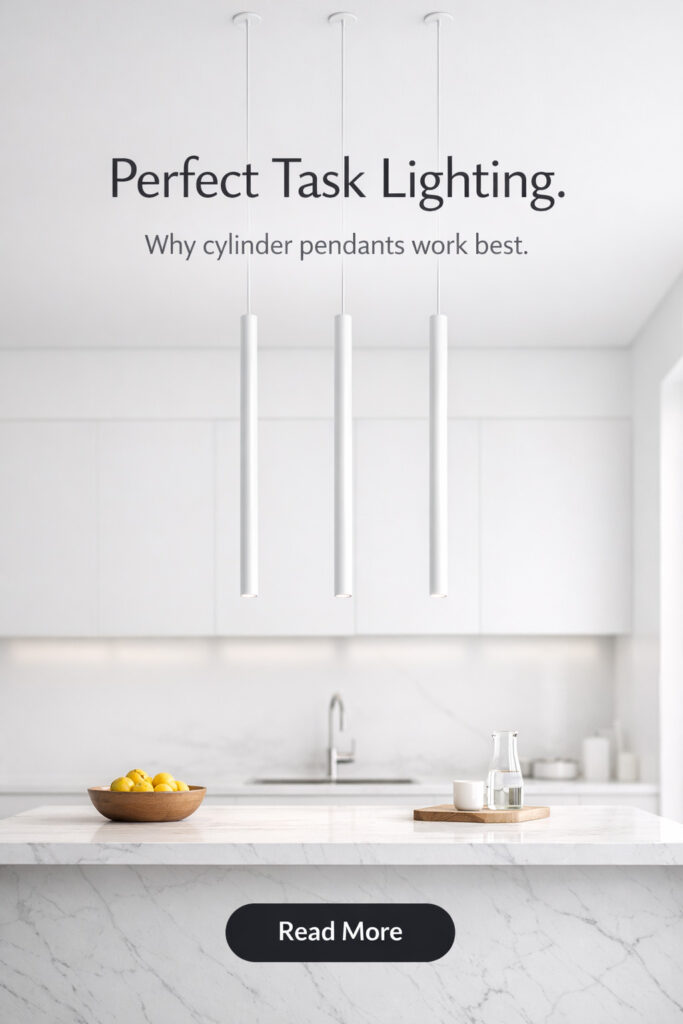
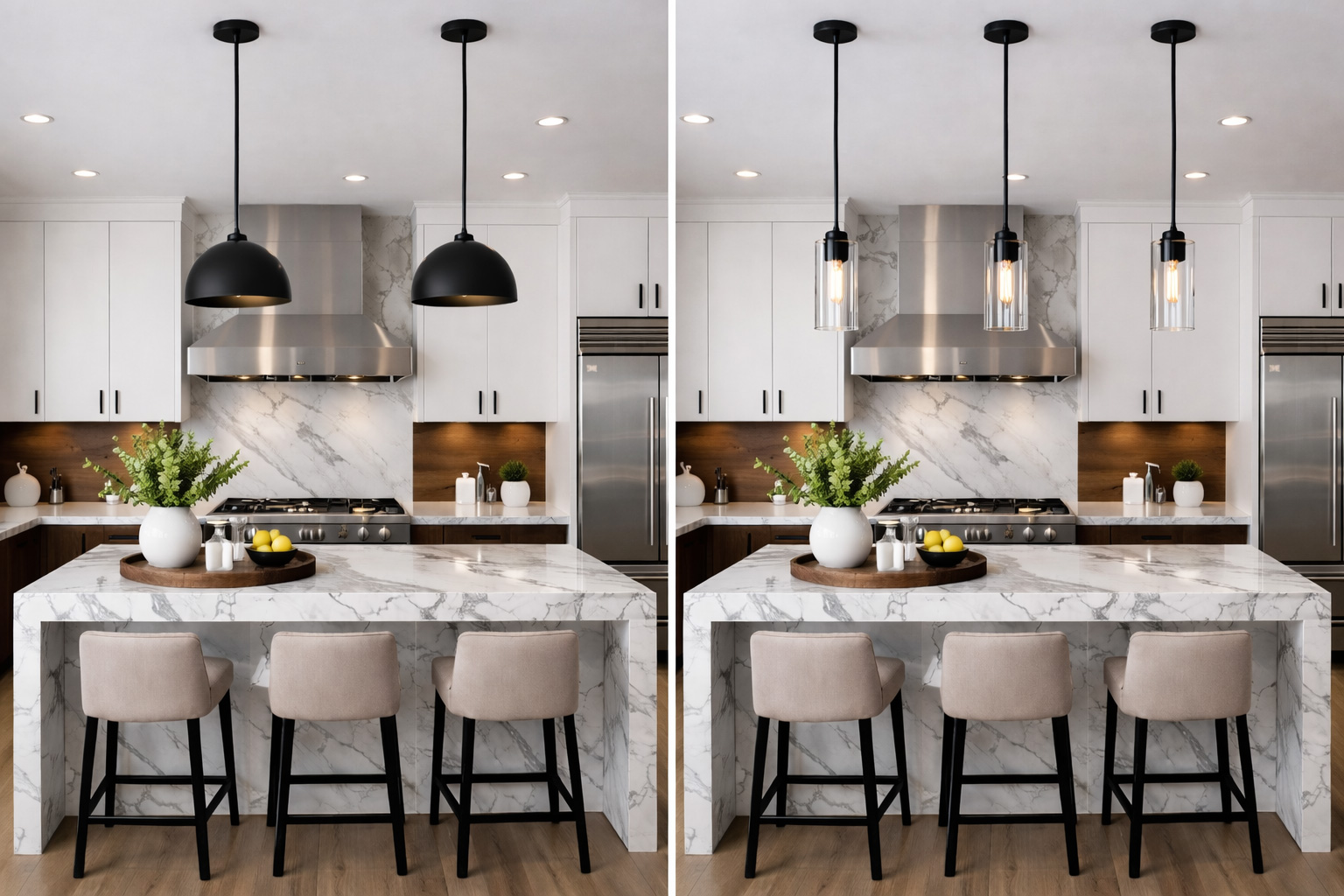
How many pendants over a kitchen island? It comes down to proportion. Get it right and the pendants frame the island beautifully. Get it wrong and the space looks cramped or sparse.
This guide focuses specifically on spacing and quantity numbers. For full island lighting design and styling, see our main Kitchen Lighting Guide.
Some links in this guide are affiliate links, meaning we may earn a commission if you purchase — at no extra cost to you. This helps keep LightGuru free.
2 or 3 Pendants Over a Kitchen Island: The Quick Rule
Island under 180cm = 2 pendants
Island over 180cm = 3 pendants
This answers how many pendants over kitchen island for 90% of UK homes. But island length isn’t the only factor — pendant size, ceiling height, and what’s on the island all play a role. Read on for the full breakdown.
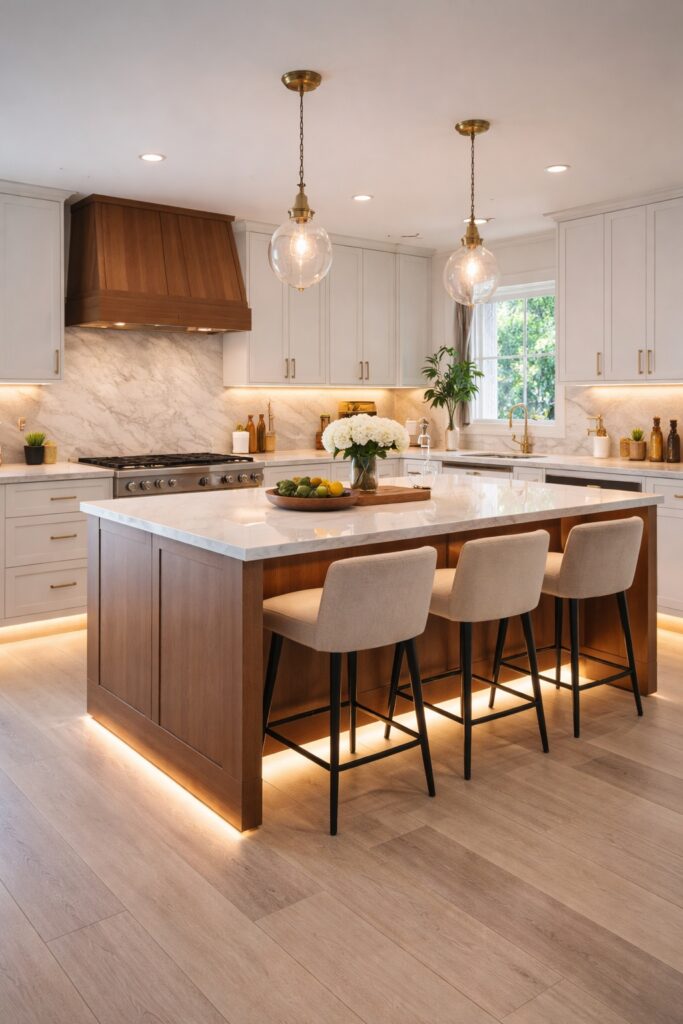

How Many Pendants Over Kitchen Island by Length
Here’s the detailed breakdown by island size:
| Island Length | Number of Pendants | Notes |
|---|---|---|
| 120–150cm | 2 (or 1 large statement) | Small islands suit fewer, larger pendants |
| 150–180cm | 2 | The sweet spot for two pendants |
| 180–220cm | 2 or 3 | Either works — depends on pendant size |
| 220–260cm | 3 | Standard choice for larger islands |
| 260cm+ | 3–4 (or linear bar) | Very long islands may suit a single linear fixture |
Most UK kitchen islands fall between 150–220cm. If yours is in this range, both 2 and 3 can work — it comes down to pendant diameter and personal preference.
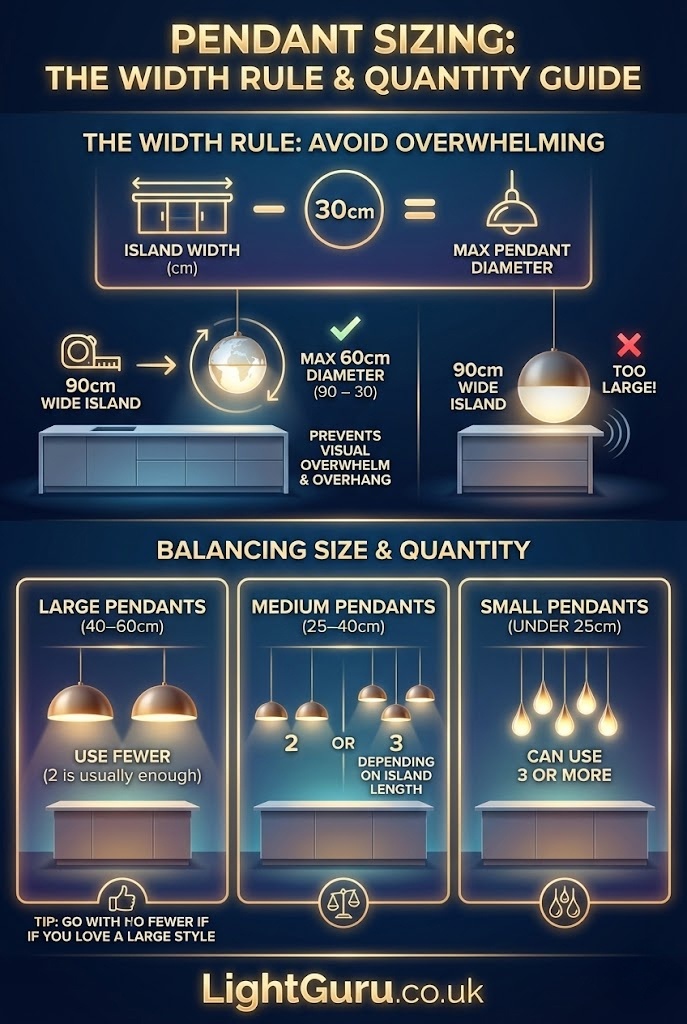
Pendant Sizing: The Width Rule
When deciding how many pendants over kitchen island, size matters as much as quantity. Pendant size matters as much as quantity.
Here’s the formula:
- Island width (cm) – 30cm = maximum pendant diameter
- Example: 90cm wide island → pendants should be 60cm diameter or less.
This prevents pendants from visually overwhelming the island or hanging over the edges.
Balancing Size and Quantity
- Large pendants (40–60cm diameter) → use fewer (2 is usually enough)
- Medium pendants (25–40cm diameter) → 2 or 3 depending on island length
- Small pendants (under 25cm diameter) → can use 3 or more
If you love a particular pendant but it’s on the larger side, go with 2 even on a longer island. Two oversized pendants often look more intentional than three crowded ones.
For statement pendants in this size range, the Eglo Tarbes is a popular choice for UK kitchens — available in 3-light bars or individual pendants.
Spacing Between Pendants
Getting the gap right prevents that “too crowded” or “too spread out” look.
Pendant diameter ÷ 2 = gap between pendants
Example: 30cm diameter pendants → 15cm gap between each.
Edge Clearance
Leave at least 15–20cm between the outer edge of each end pendant and the end of the island. This prevents the pendants from looking like they’re about to fall off.
Total Coverage Rule
Your pendants (including gaps) should cover roughly 60–75% of the island length. This leaves breathing room at each end while keeping the lighting centred over the work surface.

Hanging Height
How low you hang pendants affects both function and aesthetics.
Recommended height: 65–80cm from island surface to bottom of pendant
| Situation | Recommended Height |
|---|---|
| Standard ceiling (240cm) | 70–75cm above island |
| High ceiling (270cm+) | 75–85cm above island |
| Low ceiling (under 230cm) | 65–70cm above island |
| Island used for dining | 70–80cm (higher end for comfort) |
If you need adjustable height, look for pendants with configurable cable drops like the Industville Brooklyn Dome — you can shorten the cable on site to get the exact drop you need.
The Sightline Test
Stand on one side of the island and look across to the other side. If the pendants block your view of someone’s face, they’re too low. Adjust until you can see across comfortably while seated or standing.
The Chartered Institution of Building Services Engineers (CIBSE) recommends task lighting of 300-500 lux for kitchen preparation areas.
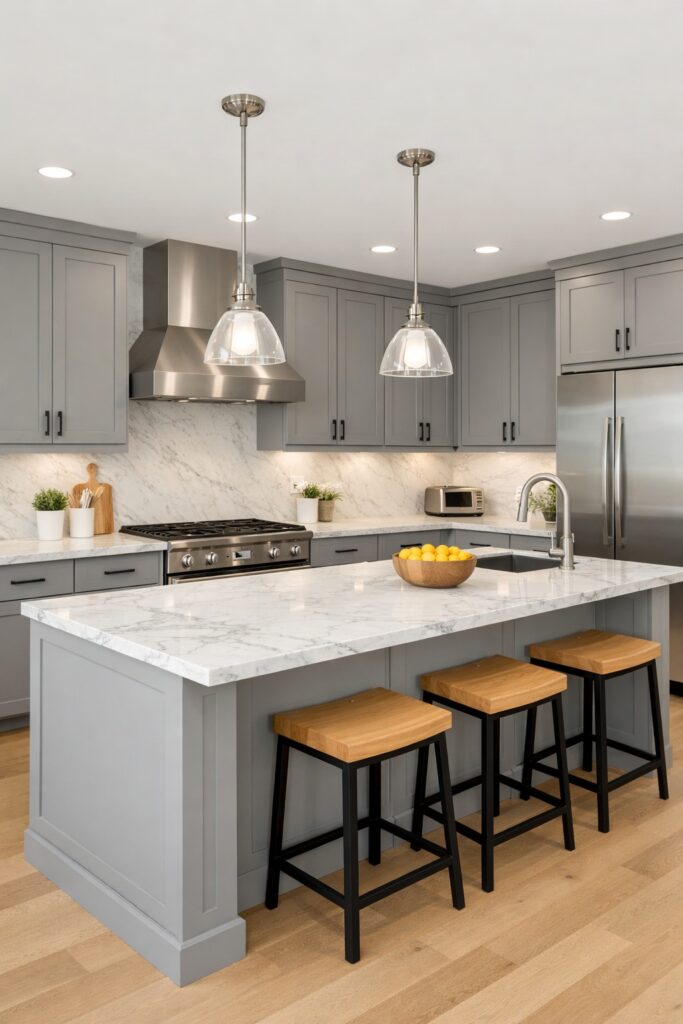
When to Choose 2 Pendants
Two pendants work best when:
- Your island is under 180cm long — three will look cramped
- You’re using larger pendants (40cm+ diameter) — two statement pieces have more impact
- You prefer a minimal, uncluttered look — fewer fixtures feel calmer
- You have low ceilings — two pendants feel less oppressive than three
- Your island has a hob — fewer pendants means less cleaning and better extractor clearance
Two pendants create symmetry and balance. They’re the safer choice if you’re unsure.
When to Choose 3 Pendants
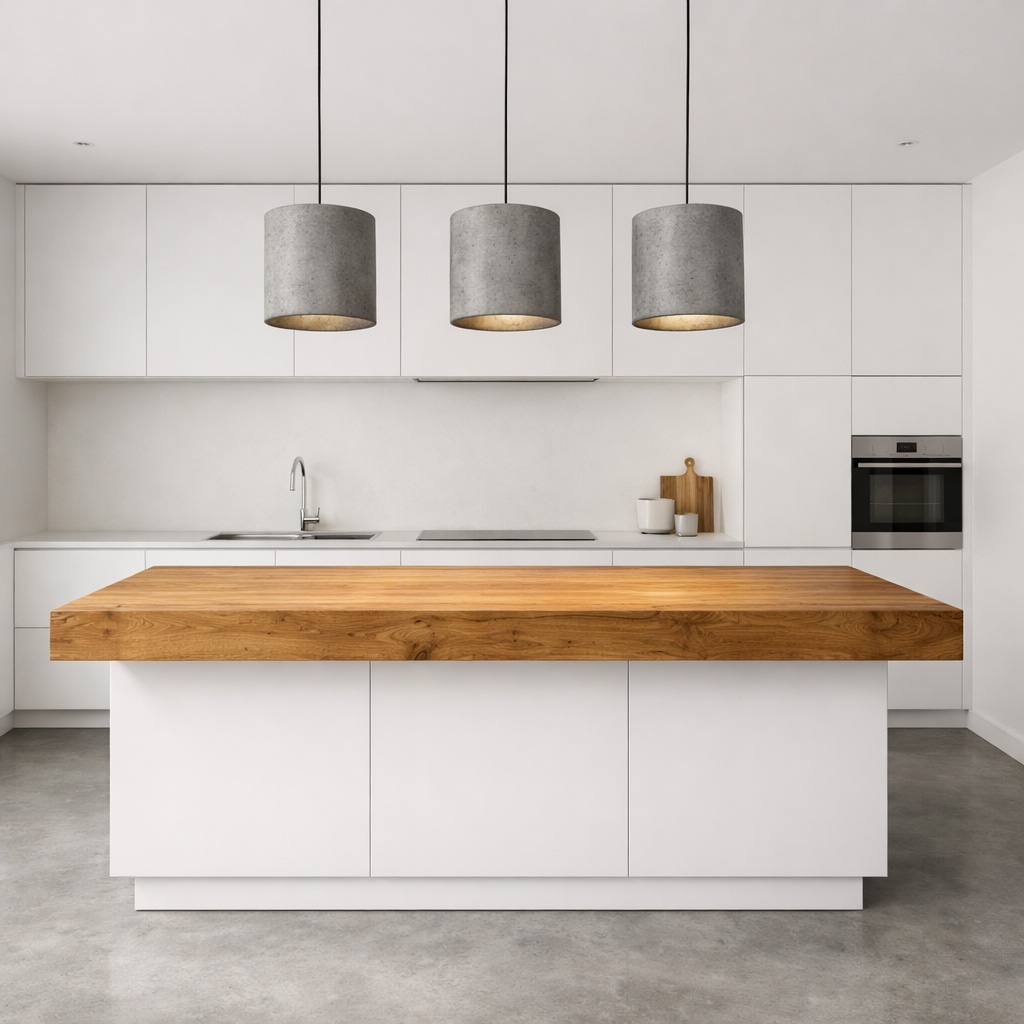
Three pendants work best when:
- Your island is over 180cm long — two may leave dark spots at the ends
- You’re using smaller or slimline pendants — they need grouping to have visual weight
- You want a design statement — odd numbers feel more “styled”
- You have high ceilings — three pendants fill vertical space better
- Your island serves multiple functions — prep at one end, seating at the other
For a classic three-pendant setup, the Nordic Natural Stone Pendant Light gives you a ceiling bar with adjustable drop lengths — simpler than wiring three separate fixtures.
Three pendants create rhythm. The centre pendant naturally becomes a focal point, with the outer two framing it.
UK-Specific Considerations
Typical UK Island Sizes
Most UK kitchen islands are between 160–200cm long and 90–100cm wide. This puts many homeowners right in the “2 or 3 could work” zone.
Ceiling Heights
- Victorian/Edwardian homes: Often 280–300cm ceilings — can handle longer pendant drops and larger fixtures
- 1960s–80s builds: Typically 240cm — standard pendant heights work well
- New builds: Usually 240–250cm — watch out for very large pendants overwhelming the space
- Loft conversions/extensions: Variable — measure carefully, especially with sloped ceilings
Open-Plan Layouts
If your kitchen opens into a living or dining area, consider sightlines from the sofa or dining table. Pendants that look perfectly positioned from the kitchen side might block views from the living area.
Keep pendant heights consistent and avoid very long drops that create visual barriers.

Special Situations
Island with a Hob
If your island includes a hob with an extractor above:
- Position pendants either side of the extractor, not underneath it
- Two pendants (one each side) often works better than three
- Choose pendants that are easy to clean — cooking grease travels
- Avoid fabric or intricate designs that trap grime
Island with Seating
If one end of your island has bar stools:
- Consider weighting your pendant placement toward the seating end
- Alternatively, use 3 pendants with the end pendant positioned over the seating area
- Ensure hanging height allows comfortable conversation without pendants in faces
Very Long Islands (260cm+)
For extra-long islands, you have three options:
- Four pendants — works if they’re small to medium diameter
- Three larger pendants — spaced wider apart
- Linear suspension — a single bar fixture that spans the island
Linear fixtures avoid the spacing headaches of multiple pendants and give a clean, contemporary look.
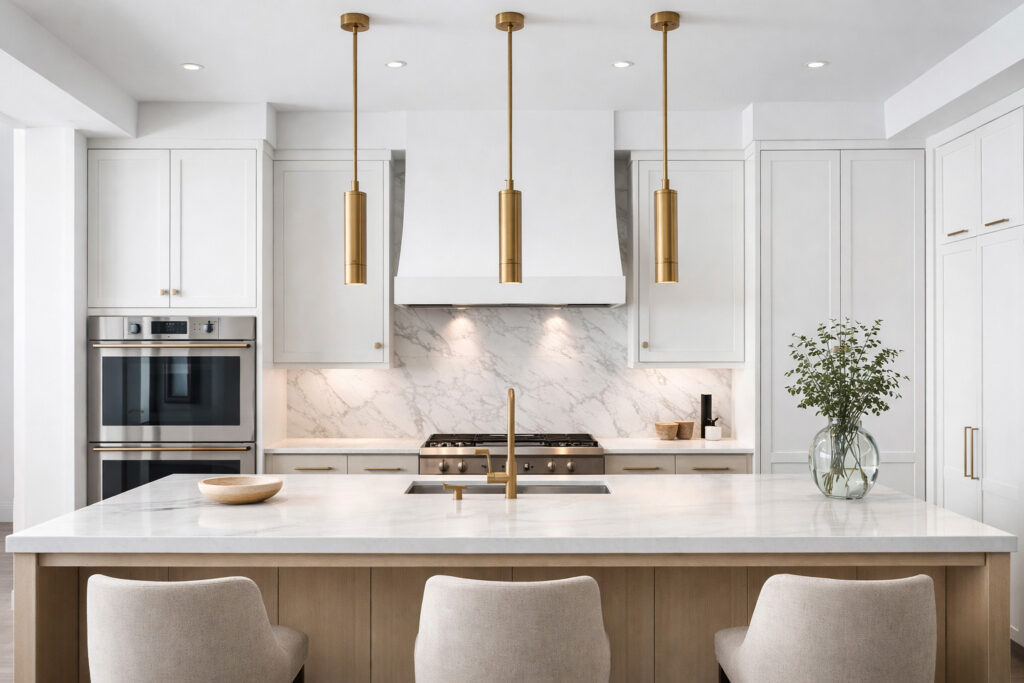
Quick Decision Flowchart
Step 1: Measure your island length
- Under 180cm → 2 pendants
- Over 180cm → consider 3
Step 2: Check your pendant diameter
- Large (40cm+) → lean toward 2
- Small/medium (under 40cm) → 3 is fine
Step 3: Consider your ceiling height
- Low ceiling → 2 pendants (less visual weight)
- High ceiling → 3 pendants (fills the space)
Step 4: Check for obstacles
- Hob/extractor on island → 2 pendants either side
- Clear island → 2 or 3 based on steps above

Common Mistakes to Avoid
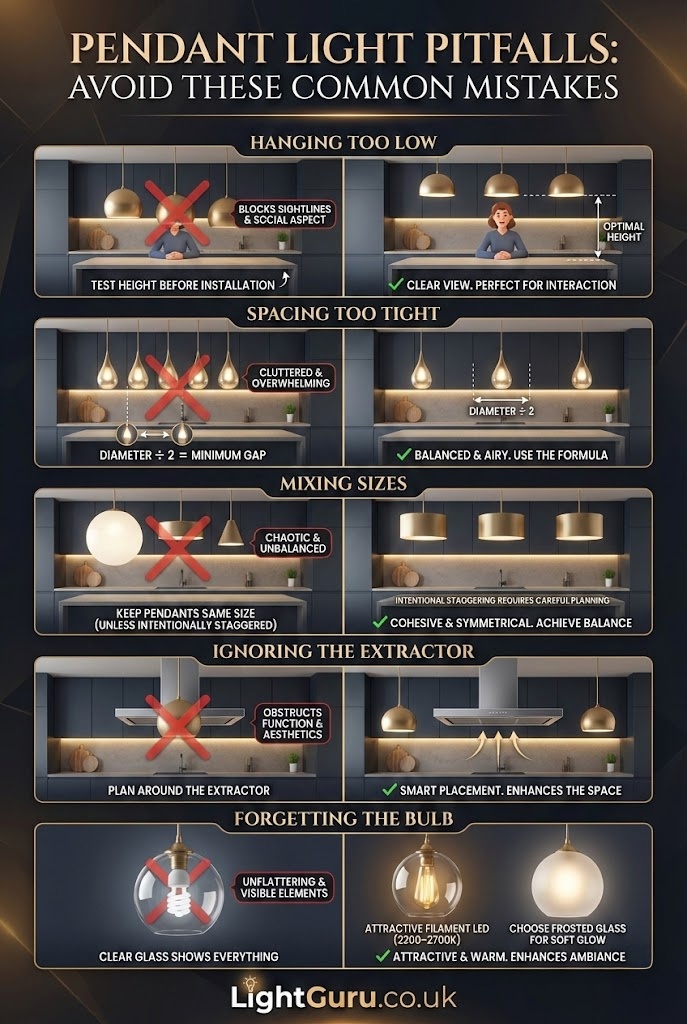
Hanging too low — Pendants that block sightlines ruin the social aspect of an island. Test height before final installation.
Spacing too tight — Cramped pendants look cluttered. Use the diameter ÷ 2 formula.
Mixing sizes — Unless intentionally staggered, keep all pendants the same size for a balanced look.
Ignoring the extractor — If you have a ceiling-mounted extractor, plan pendant positions around it, not through it.
Forgetting the bulb — Clear glass pendants show everything. Choose attractive bulbs (filament LEDs at 2200–2700K) or go for frosted glass.
Quick Reference Summary
| Factor | 2 Pendants | 3 Pendants |
|---|---|---|
| Island length | Under 180cm | Over 180cm |
| Pendant diameter | Large (40cm+) | Small/medium (under 40cm) |
| Ceiling height | Low (under 240cm) | High (over 250cm) |
| Style preference | Minimal, calm | Styled, statement |
| Island has hob | Yes | No |
FAQs
Can I use 4 pendants over my island?
Only on very long islands (260cm+) with small pendants. On standard islands, 4 looks cluttered.
Should pendant spacing match my downlight spacing?
No. Treat them as separate layers. Pendants are decorative; downlights are functional. They don’t need to align.
What if my pendants aren’t centred over the island?
If existing electrics prevent centring, consider a ceiling bar or track that allows multiple pendants to hang from offset positions.
Is it OK to mix pendant sizes?
Intentionally staggered heights and sizes can work as a design feature, but it’s harder to get right. Matching sizes is safer.
Do clear glass pendants provide enough light?
Clear glass provides less diffused light than frosted. You may want to add downlights for task lighting if your pendants are primarily decorative.
What’s the best colour temperature for pendant bulbs?
2700–3000K for warm, inviting light. Avoid anything above 4000K unless you want a clinical feel.
Related Guides
- Kitchen Downlight Spacing Guide — how to position ceiling lights for even coverage
- Kitchen Lighting Ideas — full guide to layered kitchen lighting
- Low Ceiling Kitchen Lighting — advice for restricted ceiling heights