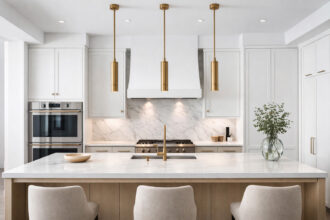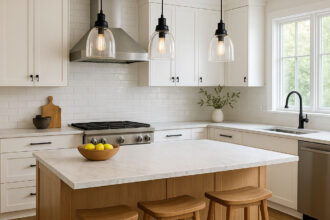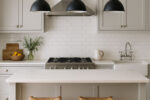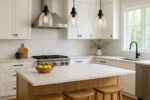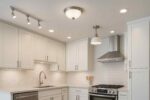

Kitchen lighting ideas are one of the quickest ways to make a kitchen feel better and work better. It affects how clearly you can prep food, how comfortable the room feels in the evening, and whether the space looks warm and inviting or bright and harsh.
Most kitchens struggle for the same reasons. The ceiling lights are doing all the work, so worktops end up with shadows. The colour temperature is slightly off, so white units look grey or food looks dull. Or the room is bright in the middle but dim at the edges, which makes the whole kitchen feel smaller than it is.
The fix is not one “perfect” fitting. It’s a simple system: layered lighting. You combine general lighting for the whole room, task lighting where you actually work, and a softer layer for mood and depth. Once you understand that, the choices become much easier, whether you’re planning a new kitchen or improving the one you have.
This guide is a practical starting point for UK kitchens. It covers layouts, brightness, colour temperature, ceiling lighting options, island lighting, under cabinet lighting and smart scenes. Each section gives you clear principles and the common mistakes to avoid, with links to more detailed how tos where you want exact spacing, brightness targets, or fixture comparisons.
By the end, you’ll have a plan that looks good, feels right day to day, and avoids the usual traps that lead to glare, shadows, and wasted money.

Table of Contents
Layered lighting in kitchens
Layered lighting is the foundation of every well lit kitchen. Relying on a single ceiling light or a grid of downlights almost always leads to shadows, glare, or a space that feels flat once the sun goes down.
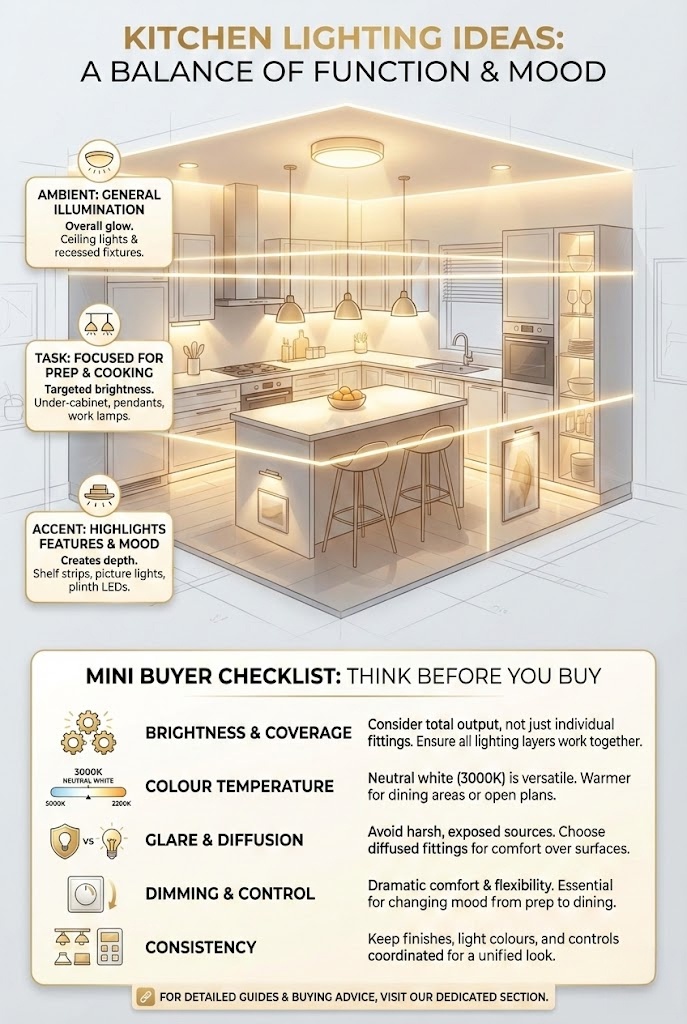
A layered approach breaks kitchen lighting into three clear roles.
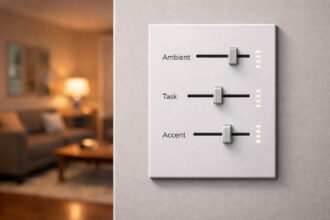
Ambient lighting provides general light for moving around the room safely. This usually comes from ceiling lights such as downlights, flush fittings, or track lighting. Its job is coverage, not drama.
Task lighting focuses light where you actually work. Worktops, sinks, and hobs need brighter, more direct light so you can see clearly without casting shadows from your own body or wall units.
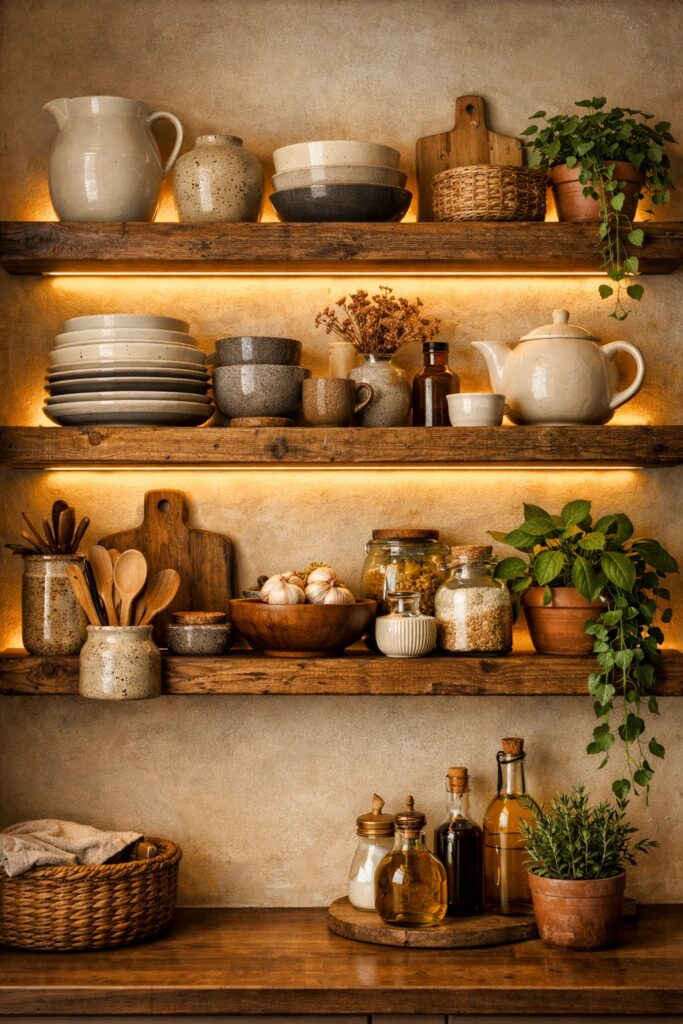
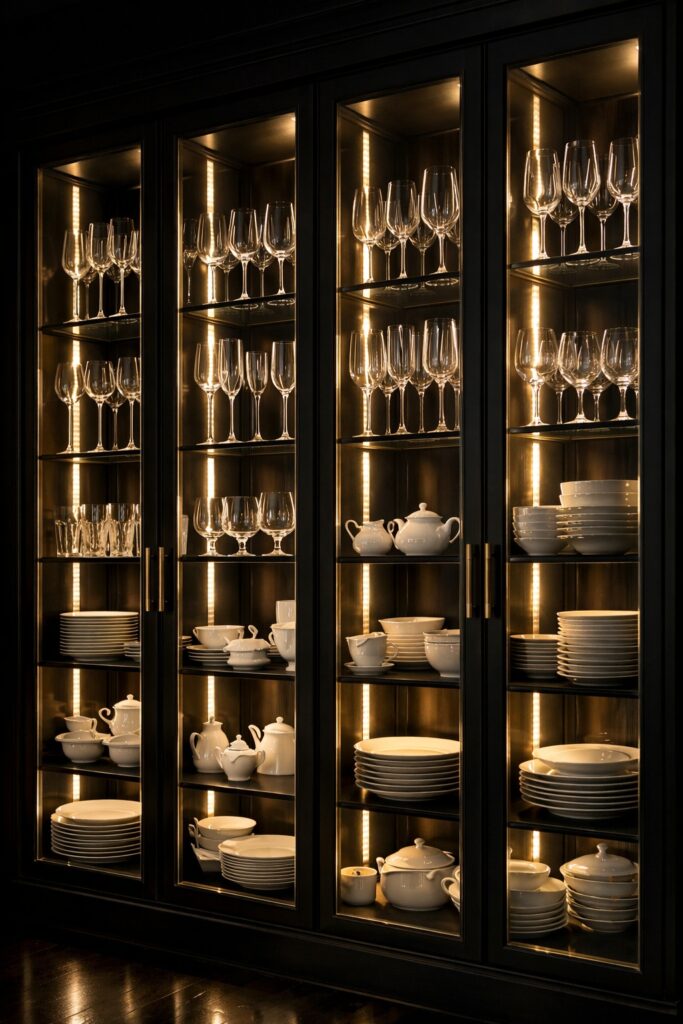
Accent lighting adds depth and atmosphere. This includes shelf lighting, plinth lighting, and lighting inside glass cabinets. It softens the room in the evening and stops the kitchen feeling like a workspace after dark.
The most common mistake is trying to make ambient lighting do all three jobs. This leads to too many ceiling lights, harsh brightness, and dark worktops. A better approach is to reduce the ceiling lighting slightly and let task and accent lighting do the heavy lifting where it matters. Traditional and farmhouse kitchens rely more heavily on layered lighting to maintain warmth without harsh brightness.
When planning a kitchen from scratch, it helps to think about lighting in the same order you use the room. First, make sure the whole space is evenly lit. Next, ensure every work area has its own dedicated task light. Finally, add a softer layer that can be left on in the evening without the kitchen feeling overlit.
If you want a simple step by step way to put this together, our kitchen lighting layout guide shows how to plan each layer so they work together rather than competing. For shadow free prep areas in particular, the under cabinet lighting guide explains how task lighting should be positioned and why placement matters more than brightness.

How many lumens you actually need (by room size)
One of the most common questions with kitchen lighting is how bright it should be. The answer is not about wattage or the number of fittings. It is about total light output, measured in lumens, and how that light is distributed around the room.
A kitchen needs more light than most other rooms because it is a working space. You need clear visibility on worktops, sinks, and cooking areas, while still keeping the overall feel comfortable rather than harsh.
As a general principle, larger kitchens need more total lumens, but small kitchens often need lighting to be placed more carefully. A compact kitchen with poor lighting placement can feel darker than a larger room with well spread light. Ceiling height also matters. Higher ceilings need more output to achieve the same brightness at worktop level.
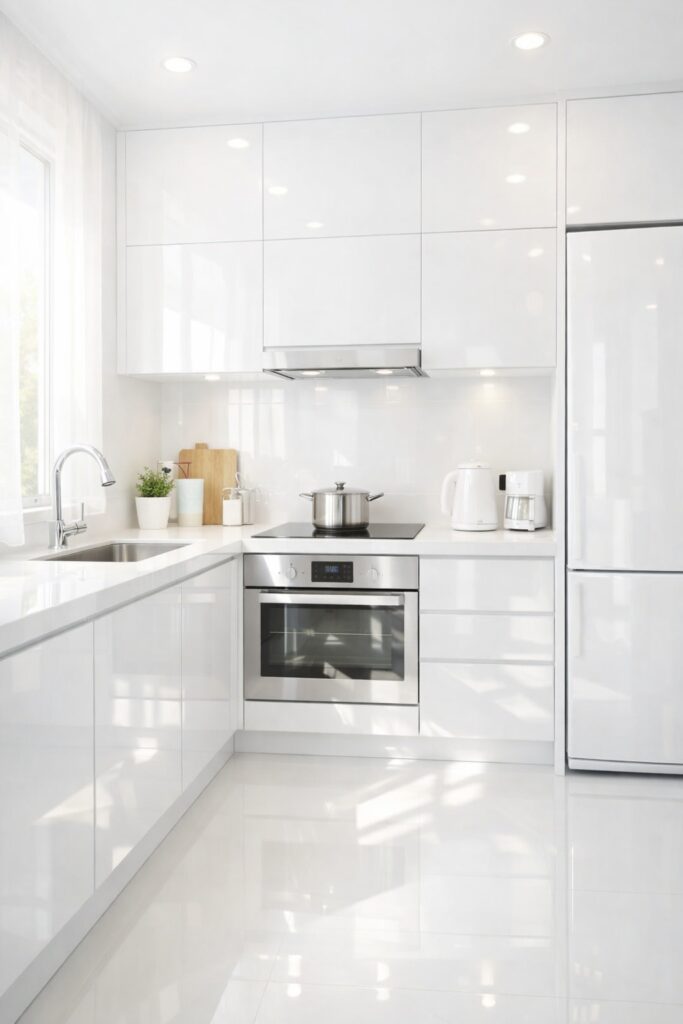
Finishes make a difference too. White cabinets, pale worktops, and reflective splashbacks bounce light around the room. Dark cabinetry and matte surfaces absorb light, meaning you may need higher output or additional task lighting to compensate.
A common mistake is overloading the ceiling with bright fittings to make up for dark areas. This usually creates glare and uneven light rather than solving the problem. A better approach is to calculate the total brightness the room needs, then divide it sensibly between ceiling lighting and task lighting.
For typical brightness targets and examples by kitchen size, our lumens for kitchens guide breaks down what works in real homes. If you want exact figures based on your room dimensions, the room lumens calculator lets you work out how much light your kitchen actually needs before choosing fittings.

Colour temperature for kitchens (2700K vs 3000K vs 4000K)
Colour temperature has a bigger impact on how a kitchen feels than most people expect. It affects not only the mood of the space, but also how food looks, how clean surfaces appear, and whether the lighting feels comfortable for long periods of use.
Colour temperature is measured in kelvin (K). The lower the number, the warmer and more yellow the light appears. Higher numbers produce cooler, whiter light.
Colour temperature is measured in kelvin (K), a standard defined by lighting bodies such as the International Commission on Illumination.
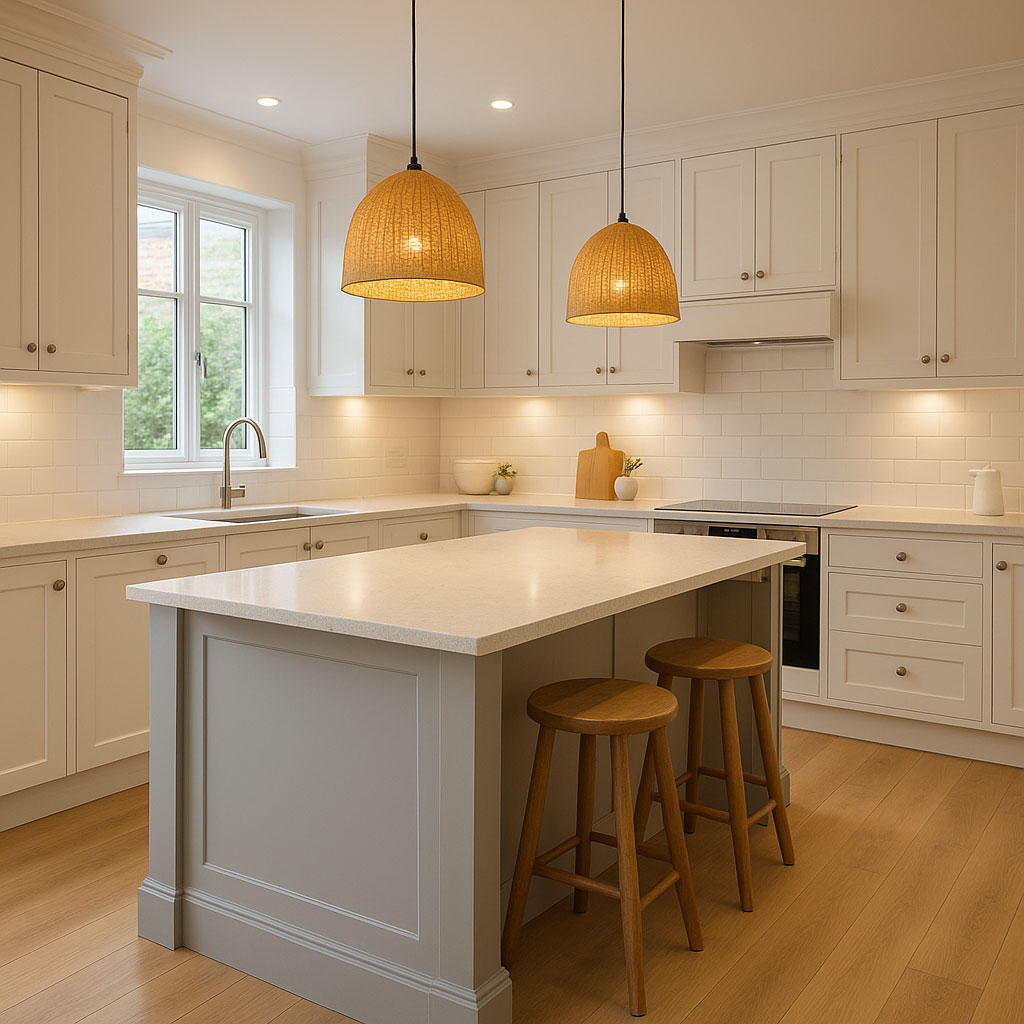
2700K creates a warm, cosy feel similar to traditional incandescent lighting. It can work well in kitchens that are open to living areas or in traditional and farmhouse style spaces. However, it can sometimes make worktops look dull and reduce contrast when preparing food.
3000K is the most popular choice for modern kitchens. It strikes a balance between warmth and clarity, making it easier to see detail without the space feeling cold. In most UK kitchens, 3000K works well for both ceiling lights and under cabinet lighting.
4000K produces a brighter, crisper white light. It can be useful for task focused areas, but when used throughout an entire kitchen it often feels clinical, especially in the evening. This is why it is less common in domestic kitchens than in utility rooms or commercial spaces.
A common mistake is mixing colour temperatures without realising it. For example, warm ceiling lights combined with very cool under cabinet lighting can make the kitchen feel disjointed. Consistency matters more than choosing the “perfect” kelvin number.
In flexible spaces, tunable white lighting allows you to adjust colour temperature throughout the day, using brighter light for cooking and softer light in the evening. This can be particularly useful in open plan kitchen diners.
Our colour temperature guide for kitchens explains how to choose the right balance for different layouts and finishes, while the article on tunable white lighting looks at when adjustable colour temperature genuinely adds value.
Scandi and Japandi kitchens tend to favour warmer, softer lighting to reinforce calm, natural interiors.

Ceiling lighting options for kitchens
eiling lighting forms the backbone of a kitchen lighting plan. Its role is to provide even, comfortable light across the whole room so that task and accent lighting can work effectively alongside it.
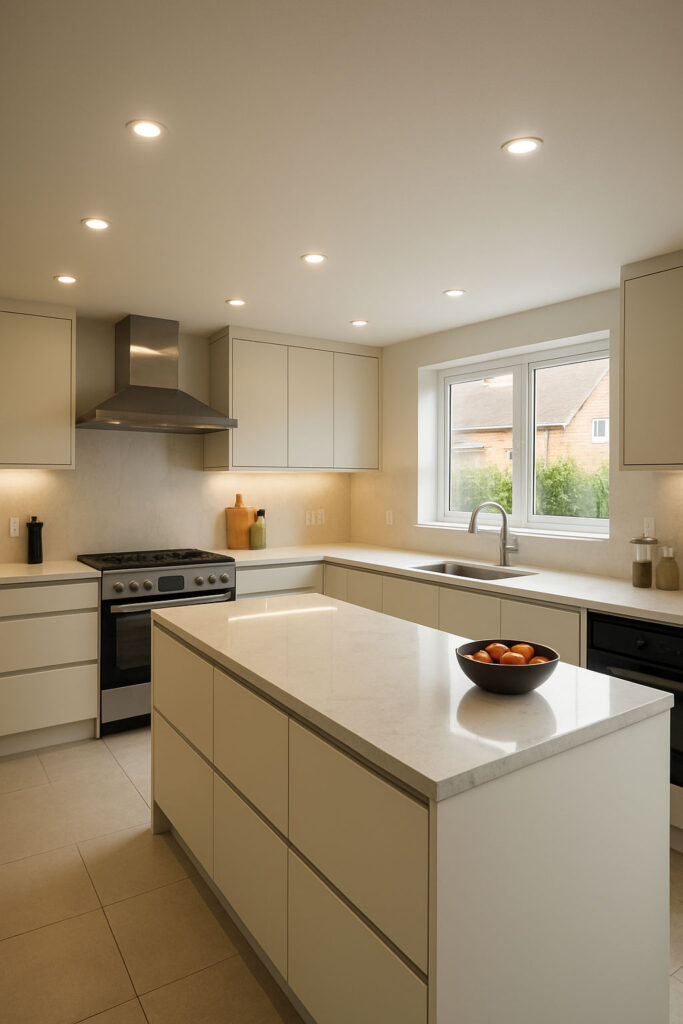
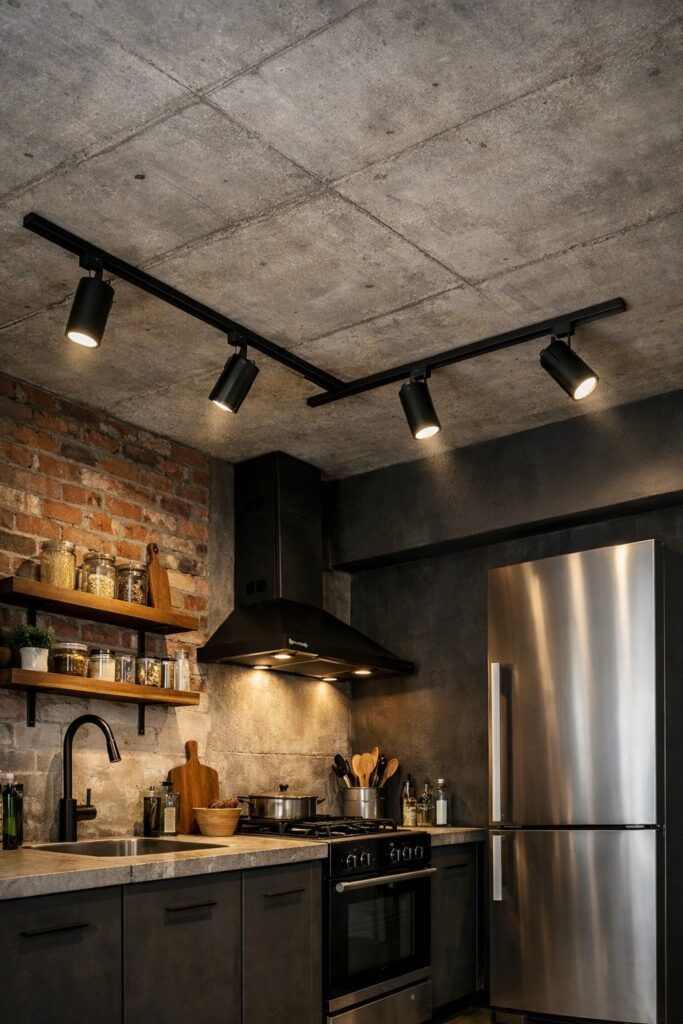
The most common ceiling lighting options in kitchens are downlights, track lighting, and flush or semi flush fittings. Each suits different layouts and ceiling heights.
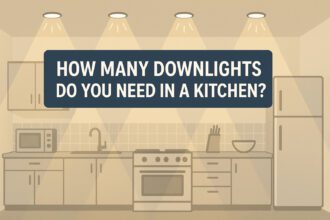
Downlights are popular because they are discreet and provide even coverage when spaced correctly provide the task lighting layer. For exact positioning, see our kitchen downlight layout guide which covers spacing rules and cabinet offsets. They work well in most kitchens, but problems arise when too many are installed or when spacing is guessed rather than planned. Poorly placed downlights can create bright spots on the floor and shadows on worktops.
Track lighting offers more flexibility. Individual heads can be aimed where light is needed most, making it useful in kitchens with unusual layouts or where fittings cannot be positioned symmetrically. Track systems also work well in modern kitchens where a more architectural look is wanted.
Flush and semi flush fittings are often the best choice in kitchens with low ceilings. They provide general light without reducing headroom or causing glare at eye level, which can be an issue with pendants or bulky fittings.
A common mistake is choosing ceiling lighting before thinking about task lighting. When ceiling lights are expected to do everything, the result is usually an overlit ceiling and poorly lit work surfaces. Ceiling lighting should support the rest of the system, not dominate it.
For detailed guidance on spacing and placement, our downlights guide for kitchens explains how many fittings you actually need and where to position them. If flexibility is more important than symmetry, the track lighting in kitchens guide shows when track systems make more sense than recessed lights.
Modern kitchens usually benefit from clean ceiling lines and neutral white light around 3000K.

Kitchen island lighting (pendants, spacing and height)
Kitchen islands often become the visual centre of the room, which means their lighting needs to work both practically and aesthetically. Island lighting should provide enough light for food preparation while also looking balanced when viewed from across the space.
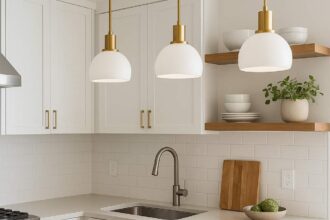
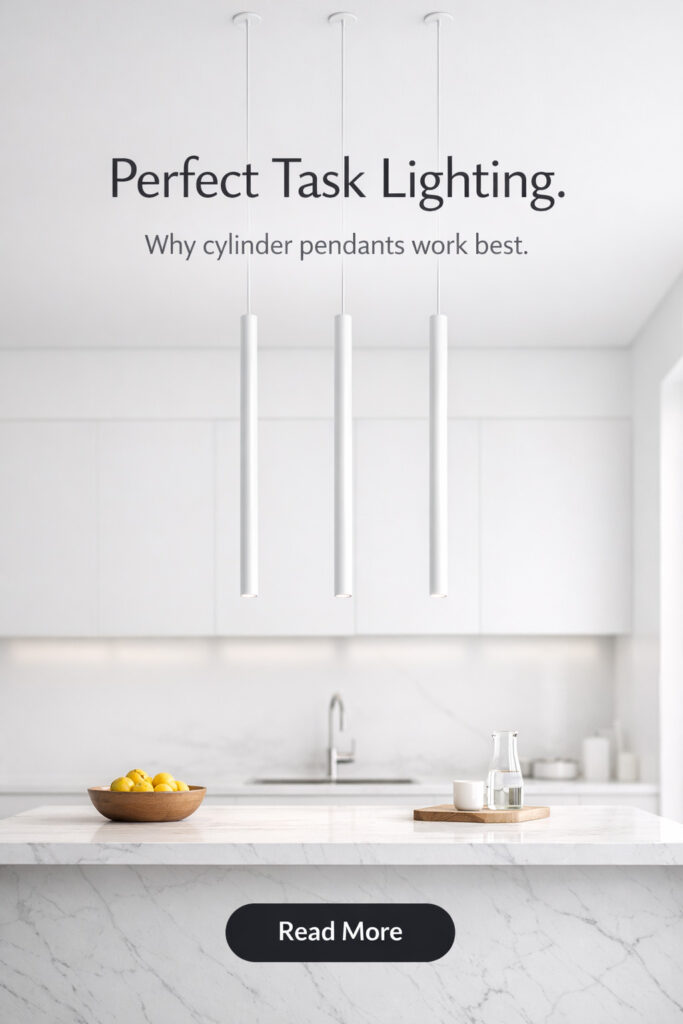
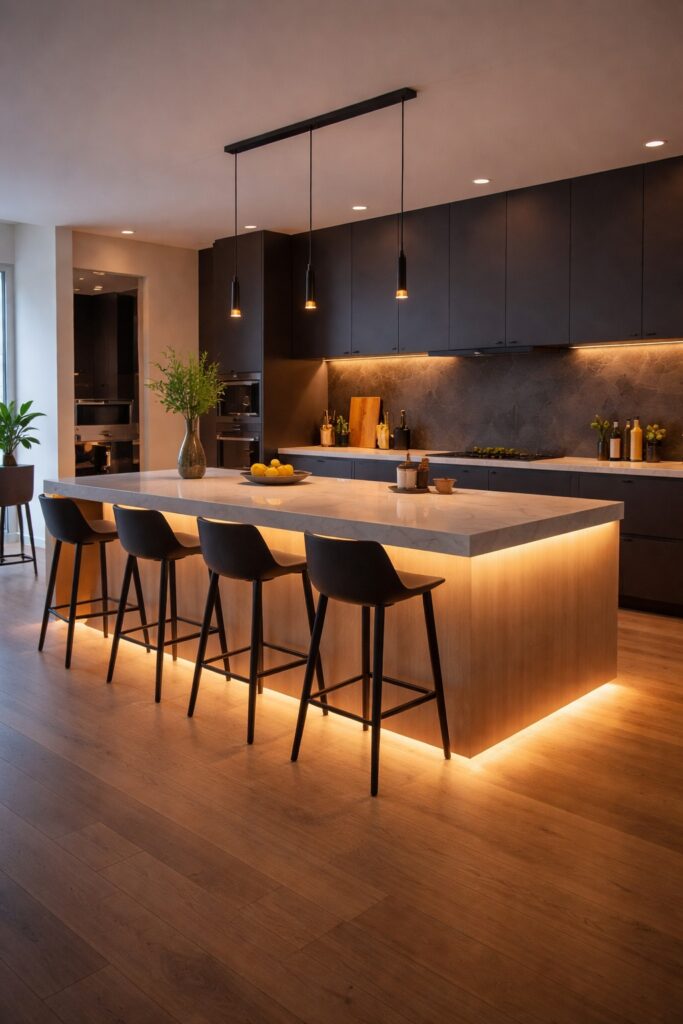
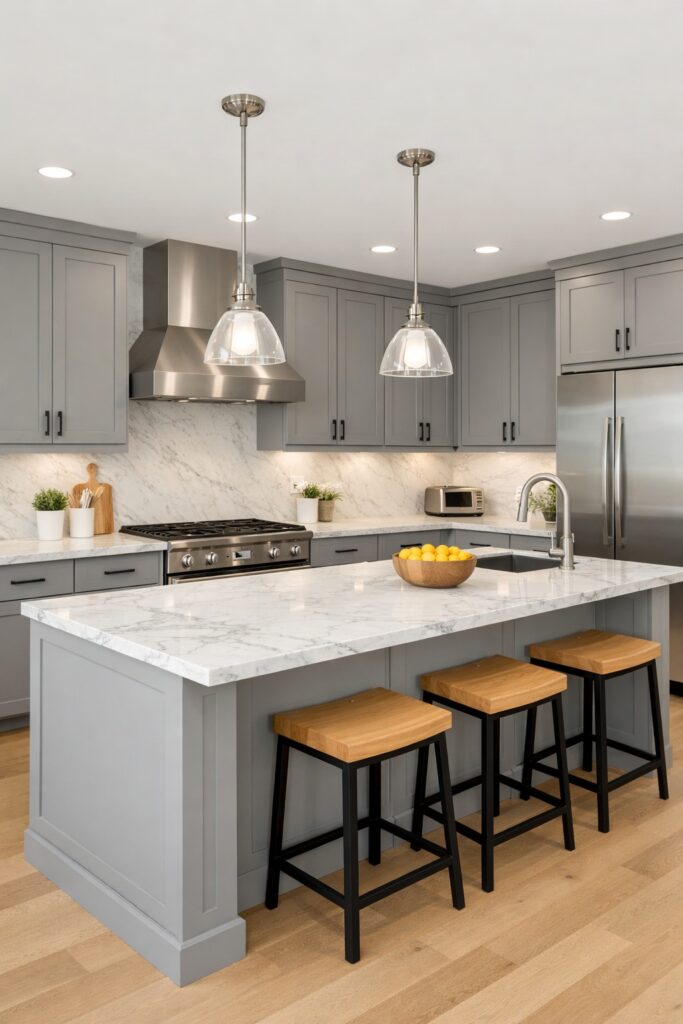
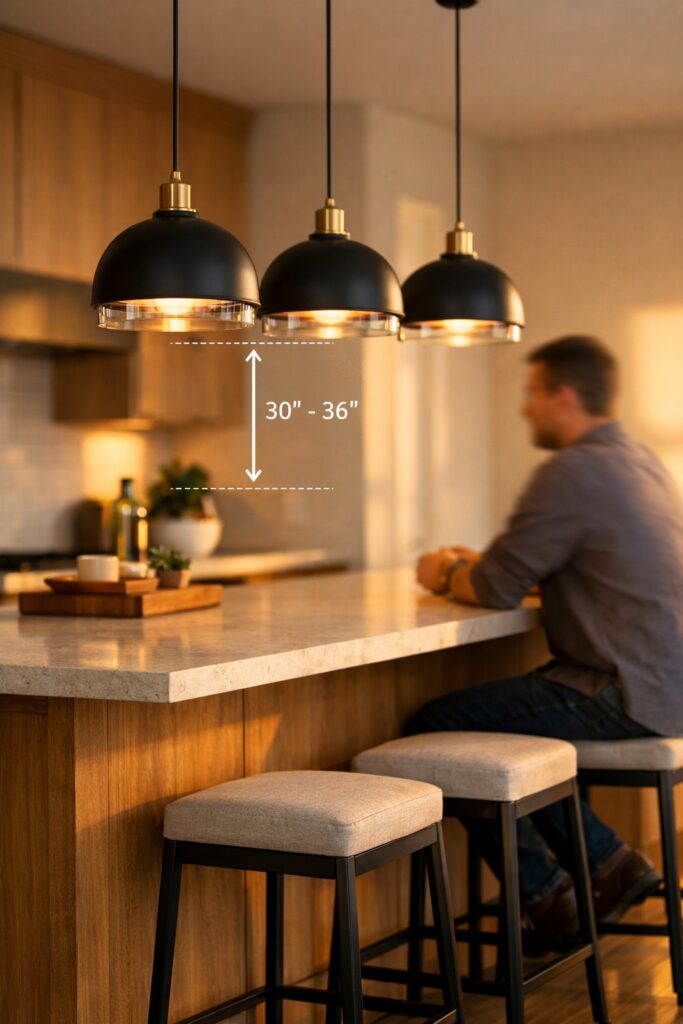
Pendant lights are the most common choice over islands, but the key decisions are not just about style. The number of pendants, their spacing, and their hanging height all affect how usable and comfortable the kitchen feels.
As a general rule, pendants should be positioned so they light the island surface without blocking sightlines or causing glare. Hanging them too low can feel intrusive, while placing them too high reduces their effectiveness and makes them look disconnected from the island.
Spacing matters as much as height. A single large pendant can work over smaller islands, while longer islands often suit two or three pendants evenly spaced along the length. The goal is visual balance rather than strict symmetry.
A common mistake is choosing pendants that are too bright or too exposed, especially in open plan kitchens. This can make the island feel harsh in the evening, even if the rest of the room is softly lit.
Our guide on how high to hang kitchen island pendants explains safe and comfortable hanging heights in UK kitchens. If you are deciding between layouts, the comparison of two vs three pendants over an island shows how different choices affect both appearance and light distribution. For kitchens with a contemporary focus, our article on statement pendants for modern kitchens explores how island lighting can become a design feature rather than just a task light.


Under cabinet and strip lighting
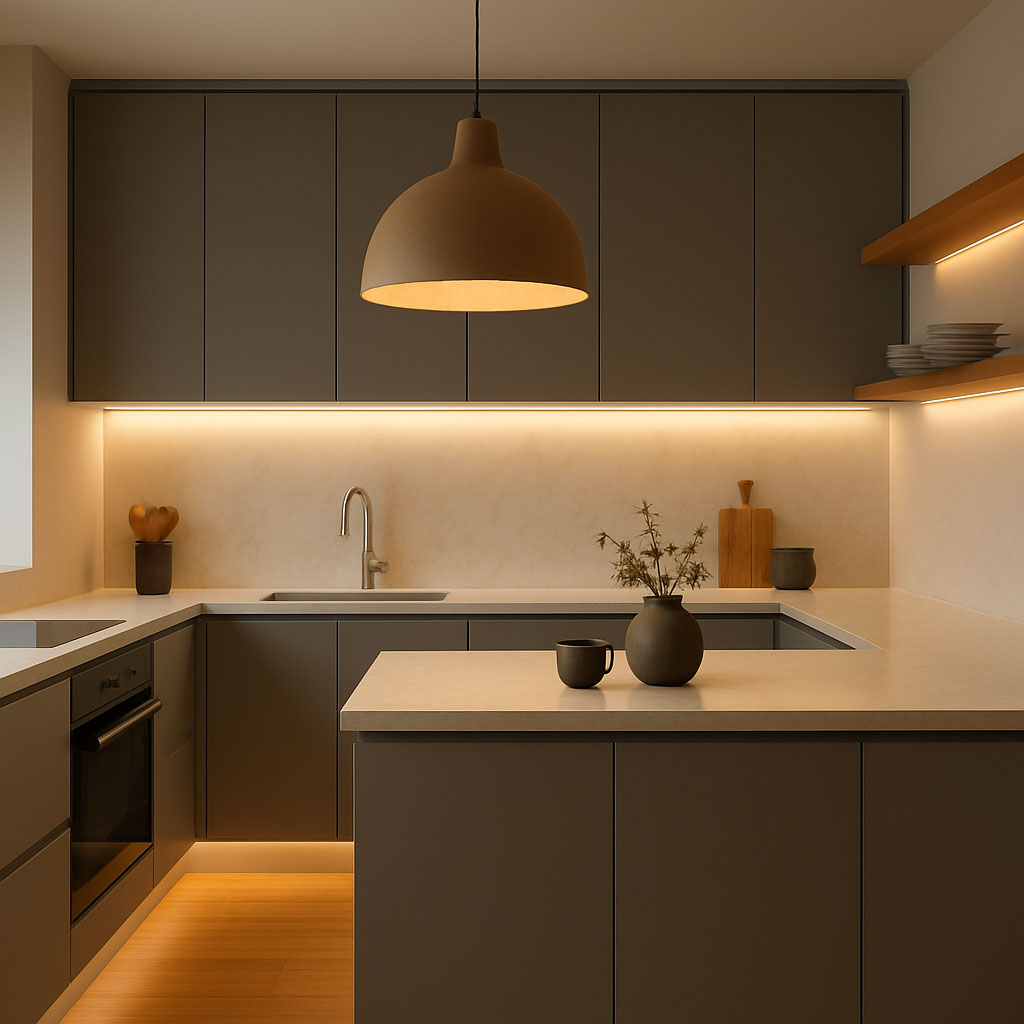
Under cabinet lighting is one of the most important elements in a kitchen lighting plan, yet it is often overlooked or treated as an add on. Its main role is to provide clear, shadow free light on worktops, where most food preparation happens.
Without under cabinet lighting, ceiling lights tend to cast shadows from your own body and from wall units. This makes worktops feel dim even in an otherwise bright kitchen. Adding task lighting directly above the work surface solves this problem immediately.
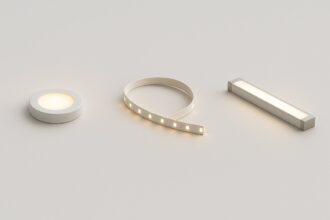
The most popular option is LED strip lighting because it provides continuous, even coverage along the full length of the cabinet run. When installed towards the front of the cabinet, it lights the worktop evenly without creating bright spots or glare on splashbacks.
Linear fittings and puck lights can also work in certain situations, particularly in smaller kitchens or where cabinets are broken up into short sections. The key is choosing a fitting that matches the cabinet layout rather than forcing one solution everywhere.
A common mistake is choosing under cabinet lighting that is too bright or too cool in colour temperature. This can create uncomfortable glare on glossy worktops and make the kitchen feel harsh. Soft neutral white light with good diffusion is usually more comfortable for everyday use.
For a detailed look at fitting types, placement, and brightness, our under cabinet lighting guide explains how to achieve shadow free prep areas. If you are considering flexible options, the LED strip lighting in kitchens guide shows where strips work best and how to size them correctly. For a direct comparison of fitting styles, the puck vs strip vs linear under cabinet lighting article breaks down the pros and cons of each approach.g itself.


Feature and mood lighting
Feature and mood lighting is what stops a kitchen feeling purely functional. While it does not need to be bright, it plays a big role in how the space feels in the evening and how visually balanced the room looks.
This layer of lighting is usually switched on when the main task lighting is off or dimmed. Its purpose is to add depth, highlight materials, and soften the space once cooking is finished.
Common examples of feature lighting include:
- Lighting inside glass fronted cabinets
- Shelf lighting on open shelving
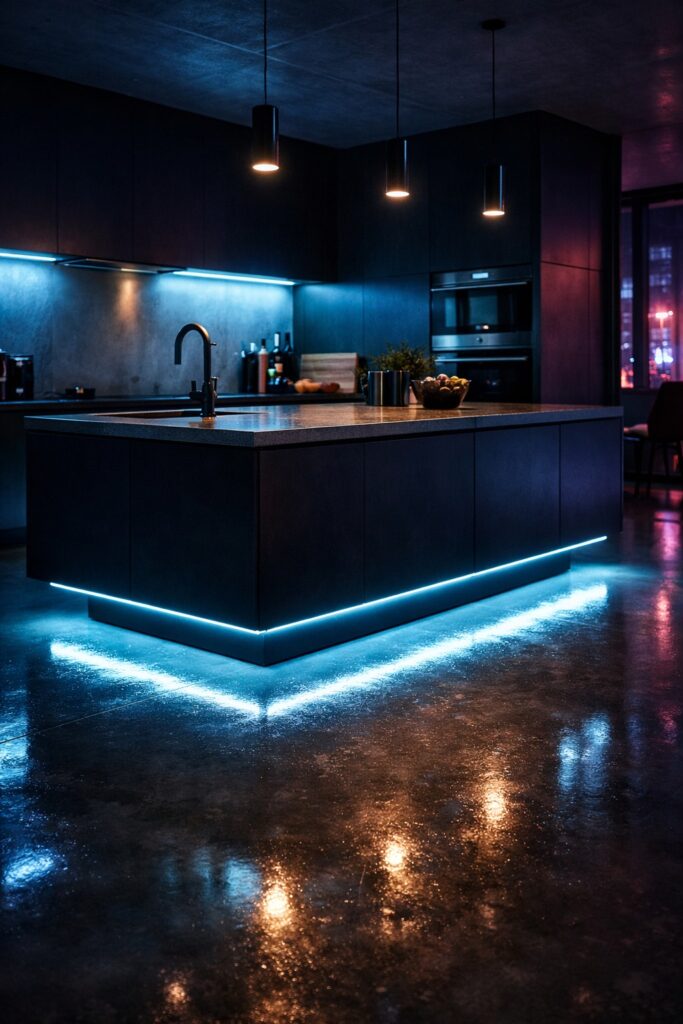
- Plinth and kickboard lighting at floor level
These lights work best when they are subtle. Overly bright feature lighting can quickly feel distracting or gimmicky, especially in kitchens with reflective surfaces.
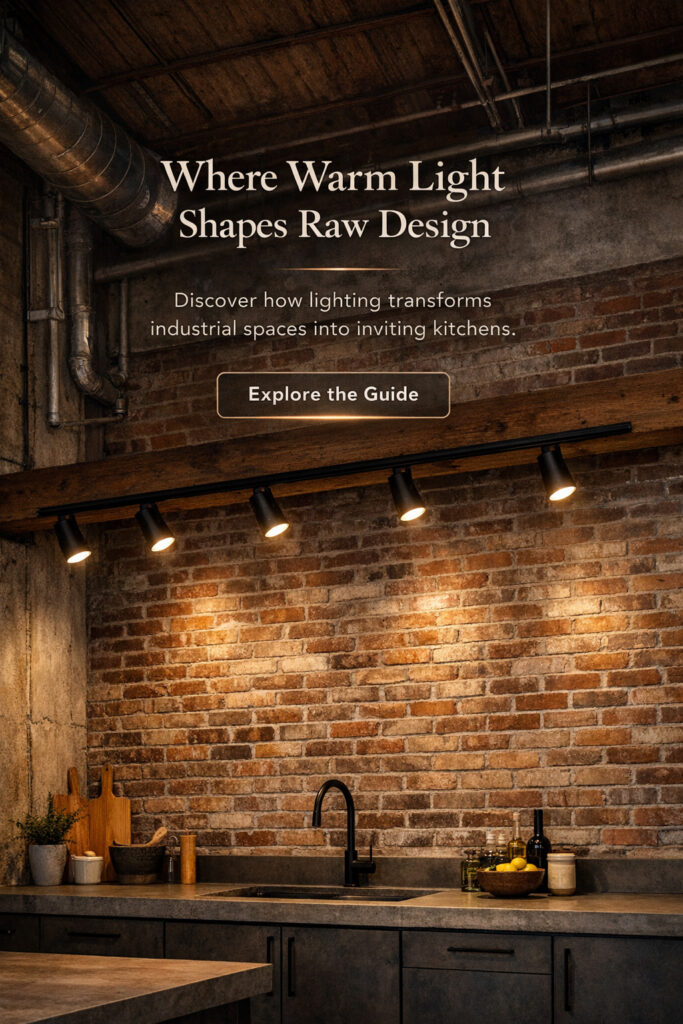
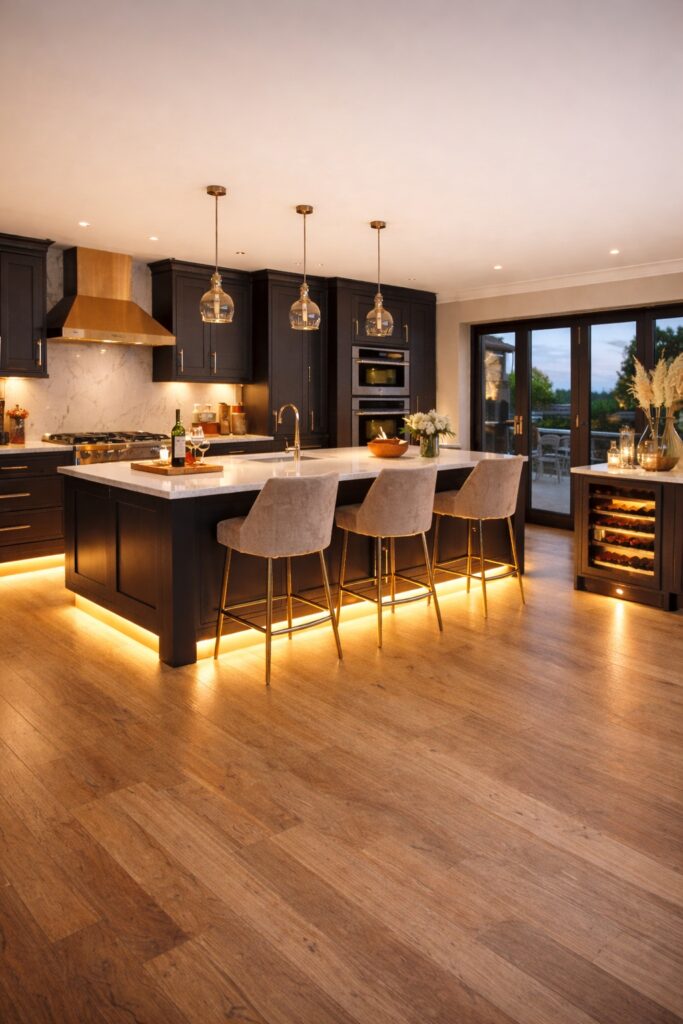
One of the most effective uses of mood lighting is balancing heavier elements in the room. Dark cabinets, deep worktops, or industrial finishes can feel visually heavy without softer points of light to break them up. Low level lighting adds contrast and helps the space feel more considered rather than stark.
A common mistake is treating feature lighting as decoration alone. When it is planned as part of the overall lighting system, it helps transition the kitchen from a daytime workspace to an evening living area.
For subtle, premium effects, our plinth and kickboard lighting ideas show how to add low level light without overpowering the room. Kitchens with exposed materials and darker finishes are explored in our industrial kitchen lighting guide, while softer, layered approaches are covered in the cottage and farmhouse kitchen lighting article.off.
Small and low ceiling kitchens
Small kitchens and kitchens with low ceilings need a slightly different lighting approach. The goal is to create even coverage without glare, while making the space feel as open as possible.
In compact kitchens, poorly placed lighting quickly becomes obvious. Harsh ceiling lights can create bright spots and shadows, while oversized fittings can make the room feel cramped. Low ceilings add another challenge, as fittings that hang too low or protrude too far can cause discomfort and visual clutter.
The most effective approach is usually a combination of:
- Evenly spaced ceiling lighting to avoid dark corners
- Strong task lighting on worktops to reduce the need for excessive ceiling brightness
- Slim or recessed fittings that preserve headroom
Flush or semi flush ceiling lights often work better than pendants in low ceiling kitchens. Where pendants are used, they are usually best reserved for specific areas such as a small island or breakfast bar, rather than the main circulation space.
Layout also matters. Narrow kitchens, such as galley layouts, need particularly even light along both sides to avoid dark worktops and reflective glare. Our galley kitchen lighting guide looks at how to achieve balanced coverage in long, narrow spaces.
Dark cabinetry can also make small kitchens feel heavier if lighting is not planned carefully. In these cases, adding under cabinet lighting and subtle feature lighting helps lift the space visually. The article on lighting tricks for kitchens with dark cabinets explains how placement matters more than simply increasing brightness.
For broader layout ideas, the small kitchen lighting ideas guide shows how thoughtful lighting can make compact kitchens feel larger and more comfortable to use.

Open plan kitchens
Open plan kitchens need lighting that works as part of a larger space rather than in isolation. The challenge is to make the kitchen feel bright and functional without overpowering adjacent dining or living areas.
In open plan layouts, lighting is one of the most effective ways to create zones. Instead of lighting the entire space evenly, it works better to treat the kitchen as its own area within the room. This usually means brighter, more functional lighting over work zones, combined with softer lighting elsewhere.
A common mistake is using the same lighting type and brightness level throughout the whole open plan area. This often leads to kitchens that feel too bright in the evening or living areas that feel flat and underlit.
Layering becomes especially important here. Ceiling lighting provides general coverage, task lighting keeps worktops usable, and accent lighting helps visually separate the kitchen from dining and seating zones. Dimming and smart controls make this much easier to manage day to day.
Pendant lighting is often used to anchor kitchen islands or dining tables within open plan spaces. When done well, this creates clear visual boundaries without the need for walls or partitions.
For a practical approach to zoning with light, our open plan kitchen diner lighting guide explains how to balance brightness levels and create comfortable transitions between areas.
Smart scenes for everyday life
Smart lighting works particularly well in kitchens because the room is used in so many different ways throughout the day. The same space might be used for cooking, eating, socialising, working, and late night visits, all of which benefit from different lighting.
Instead of thinking about smart lighting as individual bulbs or fittings, it helps to think in terms of scenes. A scene is simply a preset combination of brightness and, in some cases, colour temperature.
Common kitchen lighting scenes include:
- Cooking: brighter, neutral light focused on worktops and the hob
- Dining: softer overall light with task lighting reduced
- Evening: low level ambient and accent lighting only
- Cleaning: full brightness across all fittings
Scenes make it easy to get the right light instantly without adjusting multiple switches. This is especially useful in open plan kitchens, where lighting needs change depending on how the space is being used.
A common mistake is overcomplicating smart setups with too many scenes or colour effects that rarely get used. In kitchens, simple, functional scenes tend to work best and feel more natural over time.
Smart controls also make dimming more accessible. Dimming ceiling lights slightly while keeping task lighting bright often improves comfort without reducing usability.
Our smart kitchen lighting guide explains how to set up practical scenes and control systems without turning the kitchen into a tech project.hat double as social spaces.

Common kitchen lighting mistakes
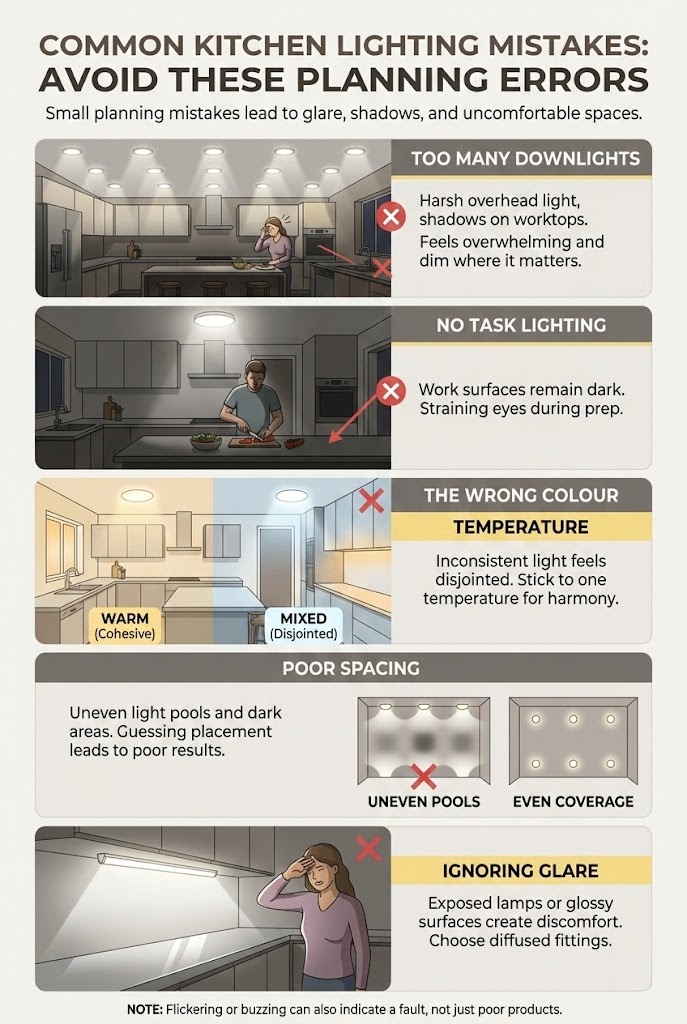
Many kitchen lighting problems are not caused by bad products, but by poor planning. Small mistakes made early can lead to glare, shadows, and spaces that feel uncomfortable to use day to day.
- Too many downlights
- No task lighting
- The wrong colour temperature
- Poor spacing
- Ignoring glare
One of the most common issues is using too many ceiling lights. Rows of downlights are often added to make a kitchen feel bright, but without task lighting they still leave worktops in shadow. This usually results in a room that feels harsh overhead and dim where it matters.
Another frequent mistake is ignoring colour temperature. Mixing warm and cool lighting without intention can make the kitchen feel disjointed, especially in the evening. Consistency across ceiling and task lighting creates a calmer, more cohesive space.
Poor spacing and placement also causes problems. Lights that are too close to walls or too far apart can create uneven pools of light and dark areas. Guessing positions rather than planning them properly often leads to disappointing results.
Glare is another issue that is easy to overlook. Exposed lamps, overly bright under cabinet lighting, or glossy surfaces combined with strong light sources can make the kitchen uncomfortable to spend time in.
Finally, many people assume that flickering or buzzing lights mean a fitting is faulty. In reality, these issues are often caused by incompatible dimmers, drivers, or lamps rather than the light itself.
Mini buyer checklist
Before choosing kitchen lighting, it helps to step back and think about how the space is actually used. Good lighting choices are usually about balance rather than chasing the brightest or most eye catching option.
A few practical points to consider before buying any fittings:
Brightness and coverage
Think about total light output across the room rather than individual fittings. Ceiling lights, task lighting, and feature lighting should work together rather than competing.
Colour temperature
Choose a colour temperature that suits how you want the kitchen to feel, especially in the evening. Neutral white lighting around 3000K works well in most UK kitchens, with warmer or tunable options where the kitchen opens into living spaces.
Glare and diffusion
Exposed light sources and poorly diffused LEDs often cause discomfort. Look for fittings that control glare, especially over worktops and islands.
Dimming and control
Dimming dramatically improves comfort and flexibility. Even basic dimming on ceiling lights can make a kitchen feel more relaxed at night.
Consistency
Try to keep finishes, light colour, and control methods consistent throughout the kitchen. A coordinated system almost always looks better than mixing unrelated fittings.
Detailed comparisons, recommendations, and buying advice live in our dedicated kitchen lighting buyer guides, which link from this page when available.
Frequently asked questions
What is the best lighting for a kitchen?
Most kitchens work best with layered lighting, combining ceiling lighting, task lighting on worktops, and a softer accent layer for evenings.
How bright should kitchen lighting be?
Brightness depends on room size, layout, and finishes, but kitchens generally need more light than living rooms, especially over work areas.
Are downlights enough on their own?
Downlights work well for general lighting, but they should be paired with under cabinet or task lighting to avoid shadows.
Is warm or cool light better in kitchens?
Neutral to warm white lighting is usually more comfortable for domestic kitchens than very cool white light.
Good kitchen lighting is about balance rather than chasing a single fitting or trend. Once the basics are right – layered lighting, appropriate brightness, and comfortable colour temperature – the rest becomes much easier to fine tune.
If you want more detail on any part of your kitchen lighting plan, the guides linked throughout this page go deeper into layouts, spacing, brightness, and common problems. Together, they form a complete reference you can come back to whenever you make changes.