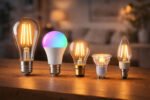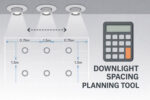

Choosing the right brightness for LED lights is one of the most common lighting questions. Too dim and your room feels dull. Too bright and it’s uncomfortable.
This guide explains exactly how many lumens you need for every room, with a free calculator below.
Quick Answer: Most living rooms need 2,500-4,000 lumens total. Kitchens need 4,000-8,000. Bedrooms need 2,000-3,000. Use the calculator below for your specific room.
| Room Type | Recommended Lux | Typical Total Lumens |
|---|---|---|
| Living room | 100–150 lux | 2,500–4,000 |
| Kitchen | 200–300 lux | 4,000–8,000 |
| Bedroom | 100 lux | 2,000–3,000 |
| Bathroom | 150–200 lux | 2,000–4,000 |
| Home office | 300–500 lux | 4,000–6,000 |
| Hallway | 100 lux | 1,000–2,000 |
Use the free calculator below to get the exact number of lumens your room needs in seconds.
If you want to understand why those numbers work, keep reading.
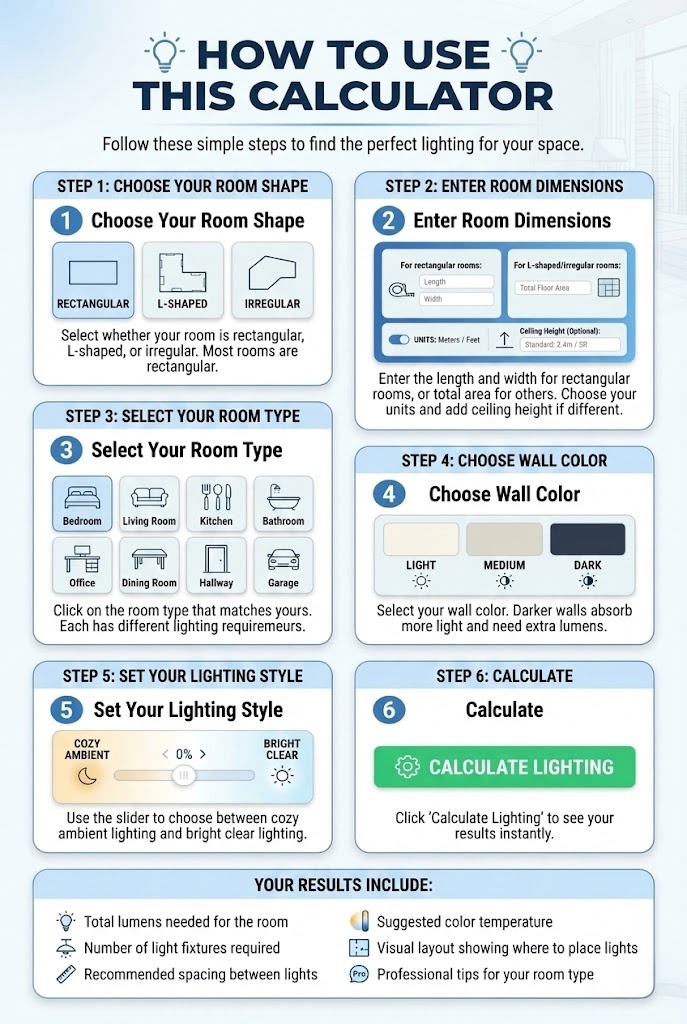
Room Lighting Calculator
Calculate the perfect lumens for any space. Works with both imperial and metric measurements.
Your Lighting Plan
Total Lumens Needed
Range:
Room Area:
Number of Fixtures
Based on 800 lumen bulbs
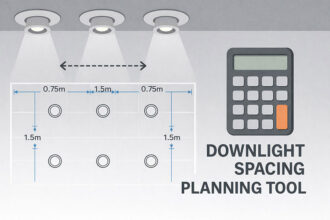
Spacing Guideline
Recommended distance between fixtures
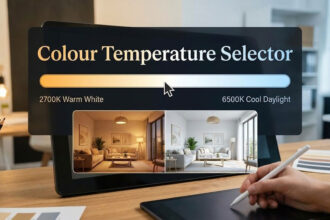
Color Temperature
Recommended warmth
Suggested Fixture Layout
Layout Guidelines
💡 Professional Tips
Expert advice tailored to your room type
Table of Contents
What Are Lumens and Why Do They Matter?
Lumens measure brightness - how much light a bulb produces.
The Old Way (Watts): You knew a 60W bulb was dimmer than 100W
The LED Way (Lumens): Watts now measure energy use, not brightness
A 10W LED produces 800 lumens - the same as an old 60W bulb but uses 85% less electricity.
Why This Matters: Two 10W LEDs can have different brightness (600 vs 800 lumens). Always check lumens, not watts.
Here's what understanding lumens does for you:
- You stop buying bulbs that are too dim (we've all been there)
- You stop overlighting rooms and making them feel like operating theatres
- You can match brightness when you're replacing old bulbs
- You actually know what you're buying instead of guessing
In homes, most LED bulbs sit somewhere between 400 lumens (pretty dim, good for mood lighting) and 1500 lumens (properly bright, kitchen or workshop territory). For everyday stuff - living rooms, bedrooms, that sort of thing—you're usually looking at 600 to 1000 lumens per bulb.
These are total room lumens from all light sources combined.

Recommended Lumens by Room Type
Here's a practical breakdown of how much light each room needs, with real-world bulb suggestions.
Living Room: 2,500-4,000 Total Lumens
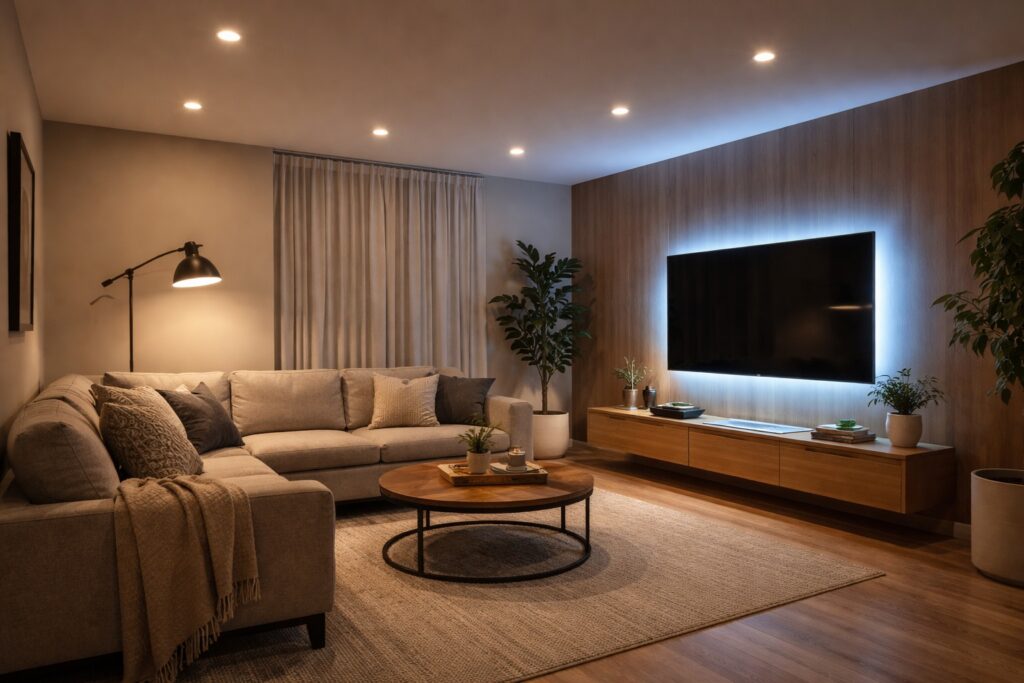
Living rooms need comfortable, flexible lighting. The space should feel warm and inviting rather than clinical.
Typical setup:
- 2-3 ceiling lights at 800-1000 lumens each
- Table lamps: 400-600 lumens
- Floor lamps: 600-800 lumens
Tips:
- Use warm white (2700K-3000K) for a cosy feel
- Add dimmer switches for evening flexibility
- Layer lighting rather than relying on one bright ceiling light
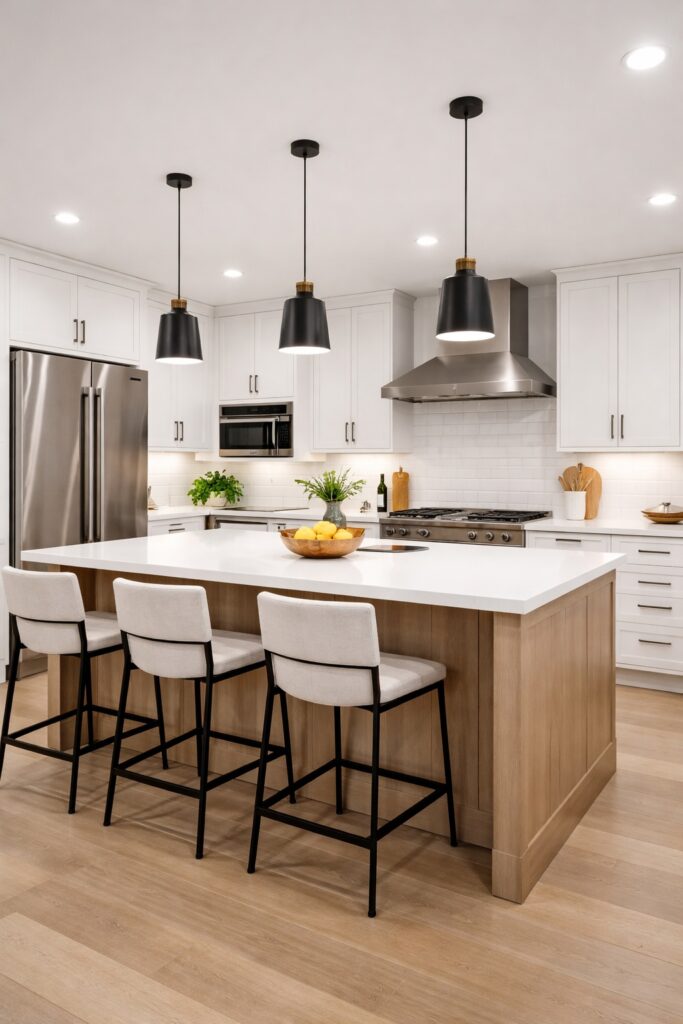
Kitchen: 4,000-8,000 Total Lumens
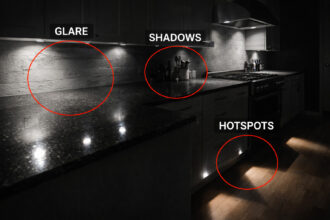
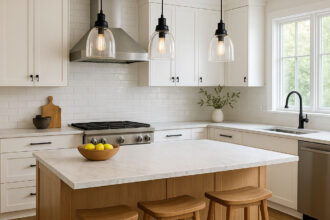
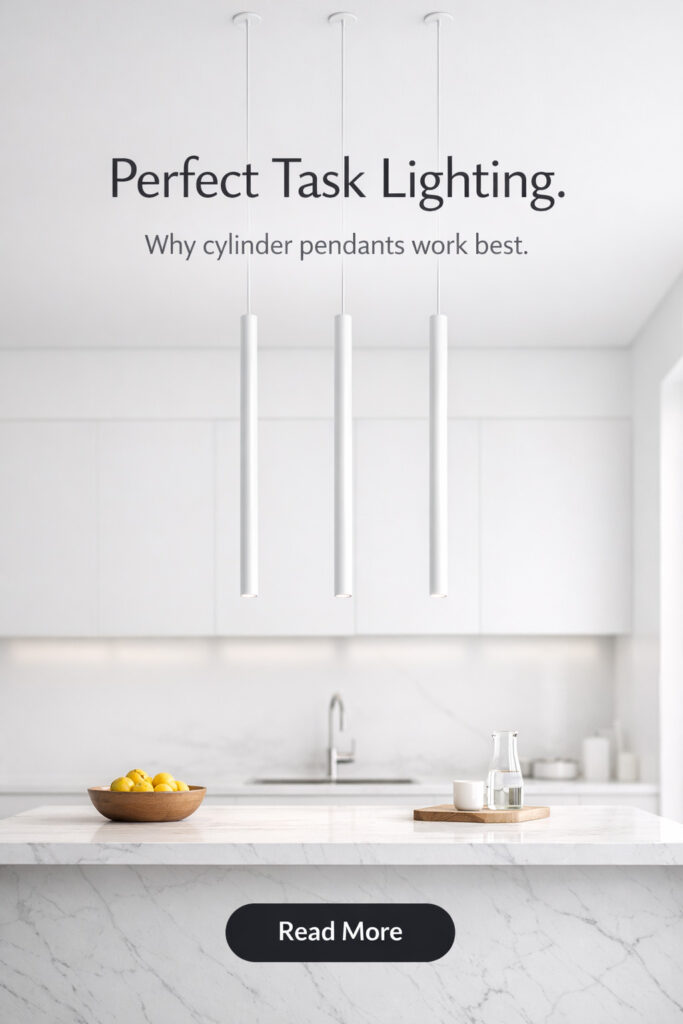
Kitchens need serious light - not vaguely bright light, but proper task lighting you can actually work with. This is where you're chopping veg, reading recipes, and trying to work out if the chicken's actually cooked through. Shadows on countertops are genuinely annoying, and dim lighting makes everything harder than it needs to be.
What actually works:
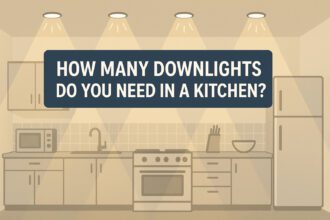
- 4-6 downlights at 600-800 lumens each (spread them out, don't cluster them all in the middle)
- Under-cabinet task lighting: 300-500 lumens per meter / 90-150 lumens per foot (essential for properly lit countertops)
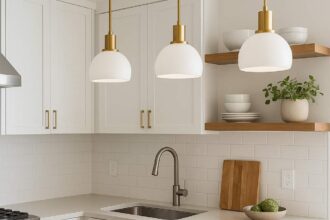
- If you've got an island, pendant lights at 800-1200 lumens each look good and do the job
Things to keep in mind:
- Use neutral white - 3000K to 4000K rather than the warm yellow tones better suited for bedrooms.
- Ceiling lights alone are not enough. Add under cabinet task lighting to avoid shadows on worktops.
- Don't just whack in loads of downlights and call it done. Layer it properly - ambient ceiling lights plus task lighting where you actually work.
Quick reality check: if you're squinting at your cutting board or using your phone flashlight to see inside cabinets, you don't have enough task lighting. Sorted lighting makes cooking way less faff.
Full kitchen lighting breakdown here: kitchen lighting ideas guide
Bedroom: 2,000-3,000 Total Lumens
Bedrooms need softer lighting for relaxation.
Typical setup:
- 1-2 ceiling lights at 600-800 lumens
- Bedside lamps: 400-600 lumens each
- Wardrobe lighting: 300-500 lumens
Tips:
- Use warm white (2700K) to promote better sleep
- Avoid placing bright lights directly above the bed
- Consider dimmable options for reading

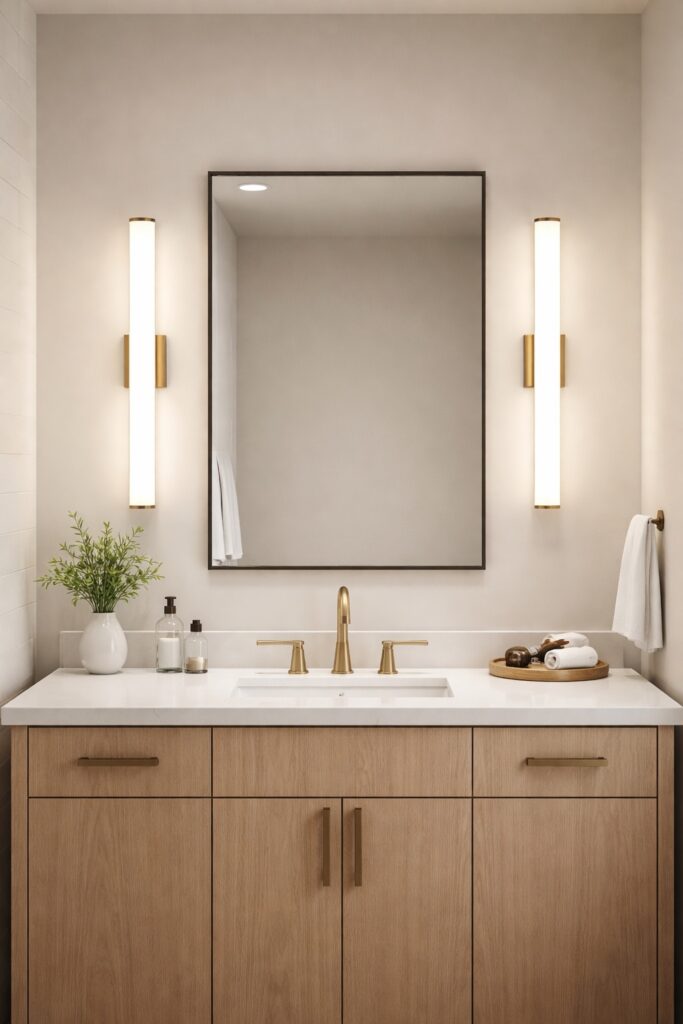
Bathroom: 2,000-4,000 Total Lumens
Bathrooms require clear, functional light around mirrors and softer ambient lighting elsewhere.
Typical setup:
- 2-3 ceiling downlights (IP65 rated): 600 lumens each
- Mirror lighting: 400-600 lumens
- Shower lighting: 400-600 lumens (IP65)
Tips:
- Use neutral white (3000K-4000K) for accurate color rendering
- Ensure mirror lighting is shadow-free
- Follow local electrical codes for safe placement in wet areas
For bathroom lighting safety requirements, see our guide on bathroom zones and IP ratings or see our guide on bathroom electrical codes and moisture ratings.
Home Office: 4,000-6,000 Total Lumens
Home offices need bright, focused lighting to reduce eye strain and maintain concentration.
Typical setup:
- 3-5 ceiling downlights at 800 lumens each
- Desk lamp: 500-800 lumens task lighting
- Ambient background lighting: 1000-1500 lumens
Tips:
- Use cool white (4000K-5000K) for alertness
- Position task lighting to avoid screen glare
- Ensure even lighting to reduce eye fatigue

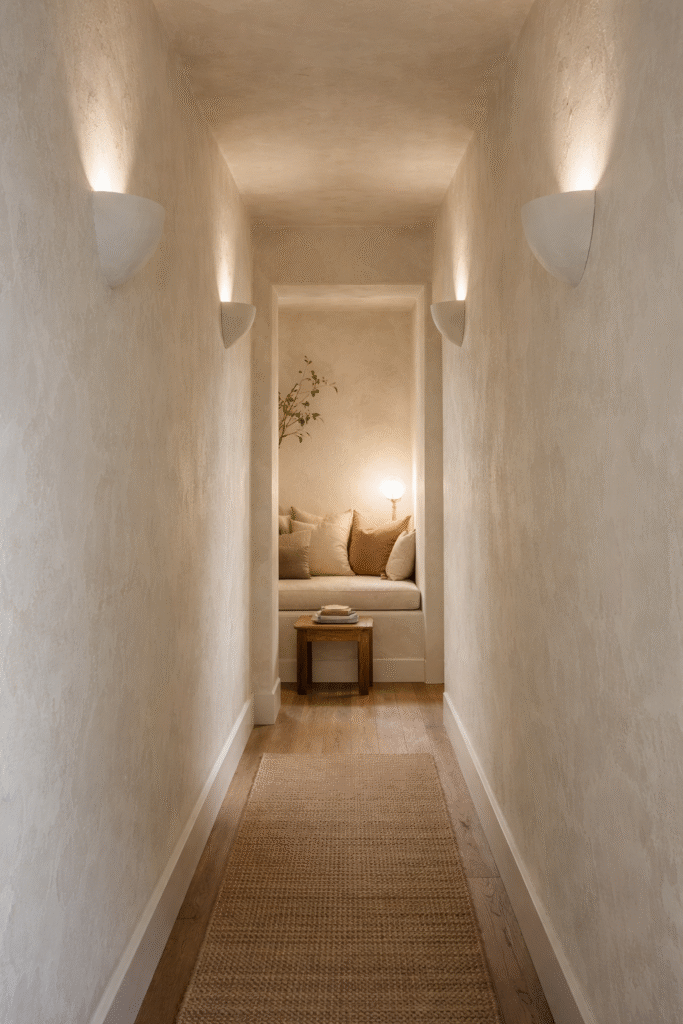
Hallway: 1,000-2,000 Total Lumens
Hallways need safe, welcoming lighting without being overly bright.
Typical setup:
- 1-2 ceiling lights at 600 lumens each
- Wall lights: 300-400 lumens
Tips:
- Use warm white for a welcoming feel
- Consider PIR sensors for efficiency
- Ensure stairs are particularly well-lit
Use this table to replace old incandescent bulbs with LED equivalents
| Old Incandescent | Lumens Output | LED Equivalent |
|---|---|---|
| 25W | 250 lumens | 3-4W LED |
| 40W | 450 lumens | 5-6W LED |
| 60W | 800 lumens | 8-10W LED |
| 75W | 1100 lumens | 11-13W LED |
| 100W | 1600 lumens | 15-18W LED |
How Room Size Affects Brightness
Room dimensions directly impact how much total light is needed, but layout and finishes also matter.
Ceiling height matters
Standard UK ceilings are around 2.4m. If your ceilings are higher than this, increase total lumens by 10–20%. High ceilings spread light further, lowering the lux level at eye height.
Small Rooms (Under 10m² / 108 ft²)
Small rooms need less total lumens but careful placement. A single bright ceiling light can feel harsh, while multiple lower-lumen sources feel more balanced.
Example: 3m × 3m bedroom (10ft × 10ft / 9m² / 97 ft²)
- Target: 100 lux
- Required: 900 lumens total
- Solution: One 600-lumen ceiling light + two 150-lumen bedside lamps
Medium Rooms (10-20m² / 108-215 ft²)
Most living rooms and bedrooms fall into this category. Multiple light sources work better than one central fitting.
Example: 5m × 4m living room (16ft × 13ft / 20m² / 215 ft²)
- Target: 150 lux
- Required: 3000 lumens total
- Solution: Three 800-lumen ceiling spots + two 300-lumen table lamps
Large Rooms (Over 20m² / 215 ft²)
Larger rooms need strategic lighting zones rather than simply adding more ceiling lights.
Example: 7m × 5m open-plan kitchen-diner (23ft × 16ft / 35m² / 377 ft²)
- Target: Mixed (300 lux kitchen zone, 150 lux dining zone)
- Required: 7,500+ lumens total
- Solution: Layered approach with task, ambient, and accent lighting
Room Finishes Impact Brightness
Reflective surfaces bounce light around, reducing the number of lumens needed:
- White walls and ceilings: Reflect up to 80% of light
- Light coloured walls: Reflect 50-70%
- Dark walls: Reflect only 10-15%
Dark rooms need 20-30% more lumens to feel equally bright.

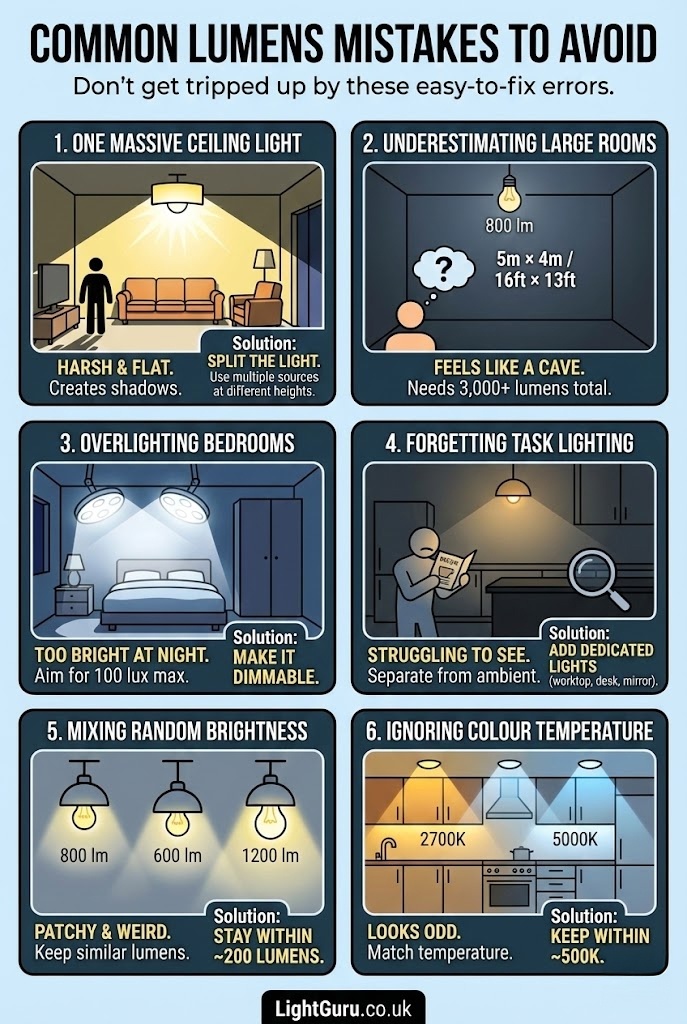
Common Lumens Mistakes to Avoid
Let me save you from the stuff that trips everyone up. These are extremely common mistakes that are easy to fix once you know what to look for, and they're all dead easy to fix once you know what you're doing wrong.
1. One Massive Ceiling Light and Nothing Else
Problem: Creates flat lighting with shadows everywhere
Fix: Use 3-5 smaller sources at different heights
2. Wildly Underestimating What Large Rooms Need
Problem: One 800lm bulb in a 20m² room
Fix: You need 3,000+ lumens total (3-4 bulbs)
3. Overlighting Bedrooms (Then Never Using Them Properly)
Problem: Treating bedrooms like kitchens
Fix: Max 2,000 lumens, always dimmable
4. Forgetting Task Lighting Exists
Problem: Relying only on ceiling lights for detailed work
Fix: Add dedicated lights at worktops, desks, and mirrors (500+ lumens each)
5. Mixing Random Bulb Brightness Throughout the Room
Problem: Random lumens across the same room (600lm, 1200lm, 800lm in three ceiling spots)
Fix: Keep bulbs within 200 lumens of each other for even lighting
6. Ignoring Colour Temperature (Then Wondering Why It Feels Wrong)
Problem: Mixing warm white (2700K) and cool white (5000K) in the same space
Fix: Match color temperature within 500K across each room
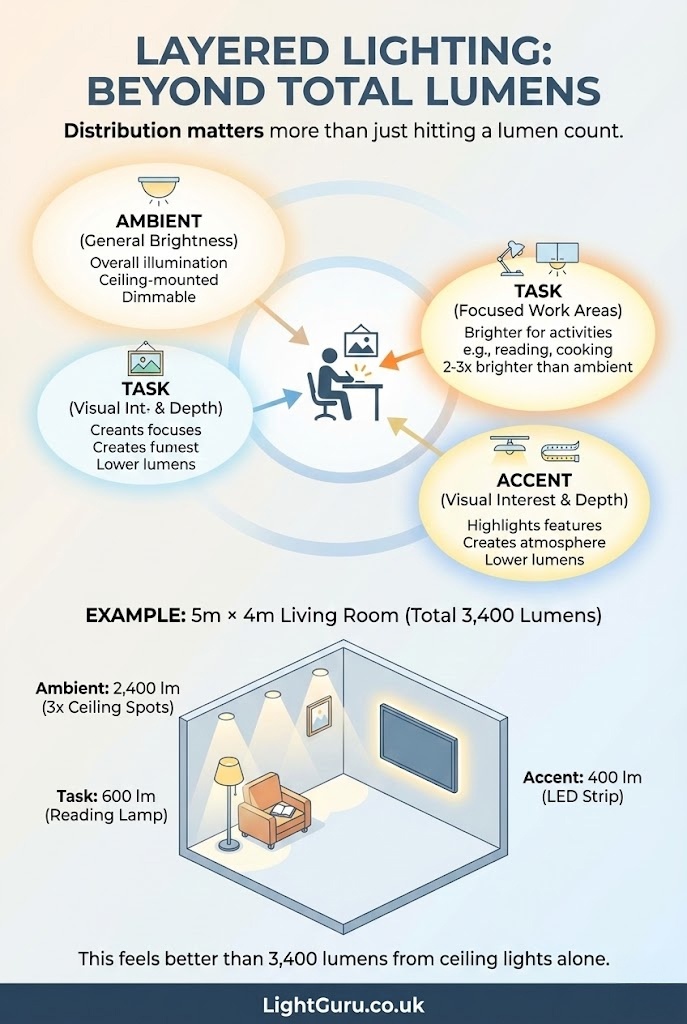
Layered Lighting: Why Total Lumens Isn't Everything
Simply hitting a target lumen count doesn't guarantee good lighting. How those lumens are distributed matters enormously.
The Three Layers
Ambient Lighting (General Room Brightness)
- Provides overall illumination
- Usually ceiling-mounted
- Should be dimmable for flexibility
Task Lighting (Focused Work Areas)
- Brighter light for specific activities
- Examples: under-cabinet kitchen lights, desk lamps, reading lights
- Typically 2-3x brighter than ambient
Accent Lighting (Visual Interest and Depth)
- Highlights features or creates atmosphere
- Examples: picture lights, LED strips, wall sconces
- Lower lumens but adds dimensionality
A well-lit room uses all three layers. For example, a 5m × 4m living room might have:
- Ambient: 2,400 lumens (three ceiling spots)
- Task: 600 lumens (reading lamp)
- Accent: 400 lumens (LED strip behind TV)
- Total: 3,400 lumens across multiple sources
This feels better than 3,400 lumens from ceiling lights alone.
Lux vs Lumens: Understanding the Difference
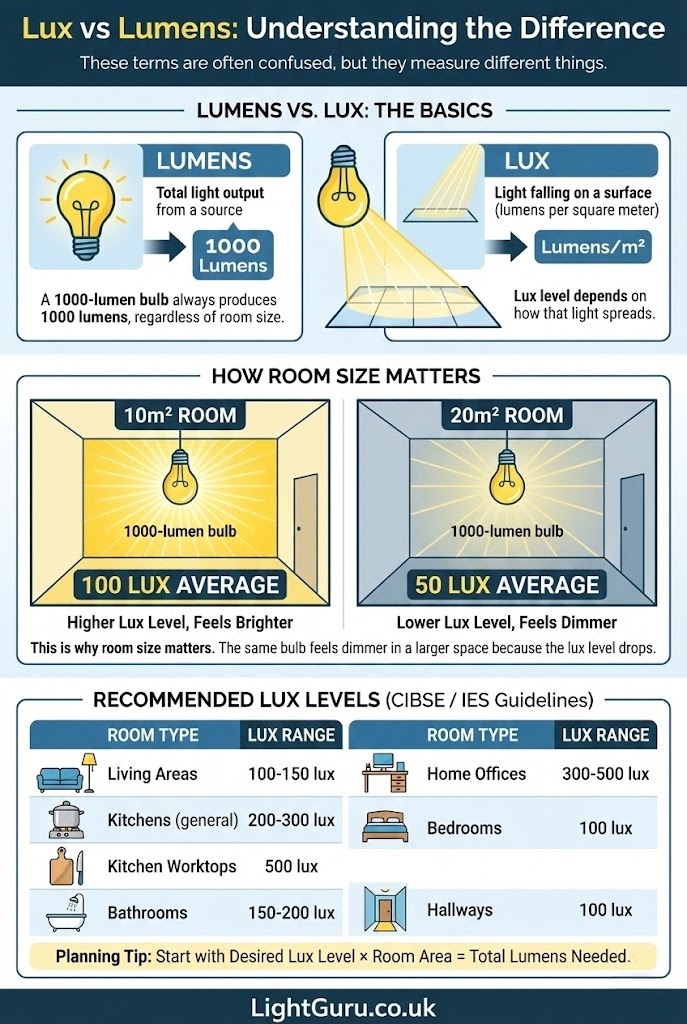
These terms are often confused, but they measure different things.
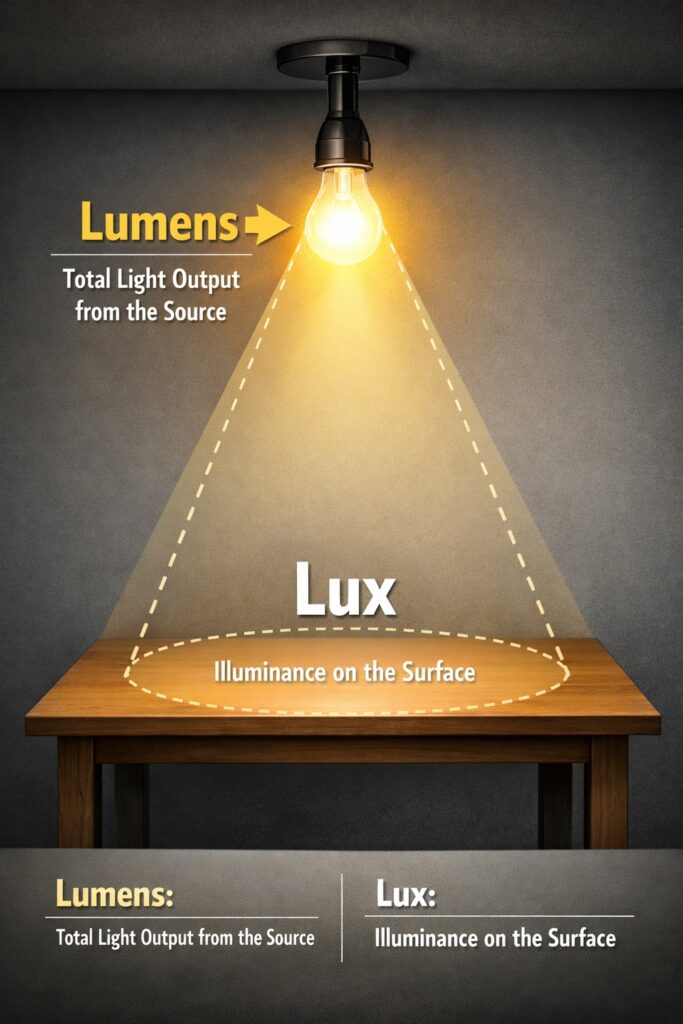
Lumens = total light output from a source Lux = light falling on a surface (lumens per square meter)
A 1000-lumen bulb always produces 1000 lumens, regardless of room size. But the lux level depends on how that light spreads:
- In a 10m² room: 100 lux average
- In a 20m² room: 50 lux average
This is why room size matters. The same bulb feels dimmer in a larger space because the lux level drops.
Recommended Lux Levels
Based on international lighting standards CIBSE /IES guidelines:
- Living areas: 100-150 lux
- Kitchens (general): 200-300 lux
- Kitchen worktops: 500 lux
- Bathrooms: 150-200 lux
- Home offices: 300-500 lux
- Bedrooms: 100 lux
- Hallways: 100 lux
When planning lighting, start with the desired lux level, multiply by room area, and you get total lumens needed.
Best LED Bulb Lumens for Homes
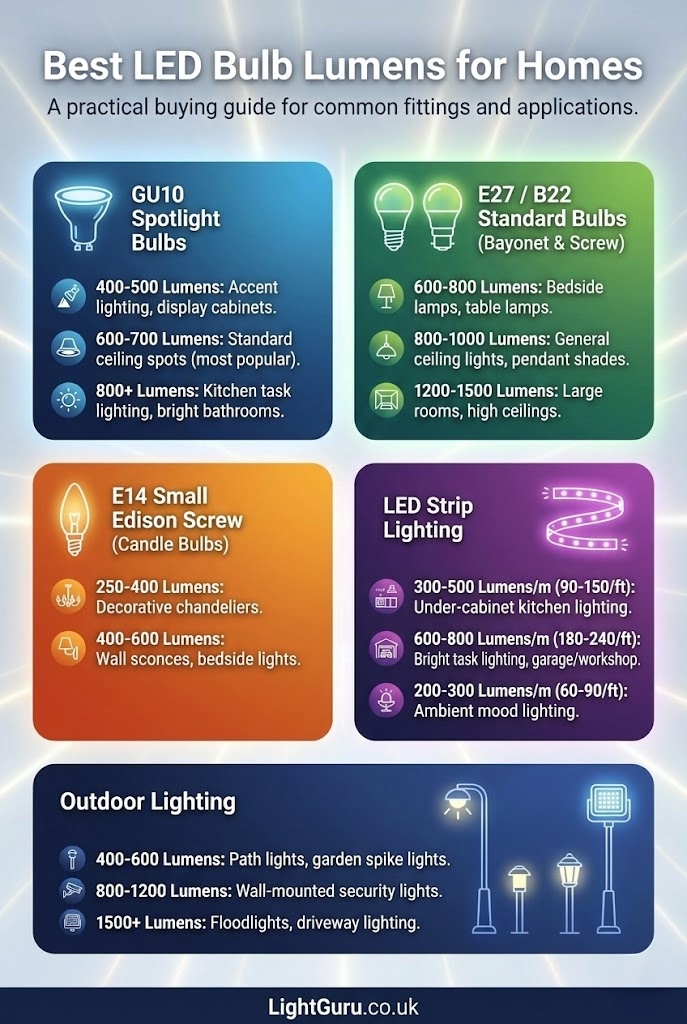
Here's a practical buying guide for common fittings.
GU10 Spotlight Bulbs
- 400-500 lumens: Accent lighting, display cabinets
- 600-700 lumens: Standard ceiling spots (most popular)
- 800+ lumens: Kitchen task lighting, bright bathrooms
E27 / B22 Standard Bulbs (Bayonet and Screw)
- 600-800 lumens: Bedside lamps, table lamps
- 800-1000 lumens: General ceiling lights, pendant shades
- 1200-1500 lumens: Large rooms, high ceilings
E14 Small Edison Screw (Candle Bulbs)
- 250-400 lumens: Decorative chandeliers
- 400-600 lumens: Wall sconces, bedside lights
LED Strip Lighting
- 300-500 lumens per meter: (90-150 per foot): Under-cabinet kitchen lighting
- 600-800 lumens per meter: (180-240 per foot): Bright task lighting, garage/workshop
- 200-300 lumens per meter: (60-90 per foot): Ambient mood lighting
Outdoor Lighting
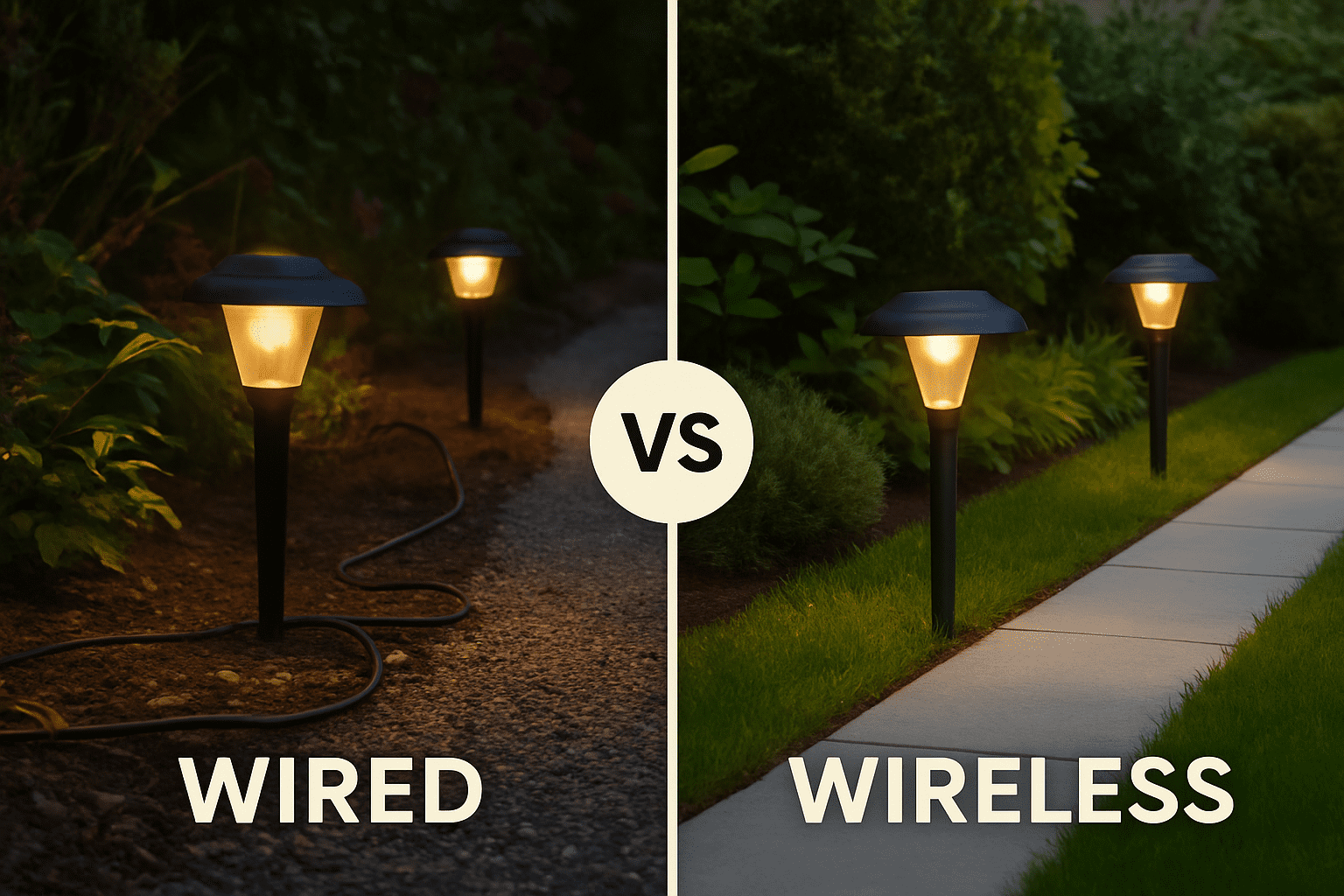
- 400-600 lumens: Path lights, garden spike lights
- 800-1200 lumens: Wall-mounted security lights
- 1500+ lumens: Floodlights, driveway lighting
For outdoor lighting calculations and fault prevention, see our outdoor lighting faults guide.
Frequently Asked Questions
How many lumens do I need for a living room?
Living Room: 3,000 lumens total (for 20m² space)
Achieve this with three 1,000-lumen ceiling lights plus table lamps for layered lighting.
Is 800 lumens bright enough for a bedroom?
Yes, 800 lumens is suitable for a small-to-medium bedroom (10-12m²). Larger bedrooms need 1,200-2,000 lumens total, ideally from multiple sources rather than one bright ceiling light.
How many lumens per square metre for a kitchen?
Kitchens need approximately 300 lumens per square meter (28 per square foot) for general lighting, plus additional task lighting over worktops (500 lux or higher).
Can you have too many lumens?
Yes. Overlighting creates glare, washes out colours, and feels uncomfortable. It's better to use dimmers and layered lighting than to install excessively bright bulbs.
What's the difference between 800 lumens and 1000 lumens?
The difference is noticeable but not dramatic—roughly 25% brighter. For most rooms, either would work, but kitchens and offices benefit from the extra brightness.
Do smart bulbs produce fewer lumens?
Some smart bulbs produce slightly fewer lumens than equivalent non-smart LEDs (typically 10-15% less). Check specifications when buying smart bulbs for task lighting.
How do I calculate lumens for an irregular-shaped room?
Measure the floor area in square meters or square feet (length × width, or divide into rectangles and add together), then multiply by the target lux level for that room type.
Should I choose higher lumens for rooms with dark walls?
Yes. Dark surfaces absorb light rather than reflecting it. Increase lumens by 20-30% in rooms with dark finishes to achieve the same perceived brightness.
Choosing bulbs?
Once you know your target lumens, match bulb brightness first, then choose colour temperature and fitting style. Avoid shopping by wattage alone.
Final Thoughts
Calculating the right number of lumens for a room is straightforward once you understand the basics. Room size, room type, and how you use the space determine how much light you need. The calculator at the top of this page takes the guesswork out by doing the maths for you.
Quick reality check: Remember that total lumens matter, but so does how you distribute that light. Multiple lower-lumen sources usually feel better than one excessively bright fitting. Add task lighting where you work, ambient lighting for general coverage, and accent lighting for depth.
When in doubt, choose dimmable bulbs and fittings. You can always reduce brightness, but you can't add lumens to a bulb that's too dim.
For help planning complete lighting layouts, see our room-by-room guides on living room lighting and bathroom lighting layouts.
Planning a kitchen? See our Kitchen Lumens Guide for worktop and prep zone targets.