This guide covers track lighting as a kitchen ceiling option. For broader lighting principles and other fixture types, see our complete Kitchen Lighting Guide.
Disclosure: This article contains affiliate links. If you purchase through these links, we may earn a small commission at no extra cost to you.
Table of Contents
Why Track Lighting Deserves a Second Look
Track lighting had a reputation problem. For years it meant chunky halogen systems that looked dated the moment they were installed. But modern track lighting has transformed into something genuinely useful: slim, adjustable, and surprisingly stylish.
The core appeal is flexibility. A single track can hold multiple adjustable heads, each aimed precisely where you need light. Unlike recessed downlights, you’re not committed to fixed positions—if your kitchen use changes, you redirect the heads rather than rewiring the ceiling.
For kitchens where downlights aren’t practical—awkward joist positions, concrete ceilings, rental properties—track lighting solves the problem with minimal disruption. One electrical connection point powers an entire run of adjustable task lights.
How Track Lighting Works
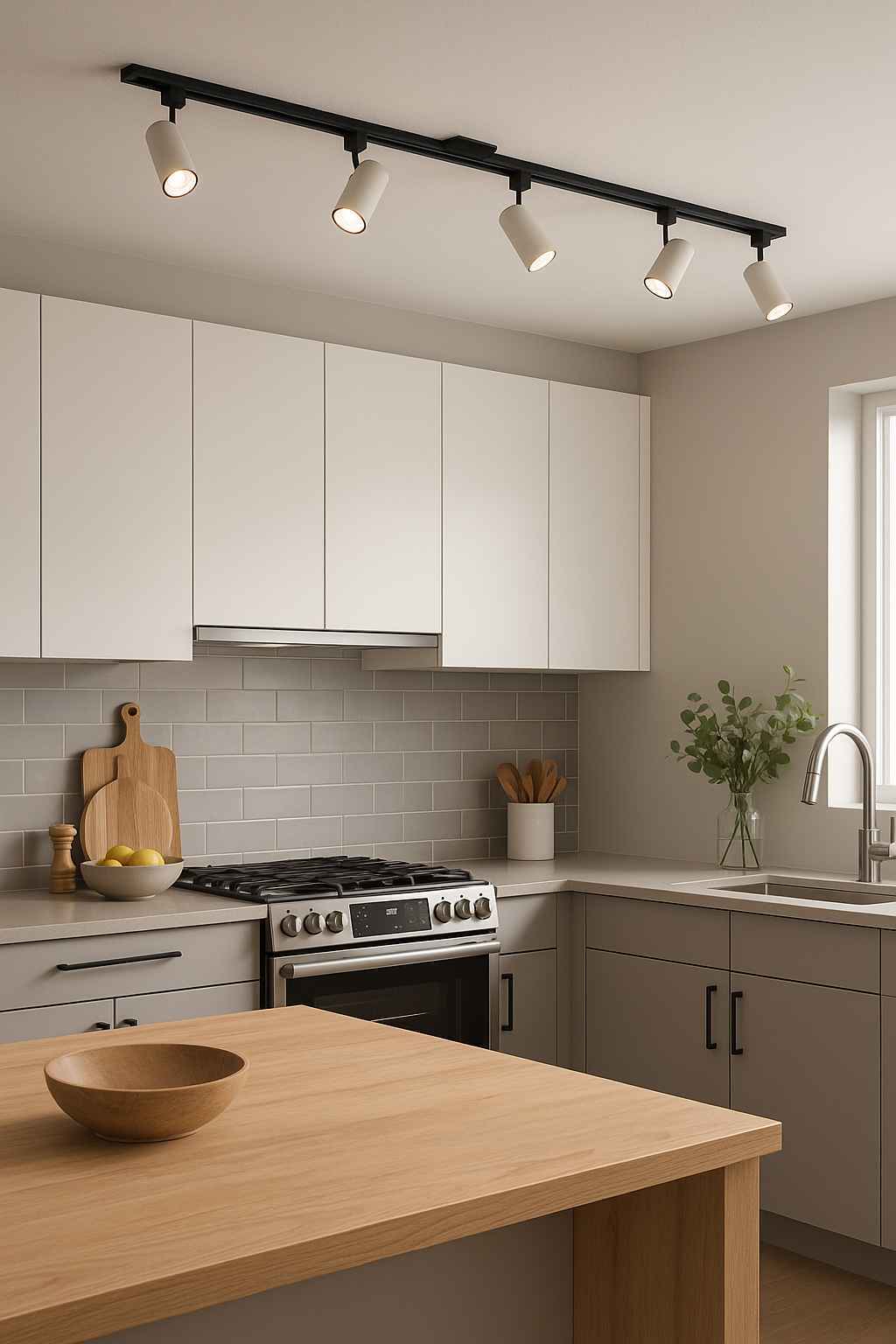
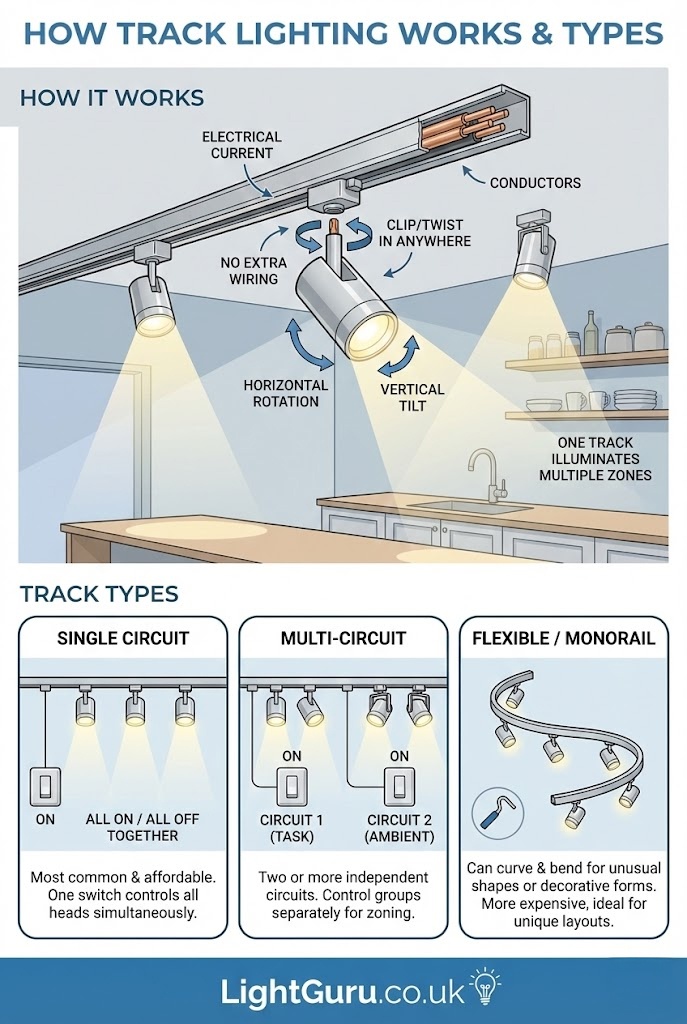
A track system consists of a metal rail (the track) mounted to the ceiling, with individual light heads that clip or twist into place anywhere along its length. The track carries electrical current, so heads can be positioned, repositioned, or added without additional wiring.
Most systems allow you to rotate each head horizontally (along the track) and tilt it vertically (to angle the beam). This means a single track running down the centre of a kitchen can illuminate both worktops, the sink, shelving, and any other zone you want to highlight.
Track Types
Single circuit tracks are the most common and affordable option. All heads on the track operate together from one switch—they’re either all on or all off.
Multi-circuit tracks have two or more independent circuits within the same rail. This lets you control different groups of heads separately, useful in larger kitchens where you might want task lighting over the worktops without illuminating the whole room.
Flexible or monorail tracks can curve and bend, following unusual ceiling shapes or creating decorative forms. They’re more expensive and less common in kitchens but work well in spaces with non-standard layouts.
When Track Lighting Makes Sense
Track lighting isn’t the right choice for every kitchen, but it excels in specific situations.
Awkward Ceiling Construction
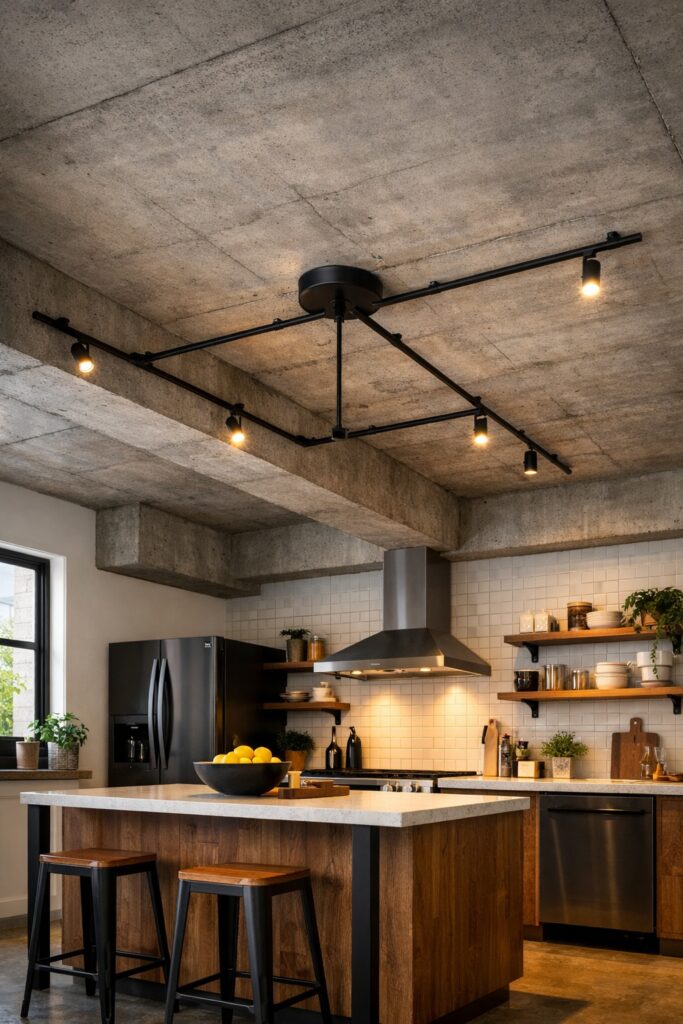
If ceiling joists, beams, or pipework prevent you from positioning recessed downlights where you actually need them, track lighting bypasses the problem entirely. The track mounts to the ceiling surface, and you angle the heads to compensate for less-than-ideal placement.
Rental Properties
Many track systems connect to an existing ceiling rose, meaning no new wiring and no holes in the ceiling. When you move, the system comes with you. This makes track lighting one of the few genuinely renter-friendly options for improving kitchen task lighting.
Low Ceilings
Recessed downlights need ceiling void depth. If you have shallow voids or concrete ceilings, surface-mounted track keeps the light source close to the ceiling without the installation complications. Choose slim-profile tracks and compact heads to minimise visual bulk.
For more on lighting low-ceilinged kitchens, see our low ceiling kitchen lighting guide.
Galley Kitchens
A single track running the length of a galley kitchen can illuminate both worktops from a central position. Angle half the heads toward one side, half toward the other. This achieves what would otherwise require two rows of downlights, from a single wiring point.
See our galley kitchen lighting guide for more layout options.
Budget Renovations
Track lighting typically costs less than installing multiple recessed downlights, especially when you factor in electrician time for cutting holes, running cables, and fitting fire hoods. A quality track system with four to six heads can transform kitchen lighting for a fraction of the cost.
Where to Position Track Lighting
Placement depends on your kitchen layout, but a few principles apply across most situations.
Galley Kitchens: Down the Centre
Run a single track along the centre line of the ceiling, parallel to the worktops. Angle heads alternately left and right to illuminate both sides. This eliminates the shadow problem that plagues galley kitchens with a single central pendant.
Position the track so it runs the full working length of the kitchen. If your galley is 3 metres long, use a 2.5–3 metre track rather than a short section that leaves the ends in darkness.
L-Shaped Kitchens: Follow the Layout
L-shaped kitchens benefit from track that follows the room’s geometry. Run one length along the main cooking area and a second, shorter track along the return. Many track systems include corner connectors that allow continuous runs around angles.
Alternatively, use two separate tracks positioned to cover each leg of the L, angling heads into the corner where the two sections meet.
Over Islands and Breakfast Bars
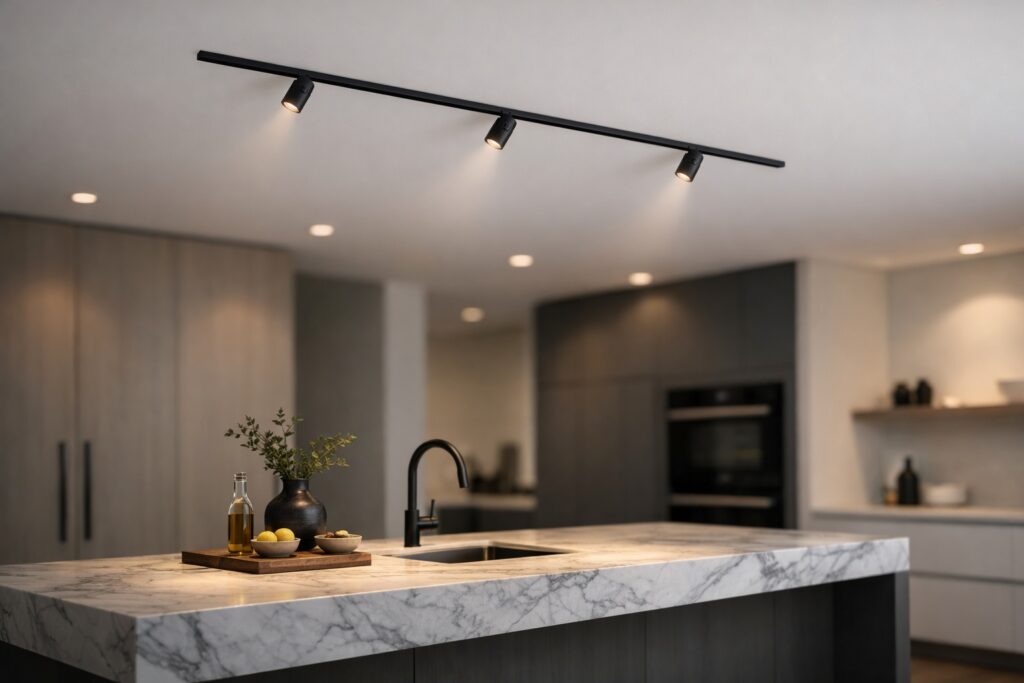
A track positioned above an island provides flexible, adjustable lighting that can adapt as your use of the space changes. Angle some heads down for task lighting over prep areas, others toward seating zones, and one or two toward the splashback or open shelving for visual interest.
This approach works well as an alternative to pendant lights, particularly in kitchens where you want a cleaner ceiling line or need the flexibility to redirect light.
Open-Plan Kitchen-Diners
In open-plan spaces, track lighting helps define the kitchen zone within the larger room. A track positioned above the cooking and prep area creates a visual boundary while providing functional task lighting.
Keep track lighting to the kitchen zone and use different fixture types (pendants, floor lamps, wall lights) in the dining and living areas to differentiate the spaces.
For more on zoning open layouts, see our open-plan kitchen-diner lighting guide.
Angling Track Heads: The Key to Good Results
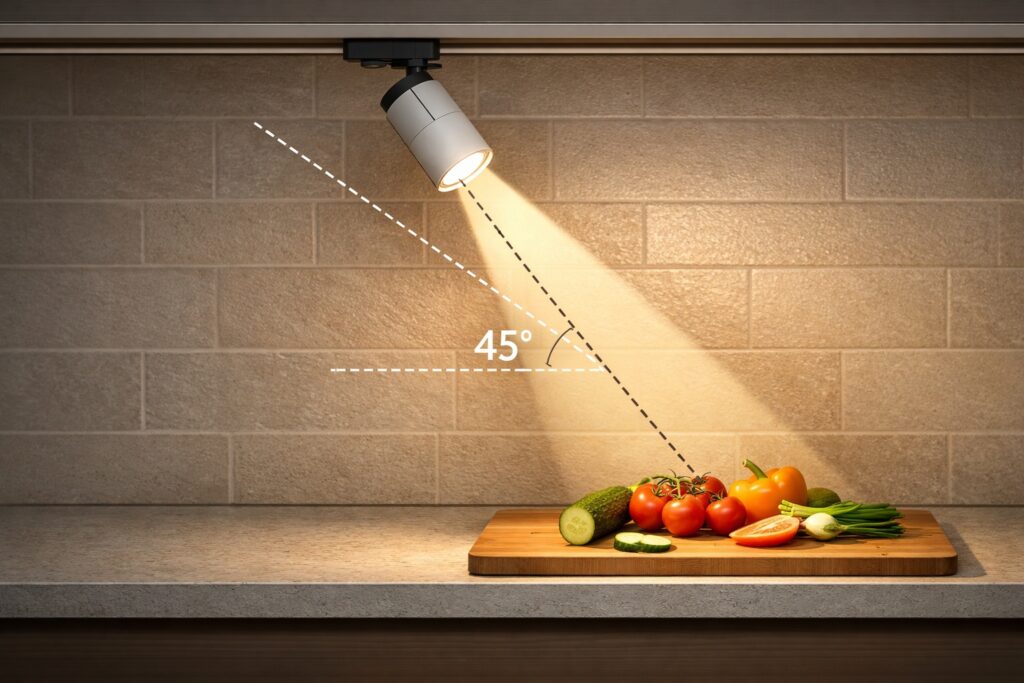
The real advantage of track lighting is adjustability, but it only works if you angle the heads thoughtfully. Pointing everything straight down wastes the system’s potential.
Toward the Worktops
The primary goal in most kitchens. Angle heads at approximately 30–45 degrees from vertical, directing light onto the work surface rather than the floor. This removes the shadows that form when you stand between a ceiling light and your chopping board.
Toward the Splashback
Angling a head or two at a textured or tiled splashback creates visual interest and reflects light back into the room. Glossy or metallic splashbacks work particularly well with directional lighting.
Toward Open Shelving
If your kitchen includes open shelves, a track head angled toward them turns functional storage into a display feature. This works especially well for shelves holding cookbooks, plants, or decorative items.
Away from Glossy Surfaces
High-gloss cabinet doors and polished worktops reflect light sources directly into your eyes if the angle is wrong. Check for glare from typical standing and seated positions, and adjust heads to avoid direct reflections.
For more on managing reflections, see our guide to kitchen lighting glare and shadows.
Colour Temperature for Track Lighting
Because track lighting is directional and often positioned as task lighting, colour temperature has a noticeable impact on both function and atmosphere.
Recommended Colour Temperatures
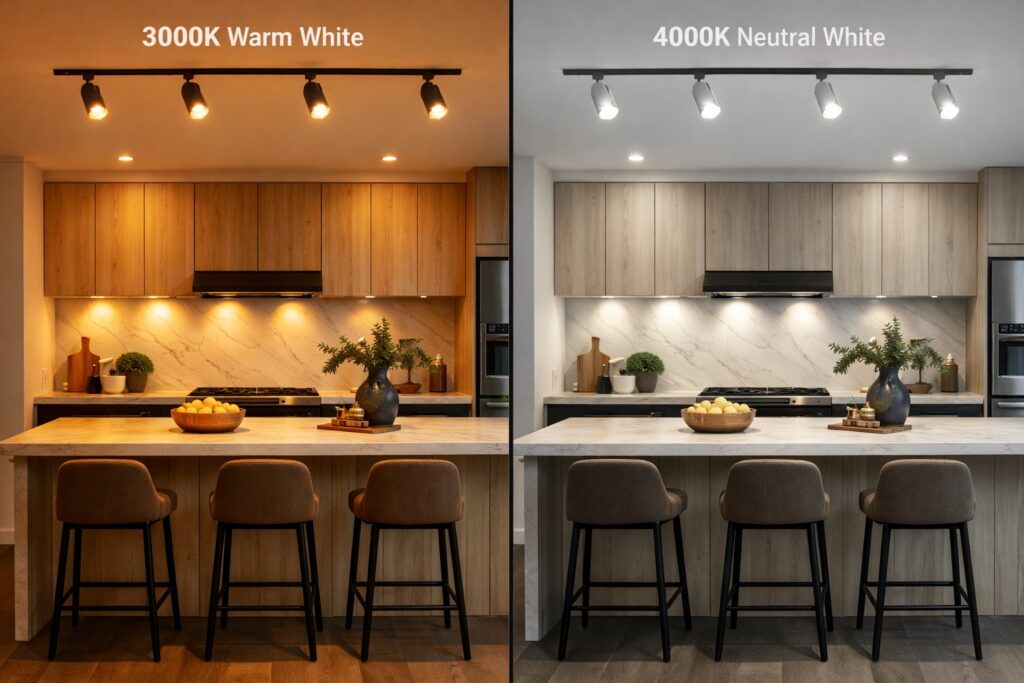
3000K (warm white) works well for most kitchens, balancing warmth with enough clarity for food preparation. This is the most versatile choice if you’re using track lighting for both task and ambient purposes.
4000K (neutral white) provides crisper, more clinical light. Useful if your track heads are primarily task-focused, illuminating worktops where accurate colour rendering matters.
2700K (extra warm) creates a relaxed, evening atmosphere but may feel too dim or yellow for active cooking. Consider this only if track lighting is supplementing other, brighter sources.
Consistency Across Heads
All heads on the same track should use the same colour temperature. Mixing warm and cool bulbs on a single system looks inconsistent and draws attention to the fixtures rather than the space they’re lighting.
Match your track lighting to other sources in the kitchen where possible. If your under-cabinet strips are 3000K, use 3000K in the track heads.
For more detail, see our colour temperature guide for kitchens or our broader colour temperature explainer.
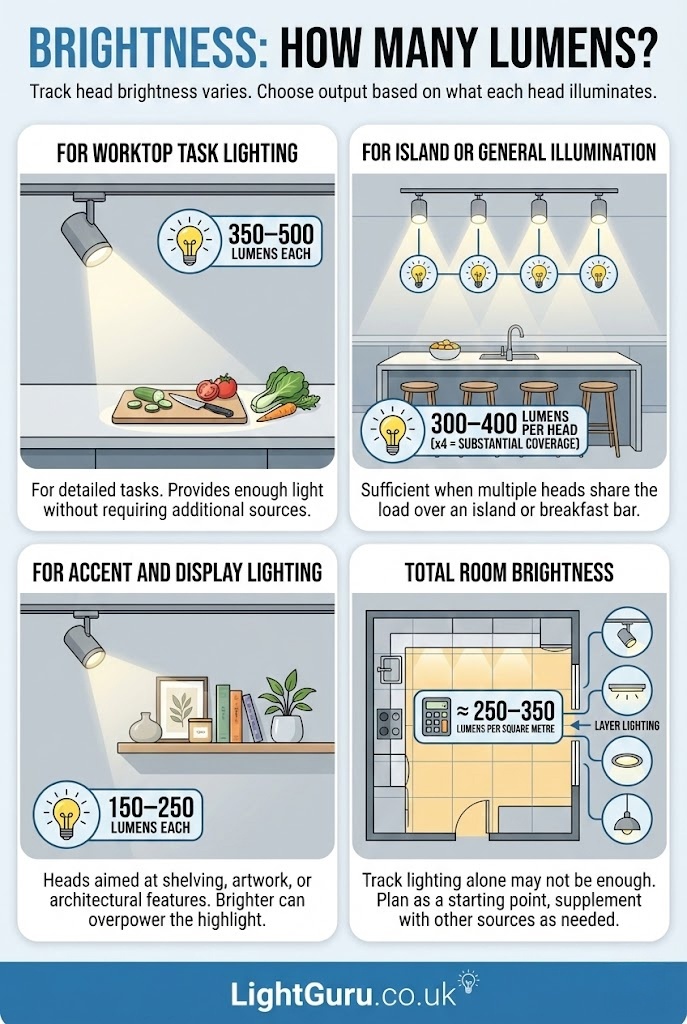
Brightness: How Many Lumens?
Track head brightness varies significantly between products. Choosing the right output depends on what each head is illuminating.
For Worktop Task Lighting
Heads aimed at food preparation areas should deliver 350–500 lumens each. This provides enough light for detailed tasks without requiring additional sources.
For Island or General Illumination
300–400 lumens per head is usually sufficient when multiple heads share the load. Four heads at 350 lumens each provides substantial coverage over an island or breakfast bar.
For Accent and Display Lighting
Heads aimed at shelving, artwork, or architectural features need less output—150–250 lumens is typically enough. Brighter accent lighting can overpower the feature you’re trying to highlight.
Total Room Brightness
Track lighting alone may not provide sufficient ambient light for larger kitchens. Plan for approximately 250–350 lumens per square metre as a starting point, and supplement with other sources (under-cabinet strips, downlights, or pendants) as needed.
For help calculating total brightness requirements, see our lumens guide.
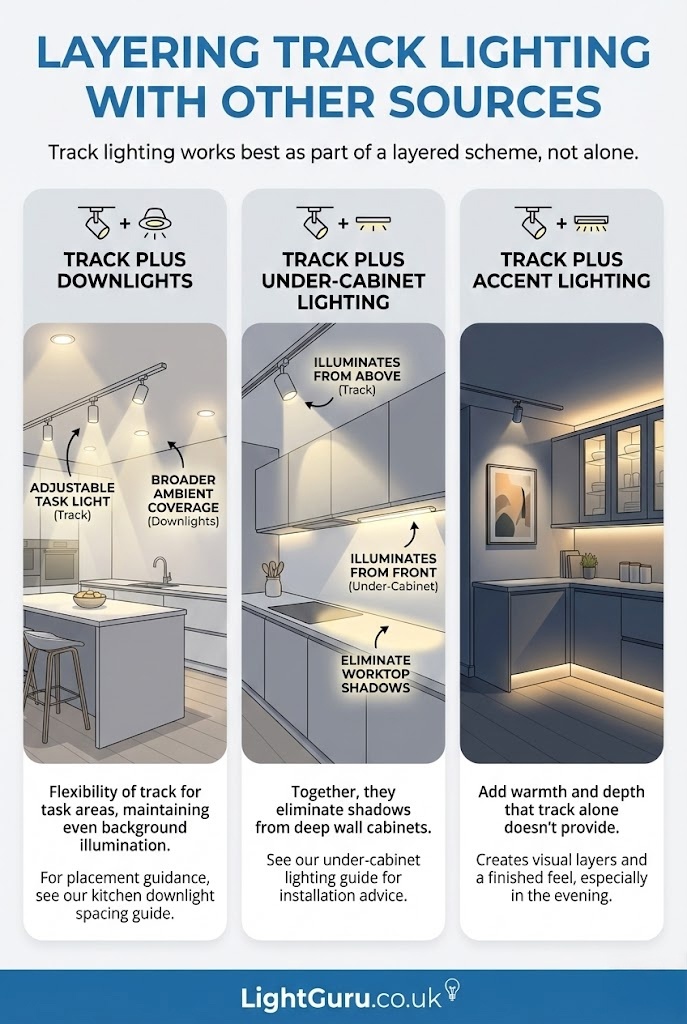
Layering Track Lighting with Other Sources
Track lighting works best as part of a layered lighting scheme rather than the sole source in the room.
Track Plus Downlights
Use track lighting for adjustable, directional task light and downlights for broader ambient coverage. This combination gives you the flexibility of track where you need it while maintaining even background illumination.
For guidance on downlight placement, see our kitchen downlight spacing guide.
Track Plus Under-Cabinet Lighting
Track heads illuminate from above; under-cabinet strips illuminate from the front. Together, they eliminate worktop shadows from both directions. This pairing is particularly effective in kitchens with deep wall cabinets that would otherwise shade the work surface.
See our under-cabinet lighting guide for installation advice.
Track Plus Accent Lighting
Plinth lighting, cabinet-top strips, or in-cabinet LEDs add warmth and depth that track lighting alone doesn’t provide. These lower-level sources create visual layers and make the kitchen feel more finished, especially in the evening.
For LED strip options, see our kitchen LED strip lighting guide.
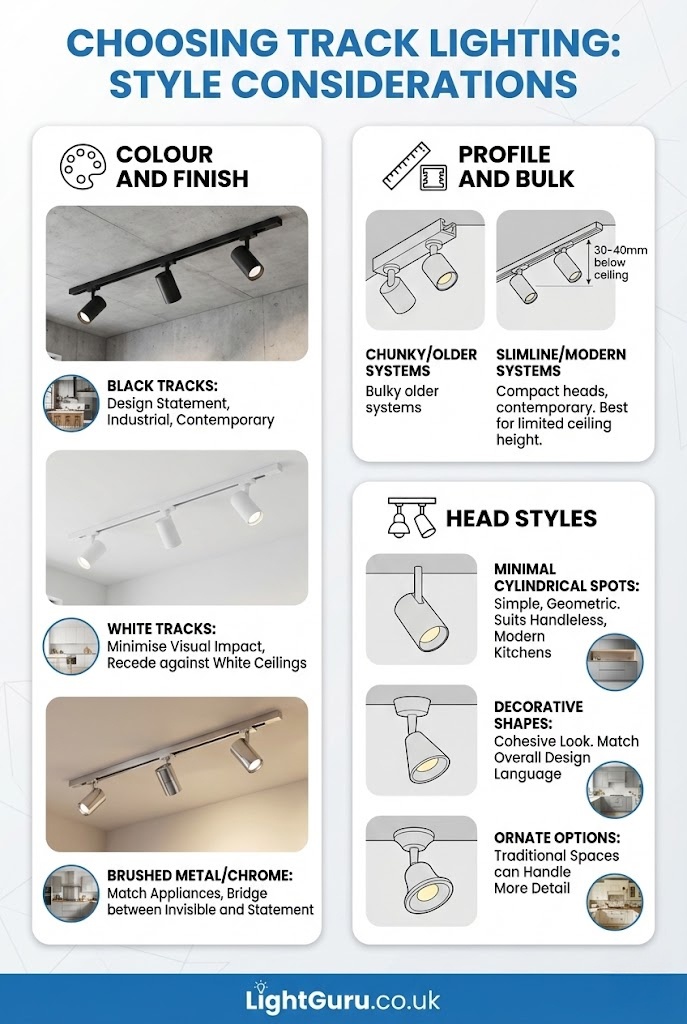
Choosing Track Lighting: Style Considerations
Modern track systems come in a range of finishes and profiles. The right choice depends on how visible you want the system to be.
Colour and Finish
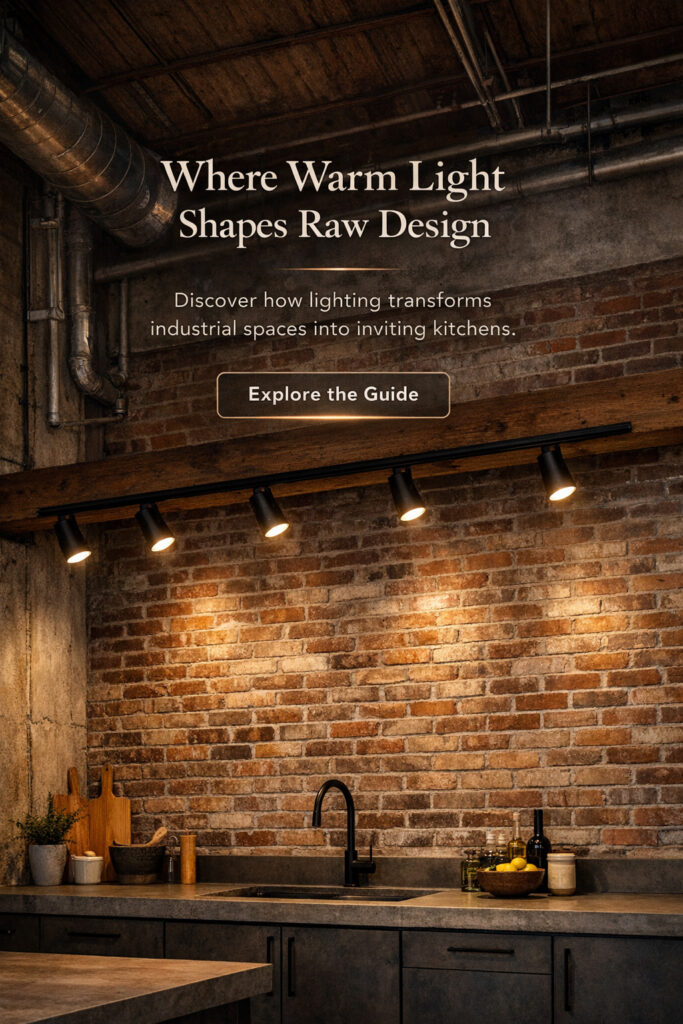
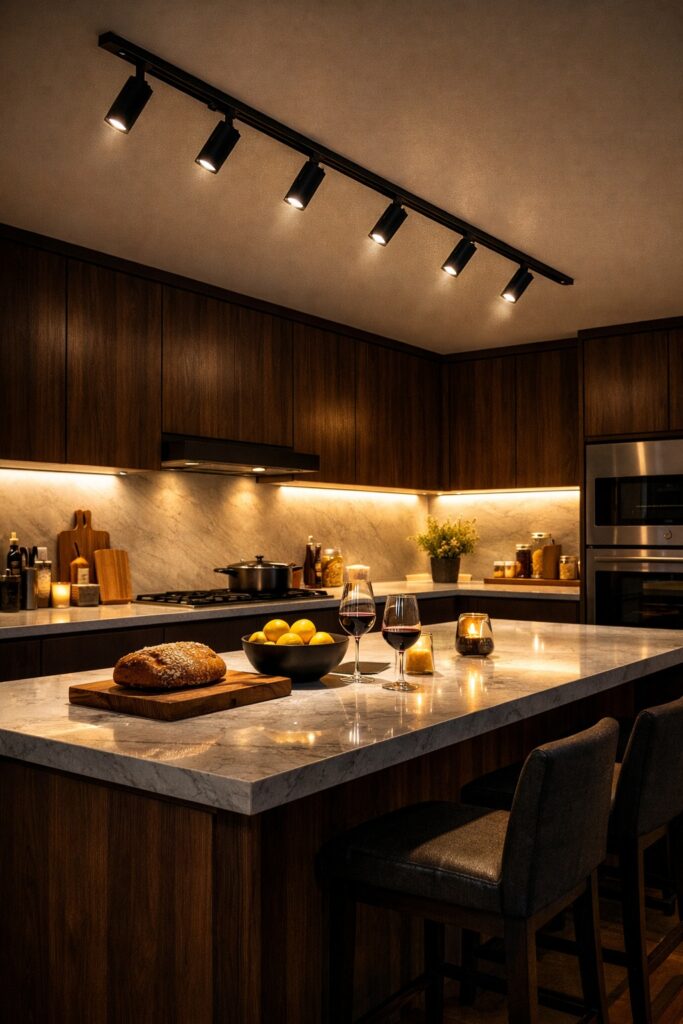
Black tracks make a design statement, working well in contemporary, industrial, or Scandi-influenced kitchens. They’re visible and intentional—part of the room’s aesthetic rather than hidden infrastructure.
White tracks recede against white ceilings, minimising visual impact. Choose white if you want the light without drawing attention to the fixture.
Brushed metal or chrome suits kitchens with stainless steel appliances or metallic hardware. These finishes bridge the gap between invisible and statement.
Profile and Bulk
Slimline tracks with compact heads look more contemporary than chunky older systems. If ceiling height is limited, choose the lowest-profile option available, some modern tracks sit just 30–40mm below the ceiling.
Head Styles
Track heads range from minimal cylindrical spots to more decorative shapes. For a cohesive look, match the head style to your kitchen’s overall design language. Handleless, modern kitchens suit simple geometric heads; more traditional spaces can handle slightly more ornate options.
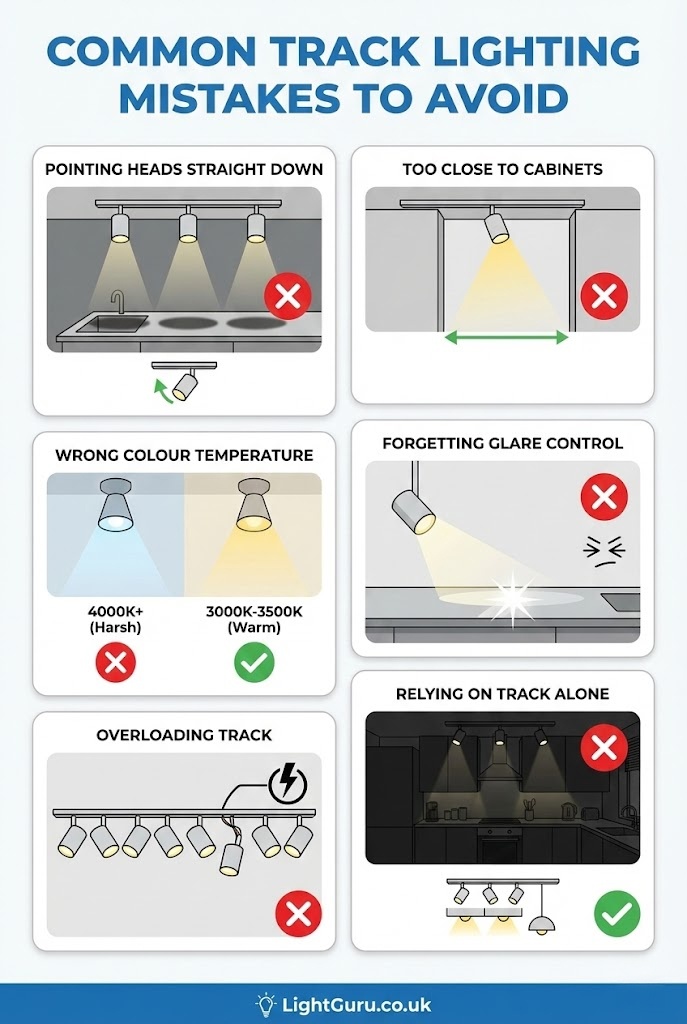
Common Track Lighting Mistakes
Pointing All Heads Straight Down
This defeats the purpose of adjustable track lighting. Straight-down beams create the same shadow problems as fixed ceiling lights. Angle heads toward work surfaces, walls, and features.
Positioning Too Close to Cabinets
Track mounted directly above wall cabinets sends light onto the cabinet tops rather than the worktop. Position the track far enough into the room (typically 60–90cm from the wall) to allow heads to angle back toward the work surface without obstruction.
Using the Wrong Colour Temperature
Track lighting at 4000K or above can feel harsh and clinical, especially in a kitchen that’s also used for dining or socialising. Stick to 3000–3500K for most residential applications.
Forgetting Glare Control
Adjustable heads pointed at the wrong angle create glare on reflective surfaces. Check the view from standing and seated positions, and adjust accordingly.
Overloading a Single Track
Too many heads on one track looks cluttered and may exceed the track’s electrical capacity. Most domestic tracks support 4–6 heads comfortably. For larger kitchens, use multiple shorter tracks rather than one overcrowded run.
Relying on Track Lighting Alone
In all but the smallest kitchens, track lighting shouldn’t be the only source. Layer it with under-cabinet strips, downlights, or pendants for a complete scheme.
For more on what can go wrong, see our guide to kitchen lighting mistakes.
Installation Considerations
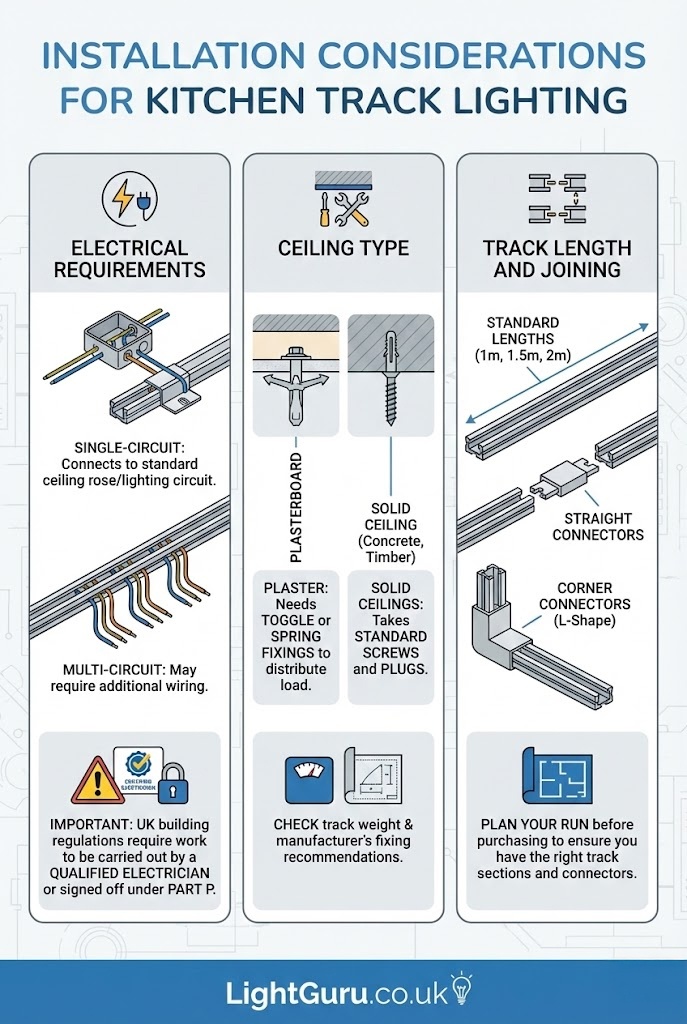
Electrical Requirements
Single-circuit track systems typically connect to a standard ceiling rose or lighting circuit. Multi-circuit systems may require additional wiring. In all cases, UK building regulations require electrical work to be carried out by a qualified electrician or signed off under Part P.
Ceiling Type
Track mounts to most ceiling surfaces with appropriate fixings. Plasterboard ceilings need toggle or spring fixings to distribute the load; solid ceilings (concrete, timber) take standard screws and plugs. Check the track weight and manufacturer’s fixing recommendations.
Track Length and Joining
Tracks come in standard lengths (typically 1m, 1.5m, 2m) and can be joined with straight connectors for longer runs or corner connectors for L-shaped layouts. Plan your run before purchasing to ensure you have the right combination of track sections and connectors.
Quick Specification Guide
Track
- Single circuit for simple on/off control
- Multi-circuit if you need separate switching
- Slim profile for low ceilings
- Black for statement, white to blend in
Heads
- Adjustable LED track heads with 350–500 lumens for task lighting
- 150–250 lumens for accent lighting
- 3000K colour temperature for most kitchens
- CRI 90+ for accurate food colours
- Adjustable tilt and rotation
Layout
- Position 60–90cm from walls to allow angling
- Angle heads 30–45° toward worktops
- 4–6 heads per track maximum
- Layer with other sources for complete coverage
Frequently Asked Questions
Is track lighting good for kitchens?
Yes—it’s one of the most flexible options for kitchen task lighting. The ability to angle individual heads makes it particularly useful for illuminating worktops without creating shadows.
Where should track lighting be placed in a kitchen?
Most commonly down the centre of a galley kitchen or above an island. Position the track far enough from walls (60–90cm) to allow heads to angle back toward worktops.
Can track lighting replace downlights?
In some kitchens, particularly galley layouts or spaces with difficult ceiling construction, track lighting can serve as the primary ceiling source. In larger kitchens, it works better alongside downlights or other ambient lighting.
Is track lighting suitable for low ceilings?
Yes—choose slim-profile tracks and compact heads to minimise how far the system projects below the ceiling. Surface-mounted track often works better than recessed downlights in low-ceiling situations.
What colour temperature should track lights be?
3000K for most kitchens, providing a balance of warmth and task visibility. Use 3500K if you want crisper light over prep areas.
Final Thoughts
Track lighting has evolved well beyond its dated reputation. Modern systems are slim, adjustable, and genuinely useful—particularly in kitchens where downlights aren’t practical or where flexibility matters.
The key is thoughtful positioning and angling. A track running down the centre of a galley kitchen, with heads directed at both worktops, solves the shadow problem that single ceiling lights create. Combined with under-cabinet strips and a few accent touches, track lighting forms part of a layered scheme that’s both functional and attractive.
For more ideas on lighting your whole kitchen, explore our complete Kitchen Lighting Guide.